
PHOT-401 · Lesson 11 of 12 · 32 min
Writing about your work
Photographers are often asked to put their work into words: an artist statement for an exhibition, a project description for a residency, wall text for a gallery, a caption for a book, a short biography for a festival program, or a paragraph for a website. Good writing does not explain away the images, but it gives viewers a way in, tells curators and editors what the work is doing, and helps you clarify your own thinking. Weak writing, full of jargon or vague claims, can make strong work seem confused. This lesson covers the kinds of writing fine art photographers produce, how to plan them with word budgets, how to revise for clarity, and how titles and captions shape the reading of images. VIS-410 covers grant applications, CVs and portfolios; this lesson concentrates on writing that accompanies the work itself.
Why writing matters
Images communicate powerfully but not precisely. Writing can supply context the images cannot show: where and when they were made, who is in them and why, what research shaped them, what questions drive the project. It can also set a tone and invite a kind of looking. At the same time, writing should not tell viewers exactly what to feel or overclaim what the images achieve. The aim is a balance: enough to orient the viewer, not so much that it closes down their own response.
Writing also benefits the artist. Trying to describe your project in 100 words forces you to decide what it is really about. Many photographers find that writing a statement mid-project changes how they shoot and edit.
Kinds of writing
- Project statement: describes a specific body of work, its subject, approach and concerns. It is the most common text in exhibitions and applications.
- General artist statement: describes your practice as a whole, the themes and methods that run through different projects.
- Wall text or introductory panel: a short text at the entrance to an exhibition, often written or edited by the curator.
- Labels and captions: brief texts beside individual works giving title, date, medium, dimensions and sometimes a sentence or two of context.
- Biography: a short third-person account of your background, education, exhibitions and achievements.
- Press release: a text issued by a gallery or festival to announce an exhibition, usually written by the venue with your input.
- Book text: essays, afterwords, captions and notes that accompany a photobook, sometimes written by the artist and sometimes by invited writers.
Word budgets
Different contexts allow different lengths, and venues often set strict limits. Plan writing by allocating words to the job each part must do. A word budget keeps you from spending most of a short statement on background and running out of space for the work itself.
| Text | Typical length | Main job |
|---|---|---|
| Short project statement | 100 to 200 words | Orient viewers and curators to one project |
| Long project statement | 300 to 500 words | Give fuller context for applications or books |
| Exhibition label | 30 to 100 words | Identify a work and give brief context |
| Short biography | 50 to 150 words | Introduce the artist in the third person |
| Introductory wall panel | 150 to 300 words | Frame the exhibition as a whole |
These lengths are typical rather than fixed. Always follow a venue's or funder's stated limit, and remember that viewers standing in a gallery read slowly and selectively; at roughly 200 words per minute, a 300-word panel asks for a minute and a half of standing attention.
Worked problem
Allocating a 150-word statement
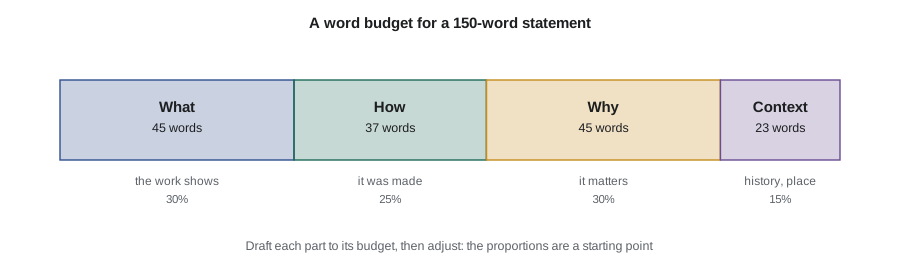
A festival asks for a project statement of no more than 150 words. Allocate words to four parts, what the work shows, how it was made, why it matters and its context, using the proportions 30%, 25%, 30% and 15%.
Show solution
- What: \( 0.30 \times 150 = 45 \) words.
- How: \( 0.25 \times 150 = 37.5 \), so about 37 words.
- Why: \( 0.30 \times 150 = 45 \) words.
- Context: \( 0.15 \times 150 = 22.5 \), so about 23 words.
- Check: \( 45 + 37 + 45 + 23 = 150 \).
Answer: About 45, 37, 45 and 23 words. Draft each part to its budget, then adjust; the proportions are a starting point, not a rule.
Worked problem
Cutting a statement to a limit
Your draft statement is 320 words and the limit is 200. By what percentage must you cut, and if the draft has 120 words of background, 80 on process, 70 on the images and 50 on meaning, where should the cuts come from?
Show solution
- Required cut: \( (320 - 200) / 320 = 120 / 320 = 37.5\% \).
- Background takes \( 120 / 320 = 37.5\% \) of the draft but is the least important for viewers.
- A possible plan: cut background to 30 words (minus 90), process to 50 (minus 30), keep images at 70 and meaning at 50, giving \( 30 + 50 + 70 + 50 = 200 \).
Answer: Cut 37.5% overall, mostly from background. The revised statement spends most of its words on the images and their meaning, which is what readers need.
What a project statement contains
A useful project statement usually answers four questions, in whatever order suits the work.
- What: what does the work show? Name the subject, place, people or materials concretely.
- How: how was it made? Mention process, method or collaboration when it matters to the meaning.
- Why: what questions, ideas or concerns drive the work? What should viewers think about?
- Context: what history, place, community, research or other artists does it respond to, if relevant?
Open with something concrete and specific rather than a general claim. "For three winters, I photographed the ice-fishing huts that appear each January on Lake Winnipeg" gives the reader a world. "My work explores the human condition" gives them nothing.
Worked problem
Revising a vague opening
Revise this opening sentence: "My photographic practice interrogates the liminal spaces between memory and identity through a visual language of absence."
Show solution
- Identify what is vague: "practice interrogates," "liminal spaces," "visual language of absence" are abstract and could describe thousands of projects.
- Ask what the work actually shows: suppose it is photographs of rooms in the artist's late grandmother's house, made after the furniture was removed.
- Rewrite concretely: "After my grandmother died, I photographed each room of her house in Sherbrooke once the furniture had gone, looking for traces of the life lived there."
Answer: The revised sentence names the subject, place and motivation, and lets readers infer ideas about memory and absence from specifics rather than abstractions.
Avoiding art-speak
Writing about contemporary art has a reputation for obscure jargon, sometimes called "art-speak" or, by some critics, "International Art English." Common features include abstract nouns ("the visual," "spatiality"), verbs that make claims for the work ("interrogates," "problematizes," "subverts"), long strings of qualifications and references to theory without explanation. Specialized vocabulary is sometimes necessary, but it should be used precisely and sparingly.
| Art-speak | Problem | Plainer alternative |
|---|---|---|
| My work interrogates notions of place | Vague, overclaims | I photograph the streets where I grew up as they are redeveloped |
| Exploring the liminal | Abstract, overused | Made at dusk, in the hour between work and home |
| The work problematizes representation | Claims without evidence | The portraits were made with sitters who chose their own poses and clothes |
| A visual language of absence | Unclear | Empty rooms, unmade beds and unused chairs |
A good test is to read your statement aloud to someone who has not seen the work. If they can describe what the pictures probably look like and why you made them, the statement is doing its job.
Titles
Titles shape how images and series are read. A descriptive title, such as a place and date, offers neutrality and documentary authority. A poetic title opens associations. A numbered or untitled approach, such as "Untitled #12," keeps attention on the image and avoids steering interpretation. Series titles carry particular weight because they frame every image. Test several titles with readers, and check that a title does not unintentionally clash with the images, overclaim or make a joke you do not intend.
Captions and labels
Captions in fine art contexts usually give basic information in a consistent format. A typical exhibition label includes artist name, title, date, medium and dimensions, and sometimes edition information or a short contextual sentence. In documentary-influenced work, captions may also identify people and places; consent and accuracy matter here, as lesson 5 discussed.
Worked problem
Formatting an exhibition label
Write a label for a pigment inkjet print titled "Winter Road, Kenora," made in 2025, 30 by 40 inches, edition 2 of 5.
Show solution
- Line 1: the artist's name.
- Line 2: the title in italics and the date: Winter Road, Kenora, 2025.
- Line 3: the medium: pigment inkjet print on cotton rag paper.
- Line 4: the dimensions and edition: 30 × 40 in, edition 2 of 5.
Answer: A consistent four-line label gives viewers and collectors the essentials. Follow the venue's house style for order, units and whether height comes before width.
Biographies
A short biography is usually written in the third person and gives your name, where you are based, your training, key exhibitions, awards, residencies and publications, sometimes with a sentence on your work. Keep it current and adapt its length to each use. Avoid listing everything; select the most relevant. A 100-word bio might give one sentence on location and background, one or two on the work, and the rest on selected achievements. VIS-410 covers CVs, which list achievements in full.
Writing process and revision
Writing about your work is easier as a habit than as a crisis before a deadline. Keep notes in your project journal, as lesson 2 suggested, and draft statements early and often. Write a long, messy version first, then cut. Read drafts aloud. Ask peers who know the work and peers who do not to respond. Keep a file of versions at different lengths, such as 50, 150 and 300 words, so you can respond quickly to calls. Revise statements as the work changes; an outdated statement is a common reason applications feel unconvincing.
Worked problem
Estimating reading time for wall text
An introductory panel has 280 words. Assuming an average reading speed of about 200 words per minute, and that people read wall text more slowly when standing, about 150 words per minute, how long will a visitor need?
Show solution
- At 200 words per minute: \( 280 / 200 = 1.4 \) minutes, about 84 seconds.
- At 150 words per minute: \( 280 / 150 \approx 1.87 \) minutes, about 112 seconds.
Answer: Between about one and a half and two minutes. Many visitors will not read that long, so put the most important information in the first two or three sentences.
Voice and honesty
Write in a voice that sounds like you, usually the first person for statements and the third person for biographies. Be honest about what the work does and how it was made. If images are staged, digitally composited or made in collaboration, say so where it matters to how viewers will read them. If you worked with a community, credit their contribution and, where appropriate, invite them to review how they are described. Accurate writing builds trust with viewers, curators and the people in your pictures.
Common mistakes
MistakeOpening a statement with a broad claim about life or humanity
InsteadOpen with something concrete and specific about the work.
MistakeUsing jargon to make the work sound important
InsteadUse plain, precise language and explain specialized terms.
MistakeIgnoring word limits set by venues and funders
InsteadPlan a word budget and write to the limit.
MistakeSpending most of a short statement on background
InsteadAllocate most words to what the work shows and why it matters.
MistakeUsing one outdated statement for every application
InsteadKeep versions at several lengths and update them as the work develops.
Summary and key terms
- Writing about work orients viewers and helps artists clarify their thinking.
- Common texts include project statements, general statements, wall text, labels, biographies and press releases.
- Word budgets allocate limited words to what, how, why and context.
- Concrete openings work better than abstract claims.
- Art-speak can be replaced with specific, plain description.
- Titles, captions and labels shape how images are read and need consistency.
- Draft early, revise often, read aloud and keep versions at several lengths.
- Project statement
- A text describing a specific body of work.
- General artist statement
- A text describing an artist's overall practice.
- Word budget
- An allocation of a text's word limit among its parts.
- Wall text
- A text panel introducing an exhibition or section.
- Label
- A short text beside a work giving title, date, medium and dimensions.
- Biography
- A short third-person account of an artist's background and achievements.
- Press release
- A venue's announcement of an exhibition.
- Art-speak
- Jargon-heavy, abstract writing about art.
- Descriptive title
- A title that states place, date or subject plainly.
- House style
- A venue's or publisher's rules for formatting text.
Practice problems
Work each problem on paper first, then reveal the answer to check.
A 200-word statement uses proportions of 30%, 25%, 30% and 15%. How many words go to "why"?
Show answer
\( 0.30 \times 200 = 60 \).
A 400-word draft must fit 250 words. What percentage must be cut?
Show answer
\( 150 / 400 = 37.5\% \).
Name the four questions a project statement usually answers.
Show answer
What, how, why and context.
What is a typical length for an exhibition label?
Show answer
About 30 to 100 words.
Rewrite "My work explores the human condition" more concretely.
Show answer
Any concrete version naming subject, place and motivation.
Name three features of art-speak.
Show answer
Abstract nouns, overclaiming verbs, unexplained theory, long qualifications.
What information does a typical exhibition label give?
Show answer
Artist, title, date, medium, dimensions and sometimes edition.
In which person is a biography usually written?
Show answer
The third person.
How long does a 300-word panel take at 150 words per minute?
Show answer
2 minutes.
Why keep statements at several lengths?
Show answer
To respond quickly and appropriately to different calls and limits.
Lesson quiz · 5 questions
Score 60% or more to complete this lesson.
Create a free account to save your progress, take quizzes and earn a certificate.