
PHOT-401 · Lesson 6 of 12 · 31 min
Reading photographs
To make strong work and to take part in critique, you need to read photographs closely: to see what is actually in them, how they are made, what they might mean and how their context shapes that meaning. Reading is a skill, not a gift. It improves with a method and with practice. This lesson gives you a practical method for looking at single images and series, drawing on formal analysis, contextual analysis and the semiotic ideas you met in VIS-210. The aim is not to arrive at a single correct interpretation but to build interpretations that are grounded in evidence from the image and its context, and to apply the same discipline to your own work.
Why close reading matters to makers
Artists who read images well make better choices. They notice when a background element pulls attention, when a crop changes a relationship between people, when a color shift alters mood, or when two images placed side by side create an unintended joke. They also talk about work more usefully in critique, because they can point to specific evidence rather than vague impressions. And they write stronger statements, because they understand what their images actually do rather than what they hoped they would do.
A four-step method
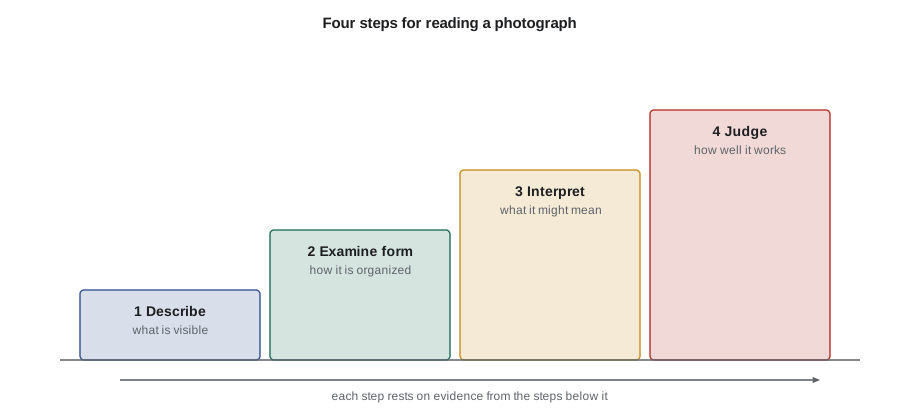
A widely used approach in art education, associated with the art educator Edmund Feldman, moves through four steps: description, analysis, interpretation and judgment. The steps prevent the most common mistake in looking, which is jumping straight to a verdict.
- Description: say what is literally visible, as neutrally as possible. Subjects, objects, setting, light, color, scale, format and any text.
- Analysis: explain how the image is organized. Composition, framing, point of view, depth of field, tonal range, color relationships, timing, and how the eye moves.
- Interpretation: propose what the image might mean, supported by evidence from description and analysis and by relevant context.
- Judgment: assess how well the image works, by what criteria, and why. In critique, judgment is offered carefully and only after the first three steps.
Formal analysis
Formal analysis looks at the visual elements and how they work together. It is the photographer's home ground, and it gives you a precise vocabulary.
- Framing and point of view: where the camera stands, how high or low, how close, what the edges include or cut off.
- Composition: placement of elements, balance, symmetry, leading lines, foreground and background relationships, negative space.
- Light: direction, quality (hard or soft), contrast, time of day, artificial or natural sources.
- Color or tone: palette, saturation, temperature, black-and-white tonal range, how color guides attention.
- Focus and depth: what is sharp, what is blurred, how depth of field separates or connects elements.
- Time: shutter speed, motion, the decisive moment versus a long, still exposure.
- Scale and format: print size, aspect ratio, presentation, which change the viewer's physical relationship to the image.
Worked problem
A formal analysis of a described image
Analyze this described photograph: a square color image, made from waist height, shows an elderly man seated at a kitchen table under a single overhead light in an otherwise dark room. He looks down at his folded hands. The table fills the lower third; behind him, an open doorway shows a brighter hallway. His face is in sharp focus; the hallway is soft.
Show solution
- Framing: the square format and waist-height viewpoint place the viewer at seated eye level, close and respectful rather than looming.
- Light: a single hard overhead source isolates the man and the table in a pool of light, with deep shadows around them, creating a theatrical, intimate mood.
- Composition: the table anchors the lower third; the bright doorway behind forms a second frame and a contrast between the dark room and an outside world.
- Focus: sharp face and soft background direct attention to his expression and hands.
Answer: Formal choices create a quiet, intimate, slightly isolated mood and set up a contrast between the lit interior moment and the brighter world beyond the door, evidence a viewer could use for interpretation.
Measuring tone and contrast
Some formal qualities can be measured, which helps when comparing images in a series or checking consistency. A histogram shows the distribution of tones from black to white. The tonal range between the darkest and lightest important areas can be expressed in stops, each a doubling of light.
Worked problem
Comparing contrast across a series
You measure luminance in two prints from your series under the same light. In print A, the brightest important highlight reflects 32 times more light than the darkest important shadow; in print B, 128 times more. How many stops of range does each show, and what does the difference suggest?
Show solution
- Print A: \( \log_2 32 = 5 \) stops.
- Print B: \( \log_2 128 = 7 \) stops.
- The two-stop difference means print B looks noticeably more contrasty and dramatic than print A.
Answer: Print A spans 5 stops and print B 7 stops. If the series is meant to feel consistent, you might soften B or strengthen A in printing so they sit together.
Contextual analysis
Context includes everything outside the frame that shapes meaning: when and where the image was made, by whom and why; the title, caption and statement; the series it belongs to; where it is shown; the history of similar images; and the social and political circumstances of its making and viewing. The same photograph of a protest can read as celebration, warning or nostalgia depending on its caption, the publication, the year it is seen and the viewer's own experience.
For your own work, contextual analysis means asking how viewers will encounter the images and what they will bring to them. A portrait of a teenager made in a small northern town may be read differently by people who live there and by visitors to a city gallery. Neither reading is wrong, but you should anticipate both.
Semiotic reading
Semiotics, the study of signs, gives tools for thinking about how photographs carry meaning. VIS-210 introduced the ideas of the theorist Roland Barthes, including denotation (the literal content of an image) and connotation (the associations and cultural meanings it carries), and his distinction in Camera Lucida between the studium (the general, culturally shared interest of an image) and the punctum (a detail that personally pierces a particular viewer). The philosopher Charles Sanders Peirce's idea of the index, a sign physically connected to what it signifies, helps explain why photographs feel like traces of reality.
In practice, semiotic reading asks: what does each element literally show, and what does it suggest? A wedding ring denotes a ring and may connote marriage, commitment, loss or tradition, depending on context. A cracked phone screen denotes damage and may connote youth, precarity or a world seen through devices. Listing denotations and connotations for key elements is a useful exercise when you are stuck on interpretation.
| Element | Denotation | Possible connotations |
|---|---|---|
| Folded hands on the table | Two hands resting together | Patience, prayer, waiting, age |
| Single overhead light | A hanging lamp lit in a dark room | Isolation, interrogation, theater, warmth |
| Bright open doorway | Light from a hallway behind | Outside world, departure, the future, hope |
| Empty chair opposite | An unoccupied seat | Absence, loss, someone expected |
Reading a series
Series add another layer: meaning emerges from relationships between images. When reading a series, look for repetition (what stays the same), variation (what changes), progression (does something develop?), juxtaposition (what happens when two images meet?) and rhythm (pace, pauses, climaxes). A typology works through repetition and variation; a narrative sequence through progression; a poetic sequence through juxtaposition and rhythm. Lesson 9 develops sequencing in detail.
Worked problem
Reading what changes
A series of 12 images shows the same living room photographed from the same corner once a month for a year. The furniture slowly disappears; in the final image the room is empty and the windows are bare. What does the series communicate that a single image could not?
Show solution
- Repetition: the identical viewpoint makes the room a constant stage.
- Variation: the gradual removal of objects becomes the event.
- Progression: the sequence moves from a lived-in home to emptiness, suggesting a move, a death, a separation or a loss.
Answer: Through repetition and change, the series communicates time and loss, a process no single photograph of a full or empty room could show.
Interpretation with evidence
Interpretation is where reading becomes thinking. A strong interpretation makes a claim about meaning and supports it with evidence from the image, the series and the context. It acknowledges other possible readings. A weak interpretation either stays vague ("it is about life") or ignores the image and projects a story onto it. Practice writing interpretations in a simple form: claim, evidence, alternative.
Worked problem
Structuring an interpretation
Write a short interpretation of the described kitchen-table photograph using claim, evidence and alternative.
Show solution
- Claim: the photograph is about solitude in old age.
- Evidence: the man is alone in a pool of light in a dark room, looking down; an empty chair faces him; a bright doorway suggests a world he is separated from.
- Alternative: he may simply be resting or praying, and the image might be about calm and routine rather than loneliness; the title or series could tip the reading either way.
Answer: A grounded interpretation names its claim, points to visible evidence and acknowledges at least one other reasonable reading.
Judgment and criteria
Judgment asks how well the work succeeds, and by what standards. Criteria might include originality, coherence, technical resolution, emotional impact, ethical integrity and how well form fits concept, the qualities introduced in lesson 1. Make your criteria explicit. "I find this less successful because the strong side light, which works in the other images, is missing here, so it reads as a different series" is useful; "I don't like it" is not.
Reading your own work
The hardest images to read are your own, because you know what you intended and remember the circumstances of making them. To read your work freshly, put prints away for a few days, look at them in a different place, turn them upside down to see composition, or ask a peer to describe them before you say anything. Write a quick description and analysis of each candidate image in your journal; the differences between what you wrote and what you meant are often revealing.
Practicing with a reading journal
Reading skills develop through regular practice. Keep a reading journal in which you analyze one photograph a week, alternating between historical and contemporary work, single images and series, and work you admire and work you find difficult. Write a short description, a formal analysis, two or three possible interpretations with evidence, and a judgment with stated criteria. Over a term, you will notice your vocabulary growing and your interpretations becoming more grounded. Compare your readings with those of critics, curators or peers; differences are not errors but opportunities to see what you missed or what others overlooked. The same habits will make your critique in lessons 7 and 8 more precise and more useful to other artists.
Common mistakes
MistakeJumping straight to judgment without describing the image
InsteadDescribe and analyze before interpreting or judging.
MistakeProjecting a story onto an image without evidence
InsteadSupport interpretations with visible evidence and context.
MistakeTreating your intended meaning as the only reading
InsteadConsider how different viewers in different contexts might read the work.
MistakeReading single images in a series in isolation
InsteadLook at repetition, variation, progression and juxtaposition across the series.
MistakeGiving judgments without stating criteria
InsteadMake the criteria for judgment explicit.
Summary and key terms
- Close reading helps artists make better choices, critique usefully and write accurate statements.
- The four-step method moves from description to analysis, interpretation and judgment.
- Formal analysis examines framing, composition, light, color, focus, time, scale and format.
- Tonal range in stops is the base-2 logarithm of the ratio between highlight and shadow luminance.
- Context, including captions, series, venue and history, shapes meaning.
- Semiotic reading separates denotation from connotation and draws on Barthes and Peirce.
- Good interpretations state a claim, give evidence and acknowledge alternatives.
- Description
- A neutral account of what is literally visible in an image.
- Formal analysis
- Examination of how visual elements are organized in an image.
- Interpretation
- A proposed meaning supported by evidence.
- Denotation
- The literal content of an image or sign.
- Connotation
- The associations and cultural meanings a sign carries.
- Studium
- Barthes' term for the general, culturally shared interest of a photograph.
- Punctum
- Barthes' term for a detail that personally pierces a viewer.
- Index
- Peirce's term for a sign physically connected to what it signifies.
- Juxtaposition
- Placing images side by side so their meanings interact.
- Tonal range
- The spread between the darkest and lightest important areas of an image.
Practice problems
Work each problem on paper first, then reveal the answer to check.
Name the four steps of the reading method.
Show answer
Description, analysis, interpretation and judgment.
List four elements examined in formal analysis.
Show answer
Framing, composition, light, color, focus, time, scale or format.
A highlight reflects 64 times more light than a shadow. How many stops is that?
Show answer
\( \log_2 64 = 6 \) stops.
What is the difference between denotation and connotation?
Show answer
Denotation is literal content; connotation is associated meaning.
Explain studium and punctum.
Show answer
Studium is general shared interest; punctum is a detail that personally strikes a viewer.
What five relationships should you look for when reading a series?
Show answer
Repetition, variation, progression, juxtaposition and rhythm.
What three parts make a structured interpretation?
Show answer
Claim, evidence and alternative.
Why state criteria when judging work?
Show answer
So the judgment is specific, testable and useful.
Give two ways to read your own work freshly.
Show answer
Wait a few days, change location, turn prints upside down or have a peer describe them first.
How can context change the meaning of a protest photograph?
Show answer
Captions, publication, date and viewer experience can make it read as celebration, warning or nostalgia.
Lesson quiz · 5 questions
Score 60% or more to complete this lesson.
Create a free account to save your progress, take quizzes and earn a certificate.