
PHOT-410 · Lesson 11 of 12 · 30 min
Hiring, outsourcing and scaling
A solo photographer eventually reaches a limit: there are only so many shoot days, editing hours and client emails one person can handle. Growth then means choosing among raising prices, getting help or adding new streams of income. Getting help can mean hiring assistants and second shooters, outsourcing editing and bookkeeping, taking on associate photographers, or employing staff. Each option changes the business's costs, risks and legal obligations. This lesson covers when to get help, the main roles in a photography business, how to price and pay help, the legal difference between contractors and employees in Canada and the United States, the economics of associates and studios, and how to decide whether to scale at all.
When to get help
The signal to get help is usually that your own time has become the bottleneck: you are turning down work, delivery times are slipping, or administration is eating into shooting and selling. A useful exercise is to list every task you do in a month, with the hours each takes, and mark which tasks only you can do, such as shooting, creative direction and key client relationships, and which someone else could do as well or better for less than your hourly value. Culling, basic retouching, bookkeeping, scheduling, social media posting and gear preparation are common candidates.
Worked problem
The value of outsourcing editing
A wedding photographer spends 12 hours editing each of 30 weddings a year. An editing service charges $0.40 per image and a typical wedding has 700 delivered images. If she spends the time saved on marketing and sales that bring in more work, and her effective hourly value is $90, is outsourcing worthwhile?
Show solution
- Outsourcing cost per wedding: \( 700 \times 0.40 = \$280 \); per year: \( 30 \times 280 = \$8400 \).
- She still needs about 2 hours per wedding to review the results, so saves \( 12 - 2 = 10 \) hours per wedding, or \( 300 \) hours a year.
- Value of the hours saved: \( 300 \times 90 = \$27\,000 \).
- Cost per hour saved: \( 8400 / 300 = \$28 \), well below her hourly value.
Answer: Outsourcing costs about $28 per hour saved against an hourly value of $90, so it is worthwhile, provided she really uses the time to earn more or rest and the quality meets her standard.
Roles in a photography business
- Assistant: helps on set with lighting, gear, grip and logistics; usually paid a day rate.
- Digital technician: manages tethered capture, files and color on commercial sets.
- Second shooter: photographs alongside the lead at weddings and events, usually for a set fee per event.
- Associate photographer: shoots jobs under your brand, using your systems, often for a fee or revenue share.
- Editor or retoucher: culls, color-corrects and retouches images, in-house or outsourced.
- Studio manager or client services coordinator: handles inquiries, scheduling, contracts, invoicing and client communication.
- Bookkeeper and accountant: handle financial records and tax filings.
- Producer: manages budgets, crews, locations and logistics on larger commercial shoots.
Many photographers start by hiring help job by job and add regular roles as work becomes steady.
Contractor or employee
Whether a worker is an independent contractor or an employee is not decided by what the contract calls them, but by the actual relationship. Getting it wrong can mean back payroll taxes, contributions, penalties and claims under employment standards law. The tests differ between the two countries and, in the United States, between federal and state law.
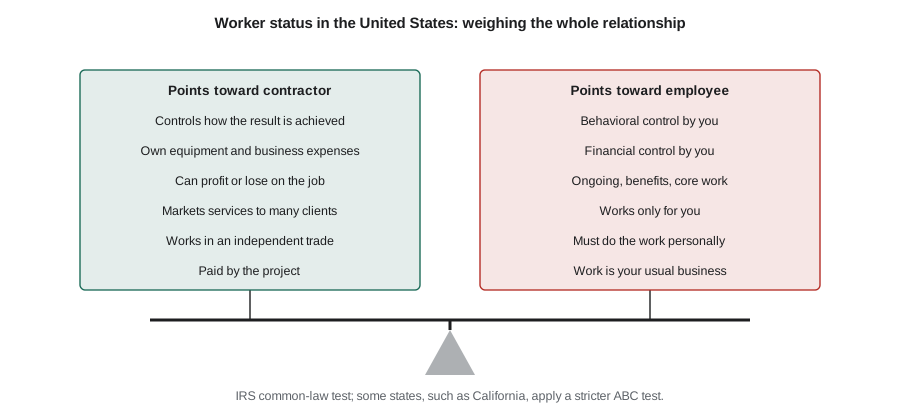
In the United States, the IRS uses a common-law test grouped into behavioral control, financial control and the relationship of the parties. The Department of Labor applies an economic reality test under the Fair Labor Standards Act; its rule on this test has changed several times in recent years, so check current guidance. Many states use stricter tests, such as California's ABC test, under which a worker is an employee unless they are free from control, do work outside the usual course of the hiring business, and are customarily engaged in an independent trade. California added a specific exemption for still photographers, photojournalists, videographers and photo editors that applies when conditions are met, such as the worker setting their own rates and not replacing an employee. If the worker is an employee, you must withhold income tax and the employee's share of Social Security and Medicare, pay the employer's 7.65% share, federal and state unemployment taxes, workers' compensation where required, and follow wage and hour laws. For contractors paid $2,000 or more for services in 2026, you generally issue Form 1099-NEC.
| Factor | Points toward contractor | Points toward employee |
|---|---|---|
| Control | Worker decides how to achieve the result | You direct how, when and where work is done |
| Tools | Worker supplies own camera and software | You supply equipment and workspace |
| Financial risk | Worker invests, can profit or lose | Worker is paid for time with no risk |
| Other clients | Worker serves many clients and markets their services | Worker works only for you, often full time |
| Helpers | Worker can hire or subcontract | Worker must do the work personally |
| Integration | Work is a separate service | Work is part of your core operations |
Paying help and the true cost of an employee
Contractors set their own rates, typically by day, event or image. Employees are paid wages, and the total cost to you includes employer payroll contributions, workers' compensation, paid holidays and any benefits. As a rough rule, employer costs add something like 8 to 15% to wages before benefits, depending on the country, province or state.
Worked problem
The full cost of a studio employee
A studio in Ohio hires a client services coordinator at $22 an hour for 30 hours a week, 52 weeks a year. Assume employer costs of 7.65% for Social Security and Medicare, about 1.5% for federal and state unemployment taxes, and 1% for workers' compensation, with one week of paid vacation already included in the 52 weeks. What is the approximate annual cost?
Show solution
- Annual wages: \( 22 \times 30 \times 52 = \$34\,320 \).
- Employer costs: \( 0.0765 + 0.015 + 0.01 = 0.1015 \); \( 34\,320 \times 0.1015 \approx \$3483 \).
- Total: \( 34\,320 + 3483 = \$37\,803 \), before any benefits, training or equipment.
Answer: About $37,800 a year. To justify the hire, the coordinator must free enough of the owner's time, or bring in enough extra sales, to cover this cost and more.
Associates and multi-shooter businesses
Some wedding and portrait businesses grow by booking more jobs than the owner can shoot and assigning them to associate photographers who work under the studio's brand. The studio handles marketing, sales, contracts, editing and delivery; the associate shoots. This can multiply revenue, but clients who book because of the owner's personal work may be disappointed, so be transparent about who will photograph them, and train associates in your style and standards.
Worked problem
Margin on an associate wedding
A studio books an associate-shot wedding at $3,600. The associate is paid $900, outsourced editing costs $300, an album costs $250 to produce, and the studio allocates $400 of marketing and sales cost per booking. What is the studio's contribution, and how does it compare with an owner-shot wedding at $5,000 with the same costs except no associate fee?
Show solution
- Associate wedding: \( 3600 - 900 - 300 - 250 - 400 = \$1750 \).
- Owner wedding: \( 5000 - 300 - 250 - 400 = \$4050 \), but it uses the owner's shooting day.
- The associate wedding earns $1,750 without the owner's time on the day, only management time.
Answer: About $1,750 per associate wedding against $4,050 per owner wedding. Associate work is less profitable per job but adds revenue beyond the owner's personal capacity.
Studio rental or ownership
A dedicated studio space adds capability and credibility but also fixed costs. Options include renting a studio by the hour or day, sharing a space with other photographers, leasing your own space, or buying property. Compare the options on cost per hour of actual use.
Worked problem
Rent by the hour or lease
A rental studio costs $75 per hour. Leasing a small studio costs $2,000 per month plus $300 for utilities and insurance. How many hours of use per year make the lease cheaper?
Show solution
- Annual lease cost: \( (2000 + 300) \times 12 = \$27\,600 \).
- Break-even hours: \( 27\,600 / 75 = 368 \) hours a year.
- That is about \( 368 / 50 \approx 7.4 \) hours a week across 50 working weeks.
Answer: The lease is cheaper only above about 368 hours of use a year, roughly a full day a week. Below that, hourly rental is cheaper and carries no long-term commitment, though a lease may bring extra income from renting the space to others.
Deciding whether to scale
Scaling is not the only definition of success. A larger business brings more revenue but also more management, payroll obligations, risk and less time behind the camera. Some photographers deliberately stay small, raise prices and choose fewer, better projects; others build studios with several shooters and staff. Decide based on your goals, test growth in steps, such as one associate or one part-time coordinator, and measure profit and personal satisfaction, not just revenue. Written processes, such as shot lists, editing presets, client communication templates and checklists, are what make any growth possible, because they let others deliver your standard.
Training and managing people
Help only adds value if people know what you expect. Write down how you want things done: a shot list template for second shooters, a gear checklist for assistants, editing presets and a style guide for retouchers, and email templates for client communications. Brief helpers before each job, give feedback afterwards, and pay promptly; reliable assistants and second shooters are in demand and will choose to work with photographers who treat them well. For contractors, agree in writing on fees, deliverables, copyright in any images they make (which they will own unless assigned in writing), portfolio use and confidentiality. For employees, follow the hiring, payroll and workplace rules of your province or state, including written policies where required.
Protecting your business when working with others
When others shoot or edit under your brand, protect the business with clear agreements. Contracts with associates and second shooters should cover image ownership or licensing back to the studio, restrictions on soliciting your clients, social media use of the images, and quality standards. Make sure your insurance covers the people working for you, or require contractors to carry their own coverage.
Growth through people is a management skill as much as a photographic one, and it can be learned step by step like any other part of the business.
Common mistakes
MistakeTreating workers as contractors because the contract says so
InsteadAssess the real relationship using the applicable tests.
MistakeHiring without calculating the full cost of an employee
InsteadInclude employer contributions, vacation pay and insurance in the cost.
MistakeOutsourcing without checking quality
InsteadTest outsourced work and give clear style guides.
MistakePromising the owner's style but sending an untrained associate
InsteadBe transparent about who shoots and train associates in your standards.
MistakeLeasing a studio before demand justifies it
InsteadCompare cost per hour of use and start with hourly rental.
Summary and key terms
- Get help when your time becomes the bottleneck and tasks can be done well by others for less than your hourly value.
- Roles include assistants, second shooters, associates, editors, coordinators, bookkeepers and producers.
- Worker status depends on the real relationship and the tests applied in each country and state.
- Employees bring payroll, contribution and employment standards obligations.
- The full cost of an employee is wages plus employer costs and benefits.
- Associates add revenue beyond the owner's capacity at lower margins.
- Studio leases pay off only above a break-even number of hours of use.
- Bottleneck
- The constraint that limits how much work a business can do.
- Second shooter
- A photographer who works alongside the lead at an event.
- Associate photographer
- A photographer who shoots jobs under another studio's brand.
- Independent contractor
- A worker in business on their own account.
- Employee
- A worker under the control of an employer in an employment relationship.
- ABC test
- A strict US state test presuming workers are employees unless three conditions are met.
- Payroll remittances
- Tax and contribution amounts an employer withholds and pays to government.
- Workers' compensation
- Insurance for workplace injuries required for many employers.
- Outsourcing
- Contracting another business to perform tasks.
- Standard operating procedure
- A written process that lets others deliver work consistently.
Practice problems
Work each problem on paper first, then reveal the answer to check.
An editor charges $0.35 per image for 600 images. What is the cost per wedding?
Show answer
\( 600 \times 0.35 = \$210 \).
Outsourcing costs $6,000 a year and saves 200 hours. What is the cost per hour saved?
Show answer
\( 6000 / 200 = \$30 \).
Name four factors used to decide worker status.
Show answer
Control, tools, financial risk, ability to subcontract, opportunity for profit, integration.
Wages are $30,000 and employer costs 12%. What is the total cost?
Show answer
\( 30\,000 \times 1.12 = \$33\,600 \).
An associate wedding sells for $3,000 with costs of $1,700. What is the contribution?
Show answer
$1,300.
A lease costs $24,000 a year and hourly rental $80. What is the break-even?
Show answer
\( 24\,000 / 80 = 300 \) hours.
In the United States, which form reports contractor payments of $2,000 or more for 2026?
Show answer
Form 1099-NEC.
Which cases set out Canada's common-law worker status factors?
Show answer
Wiebe Door Services and Sagaz Industries.
Why are written processes important for scaling?
Show answer
They let others deliver work to your standard.
Name two tasks commonly outsourced by photographers.
Show answer
Editing, retouching, bookkeeping, scheduling, social media posting.
Lesson quiz · 5 questions
Score 60% or more to complete this lesson.
Create a free account to save your progress, take quizzes and earn a certificate.