
PHOT-410 · Lesson 7 of 12 · 26 min
Sales and client relationships
Marketing brings inquiries; sales turns them into bookings and repeat clients. Many photographers dislike the idea of selling, imagining pushy tactics. Good selling in a creative service business is different: it means understanding what the client needs, explaining clearly how you can help, making it easy to say yes, and delivering an experience that leads them to come back and recommend you. This lesson covers the sales process from inquiry to booking, consultations and proposals, tiered packages and in-person sales, handling objections, ethical upselling, client experience and retention, customer relationship management, and the privacy rules that apply to client data.
The sales process
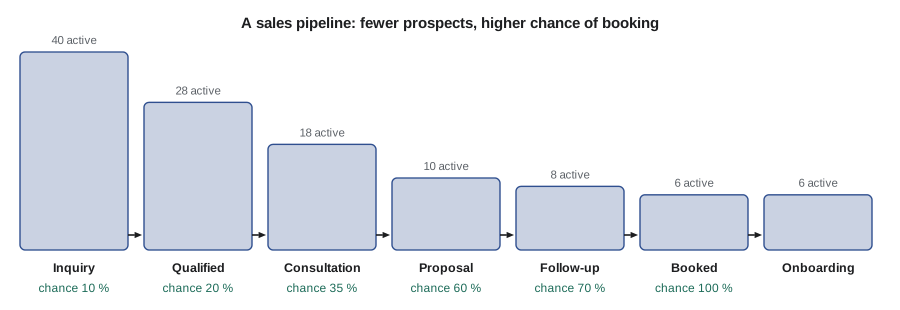
Most photography sales follow a predictable sequence, and a defined process prevents inquiries from slipping away.
- Inquiry: the prospect contacts you. Reply quickly; many buyers book the first professional who responds clearly. A target of replying within a few business hours is common.
- Qualification: confirm the basics: date, location, type of work, budget range and how images will be used. Not every inquiry is a good fit, and it is kinder to say so early.
- Consultation: a call or meeting to understand the client's goals, explain your process and build trust.
- Proposal: a written offer with options, prices and terms, sent promptly after the consultation.
- Follow-up: a reminder if the client has not replied, with an answer to any questions.
- Booking: a signed contract and deposit.
- Onboarding: a welcome message, preparation guide and schedule so the client knows what happens next.
Consultations
The consultation is where most bookings are won. Its purpose is to listen more than to talk. Ask open questions: what is the occasion or project, what do they want the images to do, who will see them, what did they like or dislike about previous photography, and what worries them. Then explain how you would approach the job and what working with you is like. For commercial clients, the consultation is often a creative call with an art director or marketing manager, and the questions focus on the brief, deliverables, schedule, usage and budget.
Take notes, summarize what you heard at the end of the call and confirm next steps. A client who feels understood is far more likely to book than one who has simply been given a price.
Proposals and tiered options
A proposal that offers two or three options, rather than a single take-it-or-leave-it price, lets clients choose the level that suits them and shifts the decision from whether to book to which option to book. The middle option is usually designed to be the best value and the most popular. The higher option anchors the range, making the middle look reasonable, and serves clients who want more.
| Package | Coverage | Deliverables | Price |
|---|---|---|---|
| Essential | 6 hours, one photographer | Online gallery of edited images | $3,200 |
| Signature | 8 hours, two photographers | Gallery plus engagement session and a 10 by 10 inch album | $4,600 |
| Complete | 10 hours, two photographers | Gallery, engagement session, 12 by 12 inch album and parent albums | $6,400 |
Worked problem
Average sale from a tier mix
Using the tiers above, last season 25% of couples chose Essential, 55% Signature and 20% Complete. What was the average sale? If a redesign shifts the mix to 15%, 60% and 25%, what is the new average?
Show solution
- Current average: \( 0.25 \times 3200 + 0.55 \times 4600 + 0.20 \times 6400 = 800 + 2530 + 1280 = \$4610 \).
- New average: \( 0.15 \times 3200 + 0.60 \times 4600 + 0.25 \times 6400 = 480 + 2760 + 1600 = \$4840 \).
- Increase per couple: \( 4840 - 4610 = \$230 \).
Answer: The average rises from $4,610 to $4,840, or $230 per couple. Over 25 weddings that is $5,750 more revenue, from clearer package design rather than more bookings.
In-person sales
Many portrait studios use in-person sales (IPS): after the session, the client returns to view the edited images, often projected at full size, and chooses prints, wall art, albums or digital files with the photographer's guidance. IPS typically produces much higher average sales than sending an online gallery with a price list, because clients see images at scale and receive advice on sizes and layouts. It also takes more time and skill. Studios that use IPS explain the process clearly at booking, including the minimum investment many clients make, so the sales meeting holds no surprises.
Some photographers prefer an all-inclusive model, with digital files and a set product credit included in the session price. It is simpler and suits clients who dislike sales meetings, but usually produces a lower average sale. Either model can work if it is presented honestly.
Handling objections
An objection is a concern that stops a client from booking. Common ones are price, timing, uncertainty about style and comparing you with a cheaper competitor. Treat objections as questions to answer, not attacks to resist.
- Listen fully and acknowledge the concern.
- Ask a question to understand it: is the issue the total amount, the timing of payment or uncertainty about value?
- Respond with information: what is included, how your process reduces risk, examples of similar work or a payment plan.
- Offer an alternative where reasonable, such as a smaller package, rather than cutting your price for the same work.
Some prospects will still choose a cheaper option, and that is fine. Not every inquiry is your client.
Worked problem
Weighted pipeline forecast
A commercial photographer has these open prospects: 6 at the inquiry stage worth an average $2,500 each with a 10% chance of booking, 3 at the consultation stage worth $4,000 each with a 35% chance, and 2 with proposals sent worth $6,000 each with a 60% chance. What is the weighted value of the pipeline?
Show solution
- Inquiries: \( 6 \times 2500 \times 0.10 = \$1500 \).
- Consultations: \( 3 \times 4000 \times 0.35 = \$4200 \).
- Proposals: \( 2 \times 6000 \times 0.60 = \$7200 \).
- Total weighted value: \( 1500 + 4200 + 7200 = \$12\,900 \).
Answer: About $12,900. The weighted pipeline is a better guide to coming revenue than the face value of every inquiry, which would be $39,000.
Ethical upselling
Upselling means offering a client more than they first asked for, such as an album, extra coverage or a larger print. It helps clients when the addition genuinely serves their goals; it harms trust when it pressures them into spending more than they can afford or want. Ethical upselling follows simple rules: show options and prices clearly in advance, recommend based on what the client told you they value, accept no without repeated pressure, and never hold images hostage or invent urgency. Payment plans can make larger purchases affordable, but they should be transparent and comply with consumer credit rules if you charge interest.
Client experience and retention
Client experience is everything a client feels from first contact to final delivery and beyond: how quickly you reply, how clear your preparation guide is, how comfortable they feel on the day, how long they wait for images, how beautifully the work is presented, and how you handle any problems. Small details are remembered: a handwritten note, a sneak preview within 48 hours, a well-packed print box.
Retention is cheaper than acquisition. Stay in touch with past clients through occasional, useful messages such as a reminder about annual family sessions or a seasonal mini-session, with consent. Ask for feedback after each job, and ask satisfied clients for reviews and referrals at the moment they are happiest, often right after delivery.
Customer relationship management
A customer relationship management (CRM) system records every prospect and client, their contact details, history, documents, payments and next steps. Many photographers use studio management software that combines CRM with contracts, invoices, questionnaires, scheduling and automated reminders. A simple spreadsheet can work at first, but automation saves hours once volume grows. Whatever tool you use, record lead sources, stages and outcomes so you can measure conversion and see where prospects drop out.
Client data and privacy
Client records include personal information: names, addresses, phone numbers, dates of family events, payment details and, of course, photographs of people, including children. Privacy law applies to how you collect, use, store and share it.
In the United States, there is no single federal privacy law for small businesses. Several states, such as California, Colorado, Virginia and others, have comprehensive privacy laws, but most apply only to businesses above revenue or data-volume thresholds, so many small studios fall outside them. All states have data breach notification laws, the FTC can act against unfair or deceptive data practices, and the Children's Online Privacy Protection Act governs online collection of data from children under 13.
Good practice is the same everywhere: collect only what you need, explain how you use it, keep galleries of private clients password-protected, secure devices and accounts with strong passwords and two-factor authentication, and ask permission before using a client's images, especially of children, in your marketing.
Follow-up and timing
Many bookings are lost not because the client chose someone else, but because nobody followed up. Prospects get busy, forget, or feel unsure about asking a question. A polite follow-up two or three days after sending a proposal, and another a week later, often brings a decision. Keep follow-ups short and helpful: answer a likely question, share a relevant example or remind them of a date that may soon be booked by someone else, if that is true. Automating these reminders in your CRM ensures they happen consistently. If a prospect decides not to book, thank them and ask, if appropriate, what influenced their decision; the answers show where your offer or process could improve.
Commercial client relationships
Commercial relationships often run through producers, art buyers and marketing managers who hire photographers repeatedly. These clients value reliability above almost everything: arriving prepared, keeping to budget, communicating clearly, delivering on time and solving problems calmly. A photographer who makes an art buyer look good to their own boss is likely to be hired again. Keep notes on each contact's preferences, send a short thank-you after each job, share relevant new work occasionally, and remember that people move between companies, taking their trusted suppliers with them. Long-term relationships with a few dependable buyers are often the foundation of a stable commercial business.
Finally, measure your sales process the same way you measure marketing. Track the share of inquiries that reach a consultation, the share of consultations that book, the average time from inquiry to booking and the average sale. Small improvements at each step compound over a year.
Review the figures each quarter alongside notes from lost prospects, since the reasons people give for not booking often point to a single fixable issue, such as slow replies or unclear package contents.
Common mistakes
MistakeReplying to inquiries a day or more later
InsteadReply quickly with a clear next step, using templates where helpful.
MistakeSending a price list instead of holding a consultation
InsteadListen to the client's goals first, then propose options.
MistakeOffering a single take-it-or-leave-it price
InsteadPresent two or three well-designed options.
MistakeCutting your price at the first objection
InsteadClarify the concern and offer a smaller option or payment plan instead.
MistakeUsing client photos in marketing without permission
InsteadGet clear consent, especially for images of children.
Summary and key terms
- A defined sales process moves inquiries through qualification, consultation, proposal, follow-up, booking and onboarding.
- Consultations focus on listening to the client's goals and concerns.
- Tiered options shift the decision to which package and can raise the average sale.
- In-person sales raise average orders but take time and must be presented honestly.
- A weighted pipeline forecast multiplies each prospect's value by its probability of booking.
- Ethical upselling recommends based on client goals without pressure.
- CRM systems and privacy safeguards protect client relationships and data.
- Qualification
- Checking whether an inquiry fits your services, dates and budget.
- Consultation
- A meeting to understand the client's goals before proposing.
- Proposal
- A written offer with options, prices and terms.
- Tiered pricing
- Offering several packages at different levels.
- Anchoring
- Influencing perceptions of value by showing a higher option first.
- In-person sales (IPS)
- A guided meeting where clients view images and order products.
- Objection
- A concern that prevents a client from booking.
- Weighted pipeline
- The sum of prospect values multiplied by their probabilities of booking.
- Customer relationship management (CRM)
- A system for recording and managing client interactions.
- Retention
- Keeping existing clients returning over time.
Practice problems
Work each problem on paper first, then reveal the answer to check.
Tiers of $2,000, $3,000 and $4,500 with a mix of 30%, 50% and 20%. What is the average sale?
Show answer
\( 600 + 1500 + 900 = \$3000 \).
5 prospects worth $3,000 at 40%. What is their weighted value?
Show answer
\( 5 \times 3000 \times 0.4 = \$6000 \).
Name the stages of the sales process.
Show answer
Inquiry, qualification, consultation, proposal, follow-up, booking, onboarding.
Why offer three options?
Show answer
Clients choose which option rather than whether to book, and the top tier anchors value.
Give two rules of ethical upselling.
Show answer
Show prices in advance, recommend based on goals, accept no, avoid false urgency.
What is in-person sales?
Show answer
A guided meeting where clients view images at scale and order products.
Name four steps for handling an objection.
Show answer
Listen, ask a clarifying question, respond with information, offer an alternative.
Which Canadian law generally governs private-sector personal information?
Show answer
PIPEDA, except where similar provincial laws apply.
Why record lead sources in a CRM?
Show answer
To measure which channels and stages convert.
When is the best time to ask for a review?
Show answer
Right after delivery, when the client is happiest.
Lesson quiz · 5 questions
Score 60% or more to complete this lesson.
Create a free account to save your progress, take quizzes and earn a certificate.