
PHOT-499 · Lesson 1 of 12 · 34 min
The capstone: purpose, outcomes and assessment
The capstone is the last course in the Photography degree and the only one in which you set the brief. Every earlier course taught a skill or a field of practice: exposure and light in PHOT-101 and PHOT-102, the digital darkroom in PHOT-202, studio work in PHOT-210 and PHOT-211, documentary practice in PHOT-230, color management and printing in PHOT-301, the commercial and editorial specialist courses at the 300 level, critique and concept in PHOT-401, business in PHOT-410, computational imaging and provenance in PHOT-420, books and exhibitions in PHOT-430 and video in PHOT-440. The capstone asks you to combine them into one sustained, professional body of work, delivered on a fixed date to a public audience, with the planning, permissions, documentation and writing that a working photographer would need for the same project outside school.
This course is therefore a guided project rather than a set of new techniques. Each lesson matches a stage of a thirteen-week term, from the brief and proposal in the first weeks to the public presentation, defense and reflection at the end. The lessons point back to the earlier course that taught each skill instead of teaching it again, and they concentrate on what is new at this stage: making decisions under real constraints, keeping a project on schedule, responding to feedback, and finishing to a standard someone outside the school would accept.
Why a capstone exists
Programs end with a capstone for three reasons. The first is integration. Skills learned in separate courses do not automatically combine; a photographer who can light a portrait, manage color and write a contract still has to decide which of those skills a given project needs and in what order. The second is evidence. A transcript lists courses, but a finished body of work shows a reviewer, an employer, a gallery or a grant jury what you can actually do when nobody is setting the steps for you. The third is transition. The capstone is designed to be the first project of your professional life rather than the last assignment of your student life, so its outputs (a body of work, a portfolio, a project text, a budget and a set of permissions) should be usable the week after you graduate.
A useful test for any decision in the term is to ask whether a professional doing this project for a client, a publisher or a gallery would make the same choice. If the answer is no, the choice is probably serving the grade rather than the work, and graders are trained to notice the difference.
Choosing the kind of capstone
Photography capstones fall into a few families. A fine art or documentary body of work is a series of fifteen to thirty finished images on a theme, developed through research and presented as an exhibition, a book or a screen-based work; it builds most directly on PHOT-230 and PHOT-401. A commercial or editorial capstone is a self-assigned campaign, editorial story or product line photographed to a professional brief, with a client-style deliverables list, usage terms and a rate card; it builds on PHOT-302, PHOT-310 and PHOT-410. A hybrid capstone combines a stills series with a short film or audio slideshow made with the methods of PHOT-440. A technical or research capstone investigates a process, such as a computational pipeline from PHOT-420, an alternative process from PHOT-240 or a printing method from PHOT-301, and presents both the images and a written account of the method.
Most students choose the first family because exhibition and book outputs suit a public showcase, but the assessment criteria apply to all of them. Whichever you choose, the project must be new work made during the term. You may build on research or test images from earlier courses, but recycled finished images do not count toward the body of work, and you must declare any earlier images you include as context.
| Family | Typical final output | Builds most on | Extra evidence expected |
|---|---|---|---|
| Fine art or documentary series | 15 to 30 images as an exhibition, book dummy or screen work | PHOT-230, PHOT-401, PHOT-430 | Research file, project text, releases |
| Commercial or editorial | A campaign or story to a written brief, with deliverables | PHOT-302, PHOT-310, PHOT-410 | Brief, shot list, estimate, usage terms |
| Hybrid stills and motion | A series plus a 1 to 3 minute film or audio slideshow | PHOT-440 | Shot plan, sound log, music license |
| Technical or research | Images plus a written method and results | PHOT-240, PHOT-301, PHOT-420 | Test records, method write-up, data |
A composite student
To keep the stages concrete, the lessons follow a composite student, Amara, through one capstone. Amara is not a real person; she combines the decisions of many students. Her project, provisionally titled Night Shift, is a documentary and portrait series about people who work overnight in her city: bakers, hospital cleaners, transit maintenance crews, a radio host, security guards and taxi drivers. She plans a twenty-image exhibition in the school gallery in week 13, a 48-page photobook dummy, an updated portfolio website and a short audio slideshow for the exhibition's screen. Her constraints are the ones most students face: about twelve hours a week for the project alongside other courses and a part-time job, a modest budget, access that has to be negotiated, and a fixed opening night that cannot move.
You will see Amara's proposal, schedule, budget, permissions, contact sheets, edit, texts, book and exhibition plans, portfolio and defense in the lessons that follow. Treat her choices as examples to argue with, not a template to copy; your project will have different subjects, risks and outputs.
Learning outcomes and how they are assessed
The course outcomes describe what you will be able to do by the end: develop and defend a proposal; plan a project with a realistic schedule, budget and risk register; secure the permissions and consents the work needs; produce, review and revise a body of work; edit and sequence it; manage files, provenance and archives; write about it; produce a finished public output; present a professional portfolio; take part in critique and defend your decisions; and plan the next stage of your practice. Each outcome is assessed by a deliverable that appears at a set point in the term.
| Deliverable | Due | Weight |
|---|---|---|
| Proposal and research file | Week 2 | 10 percent |
| Production plan: schedule, budget, permissions, risks | Week 3 | 10 percent |
| Mid-term review: work in progress and process log | Week 7 | 10 percent |
| Final body of work and output (exhibition, book or screen) | Week 13 | 40 percent |
| Writing: statement, project text, captions, alt text | Week 12 | 10 percent |
| Portfolio and online presence | Week 14 | 10 percent |
| Final critique, defense and reflection | Weeks 13 to 14 | 10 percent |
The finished work is less than half the grade. The rest assesses the process and the professional surround of the work. That weighting is deliberate: in practice, many good photographers fail on schedules, permissions, files and communication rather than on the pictures, and the capstone is the last chance to practice those parts with a safety net.
Reading the rubric
The final body of work is assessed with an analytic rubric: a table of criteria, each scored on a scale with written descriptors for each level. Analytic rubrics are used because a single holistic mark hides the reasons for a grade, while separate criteria show you where to improve and help several assessors agree. The descriptors matter more than the numbers. A score of 3 out of 4 on technical quality, for example, might be described as "consistent exposure, color and focus across the series, with minor lapses that do not distract from the work", while a 4 adds "technical choices actively support the concept, such as a consistent tonal palette that carries the mood". Read the descriptors at the start of the term and use them as a checklist at each review.
| Criterion | Weight | Level 4 descriptor (excellent) | Level 2 descriptor (developing) |
|---|---|---|---|
| Concept and research | 15 | A clear, specific idea informed by research and precedents, visible in the images | A broad topic; research listed but not reflected in the work |
| Technical quality | 20 | Exposure, focus, color and print quality are consistent and serve the concept | Uneven exposure or color that distracts from the work |
| Coherence of the body of work | 20 | Images read as one project with a consistent approach and voice | Strong single images that do not yet read as a series |
| Edit and sequence | 15 | A tight edit; sequence builds meaning, rhythm and pacing | Too many similar images; order appears arbitrary |
| Presentation and output | 20 | Finished output is professional in materials, layout and installation | Output is incomplete or poorly finished |
| Risk and ambition | 10 | Takes considered risks in subject, access or form and manages them | Plays safe or takes unmanaged risks |
Worked problem
Calculating a weighted rubric score
An assessor scores Amara's final work on a four-point scale: concept 3, technical quality 4, coherence 3, edit and sequence 2, presentation 3, risk and ambition 4. Using the weights in the table, what is her weighted score as a percentage, and which criterion offers the largest gain if improved by one level?
Show solution
- Weighted sum: \( 15 \times 3 + 20 \times 4 + 20 \times 3 + 15 \times 2 + 20 \times 3 + 10 \times 4 = 45 + 80 + 60 + 30 + 60 + 40 = 315 \).
- Maximum possible: \( 100 \times 4 = 400 \), so the score is \( 315/400 = 78.75 \) percent.
- Raising one level adds the criterion weight to the sum: technical quality and risk are already at 4; coherence or presentation would add 20 points (5 percentage points); edit and sequence would add 15 points (3.75 percentage points).
Answer: About 79 percent. Coherence and presentation offer the largest single gains, but edit and sequence is the weakest area and is often the cheapest to improve, because it needs time rather than money or new shoots.
Scoping the project to the time available
The most common capstone failure is not a weak idea but an idea too large for the term. Scope by working out your capacity, estimating the work and comparing the two before you commit. Capacity is the hours you can actually spend: for a thirteen-week term at twelve hours a week, about 156 hours, minus time lost to illness, other deadlines and travel. Estimates should cover every stage, not only shooting: research and proposal, pre-production and permissions, shooting, file management, editing, post-production, writing, printing or book production, installation, portfolio and presentation. Students consistently underestimate the stages after shooting; in completed projects, post-production, output and presentation often take as long as the shooting itself.
Worked problem
Checking scope against capacity
Amara has 12 hours a week for 13 weeks and expects to lose 10 percent of that to illness and clashes. Her first estimate is: research and proposal 14 h, pre-production and permissions 18 h, 12 shoots at 5 h each including travel, file management 10 h, editing and sequencing 16 h, post-production 22 h, writing 10 h, printing, framing and book dummy 20 h, installation 8 h, portfolio 8 h and presentation 6 h. Does the project fit?
Show solution
- Capacity: \( 12 \times 13 \times 0.9 = 140.4 \) hours.
- Estimate: \( 14 + 18 + 60 + 10 + 16 + 22 + 10 + 20 + 8 + 8 + 6 = 192 \) hours.
- Overrun: \( 192 - 140.4 \approx 52 \) hours, or about 37 percent over capacity.
- Options: reduce shoots from 12 to 9 (saves 15 h), print 15 images rather than 20 for the wall and show the rest in the book (saves about 6 h), drop the audio slideshow (saves about 10 h, if it was hidden inside post-production), and simplify the book dummy to a digital print-on-demand proof (saves about 6 h). That removes roughly 37 hours; the remaining gap needs either more hours per week in the production weeks or a smaller concept.
Answer: No. The first estimate is about 52 hours over capacity, so Amara must cut scope or add time before the proposal is approved; a plan that only fits if nothing goes wrong does not fit.
hours_per_week, weeks, loss = 12, 13, 0.10
capacity = hours_per_week * weeks * (1 - loss)
plan = {'research and proposal': 14, 'pre-production': 18, 'shooting': 60, 'file management': 10,
        'editing': 16, 'post-production': 22, 'writing': 10, 'output': 20, 'installation': 8,
        'portfolio': 8, 'presentation': 6}
total = sum(plan.values())
print(f'capacity {capacity:.1f} h, estimate {total} h, gap {total - capacity:+.1f} h')
after_shoot = sum(v for k, v in plan.items() if k not in ('research and proposal', 'pre-production', 'shooting'))
print(f'work after shooting: {after_shoot} h ({after_shoot / total:.0%} of the plan)')
revised = dict(plan, shooting=45, output=14, **{'post-production': 12})
rt = sum(revised.values())
print(f'revised estimate {rt} h, gap {rt - capacity:+.1f} h')capacity 140.4 h, estimate 192 h, gap +51.6 h work after shooting: 100 h (52% of the plan) revised estimate 161 h, gap +20.6 h
The code shows the pattern most students discover too late: more than half the hours fall after the last shoot. If your schedule has shooting until week 11, you have planned to fail.
Working back from a fixed date
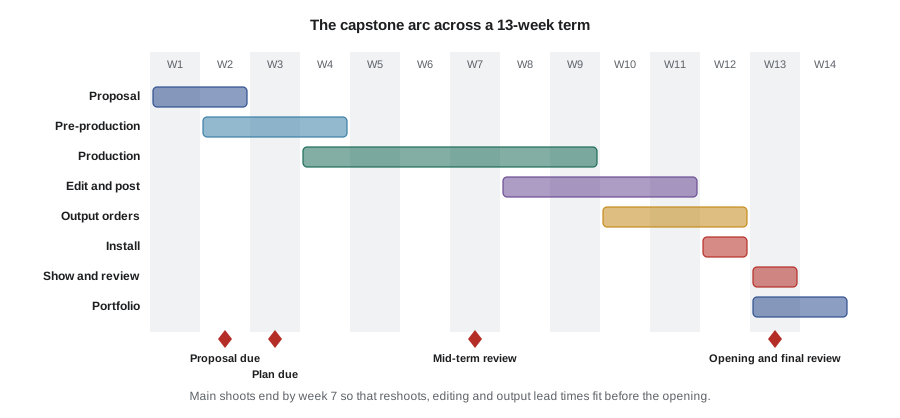
Professional projects are scheduled backward from a fixed delivery date, and the capstone has one: the opening or presentation in week 13. Start from that date and work back through the tasks with external lead times, because those are the ones you cannot speed up by working harder. A framer may need two weeks; a print lab one week plus shipping; a print-on-demand book proof ten to fifteen working days; gallery signage several days. Then add a buffer before each external hand-off. The last shoot date falls out of this calculation rather than being chosen first.
Worked problem
Finding the last safe shoot date
Amara's opening is on the Thursday of week 13. Framing needs 10 working days after prints arrive, the lab needs 5 working days plus 2 for shipping, and she wants 3 working days for final post-production of the selected images plus 5 working days to edit after the last shoot. She also wants a 3-day buffer before the framer. Counting back in working days, how many working days before the opening must the last shoot happen?
Show solution
- Installation needs the framed work 2 working days before the opening: 2.
- Framing: 10, buffer: 3, lab plus shipping: \( 5 + 2 = 7 \), final post-production: 3, editing: 5.
- Total: \( 2 + 10 + 3 + 7 + 3 + 5 = 30 \) working days, which is six working weeks.
Answer: The last shoot must be about 30 working days, or six weeks, before the opening, which puts it in week 7. Amara moves her final shoots earlier and uses weeks 8 to 9 only for reshoots of images already in the edit.
The process log and professional conduct
Throughout the term you will keep a process log: a dated record of decisions, shoots, problems, feedback received and changes made. It is assessed at mid-term and supports your defense, but it is also professional practice; editors, grant officers and clients all ask how a project developed, and a log lets you answer accurately instead of reconstructing a story afterward. Entries can be short. A good entry records what you did, what happened, what you learned and what you will do next, with the file numbers of relevant frames.
Professional conduct is part of the assessment. That means meeting the deadlines in the schedule, telling your supervisor early when something goes wrong, keeping the promises you make to subjects and partners, citing sources and precedents honestly, and disclosing any use of generative tools in line with the school's policy and the provenance practices in PHOT-420. A capstone that depends on fabricated scenes presented as documentary, undisclosed generative content, or images made without the consent the work required will fail the professional practice criteria regardless of how good the pictures look.
Using supervision and feedback well
Each student has a supervisor and meets them at set points: proposal, production plan, a fortnightly check-in and the mid-term review. Supervisors are not there to approve every image; they are there to ask questions you have not asked yourself, to spot scope and schedule problems early, and to connect you with resources. Bring something to every meeting: a contact sheet, a draft sequence, a revised schedule or a specific question. Write down the feedback, decide what you will act on and why, and record the decision in your log. You do not have to accept every suggestion, but in the defense you will need to explain why you did or did not.
| Week | Meeting | Bring | Leave with |
|---|---|---|---|
| 1 | Brief and ideas | Three possible ideas with a precedent each | One idea to develop and research tasks |
| 2 | Proposal review | Draft proposal and research file | Approval or required changes |
| 3 | Production plan | Schedule, budget, permissions plan, risk register | Approved plan |
| 5 | Check-in | First contact sheets and log | Adjustments to approach |
| 7 | Mid-term review | Work in progress, rough edit, log | Written feedback and priorities |
| 9 | Check-in | Edit, output quotes | Output decisions |
| 11 | Pre-output | Final edit, proofs, draft texts | Sign-off to order |
| 13 | Final critique and defense | Installed work, book, portfolio | Grades and feedback |
Common mistakes
MistakePlanning the shoots first and leaving output to the end
InsteadSchedule backward from the presentation date, starting with external lead times for prints, framing and books.
MistakeTreating the capstone as a set of good single images
InsteadPlan and edit for a coherent body of work assessed as a whole.
MistakeEstimating only the shooting hours
InsteadEstimate every stage; post-production, output and presentation often take as long as shooting.
MistakeHiding problems from the supervisor until the mid-term review
InsteadReport problems early and bring a proposed solution to the next meeting.
MistakeIncluding finished images from earlier courses as new work
InsteadMake new work during the term and declare any earlier images used as context.
Summary and key terms
- The capstone integrates the whole degree into one professional body of work delivered on a fixed date.
- Choose a capstone family that fits your goals: series, commercial or editorial, hybrid, or technical research.
- Most of the grade assesses process and professional practice, not only the final images.
- Read the rubric descriptors at the start and use them as a checklist at each review.
- Scope the project by comparing realistic capacity with estimates for every stage.
- Schedule backward from the opening; external lead times set the last shoot date.
- Keep a dated process log and use supervision meetings to test decisions.
- Capstone
- The final course that integrates a program into one sustained, assessed project.
- Body of work
- A coherent group of images made as one project.
- Analytic rubric
- A scoring table with separate criteria and descriptors for each level.
- Descriptor
- The written description of performance at one rubric level.
- Capacity
- The realistic number of hours available for the project.
- Scope
- The size and content of what the project will deliver.
- Backward scheduling
- Planning from a fixed delivery date back to the start.
- Lead time
- The time an external supplier needs to deliver.
- Buffer
- Spare time placed before a critical hand-off to absorb delays.
- Process log
- A dated record of decisions, shoots, feedback and changes.
Practice problems
Work each problem on paper first, then reveal the answer to check.
Name three reasons programs end with a capstone.
Show answer
Integration of skills, evidence of ability and transition to professional practice.
With 10 hours a week for 13 weeks and 15 percent lost time, what is capacity?
Show answer
\( 10 \times 13 \times 0.85 = 110.5 \) hours.
An estimate is 160 hours against a capacity of 125. By what percentage is it over?
Show answer
\( 35/125 = 28 \) percent.
Why are output tasks scheduled first in backward planning?
Show answer
They have external lead times that cannot be shortened by working harder.
A rubric criterion weighted 20 rises from level 2 to 3 on a 4-level scale with total weight 100. How many percentage points does the grade gain?
Show answer
\( 20/400 = 5 \) percentage points.
What four things should a process log entry record?
Show answer
What you did, what happened, what you learned and what you will do next.
What should you bring to every supervision meeting?
Show answer
Something concrete: contact sheets, a sequence, a revised schedule or a specific question.
Can finished images from earlier courses count toward the capstone body of work?
Show answer
No; they may be shown as declared context only.
Which capstone family needs a written method and results?
Show answer
The technical or research capstone.
Why is finished work less than half the grade?
Show answer
The course also assesses planning, permissions, files, writing, presentation and reflection, where professional projects often fail.
Lesson quiz · 5 questions
Score 60% or more to complete this lesson.
Create a free account to save your progress, take quizzes and earn a certificate.