
PHYS-130 · Lesson 12 of 12 · 28 min
Case studies and course project
This course has developed the core of classical mechanics: kinematics with constant and changing acceleration, Newton's laws and their application to springs, drag, curves and accelerating frames, work, energy and stability, momentum and collisions, rotation, equilibrium and elasticity, gravitation and orbits, and oscillations and waves. Real engineering problems rarely sit inside one lesson. This lesson works through three case studies that combine several: stopping a car safely with a highway crash cushion, sizing the drive of a passenger elevator, and estimating the power, loads and vibration of a large wind turbine. Each starts with a physical question, chooses the principles that answer it most simply, and checks the result. The lesson then sets out the course project and looks ahead.
Case study 1: a highway crash cushion
Crash cushions (impact attenuators) protect vehicles that leave the road in front of rigid hazards such as bridge piers and the ends of concrete barriers. Their job is to bring a car to rest over a controlled distance, keeping the deceleration of its occupants survivable. Energy and momentum give the essential numbers.
Worked problem
How long must the cushion be?
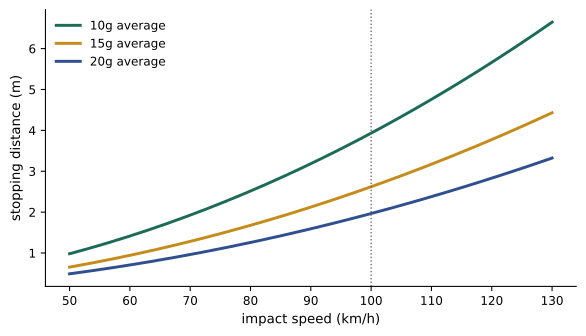
A 1500 kg car strikes a cushion head-on at 100 km/h. If the average deceleration of the occupants must not exceed about 20g, what stopping distance is needed? How much energy must the cushion absorb, and what is the average force?
Show solution
- Speed: 100/3.6 = 27.8 m/s. Kinetic energy: \(\tfrac{1}{2} \times 1500 \times 27.8^2 = 579\) kJ (Lesson 5).
- With constant deceleration a: \(d = v^2/(2a) = 27.8^2/(2 \times 20 \times 9.81) = 1.97\) m (Lesson 1).
- Average force: \(F = ma = 1500 \times 196 = 294\) kN, or equivalently energy/distance = 579 kJ/1.97 m.
- Duration: \(t = v/a = 0.14\) s; the impulse \(Ft\) equals the change in momentum, \(1500 \times 27.8 = 41\,700\) N·s (Lesson 7).
Answer: A stopping distance of about 2 m, absorbing 579 kJ with an average force near 300 kN over 0.14 s. Real decelerations are not constant, so cushions are made longer, typically 4 to 9 m for high-speed roads, to keep peaks within limits; crash testing standards (such as AASHTO MASH, used in Canada and the United States) set limits on occupant impact speed and ride-down acceleration.
Different cushions use different physics. Crushable and hydraulic units absorb energy by deformation or by pushing fluid through orifices (work against a force). Arrays of sand-filled barrels instead transfer momentum to the sand they hit: each barrel the car strikes takes up some of its momentum, so the car slows progressively, an application of conservation of momentum in a sequence of inelastic collisions. Because kinetic energy grows as v², a car at 120 km/h carries 44% more energy than at 100 km/h, so a cushion rated for the lower speed may be overwhelmed at the higher one.
Case study 2: sizing an elevator drive
A traction elevator hangs the car and a counterweight on opposite ends of steel ropes passing over a driven sheave. The counterweight typically equals the car mass plus about half the rated load, so the motor never has to lift the whole load, only the imbalance.
Worked problem
Motor power for an office elevator
A car of 1200 kg carries up to 1000 kg of passengers and has a 1700 kg counterweight. It travels at 2.5 m/s and accelerates at 1.0 m/s². With a drive efficiency of 85%, estimate the motor power needed for a full car going up, at steady speed and at the end of acceleration. Find a passenger's apparent weight during acceleration.
Show solution
- Imbalance with a full car: (2200 − 1700) × 9.81 = 4.9 kN.
- Steady speed: \(P = Fv = 4.9 \times 2.5 = 12.3\) kW at the sheave, or 12.3/0.85 = 14.4 kW from the supply (Lessons 5 and 6).
- Accelerating: the whole moving mass (2200 + 1700 = 3900 kg) must accelerate, adding 3.9 kN. At the end of acceleration: \((4.9 + 3.9) \times 2.5 = 22\) kW at the sheave, 26 kW from the supply (Lesson 3).
- A 75 kg passenger accelerating up: \(N = m(g + a) = 75 \times 10.81 = 811\) N, 10% above their weight (Lesson 4).
Answer: About 14 kW at steady speed and 26 kW peak, a fraction of what lifting the full car without a counterweight would need. Passengers feel 10% heavier when starting up, about the limit for comfort, which is why elevators also limit jerk with smooth acceleration profiles (Lesson 2). With an empty car going up, the counterweight is heavier, and a regenerative drive can return energy to the building.
The rope tension on the car side during upward acceleration is 2200 × (9.81 + 1.0) = 23.8 kN. Shared among six ropes, each carries about 4 kN, and elevator codes require the ropes' breaking strength to exceed the working load by a large safety factor, around ten or more, to allow for wear, fatigue over millions of bending cycles over the sheave, and emergency stops (Lesson 9). The same analysis, with different numbers, applies to mine hoists, cranes and funiculars.
Case study 3: a wind turbine
A modern wind turbine combines almost every topic of this course: the kinetic energy of moving air, rotational motion of the rotor, large centripetal forces in the blades, and vibration of a tall, slender tower.
Worked problem
Power from the wind
A turbine has a rotor 120 m in diameter. Find the kinetic energy flux (power) in a 10 m/s wind through the rotor area (ρ = 1.225 kg/m³), the maximum extractable power and the output at a typical power coefficient of 0.45.
Show solution
- Swept area: \(\pi \times 60^2 = 11\,300\) m².
- Mass flow through the rotor per second: \(\rho Av\); kinetic energy flux \(P = \tfrac{1}{2}\rho Av^3 = 0.5 \times 1.225 \times 11\,300 \times 1000 = 6.93\) MW.
- No turbine can capture all of it, since the air must keep moving away; the Betz limit is 16/27 = 59.3%, or 4.11 MW.
- At a power coefficient of 0.45: 0.45 × 6.93 = 3.1 MW.
Answer: About 3.1 MW. The cube law dominates siting: a site with 10% higher average wind speed yields about 33% more energy, which is why developers measure winds carefully for a year or more before building, and why turbines are tall, reaching the faster winds aloft.
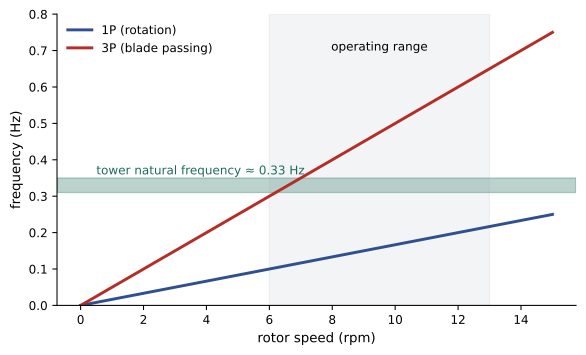
The rotor turns slowly but its blade tips move fast. Turbines are designed for a tip speed ratio (tip speed divided by wind speed) of about 7 to 9. At a ratio of 8 in a 10 m/s wind, the tip moves at 80 m/s, so the rotor turns at \(\omega = 80/60 = 1.33\) rad/s, about 13 revolutions per minute (Lesson 8). Each blade, perhaps 20 t with its center of mass 20 m from the hub, then pulls on the hub with a centripetal force of \(m\omega^2r = 20\,000 \times 1.78 \times 20 = 710\) kN (Lesson 4), on top of its weight and the aerodynamic loads, all cycling once per revolution: fatigue over 20 to 30 years and some 10⁸ load cycles governs the blade root design.
Finally, vibration. The rotor excites the tower at its rotation frequency (called 1P, here 0.21 Hz) and at the blade-passing frequency (3P, 0.64 Hz for three blades). The tower's first natural frequency (Lesson 11) must avoid both to prevent resonance. Most large turbines use a "soft-stiff" tower, with a natural frequency between 1P and 3P, around 0.3 to 0.4 Hz, which is lighter and cheaper than a tower stiff enough to stay above 3P. Variable-speed turbines must avoid lingering at speeds where 1P or 3P crosses the tower frequency.
The method behind the case studies
Each case study followed the same steps:
- State the question in physical terms: a stopping distance, a power, a force, a frequency.
- Choose the simplest principle that answers it: energy when speeds and distances matter, momentum for impacts and flows, Newton's second law for forces and accelerations, natural frequencies for vibration.
- Make the idealizations explicit: constant deceleration, rigid car, uniform wind, and decide whether each is conservative.
- Check the answer two ways where possible (energy and kinematics gave the same cushion force) and against experience.
- Interpret the result as a design decision with a margin, and note what a more detailed analysis would add.
The course project
Choose one of the following problems, or propose your own of similar scope with your instructor's approval, and prepare a report with your physical model, calculations, a measurement or simulation where possible, checks and conclusions.
- Project A: Vehicle performance. For a real car, bicycle or electric scooter, estimate drag and rolling resistance from published data or a coast-down test, find the power needed at several speeds, the energy per kilometer and the effect of a hill, and compare with stated range or fuel consumption.
- Project B: Measuring g and damping. Build a pendulum or mass-spring system, measure its period for several lengths or masses, determine g or k with an uncertainty estimate, and measure how quickly the amplitude decays.
- Project C: Structure and stability. Analyze a crane, a ladder, a cantilevered sign or a tower: find support reactions, the tipping or slipping condition, member stresses and the deformation under load, and propose a safety margin.
- Project D: Energy systems. Compare two ways of storing or delivering energy (for example, pumped hydro and batteries for a community, or a flywheel and a battery for a bus), using energy, power, efficiency and mass, and recommend one with reasons.
Every report should show free-body diagrams where forces are involved, state assumptions and their effect, check units and orders of magnitude, compare at least one result with an independent estimate or measurement, and express conclusions in engineering terms.
Looking ahead
Mechanics is the foundation for much of engineering. Statics and dynamics (ENGG-130 and later dynamics courses) develop the methods of this course into systematic tools for structures and machines; strength of materials extends stress and strain to beams, shafts and columns; fluid mechanics applies Newton's laws and energy to flowing water and air; vibrations and control engineering build on oscillations; and PHYS-131 turns from mechanical forces to electric and magnetic ones, using the same ideas of fields, potential energy and conservation laws.
Common mistakes
MistakeUsing average deceleration as if it were the peak.
InsteadReal decelerations vary; design for peaks, which are higher than averages.
MistakeIgnoring the counterweight or the accelerating mass in drive sizing.
InsteadInclude imbalance, the whole moving mass and drive efficiency.
MistakeAssuming a turbine can capture all the wind's kinetic energy.
InsteadThe Betz limit caps extraction at 59.3%; real turbines achieve about 45 to 50%.
MistakeForgetting cyclic loading in rotating machines.
InsteadLoads that repeat each revolution cause fatigue over millions of cycles.
MistakeChecking a structure's strength but not its natural frequency.
InsteadKeep natural frequencies away from forcing frequencies.
Summary and key terms
- A crash cushion must absorb ½mv² over a distance that keeps deceleration survivable; energy rises with v².
- Sand-barrel cushions slow a car by transferring momentum in a series of inelastic collisions.
- Counterweights reduce elevator motor power to the imbalance plus the force to accelerate the whole moving mass.
- Passengers feel m(g + a) during acceleration; ropes need large safety factors.
- Wind power is ½ρAv³, capped by the Betz limit of 59.3%; output grows with the cube of wind speed.
- Turbine blades carry large centripetal and cyclic loads; towers must avoid the 1P and 3P frequencies.
- The method: state the question, pick the simplest principle, idealize explicitly, check two ways, interpret with margin.
- Crash cushion
- A device that decelerates an errant vehicle in a controlled way before a hazard.
- Ride-down acceleration
- The acceleration an occupant experiences after striking the vehicle interior or restraint.
- Counterweight
- A mass balancing an elevator car to reduce the drive force.
- Traction sheave
- The driven pulley over which elevator ropes pass.
- Power coefficient
- The fraction of the wind's kinetic energy flux a turbine converts.
- Betz limit
- The theoretical maximum power coefficient, 16/27.
- Tip speed ratio
- Blade tip speed divided by wind speed.
- Soft-stiff tower
- A tower whose natural frequency lies between the rotor's 1P and 3P frequencies.
Practice problems
Work each problem on paper first, then reveal the answer to check.
Find the kinetic energy of a 2000 kg pickup at 90 km/h.
Show answer
½ × 2000 × 25² = 625 kJ.
What stopping distance limits that pickup to an average of 15g?
Show answer
25²/(2 × 147) = 2.1 m.
By how much does crash energy increase from 100 to 120 km/h?
Show answer
(1.2)² = 1.44: 44%.
An elevator imbalance is 3 kN at 1.75 m/s. Find the sheave power at steady speed.
Show answer
5.25 kW.
Find the apparent weight of an 80 kg passenger when an elevator decelerates at 0.8 m/s² while going up.
Show answer
80 × (9.81 − 0.8) = 721 N.
Find the wind power through a 100 m diameter rotor at 8 m/s (ρ = 1.225).
Show answer
½ × 1.225 × 7854 × 512 = 2.46 MW.
If wind speed rises from 8 to 9 m/s, by what factor does the power rise?
Show answer
(9/8)³ = 1.42.
Find the rotor speed in rpm for a 60 m blade with a tip speed of 75 m/s.
Show answer
ω = 1.25 rad/s = 11.9 rpm.
At 11.9 rpm, find the 1P and 3P frequencies.
Show answer
0.20 Hz and 0.60 Hz.
Why are tower natural frequencies kept away from 1P and 3P?
Show answer
To avoid resonance with the periodic forces from rotation and blade passing.
Lesson quiz · 5 questions
Score 60% or more to complete this lesson.
Create a free account to save your progress, take quizzes and earn a certificate.