
PHYS-472 · Lesson 12 of 12 · 21 min
Capstone: quantum technologies in 2026 — superconducting, trapped-ion and photonic qubits, quantum key distribution and sensing
▶ Video coming soon A video version of this lesson is on the way.
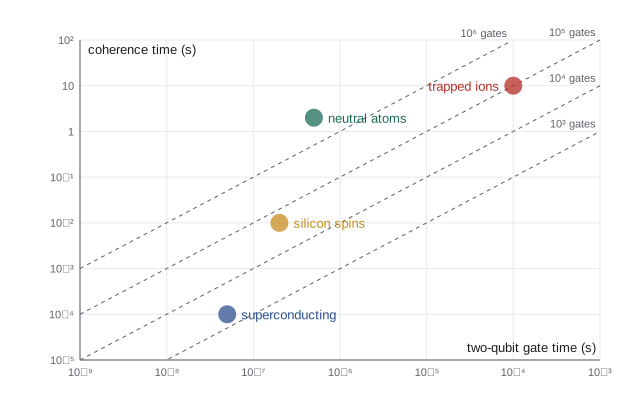
This capstone puts the course to work on the technologies built from it. Every quantum device faces the same requirements, which David DiVincenzo listed in 2000: well-defined qubits that can be scaled up, reliable initialization, coherence times long compared with gate times, a universal set of gates, and qubit-specific measurement. Different physical systems meet them in different ways and with different trade-offs, and the field in 2026 is still a competition between platforms. The lesson surveys the leading ones, then turns to the two applications already in practical use: quantum key distribution, whose security rests on lessons 9 and 10, and quantum sensing, which turns decoherence and interference into measurement.
Superconducting qubits
A superconducting qubit is an electrical circuit, a few hundred micrometers across, made of aluminum or niobium on silicon or sapphire and cooled to about 10 to 20 mK. Its key element is the Josephson junction, a thin insulating barrier between two superconductors, which acts as a nonlinear inductor. A junction shunted by a capacitor forms an anharmonic oscillator whose two lowest levels, typically 4 to 6 GHz apart, serve as the qubit; this design is the transmon, introduced at Yale in 2007. Gates are microwave pulses lasting tens of nanoseconds, and readout uses a microwave resonator whose frequency shifts depending on the qubit state. The 2025 Nobel Prize in Physics, to John Clarke, Michel Devoret and John Martinis, recognized experiments from the 1980s that showed such circuits behaving as single quantum objects, with quantized energy levels and macroscopic tunneling.
Superconducting qubits are fast and are made with the tools of chip fabrication, which favors scaling. Their coherence times, around 100 \(\mu\)s in good devices, are short, and each qubit usually couples only to its nearest neighbors. Google Quantum AI's 105-qubit Willow chip demonstrated a surface-code memory below threshold in December 2024. IBM introduced its 120-qubit Nighthawk processor in November 2025, with 218 tunable couplers in a square lattice, and expects the first verified demonstrations of quantum advantage on it by the end of 2026. IBM plans a fault-tolerant system, Starling, at its Poughkeepsie data center in 2029. In Canada, D-Wave in Burnaby builds superconducting quantum annealers, machines that use adiabatic evolution (lesson 3) to search for low-energy states of optimization problems.
Trapped ions and neutral atoms
In a trapped-ion processor, qubits are stored in two levels of single atomic ions, such as ytterbium, calcium or barium, held in a vacuum by electric fields. Every ion of an isotope is identical, the qubit levels can be chosen to be insensitive to magnetic noise, and coherence times reach seconds or longer. Gates use laser or microwave fields; two-qubit gates use the ions' shared vibrations as a bus, so any ion can interact with any other. Gate fidelities are the best of any platform, but gates take tens to hundreds of microseconds. Quantinuum launched its Helios system in November 2025 with 98 qubits and a reported two-qubit gate fidelity of 99.921 parts in 100, and ran experiments with 48 error-corrected logical qubits performing better than the physical ones. IonQ is the other leading company in the United States.
Neutral atoms, typically rubidium or cesium, are held in arrays of tightly focused laser beams called optical tweezers and can be rearranged at will. They are entangled by exciting them briefly to Rydberg states, highly excited levels with enormous dipole moments that interact strongly at distances of several micrometers. Arrays of hundreds to thousands of atoms have been built, and in 2023 a group at Harvard and MIT with QuEra ran algorithms on up to 48 logical qubits by moving atoms during the computation. The main challenge is the speed and fidelity of the Rydberg gates and of atom loss and replacement.
Photons, spins and topological qubits
Photons barely interact with their environment, so they keep coherence over long distances, which makes them ideal for communication; the same weakness makes two-photon gates hard. Photonic computing therefore uses measurement-based schemes, in which large entangled states are prepared and the computation proceeds by measuring them. Xanadu in Toronto uses squeezed light in integrated optical chips, and Photonic Inc. in Vancouver uses spin qubits in silicon linked by photons. Spin qubits in silicon quantum dots, developed by Intel and many universities, are tiny and compatible with semiconductor manufacturing.
Topological qubits would store information nonlocally, in pairs of exotic quasiparticles called Majorana zero modes, so that local noise could not disturb it. Microsoft announced a chip it called Majorana 1 in February 2025, alongside a Nature paper on measurements of the relevant nanowire devices. Many physicists were skeptical that the data established topological behavior, and the paper itself stated that its measurements did not by themselves prove the presence of Majorana modes. The approach remains a long-term bet.
Quantum key distribution
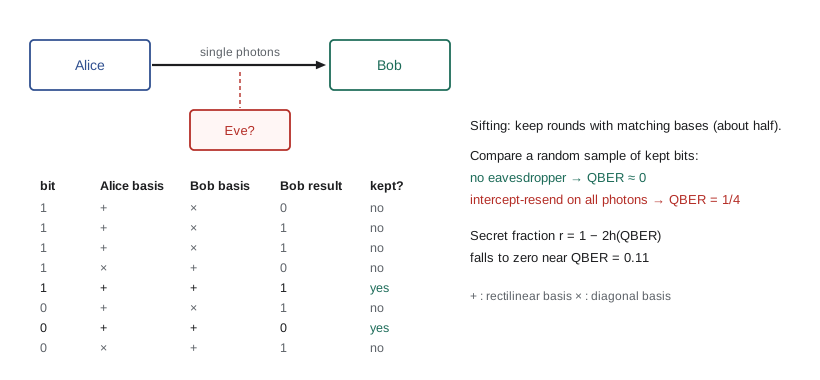
Quantum key distribution lets two parties, Alice and Bob, share a secret random key with security guaranteed by physics rather than by the difficulty of a computation. In the BB84 protocol of Bennett and Brassard (1984), Alice sends single photons, each encoding a random bit in a randomly chosen basis, rectilinear (\(|0\rangle\), \(|1\rangle\)) or diagonal (\(|{+}\rangle\), \(|{-}\rangle\)). Bob measures each in a randomly chosen basis. They then announce their bases, not their bits, over a public channel and keep only the rounds where the bases matched, about half. This sifted key should be identical.
An eavesdropper, Eve, cannot copy the photons (lesson 10), and any measurement she makes in the wrong basis disturbs them. If she intercepts every photon, measures it in a random basis and resends what she found, she introduces errors in a quarter of the sifted bits. Alice and Bob detect her by comparing a random sample of their key: the quantum bit error rate, QBER, reveals the disturbance. Below a critical QBER, the errors are removed by classical error correction and Eve's partial information is erased by privacy amplification, hashing the key into a shorter one. For BB84 with one-way processing, the secret fraction is
which vanishes at \(Q \approx 11\) parts in 100, the threshold of Shor and Preskill's security proof (2000). Practical systems use weak laser pulses with decoy states to prevent attacks on multi-photon pulses, and they have been deployed over fiber networks of thousands of kilometers and via satellite. The Chinese Micius satellite distributed keys and entanglement over more than 1,000 km starting in 2017, and Canada's planned QEYSSat mission is designed to test satellite quantum links from Canadian ground stations. Quantum key distribution is complementary to post-quantum cryptography: one relies on physics, the other on mathematical problems believed hard even for quantum computers.
import math, random

# 1. BB84 quantum key distribution with an intercept-resend eavesdropper
def h2(p): return 0.0 if p <= 0 or p >= 1 else -p * math.log2(p) - (1 - p) * math.log2(1 - p)
def bb84(n, eve_fraction, noise, rnd):
    sifted = errors = 0
    for _ in range(n):
        bit, basis = rnd.randint(0, 1), rnd.randint(0, 1)          # Alice: 0 = rectilinear, 1 = diagonal
        state_bit, state_basis = bit, basis
        if rnd.random() < eve_fraction:                             # Eve measures in a random basis and resends
            eb = rnd.randint(0, 1)
            state_bit = state_bit if eb == state_basis else rnd.randint(0, 1)
            state_basis = eb
        bb = rnd.randint(0, 1)                                      # Bob's basis
        got = state_bit if bb == state_basis else rnd.randint(0, 1)
        if rnd.random() < noise: got ^= 1                           # channel noise
        if bb == basis:                                             # sifting: keep matching bases
            sifted += 1; errors += got != bit
    return sifted, errors
rnd = random.Random(1984)
print("BB84 with 200,000 photons sent")
print("  eavesdropping  noise   sifted   QBER     secret key fraction 1 - 2h(QBER)")
for eve, noise in ((0.0, 0.0), (0.0, 0.03), (0.2, 0.0), (0.5, 0.0), (1.0, 0.0)):
    s, e = bb84(200000, eve, noise, rnd); q = e / s
    r = max(0.0, 1 - 2 * h2(q))
    print(f"     {eve:4.0%}      {noise:4.0%}   {s:6d}   {q:6.3f}        {r:.3f}")
lo, hi = 0.0, 0.5
for _ in range(60):
    mid = (lo + hi) / 2
    lo, hi = (mid, hi) if 1 - 2 * h2(mid) > 0 else (lo, mid)
print(f"  the key fraction reaches zero at QBER = {lo:.4f}")
print()

# 2. Why superconducting qubits need dilution refrigerators: thermal excitation of a 5 GHz transmon
h, kB = 6.62607015e-34, 1.380649e-23
f = 5e9
print("Thermal excited-state population of a 5 GHz qubit")
for T in (4.0, 1.0, 0.1, 0.02):
    x = h * f / (kB * T)
    print(f"  T = {T:5.2f} K   hf/kT = {x:6.2f}   P(excited) = {1 / (math.exp(x) + 1):.2e}")
print()

# 3. Quantum sensing: phase estimation with N probes, unentangled (1/sqrt N) vs entangled (1/N)
print("Phase uncertainty with N probe particles")
print("     N      standard quantum limit 1/sqrt(N)   Heisenberg limit 1/N")
for N in (1, 100, 10 ** 4, 10 ** 6):
print(f" {N:7d} {1 / math.sqrt(N):.1e} {1 / N:.1e}")BB84 with 200,000 photons sent
eavesdropping noise sifted QBER secret key fraction 1 - 2h(QBER)
0% 0% 99714 0.000 1.000
0% 3% 99759 0.031 0.605
20% 0% 100225 0.050 0.429
50% 0% 100654 0.124 0.000
100% 0% 100359 0.252 0.000
the key fraction reaches zero at QBER = 0.1100
Thermal excited-state population of a 5 GHz qubit
T = 4.00 K hf/kT = 0.06 P(excited) = 4.85e-01
T = 1.00 K hf/kT = 0.24 P(excited) = 4.40e-01
T = 0.10 K hf/kT = 2.40 P(excited) = 8.32e-02
T = 0.02 K hf/kT = 12.00 P(excited) = 6.16e-06
Phase uncertainty with N probe particles
N standard quantum limit 1/sqrt(N) Heisenberg limit 1/N
1 1.0e+00 1.0e+00
100 1.0e-01 1.0e-02
10000 1.0e-02 1.0e-04
1000000 1.0e-03 1.0e-06The simulation reproduces the two key facts. Without an eavesdropper the sifted key is perfect, and with 3 parts in 100 of channel noise about 60 of every 100 sifted bits survive as secret key. Intercepting all photons produces a QBER of one quarter and no key; even intercepting half of them pushes the error rate above the 11 parts in 100 threshold, so Alice and Bob abort. The second table explains the dilution refrigerators of superconducting processors: at 4 K a 5 GHz qubit is almost equally likely to be in either state, while at 20 mK the thermal excitation falls to a few parts per million.
Quantum sensing
Quantum systems are exquisitely sensitive to their surroundings, the property that makes decoherence a problem for computing. Sensing turns it into an advantage. A Ramsey experiment (lesson 8) measures a frequency shift \(\delta\) through the phase \(\delta t\) accumulated in a time \(t\) limited by \(T_2\). With \(N\) independent probes, the phase uncertainty falls as \(1/\sqrt N\), the standard quantum limit. Entangled probes, such as spin-squeezed atomic ensembles or GHZ states, can approach the Heisenberg limit \(1/N\), as the last part of the program tabulates. Examples of quantum sensing at work include:
Policy and outlook
Canada published a National Quantum Strategy in January 2023, with investments in research, talent and companies across computing, communication and sensing. In the United States, the National Quantum Initiative Act of 2018 coordinated federal research; bills to reauthorize and expand it passed the relevant Senate and House committees in 2026, but as of mid-2026 neither had passed a full chamber. Programs in Europe, the United Kingdom, China, Japan and Australia are similar in scale. Most experts expect error-corrected machines able to run useful algorithms beyond classical reach within roughly the next decade, while warning against claims that run ahead of the evidence.
The physics of this course underlies all of it. The time-evolution operator and the interaction picture describe gates; the adiabatic theorem describes annealers; the Einstein coefficients and selection rules describe how ions and atoms are controlled with light; scattering lengths describe the cold atoms in tweezers; density matrices and the Lindblad equation describe noise; Bell's theorem certifies entanglement; and the circuit model, no-cloning and error correction describe computation and communication. The theory that seemed complete in 1930 has turned out to have a second life as engineering.
Worked problem
Is a key secure?
A BB84 link measures a QBER of 4 parts in 100. What fraction of the sifted key can be kept as secret key? Would a QBER of 12 parts in 100 allow any key?
Show solution
- \(h(0.04) = -0.04\log_20.04 - 0.96\log_20.96 = 0.186 + 0.057 = 0.242\).
- \(r = 1 - 2 \times 0.242 = 0.515\).
- At \(Q = 0.12\), \(h = 0.529\) and \(r = 1 - 1.06 < 0\).
Answer: About half the sifted key survives at 4 parts in 100; at 12 parts in 100, above the threshold of about 11, no secret key can be extracted with this protocol and Alice and Bob must abort.
Common mistakes
MistakeComparing platforms by qubit count alone.
InsteadFidelity, connectivity and coherence matter as much; a few good qubits can beat many noisy ones.
MistakeThinking QKD protects against all attacks.
InsteadIt protects the key exchange; implementations must also guard against device flaws and need authenticated classical channels.
MistakeBelieving post-quantum cryptography needs quantum hardware.
InsteadIt runs on ordinary computers; only its security assumptions concern quantum attackers.
MistakeExpecting entangled sensors always to beat independent ones.
InsteadEntanglement is often more fragile; decoherence can erase the Heisenberg advantage.
MistakeTreating announced breakthroughs as settled.
InsteadClaims such as topological qubits need independent confirmation.
Summary and key terms
- DiVincenzo's criteria: scalable qubits, initialization, long coherence, universal gates and measurement.
- Superconducting circuits are fast but short-lived; trapped ions are slow but precise; neutral atoms offer large reconfigurable arrays; photons suit communication.
- Willow (2024) showed surface-code error suppression below threshold; Helios (2025) and Nighthawk (2025) mark the current state of ions and superconductors.
- BB84 is secure because measurement disturbs and copying is impossible; the secret fraction \(1 - 2h(Q)\) vanishes at a QBER near 11 parts in 100.
- Quantum sensing approaches the Heisenberg limit \(1/N\) using entanglement and squeezing.
- Transmon
- A superconducting qubit made of a Josephson junction shunted by a capacitor.
- Optical tweezers
- Focused laser beams that trap and move individual neutral atoms.
- QBER
- The quantum bit error rate in the sifted key of a key-distribution protocol.
- Privacy amplification
- Hashing a partially secret key into a shorter, fully secret one.
- Heisenberg limit
- The \(1/N\) scaling of measurement precision possible with \(N\) entangled probes.
Practice problems
Work each problem on paper first, then reveal the answer to check.
A qubit has \(T_2 = 1\) s and gates of 100 \(\mu\)s. How many gates fit in \(T_2\)?
Show answer
About \(10^4\).
In BB84, what fraction of photons survive sifting?
Show answer
About one half.
What QBER does an intercept-resend attack on all photons cause?
Show answer
One quarter.
What is the thermal excited population of a 5 GHz qubit at 50 mK?
Show answer
\(hf/k_BT = 4.8\), so about \(8 \times 10^{-3}\).
With \(10^6\) entangled atoms at the Heisenberg limit, how much better is the phase precision than with independent atoms?
Show answer
A factor \(\sqrt N = 1000\).
Lesson quiz · 5 questions
Score 60% or more to complete this lesson.
Create a free account to save your progress, take quizzes and earn a certificate.