
PHYS-472 · Lesson 4 of 12 · 23 min
Interaction of atoms with light: semiclassical radiation theory, Einstein coefficients and selection rules
▶ Video coming soon A video version of this lesson is on the way.
Almost everything we know about atoms comes from the light they absorb and emit. PHYS-373 computed one transition rate, the spontaneous decay of hydrogen \(2p\), and stated the dipole selection rules. This lesson develops the theory more completely. It treats the atom quantum mechanically and the light as a classical electromagnetic wave, an approach called semiclassical radiation theory. That approach explains absorption and stimulated emission directly. Spontaneous emission, which happens with no light present, needs one extra step, which Einstein supplied in 1916 and 1917 with an argument from thermal equilibrium. The lesson ends with the selection rules derived from the symmetry of the dipole operator, and with the natural line shape that follows from a finite lifetime.
The interaction Hamiltonian
An electron in an electromagnetic field with vector potential \(\mathbf A\) and scalar potential \(\phi\) has the Hamiltonian
for charge \(-e\). For a light wave in the gauge \(\phi = 0\), the field is \(\mathbf A = \mathbf A_0\cos(\mathbf k\cdot\mathbf r - \omega t)\). Expanding the square gives the interaction \((e/m)\mathbf A\cdot\mathbf p\) plus a term in \(A^2\) that is negligible for weak fields. For visible light the wavelength is about 500 nm while an atom is about 0.1 nm across, so \(\mathbf k\cdot\mathbf r \approx 10^{-3}\) over the atom and the field can be treated as uniform. This is the electric dipole approximation. A gauge transformation then brings the interaction to the more intuitive length form
where \(\mathbf d = -e\mathbf r\) is the dipole moment operator of the electron. The two forms give the same transition rates, as the operator identity \(\mathbf p = (im/\hbar)[H_0, \mathbf r]\) shows: between eigenstates of \(H_0\), \(\langle f|\mathbf p|i\rangle = im\omega_{fi}\langle f|\mathbf r|i\rangle\). The next terms in the expansion in \(\mathbf k\cdot\mathbf r\) give magnetic dipole and electric quadrupole transitions, weaker by a factor of order \((ka)^2 \sim 10^{-6}\) to \(10^{-7}\) in rate.
Absorption and stimulated emission
With the harmonic perturbation \(H' = (e\,\mathbf r\cdot\mathbf E_0/2)(e^{i\omega t} + e^{-i\omega t})\), lesson 3 showed that the \(e^{-i\omega t}\) part drives upward transitions \(E_f = E_i + \hbar\omega\) and the \(e^{+i\omega t}\) part drives downward ones. For monochromatic light exactly on resonance, a two-level atom Rabi oscillates. Most light is not monochromatic, however. Sunlight, lamplight and thermal radiation are incoherent mixtures of frequencies and polarizations. Summing transition probabilities over the spectrum with energy density \(u(\omega)\) per unit angular frequency, and averaging over random polarization and direction, which supplies a factor \(1/3\), gives a rate proportional to \(u(\omega_0)\):
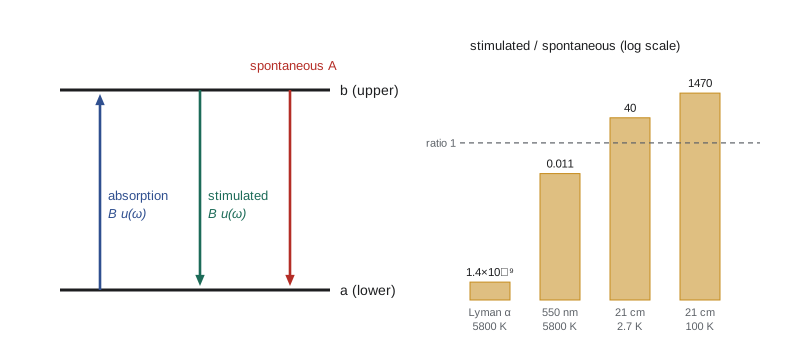
The same calculation for the downward direction gives the same coefficient: stimulated emission occurs at the rate \(B\,u(\omega_0)\) for an atom in the upper state. The equality is a consequence of the Hermiticity of the dipole operator, \(|\langle a|\mathbf d|b\rangle| = |\langle b|\mathbf d|a\rangle|\). For levels with degeneracies \(g_a\) and \(g_b\), it becomes \(g_aB_{ab} = g_bB_{ba}\). A photon of the right frequency is as likely to stimulate an excited atom to emit as it is to be absorbed by an atom in the ground state, and the stimulated photon goes into the same mode, with the same frequency, direction and phase, as the stimulating one. This is the principle of the laser.
Einstein's argument for spontaneous emission
A classical field cannot explain why an excited atom in the dark decays. Einstein's 1917 argument fixes the rate anyway. Put atoms in thermal equilibrium with blackbody radiation at temperature \(T\). Let \(A\) be the unknown rate of spontaneous emission. Detailed balance between upward and downward transitions requires
Solving for \(u\) gives \(u = (A/B)/(e^{\hbar\omega_0/k_BT} - 1)\). Comparing with Planck's law, \(u(\omega) = (\hbar\omega^3/\pi^2c^3)/(e^{\hbar\omega/k_BT} - 1)\), fixes the ratio:
Einstein did not know quantum mechanics, but he saw that equilibrium with Planck radiation demands both stimulated and spontaneous emission. The full explanation came with Dirac's quantization of the electromagnetic field in 1927. In quantum electrodynamics the field has zero-point fluctuations even in its ground state, and spontaneous emission is emission stimulated by them. The ratio of stimulated to spontaneous emission in thermal radiation is the mean photon number per mode, \(\bar n = 1/(e^{\hbar\omega/k_BT} - 1)\). At optical frequencies, even in sunlight, spontaneous emission dominates by a large factor; at radio frequencies the reverse holds.
import math

# constants (SI, CODATA 2018)
hbar = 1.054571817e-34; c = 299792458.0; e = 1.602176634e-19; eps0 = 8.8541878128e-12
a0 = 5.29177210903e-11; kB = 1.380649e-23; Ry = 13.605693122994 * e

# 1. Dipole matrix element <1s| z |2p, m=0> from the radial integral (units of a0)
R10 = lambda r: 2 * math.exp(-r)
R21 = lambda r: r * math.exp(-r / 2) / math.sqrt(24)
N = 200000; h = 60.0 / N
radial = sum(R10((k + 0.5) * h) * R21((k + 0.5) * h) * ((k + 0.5) * h) ** 3 for k in range(N)) * h
angular = 1 / math.sqrt(3)                       # integral of Y00* cos(theta) Y10 over angles
z = radial * angular
print(f"radial integral = {radial:.6f} a0,  <1s|z|2p0> = {z:.6f} a0  (exact 2^7 sqrt2 / 3^5 = {2 ** 7 * math.sqrt(2) / 3 ** 5:.6f})")

# 2. Einstein A coefficient for Lyman alpha
w = (Ry - Ry / 4) / hbar
d2 = (e * z * a0) ** 2
A = w ** 3 * d2 / (3 * math.pi * eps0 * hbar * c ** 3)
print(f"Lyman alpha: lambda = {2 * math.pi * c / w * 1e9:.2f} nm,  A = {A:.3e} per s,  lifetime = {1e9 / A:.3f} ns (accepted value 1.60 ns)")

# reduced-mass correction to the frequency changes A slightly: A scales as w^3 and as (a0 scale)^2
mu = 1 / (1 + 1 / 1836.15267343)
A_mu = A * mu ** 3 / mu ** 2
print(f"with the reduced mass of hydrogen: A = {A_mu:.3e} per s, lifetime = {1e9 / A_mu:.3f} ns")
print()

# 3. Stimulated vs spontaneous emission in thermal radiation: ratio = 1/(exp(hbar w / kT) - 1)
print("Ratio of stimulated to spontaneous emission in blackbody radiation")
for name, lam, T in (("Lyman alpha, 5800 K", 121.6e-9, 5800), ("green light, 5800 K", 550e-9, 5800),
                     ("21 cm line, 2.7 K", 0.211, 2.725), ("21 cm line, 100 K", 0.211, 100)):
    x = 2 * math.pi * hbar * c / (lam * kB * T)
    print(f"  {name:22s} hbar w / kT = {x:10.4g}   ratio = {1 / math.expm1(x):.3g}")
print()

# 4. Selection rules: angular integrals of Y_l'm* cos(theta) Y_lm with m = 0 (Gauss-Legendre-free midpoint rule)
def P(l, x):
    p0, p1 = 1.0, x
    if l == 0: return p0
    for k in range(1, l):
        p0, p1 = p1, ((2 * k + 1) * x * p1 - k * p0) / (k + 1)
    return p1
def ang(lp, l, n=4000):
    s = 0.0
    for k in range(n):
        x = -1 + (k + 0.5) * 2 / n
        s += P(lp, x) * x * P(l, x) * 2 / n
    return s * math.sqrt((2 * lp + 1) * (2 * l + 1)) / 2
print("Angular factor <l',0| cos(theta) |l,0>  (nonzero only for l' = l +/- 1)")
print("        " + "".join(f"  l={l}    " for l in range(4)))
for lp in range(4):
print(f" l'={lp} " + "".join(f"{(ang(lp, l) if abs(ang(lp, l)) > 5e-5 else 0.0):+.4f} " for l in range(4)))radial integral = 1.290266 a0, <1s|z|2p0> = 0.744936 a0 (exact 2^7 sqrt2 / 3^5 = 0.744936)
Lyman alpha: lambda = 121.50 nm, A = 6.268e+08 per s, lifetime = 1.595 ns (accepted value 1.60 ns)
with the reduced mass of hydrogen: A = 6.265e+08 per s, lifetime = 1.596 ns
Ratio of stimulated to spontaneous emission in blackbody radiation
Lyman alpha, 5800 K hbar w / kT = 20.4 ratio = 1.38e-09
green light, 5800 K hbar w / kT = 4.51 ratio = 0.0111
21 cm line, 2.7 K hbar w / kT = 0.02502 ratio = 39.5
21 cm line, 100 K hbar w / kT = 0.0006819 ratio = 1.47e+03
Angular factor <l',0| cos(theta) |l,0> (nonzero only for l' = l +/- 1)
l=0 l=1 l=2 l=3
l'=0 +0.0000 +0.5774 +0.0000 +0.0000
l'=1 +0.5774 +0.0000 +0.5164 +0.0000
l'=2 +0.0000 +0.5164 +0.0000 +0.5071
l'=3 +0.0000 +0.0000 +0.5071 +0.0000The program evaluates the radial integral \(\int R_{10}R_{21}r^3\,dr = 1.2903a\) numerically and multiplies by the angular factor \(1/\sqrt3\) to obtain \(\langle1s|z|2p_0\rangle = 2^7\sqrt2a/3^5 = 0.7449a\). The resulting lifetime of 1.595 ns, or 1.596 ns with the reduced mass, agrees with the accepted 1.60 ns. The comparison of emission processes explains why thermal sources and lasers are so different. In the Sun's atmosphere stimulated emission of Lyman alpha is negligible. For the 21 cm line of hydrogen, at the 2.7 K of the cosmic microwave background, stimulated emission is about forty times stronger than spontaneous emission, and in warmer interstellar gas over a thousand times. Radio astronomers must account for it when they measure the amount of hydrogen in galaxies.
Selection rules from symmetry
The dipole matrix element \(\langle n'\ell'm'|\mathbf r|n\ell m\rangle\) vanishes unless several conditions hold, and the reasons are symmetries. Write the components of \(\mathbf r\) in the spherical basis, \(r_0 = z\) and \(r_{\pm1} = \mp(x \pm iy)/\sqrt2\). These are proportional to \(rY_1^q(\theta, \phi)\), so \(\mathbf r\) is a vector operator, an object that transforms under rotations like an angular momentum \(1\) state. The angular part of the matrix element is an integral of three spherical harmonics,
which vanishes unless \(m' = m + q\) and \(\ell'\) can be formed by adding angular momenta \(\ell\) and \(1\), that is \(|\ell - 1| \le \ell' \le \ell + 1\). The general version of this statement is the Wigner–Eckart theorem: the matrix element of any vector operator factors into a Clebsch–Gordan coefficient, carrying all the dependence on \(m\), \(m'\) and \(q\), times a reduced matrix element independent of them. Parity rules out \(\ell' = \ell\): \(\mathbf r\) is odd under inversion and \(Y_\ell^m\) has parity \((-1)^\ell\), so the states must have opposite parity. The result is the set of electric dipole selection rules:
The last part of the program checks the angular rule numerically for \(m = 0\): only the entries with \(\ell' = \ell \pm 1\) are nonzero. The value of \(q\) is tied to the polarization of the light. Light polarized along the quantization axis drives \(\Delta m = 0\) (\(\pi\)) transitions; circularly polarized light traveling along the axis drives \(\Delta m = +1\) or \(-1\) (\(\sigma^\pm\)). In the Zeeman effect this is why the outer components of a line are circularly polarized when viewed along the field and the central component is missing.
Line shapes and the natural width
A state that decays at rate \(A\) has an amplitude \(\propto e^{-iE_bt/\hbar}e^{-At/2}\). Its Fourier transform is a Lorentzian, so the emitted light has an intensity spectrum
with full width at half maximum \(\Gamma = A\) in angular frequency, or \(\hbar A\) in energy. The relation \(\Gamma\tau = 1\), with \(\tau = 1/A\) the lifetime, is the precise form of the time-energy uncertainty for decaying states. For hydrogen \(2p\), \(\Gamma/2\pi = 100\) MHz on a transition frequency of \(2.5 \times 10^{15}\) Hz. In practice lines are broadened further by the Doppler effect of atomic motion, which gives a Gaussian profile, and by collisions; laser cooling and Doppler-free spectroscopy were developed to get below these limits.
Worked problem
Is a transition allowed?
Which of these hydrogen transitions are electric dipole allowed: \(3d \to 1s\), \(3p \to 2s\), \(4f \to 3d\), \(2s \to 1s\)? For the allowed ones, which values of \(\Delta m\) can occur?
Show solution
- \(3d \to 1s\): \(\Delta\ell = -2\), forbidden.
- \(3p \to 2s\): \(\Delta\ell = -1\), allowed, with \(\Delta m = 0, \pm1\) depending on the initial \(m\) (the final \(m\) must be 0).
- \(4f \to 3d\): \(\Delta\ell = -1\), allowed, with \(\Delta m = 0, \pm1\).
- \(2s \to 1s\): \(\Delta\ell = 0\), forbidden; it decays by two-photon emission in about 0.12 s.
Answer: Only \(3p \to 2s\) and \(4f \to 3d\) are dipole allowed. The \(3d\) state decays instead to \(2p\), and \(2s\) is metastable.
Worked problem
A ruby laser and population inversion
Show that a two-level system in thermal equilibrium cannot amplify light, and explain what a laser must do instead.
Show solution
- The net rate of stimulated emission minus absorption is \(B\,u(N_b - N_a)\), using \(g_a = g_b\).
- In equilibrium \(N_b/N_a = e^{-\hbar\omega/k_BT} < 1\), so the net effect is absorption at any positive temperature.
- Amplification requires \(N_b > N_a\), a population inversion, which no equilibrium state has.
Answer: Lasers use three or four levels and an external pump. In the ruby laser of Theodore Maiman (16 May 1960), flash lamps pump chromium ions to broad upper bands, which decay quickly to a metastable level with a lifetime of a few milliseconds; enough ions accumulate there to invert the population relative to the ground state.
Common mistakes
MistakeExpecting a classical field to cause spontaneous emission.
InsteadSpontaneous emission requires the quantized field; Einstein's argument fixes its rate.
MistakeForgetting the factor \(1/3\) from averaging over polarization.
InsteadFor isotropic unpolarized light only one Cartesian component of \(\mathbf d\) couples on average.
MistakeWriting \(\Delta\ell = 0, \pm1\) for single-electron dipole transitions.
InsteadParity forbids \(\Delta\ell = 0\).
MistakeConfusing the natural width with the Doppler width.
InsteadThe natural width \(\Gamma = A\) is set by the lifetime; Doppler broadening depends on temperature and mass.
MistakeAssuming stimulated emission is always negligible.
InsteadAt radio frequencies, or in lasers, it dominates.
Summary and key terms
- In the dipole approximation \(H' = -\mathbf d\cdot\mathbf E\), valid when the wavelength greatly exceeds the atom.
- Absorption and stimulated emission share the coefficient \(B = \pi|d_{ba}|^2/3\varepsilon_0\hbar^2\).
- Equilibrium with Planck radiation fixes \(A = (\hbar\omega^3/\pi^2c^3)B\); hydrogen \(2p\) lives 1.60 ns.
- The vector character and odd parity of \(\mathbf r\) give \(\Delta\ell = \pm1\), \(\Delta m = 0, \pm1\); the Wigner–Eckart theorem is the general statement.
- A lifetime \(\tau\) gives a Lorentzian line of width \(\Gamma = 1/\tau\).
- Dipole approximation
- Treating the light field as uniform over the atom, so that \(H' = -\mathbf d\cdot\mathbf E\).
- Einstein coefficients
- The rates \(A\) and \(B\) for spontaneous emission and for absorption or stimulated emission.
- Wigner–Eckart theorem
- Matrix elements of tensor operators factor into a Clebsch–Gordan coefficient times a reduced matrix element.
- Population inversion
- More atoms in an upper level than a lower one, required for laser gain.
- Natural linewidth
- The width \(\hbar/\tau\) of a spectral line due to the finite lifetime of the upper state.
Practice problems
Work each problem on paper first, then reveal the answer to check.
By what factor does \(A\) change if the transition frequency doubles at fixed dipole moment?
Show answer
It increases by \(2^3 = 8\).
What is the mean photon number per mode at 550 nm and 5800 K?
Show answer
About 0.011, as the program shows.
Why is \(0 \to 0\) forbidden for \(\Delta j\)?
Show answer
A vector operator cannot connect two states of zero angular momentum: a photon carries one unit.
A level has a lifetime of 10 ns. What is its natural width in MHz (as \(\Gamma/2\pi\))?
Show answer
\(1/(2\pi \times 10\ \text{ns}) \approx 16\ \text{MHz}\).
Which polarization drives \(\Delta m = 0\) transitions?
Show answer
Light linearly polarized along the quantization axis (\(\pi\) light).
Lesson quiz · 5 questions
Score 60% or more to complete this lesson.
Create a free account to save your progress, take quizzes and earn a certificate.