
PMP-101 · Lesson 2 of 12 · 26 min
PMI and the wider certification landscape
The PMP sits inside a larger system: a global professional association with local chapters, a family of standards and guides, and a ladder of certifications for different roles and career stages. It also sits alongside credentials from other bodies, such as PRINCE2 and IPMA certifications, which are popular in some countries and sectors. Understanding this landscape helps you choose the right credential, find support while you study, and make sense of the resources and terminology you will meet. This lesson describes what PMI is and how it is organized, its standards and the PMBOK Guide, its other certifications, how the CAPM compares with the PMP, how PMI credentials compare with other frameworks, and how chapters and communities help candidates in Canada and the United States.
What PMI is
The Project Management Institute is a not-for-profit professional association headquartered in Newtown Square, Pennsylvania, in the United States. It develops standards, publishes research, runs certifications, organizes conferences and supports a worldwide network of volunteer-run chapters. PMI's certifications are administered separately from its membership: you do not have to be a member to earn or hold the PMP, although members pay lower exam and renewal fees and receive access to digital copies of standards, including the PMBOK Guide. PMI also operates an accreditation body for academic programs, the Global Accreditation Center for Project Management Education Programs (GAC), whose accredited degrees reduce the experience required for the PMP (Lesson 3).
Chapters and communities
PMI chapters are local, volunteer-led organizations that hold meetings, workshops, mentoring programs, study groups and networking events, and many offer PMP exam preparation classes or study groups at modest cost. Chapter events also provide professional development units for maintaining the credential (Lesson 12). Online, PMI runs communities and a knowledge site, and candidates share experiences in forums and social media groups; these can be helpful for motivation and tips, but they also spread outdated or inaccurate information about the exam, so verify claims against PMI's own documents.
In the United States, PMI has well over a hundred chapters, from large metropolitan chapters to smaller regional ones, and many states have several. Large chapters often run frequent PMP study groups, mentoring programs and annual conferences, and some partner with universities and employers. PMI has offered the PMP exam in Spanish and other languages as well as English, which can help candidates whose first language is not English. Chapter membership is an add-on to PMI membership, with dues set by each chapter.
PMI standards and the PMBOK Guide
PMI publishes a family of standards: a standard for project management, standards for program and portfolio management, and practice guides on topics such as risk, scheduling, business analysis and agile. The best known is the PMBOK Guide. Its eighth edition, published in November 2025, presents project management through six principles (adopt a holistic view, focus on value, embed quality, lead accountably, integrate sustainability and build empowered teams), seven performance domains (governance, scope, schedule, finance, stakeholders, resources and risk) and focus areas such as artificial intelligence, project management offices and procurement. Earlier editions, especially the sixth (2017), organized the content around process groups and knowledge areas, and many study materials still use that structure because it remains a useful way to learn predictive methods.
For exam preparation, two facts matter. First, the PMP exam is based on PMI's exam content outline, not on any single edition of the PMBOK Guide; PMI states that the outline and the guide are different documents and that the exam tests the application of practice based on experience. Second, the guide remains a valuable reference for terminology and concepts, so most candidates read at least parts of it alongside other resources. PMI's Agile Practice Guide and its process-based reference material are also widely used in preparation.
| Document | What it is | Role in PMP preparation |
|---|---|---|
| PMP exam content outline (2026) | Domains, tasks, enablers and approach mix tested | Defines what the exam covers; read it first |
| PMBOK Guide, 8th edition (2025) | Principles, performance domains and focus areas | Reference for terminology and concepts |
| Earlier PMBOK editions | Process groups and knowledge areas | Useful background on predictive methods |
| Agile Practice Guide | Guide to agile approaches | Background for adaptive and hybrid questions |
| PMP certification handbook | Rules for applying, testing and policies | Read before applying |
PMI's family of certifications
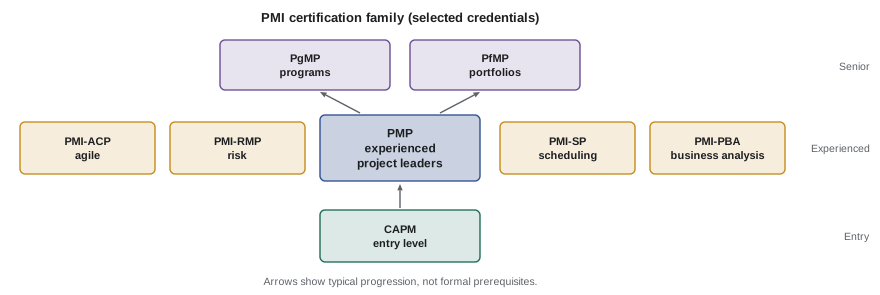
PMI offers certifications for different roles and levels of experience. At the time of writing, the family included:
- Certified Associate in Project Management (CAPM): an entry-level credential requiring secondary education and 23 hours of project management education, with no experience requirement.
- Project Management Professional (PMP): the flagship credential for experienced project leaders.
- PMI Agile Certified Practitioner (PMI-ACP): for practitioners who work with agile approaches.
- Program Management Professional (PgMP) and Portfolio Management Professional (PfMP): advanced credentials for people who manage groups of related projects or whole portfolios.
- Specialist credentials such as PMI Risk Management Professional (PMI-RMP), PMI Scheduling Professional (PMI-SP) and PMI Professional in Business Analysis (PMI-PBA).
- Newer micro-credentials and specialized certifications, for example in PMO practice, which PMI has added and adjusted over time.
Check PMI's website for the current list, because credentials are added, renamed and retired from time to time.
CAPM or PMP?
The CAPM is often a better first step for students, recent graduates, team members and career changers who have not yet led projects. At the time of writing, the CAPM exam consisted of 150 questions (135 scored and 15 unscored) in 180 minutes, covering project management fundamentals, predictive methods, agile frameworks and business analysis frameworks. It requires no experience, only secondary education and 23 hours of project management education. An active CAPM also satisfies the 35-hour education requirement for the PMP, which is useful for people who plan to move up later. The PMP, by contrast, requires significant leadership experience and tests judgment in complex scenarios. Some people skip the CAPM and wait until they qualify for the PMP, especially if they will qualify within a year or two; others value the CAPM as an early signal on their CV and a structured introduction to the field.
Worked problem
Choosing between CAPM and PMP
Lina finished a two-year business diploma eight months ago and now works as a project coordinator, tracking schedules and minutes for a project manager. Theo has a bachelor's degree and has led software release projects for four years. Which credential suits each person now?
Show solution
- Lina: with a diploma (associate-level education) she would need 48 months of leading and directing projects for the PMP; she has eight months of coordination, which may not count as leading and directing.
- Lina therefore suits the CAPM now, which needs only her secondary education and 23 hours of training, and which also covers the PMP education requirement for as long as it is active.
- Theo: with a bachelor's degree he needs 36 months; four years of leading releases likely qualifies.
- Theo should pursue the PMP directly.
Answer: Lina should take the CAPM now and plan for the PMP once she has enough leadership experience; Theo should pursue the PMP directly.
Other project management frameworks and credentials
The PMP is not the only respected project management credential. Others include:
- PRINCE2, a structured project management method maintained by the PeopleCert group, widely used in the United Kingdom, Europe, Australia and parts of the public sector elsewhere, with Foundation and Practitioner certifications. PRINCE2 is a method, prescribing principles, practices and processes, while the PMP certifies a person's broader knowledge and experience across approaches.
- IPMA certifications, offered through national associations of the International Project Management Association, which assess competence at four levels.
- Agile certifications such as those from Scrum.org and Scrum Alliance, and scaled agile certifications, popular in software and digital teams.
- Industry-specific credentials, such as construction management certifications, cost engineering certifications and contractor licenses, which may matter more than a general credential in particular sectors.
Many professionals hold more than one. A common pattern is a PMP for general recognition, plus an agile certification for software work, or PRINCE2 for organizations that use that method. Other programs in this stream cover ITIL, PRINCE2 and CISSP preparation.
| Credential | Body | Experience required | Typical strength |
|---|---|---|---|
| PMP | PMI | Yes, 24–60 months depending on education | Global, cross-industry recognition |
| CAPM | PMI | No | Entry-level knowledge |
| PRINCE2 Foundation and Practitioner | PeopleCert | No formal experience for Foundation | Structured method, strong in UK and public sector |
| IPMA levels A–D | IPMA member associations | Varies by level | Competence-based assessment |
| Scrum certifications | Scrum.org, Scrum Alliance and others | Usually no | Agile team roles |
How employers view the PMP
Employers use the PMP in several ways: as a filter in job postings, a requirement for named personnel in government and large-client bids, a factor in promotion decisions, and a way to establish a common vocabulary across project teams. Some organizations sponsor groups of staff through the PMP and run internal study cohorts. In consulting and contracting, the number of certified staff may appear in proposals. On the other hand, some technology and start-up employers value demonstrated delivery and agile experience more than formal certifications, and some construction and engineering employers value licenses and technical credentials more. Researching the expectations in your target roles, for example by reviewing job postings and asking hiring managers, is a sensible step before committing time and money.
The value of membership
PMI membership is optional but often worthwhile for candidates. Benefits at the time of writing included lower exam and renewal fees, free digital access to standards including the PMBOK Guide, access to templates and research, and discounts on events and some courses. Because the fee discount alone can exceed the cost of a year's membership, many candidates join before paying for the exam. Lesson 8 calculates whether membership pays for itself in a typical case.
Ethics and the PMI code
Every PMP applicant agrees to follow PMI's Code of Ethics and Professional Conduct, which is built around four values: responsibility, respect, fairness and honesty. The code applies to how you apply for the credential (for example, describing your experience truthfully), how you take the exam (no sharing or memorizing questions for others) and how you practice as a certified professional. PMI can investigate complaints and sanction holders who breach the code, up to revoking the credential. The values also appear in exam questions, which often reward answers that are honest, transparent and fair to stakeholders.
How the pieces fit together
It helps to picture PMI's offerings as layers. At the base are the standards and guides, such as The Standard for Project Management and the PMBOK Guide, which describe principles, performance domains and practices in general terms. Above them sit the practice guides, such as the Agile Practice Guide, which go deeper into particular approaches. The certifications sit on top: each is based on its own exam content outline, drawn from a study of what practitioners in that role actually do, and uses the standards and guides as references rather than as a syllabus. Chapters, communities and events form the surrounding network through which members learn, volunteer and earn professional development units.
This layering explains a common source of confusion. Candidates sometimes assume that the PMP exam is a test of the PMBOK Guide, and that memorizing it is the route to passing. In practice the exam tests the tasks in the outline, applied to realistic scenarios, and the PMBOK Guide is one of several references that explain the concepts behind those tasks. A candidate who has read the guide closely but cannot judge what a project leader should do first in an awkward stakeholder situation will struggle, while one who understands the reasoning behind good practice will usually cope even with unfamiliar terminology.
Choosing between credentials
When deciding which credential to pursue first, three questions are useful. First, what does your role require now, and what will it require in two or three years? Second, which credentials do employers and clients in your sector actually ask for, as seen in job postings and tender documents? Third, which credentials can you realistically qualify for and prepare for in the time available? For many practitioners the answers point to the PMP; for those early in their careers, to the CAPM; and for those in organizations that standardize on another method, to that method's certification, perhaps alongside the PMP later.
Common mistakes
MistakeBelieving the exam is based on one edition of the PMBOK Guide.
InsteadUse the exam content outline as the definition of the exam.
MistakeAssuming membership is required for the PMP.
InsteadMembership is optional but reduces fees and adds resources.
MistakeTrusting forum posts about the exam uncritically.
InsteadVerify claims against PMI's documents.
MistakeChoosing a credential without checking employer expectations.
InsteadResearch which credentials your target roles value.
MistakeIgnoring the CAPM when you lack experience.
InsteadConsider the CAPM as a first step that also covers PMP education.
Summary and key terms
- PMI is a not-for-profit association that runs standards, certifications and chapters.
- Chapters offer study groups, mentoring and PDU opportunities in both countries.
- The PMBOK Guide 8th edition (2025) uses principles, performance domains and focus areas.
- The exam content outline, not the PMBOK Guide, defines the exam.
- PMI's family runs from CAPM through PMP, specialist credentials, PgMP and PfMP.
- An active CAPM satisfies the PMP education requirement.
- PRINCE2, IPMA and agile credentials complement or compete with the PMP in some sectors.
- Chapter
- Local volunteer-led PMI organization.
- GAC
- PMI's Global Accreditation Center for academic programs.
- Standard
- A formal PMI document defining practice.
- Performance domain
- A group of related activities in the PMBOK Guide.
- Principle
- A fundamental guideline for project management behavior.
- PMI-ACP
- PMI Agile Certified Practitioner credential.
- PgMP
- Program Management Professional credential.
- PfMP
- Portfolio Management Professional credential.
- PRINCE2
- A structured project management method maintained by PeopleCert.
- Code of Ethics
- PMI's code based on responsibility, respect, fairness and honesty.
Practice problems
Work each problem on paper first, then reveal the answer to check.
Is PMI membership required to hold the PMP?
Show answer
No.
When was the PMBOK Guide 8th edition published?
Show answer
November 2025.
Name two PMBOK 8 principles.
Show answer
Holistic view, focus on value, embed quality, lead accountably, integrate sustainability, empowered teams.
Name three PMBOK 8 performance domains.
Show answer
Governance, scope, schedule, finance, stakeholders, resources, risk.
What defines what the PMP exam tests?
Show answer
The exam content outline.
How many training hours does the CAPM require?
Show answer
23 hours.
What does an active CAPM do for PMP applicants?
Show answer
Satisfies the 35-hour education requirement.
Name two advanced PMI credentials.
Show answer
PgMP and PfMP.
What are the four values of PMI's code?
Show answer
Responsibility, respect, fairness and honesty.
Name one benefit of chapter membership.
Show answer
Study groups, mentoring, networking, PDU events.
Lesson quiz · 5 questions
Score 60% or more to complete this lesson.
Create a free account to save your progress, take quizzes and earn a certificate.