
PMP-101 · Lesson 5 of 12 · 27 min
The 2026 exam content outline
The exam content outline (ECO) is the single most important document for PMP preparation. It defines what the exam tests: the domains, the tasks within each domain, the enablers that illustrate each task, the share of questions devoted to each domain, and the mix of project approaches. Every good study plan starts by reading it. This lesson explains why PMI periodically revises the outline, the structure of the outline launched in July 2026, how the domain weights changed, how approaches are distributed across the exam, what tasks and enablers are, how to read the outline as a study tool, and how the outline relates to the PMBOK Guide and other references. Lessons 6 and 7 look at the tasks in each domain in more detail.
Why the outline changes
PMI bases the PMP exam on a periodic study of what project professionals actually do, sometimes called a job task analysis or global practice analysis. Practitioners from many countries and industries are surveyed about the tasks they perform and how important those tasks are; the results are used to build an outline that reflects current practice. Because project work has changed, with more agile and hybrid delivery, greater attention to value, sustainability and governance, and the arrival of artificial intelligence tools, the outline changes too. The 2021 outline introduced the People, Process and Business Environment domains. The 2026 outline keeps those domains but reflects a profession in which project leaders are expected to engage much more with strategy, governance, compliance, organizational change and the external environment.
The structure of the 2026 outline
At the time of writing, the outline launched on 9 July 2026 contained three domains, each with a set of tasks, and each task illustrated by enablers. PMI's outline listed eight tasks under People, ten under Process and eight under Business Environment. The domains and their approximate share of scored questions were:
| Domain | Share of questions (2021 outline) | Share of questions (2026 outline) | Number of tasks (2026) |
|---|---|---|---|
| People | 42 % | 33 % | 8 |
| Process | 50 % | 41 % | 10 |
| Business Environment | 8 % | 26 % | 8 |
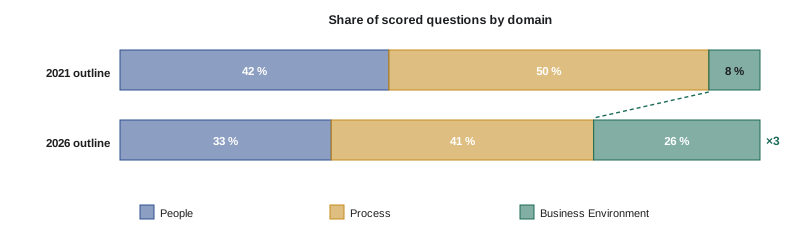
The most striking change is the Business Environment domain, which rose from 8 % to 26 %: roughly one question in four now concerns governance, compliance, change control, issues, risk, continuous improvement, organizational change and the external environment. Candidates who prepared using older materials, which treated the business environment as a minor topic, need to adjust their study plans significantly.
Approaches across the exam
The outline also states how questions are distributed across project approaches. At the time of writing, PMI described approximately 40 % of items as addressing predictive approaches, with the remaining 60 % split between adaptive (agile) and hybrid approaches, and noted that the exact numbers vary between exam forms. Approaches are not a separate domain: they appear throughout all three domains, so you may meet an agile question about stakeholder engagement, a hybrid question about risk, or a predictive question about procurement. Questions often do not name the approach directly; instead, the scenario describes iterations, a product owner, a backlog, a fixed design, a gated life cycle or a regulatory deadline, and you must infer which approach is in use and answer accordingly.
Worked problem
How many questions of each kind?
The 2026 PMP exam has 180 questions, of which 170 are scored. Approximately how many scored questions fall in each domain, and roughly how many address predictive approaches?
Show solution
- People: 0.33 × 170 ≈ 56 questions.
- Process: 0.41 × 170 ≈ 70 questions.
- Business Environment: 0.26 × 170 ≈ 44 questions.
- Check: 56 + 70 + 44 = 170.
- Predictive: about 0.40 × 170 ≈ 68 questions; adaptive and hybrid together about 102.
Answer: About 56 People, 70 Process and 44 Business Environment questions; about 68 predictive and about 102 adaptive or hybrid questions, varying by exam form.
Tasks and enablers
Each domain lists tasks: the high-level responsibilities of a project leader, such as manage conflicts, plan and manage risk, or evaluate project status. Under each task, the outline lists enablers: illustrative examples of the work involved in performing the task, such as interpreting the source of a conflict, analyzing risk exposure or reviewing performance data. Enablers are not an exhaustive list of exam topics, and the exam can test anything reasonably related to a task, but they are a useful guide to what PMI considers part of each task. Many candidates turn the outline into a checklist: for each task and enabler, they note whether they understand the concepts, have practiced related questions and can apply them in predictive, agile and hybrid contexts.
| Term | Meaning | Example |
|---|---|---|
| Domain | A major area of project leadership | Business Environment |
| Task | A core responsibility within a domain | Plan and manage risk |
| Enabler | An illustrative activity showing how the task is done | Assess and prioritize risks |
| Approach | The way work is planned and delivered | Predictive, adaptive or hybrid |
Reading the outline as a study tool
The outline is short compared with the books written about it, which makes it easy to skim and then forget. A more effective method is to use it actively:
- Read it once completely to understand the structure and weights.
- Build a tracking sheet listing every task, with columns for confidence, study resources, practice question scores and notes.
- Allocate study time roughly in proportion to the domain weights, adjusted for your weaknesses; an experienced predictive project manager may need extra time on agile and business environment tasks.
- After each practice exam, map wrong answers to tasks, so that you see where your understanding is weak.
- Return to the outline in the last weeks before the exam to confirm nothing has been missed.
Worked problem
Allocating study time by weight
Ravi plans 90 hours of content study beyond his 35 hours of training. He has strong predictive experience in construction but little agile experience and almost no involvement in governance and compliance. How might he allocate his time?
Show solution
- Start from the weights: People 33 % (about 30 hours), Process 41 % (about 37 hours), Business Environment 26 % (about 23 hours).
- Adjust for strengths: reduce Process by about 7 hours, since predictive planning is familiar, to 30 hours.
- Adjust for weaknesses: add those 7 hours to Business Environment, raising it to 30 hours.
- Within each domain, give agile and hybrid scenarios a larger share, since 60 % of questions involve them.
Answer: About 30 hours each for People, Process and Business Environment, with a deliberate emphasis on agile and hybrid scenarios throughout.
What else the outline tells you
Besides domains and tasks, the outline and PMI's accompanying materials describe the exam format: the number of questions, the time allowed, the breaks and the question types, which Lessons 9 and 10 cover. PMI also explains that the outline is not tied to a single reference, and that questions test the application of practices based on experience. In practice, this means that the exam rewards understanding why a practice is used and when, not memorizing terms. Questions frequently ask what the project manager should do next, what they should do first, or what the best response is, which requires judgment about priorities, ethics and the specific context of the scenario.
Outline and references
Because the outline defines the exam, references are tools for learning the concepts behind it. The PMBOK Guide 8th edition (2025) explains principles, performance domains and focus areas; the Agile Practice Guide explains adaptive approaches; and many independent prep books and courses map these sources to the outline's tasks. When you meet conflicting terminology between sources, prioritize understanding the concept over memorizing a particular phrase, and prefer the outline's wording when describing what the exam tests. Beware of materials written for the 2021 outline: they may be accurate on many concepts but underweight the business environment and lack the new question formats.
Changes to expect over time
PMI typically revises the outline every few years. When an exam changes, PMI announces the date in advance and publishes the new outline months before launch, and training providers update their materials. Candidates whose exams fall near a changeover should check which version applies to their exam date. If you are reading this course long after October 2026, check whether a newer outline has been published, and use this lesson's method with the current document.
A closer look at the weights in practice
Weights describe the share of scored questions, not the difficulty or importance of individual topics. A domain with a lower weight can still be where a candidate loses the most marks if it is unfamiliar. For example, an experienced predictive project manager might score highly on Process questions without much study, yet find Business Environment questions on governance, compliance and organizational change hard because they require a strategic perspective that their roles have not demanded. Conversely, an agile coach might be strong on People and adaptive delivery but weaker on procurement, contracts and formal change control.
A useful exercise early in preparation is a diagnostic test: a short mixed set of questions covering all three domains, taken before serious study begins. Record your result by domain and approach, compare it with the weights, and let the gap guide your plan. Repeat a similar diagnostic a third of the way through and again two thirds of the way through to confirm that the gaps are closing.
Turning the outline into a tracker
A tracker can be as simple as a spreadsheet with one row per task. Useful columns include the domain, the task name, a confidence score from 1 to 5, the resources used, the date last reviewed, the percentage correct on practice questions linked to the task, and notes on common errors. Sorting the sheet by confidence or practice score shows where the next study session should go. Reviewing it weekly keeps the outline in view, and it gives a clear picture of readiness in the final weeks.
Some candidates also add columns for each approach, marking whether they can explain how the task is performed in predictive, adaptive and hybrid settings. For a task such as manage scope, that might mean being able to describe a work breakdown structure and change control board in a predictive project, a product backlog and product owner in an agile one, and a combination in a hybrid project with fixed contract milestones and iterative delivery.
Avoiding over-reliance on memorization
Because the outline is task-based and the questions are situational, lists and mnemonics are of limited value on their own. They can help you remember the elements of a concept, but the exam will rarely ask you to recite a list. Instead it asks which action best fits a situation. Pair any memorized material with practice applying it to scenarios, and ask yourself in each case why a particular action comes before another.
| Week of study | Diagnostic People | Diagnostic Process | Diagnostic Business Environment |
|---|---|---|---|
| Week 0 | 62 % | 71 % | 38 % |
| Week 4 | 66 % | 73 % | 55 % |
| Week 8 | 72 % | 76 % | 68 % |
Reading such a tracker, the candidate can see that the largest gains came in the domain that started weakest, which is exactly what a weight-informed plan should produce. Domains where scores plateau deserve a change of method rather than simply more hours.
Where to find the outline
PMI publishes the exam content outline as a free download on its PMP certification pages, alongside a summary of exam changes and frequently asked questions. Save a copy, note the version and date printed on it, and check PMI's site again shortly before your exam in case of clarifications. Training providers often publish annotated versions, but treat PMI's document as the authority when wording differs.
Common mistakes
MistakeStudying from materials built on the 2021 outline only.
InsteadUse materials aligned with the July 2026 outline.
MistakeTreating the business environment as a minor topic.
InsteadExpect about one question in four from it.
MistakeAssuming approaches are a separate section.
InsteadExpect predictive, agile and hybrid scenarios in all domains.
MistakeTreating enablers as an exhaustive syllabus.
InsteadUse them as illustrations of each task.
MistakeReading the outline once and forgetting it.
InsteadTurn it into a tracking sheet and revisit it.
Summary and key terms
- The exam content outline defines what the PMP exam tests.
- The 2026 outline launched on 9 July 2026 with three domains.
- Weights: People 33 %, Process 41 %, Business Environment 26 %.
- About 40 % of items are predictive and 60 % adaptive or hybrid.
- Tasks are responsibilities; enablers illustrate how they are performed.
- Use the outline as a tracking sheet to guide study time.
- References such as the PMBOK Guide support learning but do not define the exam.
- Exam content outline
- PMI document defining domains, tasks and weights.
- Global practice analysis
- Survey of practitioners used to build the outline.
- Domain
- A major area of the outline.
- Task
- A core responsibility within a domain.
- Enabler
- An illustrative activity for a task.
- Weight
- Share of scored questions for a domain.
- Predictive
- Plan-driven approach with early scope definition.
- Adaptive
- Iterative, incremental approach such as agile.
- Hybrid
- Combination of predictive and adaptive elements.
- Exam form
- One version of the exam with its own question set.
Practice problems
Work each problem on paper first, then reveal the answer to check.
When was the 2026 outline launched?
Show answer
9 July 2026.
Weight of the People domain in 2026?
Show answer
33 %.
Weight of Business Environment in 2021 and 2026?
Show answer
8 % and 26 %.
How many tasks are in the Process domain?
Show answer
10.
Approximate share of predictive items?
Show answer
About 40 %.
About how many scored questions come from Process?
Show answer
About 70.
What is an enabler?
Show answer
An illustrative activity showing how a task is performed.
Are approaches a separate domain?
Show answer
No, they appear across all domains.
With 60 hours of study, about how many go to People by weight?
Show answer
About 20 hours.
What should you prioritize when sources conflict?
Show answer
Understanding the concept and the outline's wording.
Lesson quiz · 5 questions
Score 60% or more to complete this lesson.
Create a free account to save your progress, take quizzes and earn a certificate.