
PMP-110 · Lesson 3 of 12 · 27 min
The project manager's role and the Talent Triangle
Who is the project manager, what are they responsible for, and what makes one effective? PMI answers these questions in several places: in the PMBOK Guide's description of the role, in the PMI Talent Triangle that organizes the skills project professionals need, and in the PMI Code of Ethics and Professional Conduct. This lesson brings them together. It also introduces a theme that runs through the 2026 exam: the project manager as a servant leader and integrator who enables the team, rather than a controller who directs every task.
The role in one sentence
The PMBOK Guide describes the project manager as the person assigned by the performing organization to lead the team that is responsible for achieving the project objectives. Three words in that sentence are worth noticing. Assigned: the role is given by the organization, usually through the charter, which also defines the project manager's authority. Lead: the emphasis is on leadership, not just administration. Team: the project manager achieves objectives through others, so building and enabling the team is central to the job.
A common metaphor compares the project manager to an orchestra conductor. The conductor does not play every instrument, but understands the score, coordinates timing, communicates the interpretation, listens for problems and adjusts. Similarly, a project manager may not be the deepest technical expert, but must understand the work well enough to integrate it, coordinate the people doing it, communicate with stakeholders and spot trouble early.
Spheres of influence
The project manager works in several spheres at once. Within the project, they lead the team, manage communication and integrate the work. Within the organization, they interact with sponsors, functional managers, other project managers, the PMO and governance bodies, competing for resources and aligning with priorities. Within the industry, they stay aware of trends, standards and regulations that affect the project. In the profession, they contribute knowledge, mentor others and keep their own skills current. The exam often tests the organizational sphere: a project manager negotiating with a functional manager for a specialist, or escalating to a sponsor when priorities conflict.
Integration: the core responsibility
If one responsibility defines the role, it is integration. Integration means bringing together processes, knowledge, people and work so the project behaves as a coherent whole. The project manager integrates at several levels: the process level (making plans, risks, schedules and budgets consistent), the cognitive level (applying knowledge and judgment across disciplines), and the context level (fitting the project to its organization, technology and environment). When a schedule change affects cost, risk, resources and stakeholder commitments, it is the project manager who sees the connections and coordinates the response.
In adaptive environments, integration is shared more widely. The team self-organizes around work, the product owner manages the backlog and stakeholders collaborate directly with the team. The project manager, or a role such as a team facilitator, focuses on creating the conditions for this: removing impediments, protecting the team's focus, connecting the team with stakeholders and making sure governance requirements are met without burying the team in bureaucracy.
The PMI Talent Triangle
PMI's Talent Triangle groups the skills that project professionals need into three areas. It shapes PMI's continuing education requirements: PDUs earned for maintaining the PMP are categorized against it, as PMP-101 explained. The current version, introduced in 2022, uses these labels.
| Area | What it covers | Examples |
|---|---|---|
| Ways of Working | Mastering the approaches and techniques for getting work done | Predictive scheduling, agile practices, hybrid design, risk methods, earned value, design thinking |
| Power Skills | Interpersonal skills that let you influence and lead | Communication, collaborative leadership, empathy, problem-solving, strategic thinking, coaching |
| Business Acumen | Understanding how decisions affect the organization and its environment | Strategy alignment, benefits, financial literacy, compliance, market awareness, governance |
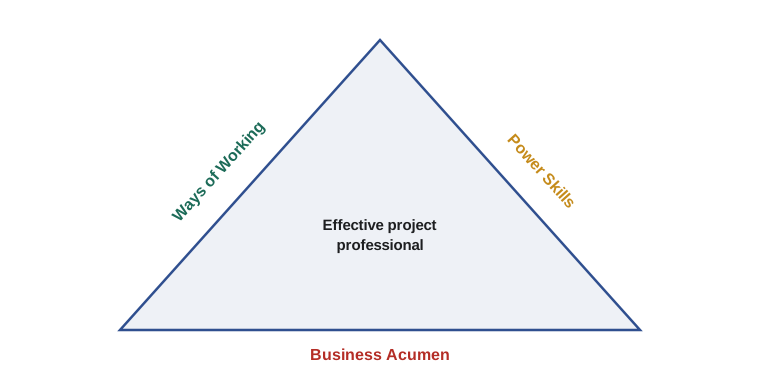
Research by PMI and others has repeatedly found that technical skill alone does not predict project success. Sponsors value project managers who can explain how the project serves strategy and who can build trust with stakeholders. That is why the 2026 exam gives the People domain a third of the weight and the Business Environment domain about a quarter: the exam tests the whole triangle, not just process knowledge.
Worked problem
Planning PDUs across the triangle
A PMP holder needs 60 PDUs in a three-year cycle. They plan 35 education PDUs and 25 giving-back PDUs (the maximum allowed). Their 35 education PDUs are split 15 Ways of Working, 12 Power Skills and 8 Business Acumen. What fraction of their education PDUs is in Business Acumen, and how many more PDUs would they need in that area to make it a quarter of their education PDUs?
Show solution
- Business Acumen fraction: 8 / 35 ≈ 23 %.
- A quarter of 35 is 8.75, so they need about 0.75 more PDUs in Business Acumen, for example by moving one PDU from Ways of Working.
Answer: About 23 %; shifting one PDU would bring Business Acumen above a quarter. PMI's exact minimum per area should be checked in the current CCR handbook.
Leadership and management
Management and leadership overlap but differ. Management focuses on systems: planning, organizing, controlling and coordinating so that work happens efficiently. Leadership focuses on people: setting direction, inspiring, influencing and building trust so that people want to achieve the goal. Project managers need both. A project manager who only manages may have a perfect plan that nobody believes in; one who only leads may have an enthusiastic team that drifts without structure.
| Management emphasis | Leadership emphasis |
|---|---|
| Uses positional power | Uses relational power and influence |
| Maintains and administers | Develops and innovates |
| Focuses on systems and structure | Focuses on relationships and trust |
| Relies on control | Inspires trust |
| Focuses on near-term goals | Focuses on long-range vision |
| Asks how and when | Asks what and why |
Servant leadership is the style PMI most often associates with modern project work, especially adaptive teams. A servant leader puts the team's needs first: removing impediments, shielding the team from distractions, encouraging growth and sharing decision-making. Servant leadership does not mean passivity; a servant leader still sets direction, holds the team to commitments and makes hard calls when needed. PMP-120 covers leadership styles, team development and emotional intelligence in depth.
Authority and power
A project manager's formal authority varies with the organizational structure, as lesson 7 explains. In a functional organization it may be very limited; in a projectized organization it is high. Because authority is often less than responsibility, project managers rely on several forms of power. Positional or formal power comes from the role. Expert power comes from knowledge. Referent power comes from being respected or liked. Reward and coercive power come from the ability to give or withhold benefits. Informational power comes from controlling information. Relational power comes from networks and alliances. The exam generally favors expert, referent and relational power and treats coercive power as a last resort.
Ethics and professional conduct
Every PMP candidate agrees to the PMI Code of Ethics and Professional Conduct. The code is built on four values: responsibility, respect, fairness and honesty. For each value it sets out aspirational standards, which practitioners strive to uphold, and mandatory standards, which are firm requirements that can lead to disciplinary action if breached.
| Value | In practice |
|---|---|
| Responsibility | Take ownership of decisions and their consequences; accept only assignments you are qualified for; report unethical conduct; protect proprietary information. |
| Respect | Listen to others' views; negotiate in good faith; respect cultural norms; do not act abusively. |
| Fairness | Make decisions impartially; disclose conflicts of interest; do not discriminate; give equal access to information. |
| Honesty | Seek and tell the truth; do not deceive; make commitments in good faith; correct mistakes. |
Ethics questions on the exam usually involve a temptation: a vendor offers a gift, a sponsor asks you to hide a delay, a team member falsifies test results, or you are asked to manage work you are not qualified for. The best answer is nearly always to act transparently, follow policy and law, disclose conflicts and address the issue directly with the people involved, escalating if necessary. Ignoring the problem, quietly fixing the data or "doing what the sponsor wants" are traps.
Worked problem
An ethics scenario
A supplier bidding for a contract on your project invites you to a free weekend at a ski resort "to discuss requirements". Company policy limits gifts to $50. What should you do?
Show solution
- Identify the values involved: fairness (impartial procurement) and honesty (transparency).
- The offer far exceeds policy and creates at least the appearance of a conflict of interest.
- Decline the offer, inform your procurement lead or manager as policy requires, and keep communication with all bidders equal.
Answer: Decline, disclose and follow the procurement and gift policies. Accepting, or accepting and "staying neutral", would breach fairness standards.
In the US, ethical obligations also come from law and sector codes: federal ethics rules for employees and contractors, the Federal Acquisition Regulation's procurement integrity provisions, state ethics laws and, for engineers and other licensed professionals working as project managers, their licensing board's rules. The PMI code adds to these obligations; it never overrides the law.
Competence over time
Project management competence develops through education, experience and reflection. Many organizations describe career paths from project coordinator to project manager, senior project manager, program manager and portfolio or PMO leader. The PMP experience requirement reflects the idea that judgment grows with practice: you need to have led projects, not just studied them. As you work through this course, connect each concept to projects you have seen. The exam's scenario questions reward the kind of judgment that comes from asking "what would actually work here?" rather than reciting definitions.
A week in the life
What does the role look like day to day? A typical week for a project manager on a mid-sized hybrid project might include a sponsor check-in on risks and decisions, a steering committee report, negotiation with a functional manager over a specialist's availability, a review of the integrated schedule and budget forecast, attendance at team reviews and retrospectives, a conversation with a vendor about a late deliverable, coaching a new team member, and time spent simply walking around, in person or online, listening for problems before they grow. Very little of this is filling in templates. Most of it is communication, judgment and coordination, which is why PMI estimates that project managers spend the large majority of their time communicating.
This pattern explains why scenario questions so often begin with "the project manager should first..." The best first step is usually to gather information, talk to the people involved or consult the relevant plan or agreement, rather than to act unilaterally or escalate immediately.
Common mistakes
MistakeAssuming the project manager must be the top technical expert.
InsteadThe role is to lead and integrate, drawing on others' expertise.
MistakeTreating servant leadership as passive.
InsteadServant leaders still set direction and hold the team to commitments.
MistakeReaching for coercive power first.
InsteadThe exam favors expert, referent and relational power.
MistakeThinking the PMI code replaces law or company policy.
InsteadIt adds to them.
MistakeIgnoring Business Acumen.
InsteadLinking work to strategy and benefits is part of the role, not someone else's job.
Summary and key terms
- The project manager is assigned by the organization to lead the team that achieves the project objectives.
- They work across the project, organization, industry and profession.
- Integration of processes, knowledge, people and context is the core responsibility.
- The Talent Triangle groups skills into Ways of Working, Power Skills and Business Acumen.
- Effective project managers combine management of systems with leadership of people, often as servant leaders.
- Influence relies more on expert, referent and relational power than on positional or coercive power.
- The PMI code rests on responsibility, respect, fairness and honesty, with aspirational and mandatory standards.
- Project manager
- The person assigned to lead the team responsible for achieving the project objectives.
- Integration
- Combining processes, knowledge, people and work into a coherent whole.
- Talent Triangle
- PMI's grouping of skills into Ways of Working, Power Skills and Business Acumen.
- Servant leadership
- A style that puts the team's needs first and removes obstacles to its success.
- Expert power
- Influence based on knowledge or skill.
- Referent power
- Influence based on respect, admiration or personal connection.
- Relational power
- Influence from networks, connections and alliances.
- Aspirational standard
- An ethical standard practitioners strive to meet.
- Mandatory standard
- An ethical requirement whose breach can lead to discipline.
- Conflict of interest
- A situation where personal interests could influence professional judgment.
Practice problems
Work each problem on paper first, then reveal the answer to check.
Name the three areas of the Talent Triangle.
Show answer
Ways of Working, Power Skills and Business Acumen.
Name the four values of the PMI code.
Show answer
Responsibility, respect, fairness and honesty.
Which document usually defines the project manager's authority?
Show answer
The project charter.
Give an example of expert power.
Show answer
Influence because the team trusts your scheduling or technical knowledge.
What is the difference between aspirational and mandatory standards?
Show answer
Aspirational standards are goals; mandatory standards are firm requirements.
Which Talent Triangle area includes understanding strategy and finance?
Show answer
Business Acumen.
A team member asks you to backdate test records. What value is at stake?
Show answer
Honesty, and responsibility to report misconduct.
What does a servant leader do about impediments?
Show answer
Works to remove them so the team can deliver.
Name the four spheres of influence.
Show answer
Project, organization, industry and profession.
Leadership or management: building trust and setting vision?
Show answer
Leadership.
Lesson quiz · 5 questions
Score 60% or more to complete this lesson.
Create a free account to save your progress, take quizzes and earn a certificate.