
PMP-110 · Lesson 8 of 12 · 30 min
Enterprise environmental factors and organizational process assets
Two phrases appear again and again in PMI material: enterprise environmental factors and organizational process assets. They name the two kinds of influence that every project inherits from its surroundings. Enterprise environmental factors (EEFs) are conditions the project team does not control that influence, constrain or direct the project. Organizational process assets (OPAs) are the plans, processes, policies, procedures and knowledge bases that the organization makes available for the project to use. Recognizing them helps you understand constraints, avoid reinventing what already exists and answer exam questions that ask what a project manager should consult first.
Enterprise environmental factors
EEFs can come from inside or outside the organization. They are not controlled by the project team, though some can be influenced over time. They may help or hinder the project.
| Internal EEFs | External EEFs |
|---|---|
| Organizational culture, structure and governance | Marketplace conditions: competitors, market share, brand recognition |
| Geographic distribution of facilities and resources | Social and cultural influences and issues |
| Infrastructure: facilities, equipment, IT systems and capacity | Legal restrictions: laws, regulations, data protection, labor and safety rules |
| Information technology software, such as scheduling tools | Commercial databases: cost estimating data, industry studies |
| Resource availability: contracts, approved suppliers, staffing | Academic research and industry studies |
| Employee capability: skills, competencies, specialized knowledge | Government or industry standards |
| Security and safety policies | Financial considerations: exchange rates, interest rates, inflation, tariffs |
| Organizational attitudes to risk | Physical environment: weather, climate, working conditions |
EEFs often appear in scenarios as constraints. A union agreement limits overtime. A privacy law restricts where data can be stored. A hiring freeze limits staffing. Severe winter weather shortens the construction season. Exchange rates change the cost of imported equipment. The project manager cannot change these directly, so the right response is to understand them early, plan around them and monitor them for change.
Worked problem
An external EEF affecting cost
A project budgets for equipment priced at €400,000 when the exchange rate is 1.48 in local currency per euro. By the time of purchase the rate is 1.55. What is the cost increase, and what should the project manager do?
Show solution
- Original cost: 400,000 × 1.48 = 592,000.
- New cost: 400,000 × 1.55 = 620,000.
- Increase: 620,000 − 592,000 = 28,000, about 4.7 %.
- Response: check contingency reserves, assess whether the increase stays within approved limits, report through governance and consider hedging or contract terms for remaining purchases.
Answer: About 28,000 more. Exchange rates are an external EEF the project cannot control, so the response is to use reserves, report and manage the remaining exposure.
Organizational process assets
OPAs belong to the organization and are available for the project to use, and sometimes to update. PMI groups them into two categories.
- Processes, policies and procedures: guidelines and criteria for tailoring, templates (such as charter, risk register and status report templates), standards, life cycles and methods, change control procedures, financial controls, quality policies, procurement rules, and issue and defect management procedures. These are usually established by the PMO or other functions and are not normally updated by the project.
- Organizational knowledge repositories: lessons learned, historical information from earlier projects (estimates, actual costs, schedules, risk data), configuration management repositories, financial data, issue and defect records, and project files. These are updated by projects as they proceed.
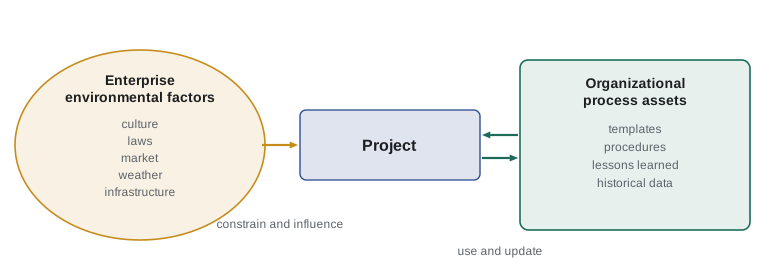
A useful test: if it is something the organization owns and you can pick up and use, such as a template, a policy document or last year's project data, it is an OPA. If it is a condition you have to work within, such as the law, the culture or the market, it is an EEF. Some items sit near the boundary; for example, an organization's overall risk appetite is usually treated as an EEF, while its risk management procedure is an OPA.
Worked problem
Classifying influences
Classify each as an EEF or OPA: (a) a lessons-learned register from a similar project; (b) a provincial or state safety regulation; (c) the company's change request template; (d) a shortage of qualified electricians in the region; (e) the organization's cautious attitude to new technology.
Show solution
- (a) Knowledge repository the project can use: OPA.
- (b) Legal restriction outside the team's control: EEF.
- (c) Organizational template: OPA.
- (d) Marketplace and resource availability condition: EEF.
- (e) Cultural attitude: EEF.
Answer: (a) and (c) are OPAs; (b), (d) and (e) are EEFs.
Using historical information and lessons learned
Historical information is one of the most valuable OPAs, especially for estimating. Analogous estimating uses the actual duration or cost of a similar earlier project. Parametric estimating uses a statistical relationship from historical data, such as cost per workstation or hours per test case. Both depend on good records. A project manager who starts estimating from scratch when similar projects have been done before is ignoring an important asset, and an exam answer that says "review historical information" or "consult lessons learned" is often a strong first step.
Worked problem
Parametric estimate from historical data
Records from five past office fit-outs show an average cost of 18,500 per workstation, adjusted to current prices. The new fit-out has 64 workstations. Estimate the cost and add a 10 % contingency because the new building is older.
Show solution
- Base estimate: 64 × 18,500 = 1,184,000.
- Contingency: 0.10 × 1,184,000 = 118,400.
- Total: 1,184,000 + 118,400 = 1,302,400.
Answer: About 1.3 million including contingency, with the age of the building noted as an assumption to revisit.
Lessons learned are captured throughout a project, not only at the end. Adaptive teams capture them in retrospectives every iteration; predictive teams may hold reviews at phase gates. The lessons learned register is a project document during the project, and at closure its contents are transferred to the organization's repository, where they become an OPA for future projects. The 2026 exam content outline includes a People task to help ensure knowledge transfer and a Business Environment task on continuous improvement, both of which rely on this cycle.
Working within constraints and assumptions
EEFs and OPAs feed directly into a project's assumptions and constraints. A constraint is a limiting factor that affects the execution of the project, such as a fixed budget, a mandated technology or a regulatory deadline. An assumption is a factor considered true, real or certain without proof, such as "the vendor will deliver in eight weeks" or "staff will be released for training". Assumptions and constraints are recorded in an assumption log, starting at initiation, and should be validated over time; an assumption that proves false becomes a risk or an issue.
| Item | Assumption or constraint? | Likely source |
|---|---|---|
| Budget is capped at $2.5 million | Constraint | Sponsor or funding decision |
| All data must stay in the country | Constraint | Legal EEF or security policy (OPA) |
| Key users will be available two days a week | Assumption | Team judgment; should be confirmed |
| Standard procurement takes 60 days | Assumption based on history | Historical information (OPA) |
| Work cannot start before the permit is issued | Constraint | Regulatory EEF |
US projects often face EEFs such as federal and state privacy and data protection laws, Section 508 accessibility requirements for federal technology, state labor and safety rules alongside OSHA, Davis-Bacon prevailing wage rules on many federally funded construction projects, and regional weather and climate. Typical OPAs include agency project management policies, acquisition templates and capital planning guidance.
Updating OPAs
Projects not only use OPAs; they improve them. Updated estimates, new templates, revised procedures suggested by the team, risk data and lessons learned all flow back into the organization. Closing a project properly includes archiving project documents, transferring lessons learned and updating historical data, so that the next project starts with better information. When a scenario asks what the project manager should do at closure, updating organizational process assets is often part of the answer.
EEFs that change during the project
EEFs are not fixed at the start. Interest rates rise, a new regulation is announced, a key supplier is acquired, a labor dispute begins, or a pandemic changes how people work. The 2026 exam content outline includes a Business Environment task to evaluate external business environment changes, which in practice means monitoring the environment, assessing the impact of changes on the project and its business case, and adjusting plans through the proper channels. A project manager might keep a short watch list of external factors relevant to the project, review it at each status cycle and raise significant changes with the sponsor.
Worked problem
Responding to a regulatory change
Midway through building a customer data platform, a new privacy regulation is announced that will require explicit consent for a type of data the platform uses. It takes effect in nine months; the platform is due to launch in six. What should the project manager do?
Show solution
- Assess the impact with the privacy office or legal advisers: which features and data are affected?
- Update the risk register and assumption log; the assumption that current consent is sufficient no longer holds.
- Develop options, such as adding a consent feature before launch or launching without the affected data.
- Bring the analysis and options to the sponsor or change control board for a decision, and update plans accordingly.
Answer: Treat it as an external EEF change: analyze, update risks and assumptions, develop options and take a decision through governance. Ignoring it until the deadline would expose the organization to non-compliance.
OPAs and the PMO
In many organizations, the PMO is the custodian of OPAs: it maintains templates, methods, tailoring guidelines and lessons-learned repositories. Project managers should know what their PMO offers and how to request changes. If a template or procedure does not fit the project, the right response is usually to tailor within the allowed guidelines and suggest improvements, not to ignore it. Over time, suggestions from projects keep the OPAs current and useful.
Good OPAs save real effort. A tested risk checklist from similar projects can surface threats a new team would not think of. A standard contract template protects the organization in ways a project team might miss. A library of estimates speeds up planning and improves accuracy. Part of a project manager's value to the organization is both using these assets well and leaving them better than they were found.
A simple discipline helps: at the start of planning, spend an hour with the team listing the EEFs that could affect the project and the OPAs available to it. The list often reveals constraints nobody had mentioned, such as a blackout period for system changes at year end, and assets nobody had found, such as a ready-made test plan from a sister project.
Revisit the list at each phase gate or release planning session, because both the environment and the organization's assets keep changing.
Finally, note the difference between using an OPA and being bound by it. Templates and checklists are aids that can usually be tailored. Policies and mandatory procedures, such as financial controls or security standards, must be followed unless a formal exception is approved. Knowing which is which, often by asking the PMO, prevents both needless bureaucracy and accidental non-compliance.
Common mistakes
MistakeTreating laws or culture as OPAs.
InsteadThey are EEFs, outside the team's control.
MistakeTreating templates or lessons learned as EEFs.
InsteadThey are OPAs the organization provides.
MistakeStarting estimates from scratch when historical information exists.
InsteadConsult historical information and lessons learned first.
MistakeCapturing lessons learned only at the end.
InsteadCapture them throughout.
MistakeLeaving assumptions unvalidated.
InsteadFalse assumptions become risks or issues.
Summary and key terms
- EEFs are conditions outside the team's control that influence, constrain or direct the project.
- EEFs can be internal, such as culture and infrastructure, or external, such as laws and markets.
- OPAs are the organization's processes, policies, procedures and knowledge repositories.
- Historical information and lessons learned are key OPAs for estimating and planning.
- Lessons learned are captured throughout and transferred to the organization at closure.
- Assumptions and constraints often trace back to EEFs and OPAs and are recorded in an assumption log.
- Projects update OPAs, improving the organization's capability.
- Enterprise environmental factors
- Conditions outside the team's control that influence the project.
- Organizational process assets
- Plans, processes, policies, procedures and knowledge bases available to the project.
- Historical information
- Records from past projects used for planning and estimating.
- Lessons learned register
- A project document recording knowledge gained during the project.
- Lessons learned repository
- The organization's store of lessons from past projects.
- Constraint
- A limiting factor that affects project execution.
- Assumption
- A factor considered true without proof for planning purposes.
- Assumption log
- A record of assumptions and constraints throughout the project.
- Analogous estimating
- Estimating from the actual values of a similar past project.
- Parametric estimating
- Estimating from a statistical relationship in historical data.
Practice problems
Work each problem on paper first, then reveal the answer to check.
Is a new tax regulation an EEF or an OPA?
Show answer
An EEF.
Is the organization's risk register template an EEF or an OPA?
Show answer
An OPA.
Name the two categories of OPAs.
Show answer
Processes, policies and procedures; and organizational knowledge repositories.
50 workstations at 20,000 each: parametric estimate?
Show answer
1,000,000.
When are lessons learned captured?
Show answer
Throughout the project, and transferred at closure.
What happens when an assumption proves false?
Show answer
It becomes a risk or an issue to manage.
Give two external EEFs.
Show answer
Laws, market conditions, exchange rates, weather, industry standards.
€100,000 at 1.40 then 1.50: cost increase?
Show answer
10,000 in local currency.
Which category of OPA do projects normally update?
Show answer
Organizational knowledge repositories.
Is organizational culture an EEF or OPA?
Show answer
An EEF.
Lesson quiz · 5 questions
Score 60% or more to complete this lesson.
Create a free account to save your progress, take quizzes and earn a certificate.