
PMP-131 · Lesson 12 of 12 · 27 min
Capstone: closing projects and phases, with exam strategy
Projects are temporary, so every project ends, whether it delivers everything, delivers part, or is canceled. Closing is where many projects become careless: the team drifts to new work, contracts are left open, lessons are not captured, and the operations team inherits a product without the knowledge to run it. This capstone lesson covers closing a project or phase, closing procurements and transitioning the product, using the end of Project Compass as the example. It then pulls together quality, risk, procurement and integration into a strategy for the exam questions on these topics.
What closing involves
Closing a project or phase finalizes all activities for the project, phase or contract. Its purposes are to confirm that the work is complete and accepted (or to document why it was not), to transfer the product to those who will use and support it, to close contracts and finances, to capture knowledge, to release people and resources, and to archive records. Closing applies at the end of each phase as well as at the end of the project: Project Compass closed its design phase when drawings were approved and its fit-out phase at substantial completion, each with a short closure review.
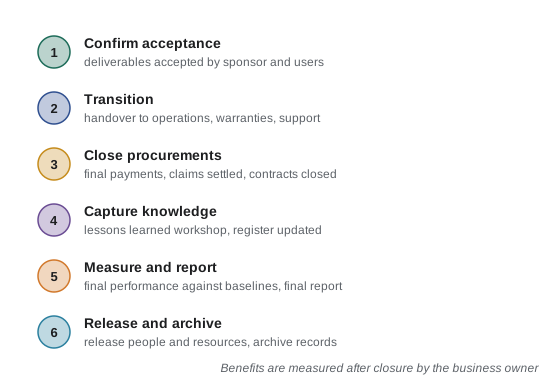
| Step | What it involves | Project Compass |
|---|---|---|
| Confirm acceptance | Obtain formal acceptance of deliverables against acceptance criteria | Sponsor signs acceptance after the soak test, final inspections and app release 2 |
| Transition the product | Hand over to operations with documentation, training, warranties and support arrangements | Branch manager receives operating manuals, warranty list and support contacts |
| Close procurements | Confirm seller deliverables, settle claims, make final payments, close contracts | Holdback released after the lien period; kiosk ceiling price confirmed |
| Capture knowledge | Hold a lessons learned session, update the register and organizational process assets | Workshop with all workstreams; nine new entries in the register |
| Measure and report | Compare final performance with baselines and objectives; issue the final report | Final cost, schedule and quality results reported to the board |
| Release and archive | Release team members and resources; archive project records | Temporary tagging staff released; records filed in the library's records system |
Administrative closure is the term often used for the internal steps: collecting records, analyzing success and failure, gathering lessons, and archiving. Contract closure covers the procurements. Both are needed; a project with a completed final report but open contracts is not closed.
Closing procurements
Closing a procurement confirms that the seller has delivered everything required and the buyer has met its obligations. The buyer verifies that all deliverables have been accepted, resolves open claims, makes final payments, releases holdbacks or retainage when the contract allows, confirms warranty terms, and gives the seller formal written notice that the contract is complete. A procurement audit, a structured review of the procurement process from planning to closure, captures what worked and what did not for future procurements.
Disputes should be settled before closure wherever possible, through negotiation or the contract's dispute resolution steps (lesson 9). Contracts can also end early: by mutual agreement, for the buyer's convenience if the contract allows, or for default if a party fails to perform. Early termination still requires closure, including settlement of the work done to date.
For Project Compass, the fit-out contract could not be closed at substantial completion, because retainage was held until final completion and the contractor's lien waivers were received. The kiosk contract was closed after acceptance, with the final price confirmed under the FPIF terms. The app contract closed after release 2, with source code, documentation and accounts handed over as the contract required. At the time of the final report, the fit-out contract was still open pending final completion items: it is one of the two items still open on the closure checklist below; the other is the final report itself, which went to the board the following week.
The kiosk vendor's actual cost, disclosed for the incentive calculation, came to $318,000, below the point of total assumption of $321,400. Its fee was $30,000 − 30 % × $18,000 = $24,600, so the library paid $342,600, under the $345,000 ceiling. The incentive structure worked as intended: the vendor carried part of the overrun, and the library's exposure stayed below the ceiling.
Final performance and the final report
# Closing Project Compass: final performance against the original and revised baselines ($000)
bac = 2400
approved_changes = 18                 # CR-02, CR-03 and CR-06 from the change log
mgmt_reserve_released = 120           # approved by the sponsor in month 7
board_top_up = 50                     # extra funding approved by the board in month 7
revised = bac + approved_changes + mgmt_reserve_released + board_top_up
final_cost = 2571
print(f"Original BAC {bac:,}  revised cost baseline {revised:,}  final cost {final_cost:,}")
print(f"Against original BAC: {final_cost - bac:+,} ({(final_cost - bac) / bac:+.1%})")
print(f"Against revised baseline: {final_cost - revised:+,}")
planned_days, actual_days = 100, 108
print(f"Fit-out critical path {actual_days} vs {planned_days} working days "
      f"({actual_days - planned_days:+d}; the Monte Carlo P50 was about 108)")
checklist = {
 "Sponsor acceptance of all deliverables signed": True, "All procurement contracts closed": False,
 "Final lessons learned workshop held": True, "Records archived in the library's records system": True,
 "Team members released with performance input": True, "Operations handover and warranty list": True,
 "Benefits measurement plan handed to branch manager": True, "Final report issued to the board": False,
}
print(f"\nClosure checklist: {sum(checklist.values())}/{len(checklist)} complete")
for k, v in checklist.items():
    if not v:
print(" open:", k)Original BAC 2,400 revised cost baseline 2,588 final cost 2,571 Against original BAC: +171 (+7.1%) Against revised baseline: -17 Fit-out critical path 108 vs 100 working days (+8; the Monte Carlo P50 was about 108) Closure checklist: 6/8 complete open: All procurement contracts closed open: Final report issued to the board
The branch opened eight working days later than the baseline plan, close to the P50 of about 108 days from PMP-130's schedule simulation, and within the window the board was told to expect after the permit delay. The final cost of $2.571 million was $171,000 (7.1 %) above the original BAC of $2.4 million, but $17,000 below the revised baseline of $2.588 million that the board approved in month 7 after the month 6 forecast, once the management reserve, the $50,000 top-up and the approved changes were included. Quality results were good: the gate read rate averaged 99.7 %, kiosks completed 98.6 % of checkouts unassisted in the first month, the app had 99.3 % crash-free sessions, and the accessibility review found no nonconformities.
The final report summarizes the project's performance against its objectives: scope delivered, quality results, schedule and cost against original and revised baselines with explanations, risks that occurred and how they were handled, benefits expected and how they will be measured, and recommendations. It should be honest about variances. The Compass report explains that the cost overrun came mainly from construction unit costs above the estimate and slower initial tagging, that the overall cost risk had been flagged at baseline with a low confidence level, and that the board's early decision in month 7 allowed corrective actions to limit the final overrun.
Lessons learned and transition
The final lessons learned workshop brought together the library staff, the architect, the contractor's site lead, the kiosk vendor and the app team. Lessons are recorded in the register and, where they apply beyond this project, used to update the library's templates and procedures. Among the nine new entries: complete the permit submission checklist before applying; include tariff and duty provisions in supply terms rather than accepting pass-through by default; run Monte Carlo cost analysis before setting public budgets; put a two-week soak test into every kiosk contract; and check building service responsibilities in the lease as part of risk identification.
Transition is where the project's output becomes the organization's asset. The branch manager received operating manuals, a list of warranties with expiry dates, support contacts and service levels, training records, the configuration register for kiosk firmware, and an issues list of minor items with owners and dates. Benefits, such as visits, loans and community room bookings, will be measured by the branch manager at 6 and 12 months against the business case; benefits realization belongs to the business owner, and PMP-150 covers it in depth. The project team was released with written input to each member's performance review, a step PMP-120 recommended, and the team celebrated the opening with the branch staff.
Closing in adaptive and terminated projects
Adaptive projects close continuously in small ways: each increment is reviewed and accepted, retrospectives capture lessons as the work proceeds, and the product owner decides when enough value has been delivered to stop. Final closure still involves handover to operations or a product team, closing contracts, final reporting and archiving. For the Compass app, ongoing development passed to the library's digital services team, with the backlog of future features, the source code and the test suite.
A project that is canceled before completion also needs closure. The reasons for termination are documented, work completed is assessed and, where useful, handed over, contracts are terminated according to their terms, people are released and lessons are captured. A well-closed canceled project protects the organization's money and learning; a canceled project that is simply abandoned wastes both.
Exam strategy for quality, risk, procurement and integration
Questions on these topics follow recognizable patterns. Most are situational: a scenario followed by "what should the project manager do next?" or "what is the best action?". A smaller number are calculations. A structured approach helps.
| Topic | What the best answer usually does | Common wrong answers |
|---|---|---|
| Quality | Prevents defects, investigates causes with data, uses the right tool, verifies before acceptance | Inspects everything, blames people, tampers with a stable process |
| Risk | Updates the register, uses the planned response, involves the risk owner, escalates beyond authority, considers opportunities | Ignores triggers, treats issues as risks, uses contingency for unidentified events |
| Procurement | Follows the contract and procurement process, works through the contracting authority, treats bidders equally | Agrees changes verbally, favors one bidder, skips negotiation steps for claims |
| Change | Assesses impact, presents options, submits a change request, follows authority levels, updates baselines after approval | Implements immediately, refuses outright, changes baselines to hide variances |
| Closure | Obtains acceptance, closes contracts, captures lessons, transitions, releases resources | Releases the team before closing, skips lessons learned, leaves contracts open |
| Calculation | Formula | Remember |
|---|---|---|
| Expected monetary value | EMV = probability × impact | Threats negative, opportunities positive |
| Decision tree | Roll back from right to left; subtract branch costs | Choose the best EMV at each decision node |
| Cost of quality | Prevention + appraisal + internal failure + external failure | Conformance vs nonconformance |
| Control charts | Signals: point outside limits, or seven in a row on one side | Limits come from data, not specifications |
| FPIF fee and price | Fee = target fee + seller share × (target cost − actual cost); price capped at ceiling | Share ratio is buyer/seller |
| Point of total assumption | PTA = (ceiling price − target price) / buyer share + target cost | Above PTA the seller bears every extra dollar |
| CPIF fee | Same fee formula, limited by minimum and maximum fee; costs always reimbursed | Total paid = actual cost + fee |
| Make or buy break-even | Quantity = (make fixed cost − buy fixed cost) / (buy unit cost − make unit cost) | Then weigh non-cost factors |
For situational questions, read the last sentence first to see what is asked, then identify the topic and the stage of the project. Ask what has already been done in the scenario: if a risk has occurred and a contingency plan exists, implement it; if not, it is a workaround or an issue. Prefer answers that analyze before acting, follow the agreed processes and plans, involve the right people, and address causes rather than symptoms. Be wary of answers that are passive (wait and see), that bypass governance, or that blame individuals. Finally, notice the approach: in an agile scenario, backlog reprioritization and team decisions often replace formal change requests and inspections.
Worked problem
An integrated scenario
A week before acceptance on another project, testing shows that a supplier's components fail at twice the agreed rate. The supplier's contract is fixed price, the risk of component failure was in the register with a planned response (switch to a second qualified supplier), and switching would delay acceptance by ten days, which exceeds the project manager's authority. What should the project manager do?
Show solution
- Quality: confirm the failure rate with data and identify whether the cause is the components, installation or testing (control quality, root cause analysis).
- Risk: the risk has occurred and has a planned contingency response; it moves to the issue log and the response is prepared.
- Procurement: notify the supplier formally under the contract of the nonconformance and its obligations; involve the contracting officer.
- Change: a ten-day delay exceeds the project manager's authority, so submit a change request with impact analysis and options to the CCB or sponsor.
- Integration: update plans after the decision, communicate to stakeholders and record lessons learned.
Answer: Confirm the problem with data, implement the planned risk response through the issue log, enforce the contract through the contracting officer, and obtain a decision on the schedule impact through change control before updating plans.
Common mistakes
MistakeReleasing the team before closure activities are finished.
InsteadComplete acceptance, procurement closure, lessons learned and archiving first, then release resources.
MistakeTreating the final report as a success story only.
InsteadReport performance honestly against original and revised baselines, with explanations.
MistakeLeaving contracts open after the project ends.
InsteadClose every procurement formally, including final payments and claims.
MistakeAbandoning a canceled project without closure.
InsteadDocument the reasons, close contracts, hand over useful work and capture lessons.
MistakeExpecting the project to measure long-term benefits.
InsteadHand over a benefits measurement plan to the business owner, who measures benefits after closure.
Summary and key terms
- Closing finalizes all activities: acceptance, transition, procurement closure, knowledge capture, final reporting, release and archiving.
- Phases and contracts close as well as projects; canceled projects also need closure.
- Closing procurements: verify deliverables, settle claims, make final payments, release holdbacks, confirm warranties, give written notice.
- The final report compares performance with original and revised baselines honestly.
- Transition hands over documentation, warranties, support and benefits measurement to the business owner.
- For exam questions, analyze first, follow processes, involve the right authority and address causes.
- Administrative closure
- Internal activities to finalize a project or phase, such as records, lessons and archiving.
- Contract closure
- Completing and settling a contract, including final payments and resolution of claims.
- Procurement audit
- A structured review of the procurement process from planning to closure.
- Final report
- A summary of project performance and outcomes at closure.
- Transition
- Handing over the product and the knowledge needed to operate and support it.
- Termination for convenience
- Ending a contract at the buyer's choice, where the contract permits, with settlement for work done.
- Benefits measurement plan
- A plan for measuring the benefits of the project after delivery.
Practice problems
Work each problem on paper first, then reveal the answer to check.
Name four closing activities.
Show answer
Acceptance, transition, procurement closure, lessons learned, final report, release, archiving.
What should happen before the team is released?
Show answer
Closure activities, including lessons learned and archiving.
Does a canceled project need closure?
Show answer
Yes.
Who measures benefits after the project?
Show answer
The business owner, using the benefits measurement plan.
What is a procurement audit?
Show answer
A review of the procurement process to learn for future procurements.
Target cost 300, target fee 30, share 70/30, actual cost 318. Fee and price?
Show answer
Fee 24.6; price 342.6.
Why compare final cost with both original and revised baselines?
Show answer
To show total change since approval and performance after approved changes.
What does the final report include?
Show answer
Scope, quality, schedule and cost results, risks, benefits plan, lessons and recommendations.
In an exam scenario, a risk occurs and a contingency plan exists. What is the usual best answer?
Show answer
Implement the planned response and update the register and issue log.
What must happen before contract closure?
Show answer
Deliverables accepted, claims settled, final payment made.
Lesson quiz · 5 questions
Score 60% or more to complete this lesson.
Create a free account to save your progress, take quizzes and earn a certificate.