
PMP-131 · Lesson 8 of 12 · 26 min
Contract types and incentives
The payment terms of a contract decide who carries the risk of costs running higher than expected, and they shape how the seller behaves. A seller paid a fixed price has every reason to control costs and may resist changes; a seller reimbursed for costs has less reason to control them but will accept changes readily. Choosing the right contract type is therefore a risk response as much as a purchasing decision. This lesson compares fixed-price, cost-reimbursable and time and materials contracts, works through the incentive calculations that appear on the exam, including the point of total assumption, and shows which types Project Compass chose and why.
The three families
Contracts fall into three broad families. In fixed-price contracts, the buyer pays a set price for a defined scope, and the seller bears most of the cost risk. In cost-reimbursable contracts, the buyer pays the seller's allowable costs plus a fee, and the buyer bears most of the cost risk. Time and materials (T&M) contracts sit between them: the buyer pays agreed rates for labor and materials as they are used, often with a ceiling.
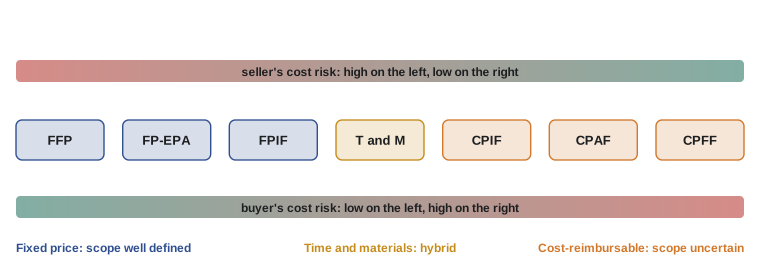
| Type | How the seller is paid | Who carries cost risk | Typical use |
|---|---|---|---|
| Firm fixed price (FFP) | A set price for the defined scope, regardless of actual cost | Seller | Well-defined goods and work: furniture, tags, a fully designed fit-out |
| Fixed price incentive fee (FPIF) | Target cost and fee with a share ratio, capped at a ceiling price | Shared up to the ceiling, then seller | Defined scope with some cost uncertainty, where savings should be rewarded |
| Fixed price with economic price adjustment (FP-EPA) | Fixed price adjusted by an agreed index, such as steel or labor costs | Seller, except for index movements | Multi-year contracts or volatile materials |
| Cost plus fixed fee (CPFF) | Allowable costs plus a fee fixed as an amount at the start | Buyer | Uncertain scope, research, early design |
| Cost plus incentive fee (CPIF) | Allowable costs plus a target fee adjusted by a share ratio, within minimum and maximum fees | Mostly buyer, partly seller | Uncertain scope where cost control should be rewarded |
| Cost plus award fee (CPAF) | Allowable costs plus a base fee and an award fee judged against criteria | Buyer | Work where performance is hard to measure objectively |
| Time and materials (T&M) | Hourly or daily rates and materials at cost or with a markup, often with a not-to-exceed ceiling | Mostly buyer, limited by the ceiling | Staff augmentation, small or urgent work, evolving scope |
Two less common forms also appear in questions. A cost plus percentage of cost (CPPC) contract pays costs plus a fee calculated as a percentage of those costs. It rewards the seller for spending more and is prohibited in US federal contracting and discouraged almost everywhere. A unit price contract pays a set rate per unit of work, such as per item tagged or per length of cable installed, and is common for repetitive work where quantities are uncertain.
Fixed-price contracts
Firm fixed price is the buyer's preferred type when scope is well defined, because the price is known and the seller bears the cost risk. It has costs of its own. Sellers add a risk premium when scope is uncertain, so an FFP contract for poorly defined work can be expensive. Any change to scope leads to a change order that the seller can price, sometimes generously, because the buyer has no alternative supplier mid-contract. And a seller losing money on a fixed price may cut corners, so quality control matters more, not less.
Project Compass's fit-out uses a stipulated sum (fixed price) contract based on the AIA A101 standard form with the A201 general conditions, with unit prices for likely variations such as extra data outlets. The furniture, the tags and the shelving are bought on firm fixed-price purchase orders. The tag order is effectively FFP for the supplier's own costs, but its terms pass tariff surcharges through to the buyer, which is a narrow form of price adjustment: lesson 6 showed the result.
Fixed price with economic price adjustment protects both sides from changes they cannot control over a long contract, using a published index. The library did not use it for Project Compass, whose purchases are short, but its regional purchasing agreement for library supplies, which runs for five years, adjusts prices annually by a consumer price index.
Incentive contracts and the point of total assumption
Incentive contracts reward sellers for controlling costs by sharing savings and overruns. A fixed price incentive fee contract has a target cost, a target fee (profit), a share ratio and a ceiling price. If actual cost is below target, the seller keeps its share of the saving as extra fee; if above, its fee falls by its share of the overrun. The share ratio is written buyer/seller: 70/30 means the buyer takes 70 % of any underrun or overrun and the seller 30 %. The ceiling price is the most the buyer will pay.
The point of total assumption (PTA) is the cost above which the seller bears every additional dollar, because the ceiling price has been reached. It is calculated as:
where the target price is the target cost plus the target fee. Above the PTA, the seller is effectively working under a firm fixed price at the ceiling. The PTA matters to both sides: for the buyer it marks where its cost exposure stops, and a seller approaching it has strong reasons to submit claims or seek changes, so the buyer should watch performance closely as costs near that point.
# Fixed price incentive fee (FPIF) for the kiosk and security gate package ($000, invented)
target_cost, target_fee, ceiling_price = 300, 30, 345
buyer_share = 0.70                          # 70/30 share: buyer 70 %, seller 30 % of overrun or underrun
target_price = target_cost + target_fee
pta = (ceiling_price - target_price) / buyer_share + target_cost
print(f"Target price {target_price}, ceiling price {ceiling_price}, PTA {pta:.1f}")
print(f"{'Actual cost':>11s}{'Price paid':>12s}{'Seller profit':>15s}")
for actual in (270, 300, 321.4, 345, 370):
    fee = target_fee + (1 - buyer_share) * (target_cost - actual)
    price = min(actual + fee, ceiling_price)
print(f"{actual:11.1f}{price:12.1f}{price - actual:15.1f}")Target price 330, ceiling price 345, PTA 321.4
Actual cost Price paid Seller profit
270.0 309.0 39.0
300.0 330.0 30.0
321.4 345.0 23.6
345.0 345.0 0.0
370.0 345.0 -25.0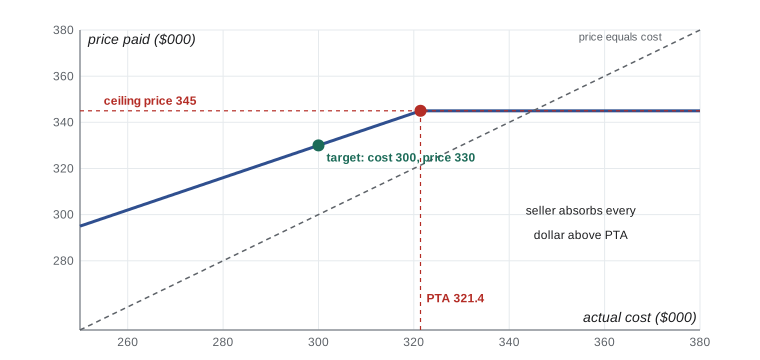
If the kiosk package costs the seller $270,000, $30,000 under target, the seller's fee rises by 30 % of the saving to $39,000 and the library pays $309,000: both benefit. At target cost the library pays the target price of $330,000. At the PTA of $321,400, the formula fee is $23,600 and the price reaches the ceiling of $345,000. Above that, the price stays at $345,000 and the seller's profit shrinks dollar for dollar; at $345,000 of cost it makes nothing, and at $370,000 it loses $25,000.
Cost plus incentive fee contracts apply the same idea to cost-reimbursable work: the buyer pays all allowable costs, and the fee varies with the share ratio between a minimum and a maximum fee.
# Cost plus incentive fee (CPIF) for the mobile app developer ($000, invented)
target_cost, target_fee = 180, 14
buyer_share = 0.80                          # 80/20: seller keeps 20 % of savings, bears 20 % of overrun in fee
min_fee, max_fee = 4, 24
def cpif(actual):
    fee = target_fee + (1 - buyer_share) * (target_cost - actual)
    fee = max(min_fee, min(max_fee, fee))
    return fee, actual + fee
print(f"{'Actual cost':>11s}{'Fee':>7s}{'Total paid':>12s}")
for actual in (130, 160, 180, 200, 250):
    fee, paid = cpif(actual)
    print(f"{actual:11d}{fee:7.1f}{paid:12.1f}")
# Compare: cost plus fixed fee of 14 regardless of cost
print("CPFF at 250 actual cost would pay", 250 + 14)Actual cost Fee Total paid
130 24.0 154.0
160 18.0 178.0
180 14.0 194.0
200 10.0 210.0
250 4.0 254.0
CPFF at 250 actual cost would pay 264At target cost the fee is $14,000. Under target, the seller earns more fee, up to $24,000; over target, it earns less, down to a minimum of $4,000, but its costs are always reimbursed. At $250,000 of cost, the library pays $254,000, compared with $264,000 under a cost plus fixed fee contract with the same $14,000 fee: the incentive saves the buyer a little and gives the seller a reason to keep costs down. The library ultimately chose time and materials with a not-to-exceed ceiling for the app, because its agile approach made a target cost hard to define, but CPIF calculations are common on the exam.
Award fees and time and materials
A cost plus award fee contract pays costs plus a base fee, often small, and an award fee that the buyer grants based on its evaluation of performance against criteria such as quality, timeliness and responsiveness. Award fee decisions are usually made by the buyer alone and are not open to dispute, which gives the buyer leverage over aspects of performance that are hard to measure, at the cost of administrative effort.
Time and materials contracts are simple to set up and flexible, which suits work that cannot be defined well in advance, short engagements and adding skills to a team. The buyer carries the risk that hours run longer than expected, so T&M contracts need a not-to-exceed ceiling, regular reporting of hours against progress and a clear right to stop. The Project Compass app contract pays agreed daily rates for a team of four, capped at $210,000, with a release-by-release review in which the product owner checks that working software is being delivered for the money spent.
Choosing a contract type
The main factor is how well the scope can be defined. Well-defined scope favors fixed price; uncertain scope favors cost-reimbursable or T&M. Other factors include the urgency of the work (T&M can start quickly), the buyer's ability to monitor costs (cost-reimbursable contracts require auditing of the seller's costs), market conditions, the seller's appetite for risk, the size and duration of the contract, and organizational policy. In US federal contracting, policy currently pushes strongly toward fixed price; organizations in both countries commonly require approval for cost-reimbursable contracts above certain values.
| Situation | Likely best type | Reason |
|---|---|---|
| Fully designed fit-out, competitive market | Fixed price (stipulated) | Scope defined; competition gives a fair price |
| Kiosk package with integration uncertainty | FPIF | Mostly defined, but sharing cost risk lowers the risk premium and rewards savings |
| App built iteratively with evolving features | T&M with ceiling | Scope emerges; ceiling and release reviews limit exposure |
| Five-year supply agreement | FP-EPA | Fixed price adjusted for inflation over a long term |
| Investigating unknown building conditions | Cost plus fixed fee or T&M | Work cannot be defined until it is done |
Contract type also affects behavior around change. Under FFP, every change has a price and the seller may look for changes to recover margin. Under cost-reimbursable contracts, the seller is relaxed about changes but the buyer must watch scope creep closely. Under T&M, the buyer must manage the work actively, because the seller is paid for effort, not results. Whatever the type, the contract should define how changes are requested, priced and approved, which connects procurement to integrated change control (lesson 11).
Worked problem
An FPIF calculation
A contract has a target cost of $500,000, a target fee of $50,000, a share ratio of 80/20 (buyer/seller) and a ceiling price of $590,000. Actual cost is $540,000. What is the fee, the price paid and the PTA?
Show solution
- Overrun = 540,000 − 500,000 = $40,000. Seller's share = 20 % × 40,000 = $8,000.
- Fee = 50,000 − 8,000 = $42,000. Price = 540,000 + 42,000 = $582,000, which is below the ceiling of $590,000, so the library pays $582,000.
- Target price = 500,000 + 50,000 = $550,000.
- PTA = (590,000 − 550,000) / 0.80 + 500,000 = 50,000 + 500,000 = $550,000.
Answer: Fee $42,000, price $582,000 and PTA $550,000. Above $550,000 of cost, the seller bears every additional dollar.
Common mistakes
MistakeUsing a firm fixed price contract for poorly defined work to "transfer the risk".
InsteadExpect a large risk premium and frequent change orders; define scope first or choose another type.
MistakeReading a share ratio as seller/buyer.
InsteadShare ratios are written buyer/seller: 70/30 means the buyer takes 70 %.
MistakeForgetting that the price can never exceed the ceiling in an FPIF contract.
InsteadCap the price at the ceiling; above the PTA the seller absorbs all extra cost.
MistakeLeaving a T&M contract without a ceiling or reporting.
InsteadAdd a not-to-exceed amount, progress reporting and a right to stop.
MistakeUsing cost plus percentage of cost.
InsteadAvoid it: it rewards higher spending.
Summary and key terms
- Fixed-price contracts put cost risk on the seller; cost-reimbursable contracts put it on the buyer; T&M sits between.
- FFP suits defined scope; FPIF shares cost risk up to a ceiling; FP-EPA adjusts by an index.
- CPFF, CPIF and CPAF reimburse costs with fixed, incentive or award fees.
- Share ratios are buyer/seller; incentive fee = target fee + seller share × (target cost − actual cost).
- PTA = (ceiling price − target price) / buyer share + target cost.
- Choose by scope definition, urgency, monitoring ability, market and policy; define change procedures in every contract.
- Firm fixed price
- A contract in which the price is set and not subject to adjustment for the seller's costs.
- Fixed price incentive fee
- A fixed-price contract with a target cost, target fee, share ratio and ceiling price.
- Fixed price with economic price adjustment
- A fixed-price contract adjusted for changes in an agreed index.
- Cost plus fixed fee
- A contract reimbursing allowable costs plus a fee fixed at the outset.
- Cost plus incentive fee
- A contract reimbursing costs plus a fee adjusted by performance against a target cost.
- Cost plus award fee
- A contract reimbursing costs plus a fee awarded by the buyer based on performance criteria.
- Time and materials
- A contract paying agreed rates for labor and materials as used.
- Share ratio
- The division of cost underruns or overruns between buyer and seller, written buyer/seller.
- Ceiling price
- The maximum price the buyer will pay under a fixed price incentive contract.
- Point of total assumption
- The cost above which the seller bears all additional costs.
Practice problems
Work each problem on paper first, then reveal the answer to check.
Which contract type places the most cost risk on the seller?
Show answer
Firm fixed price.
Which type places the most cost risk on the buyer?
Show answer
Cost-reimbursable types such as CPFF (and the discouraged CPPC).
Target cost 100, target fee 10, ceiling 120, share 60/40. What is the PTA?
Show answer
(120 − 110) / 0.6 + 100 ≈ 116.7.
Same contract, actual cost 90. Fee and price?
Show answer
Fee = 10 + 0.4 × 10 = 14; price = 104.
What does a 75/25 share ratio mean?
Show answer
The buyer takes 75 % and the seller 25 % of any underrun or overrun.
Which contract type suits a long supply agreement exposed to inflation?
Show answer
Fixed price with economic price adjustment.
What should every T&M contract include?
Show answer
A not-to-exceed ceiling, reporting and a right to stop.
Which contract type uses a buyer's judgment of performance to set part of the fee?
Show answer
Cost plus award fee.
Why is CPPC discouraged?
Show answer
It increases the fee as costs rise, rewarding overspending.
What is the main factor in choosing between fixed price and cost-reimbursable?
Show answer
How well the scope can be defined.
Lesson quiz · 5 questions
Score 60% or more to complete this lesson.
Create a free account to save your progress, take quizzes and earn a certificate.