
PRIN-120 · Lesson 12 of 12 · 31 min
Capstone: applying the people element to a project
This capstone brings the course together in one invented case. You will follow a project from mandate to closure and apply each part of the people element and the project context: mapping the organizations and layers, forming and onboarding the board, setting up supplier relationships, assessing change impact, leading the team, planning communication, setting performance targets including sustainability, handling an exception with people causes, and recording tailoring and lessons. The case, the organizations and all numbers are invented for learning purposes.
The case: Lakeside Community Health Hub
A county health department plans to consolidate three small community clinics into one new Lakeside Community Health Hub. The project includes renovating a leased building, moving 85 staff, introducing a shared appointment booking system and changing how patients book visits. A construction contractor will renovate the building under a fixed-price contract, and a software supplier will configure the booking system under a time-and-materials contract with a cap. The project sits within the department's community care modernization program. The budget is 4.2 million dollars over 14 months. The department has committed to reducing emissions from its facilities and to accessible services under the Americans with Disabilities Act.
Step 1: mapping the context
The first task is to map the organizational and project ecosystems and the management layers. This tells the project manager who holds authority, who will be affected and where relationships need building.
| Layer or group | Who in this case | Notes |
|---|---|---|
| Business layer | Community care modernization program board | Sets project tolerances; owns program benefits; provides communications team |
| Directing | Project board: executive, senior user, two senior suppliers | See step 2 |
| Managing | Project manager from the program office, with project support | Experienced in facilities projects, less in system rollouts |
| Delivering | Contractor's site team; software supplier's configuration team; internal training team | Three teams from three organizations |
| Affected groups | 85 clinic staff, about 12,000 regular patients, a union local, neighbors of the new site | See step 4 |
| Other stakeholders | Building landlord, accessibility advisory group, municipal planning office | Approvals and advice |
Step 2: forming and onboarding the board
The board must represent business, user and supplier interests with people who have authority, credibility, ability to delegate and availability.
Worked problem
Choosing the board
Candidates: the program director (busy, owns program budget); the director of community clinics (manages all 85 staff, respected by them); a clinic nurse manager (respected, but no authority over other clinics); the contractor's operations director; the software supplier's account manager (sales role); the software supplier's delivery director. Propose a board and assurance arrangements.
Show solution
- Executive: the program director holds budget authority, but availability is a concern; agree a fixed monthly board slot and a named deputy for urgent exceptions.
- Senior user: the director of community clinics, who has authority over all affected staff and credibility with them.
- User representation: the nurse manager joins a user group that reports to the senior user, rather than the board.
- Senior suppliers: the contractor's operations director and the software supplier's delivery director, not the account manager, because board members must commit resources and act for the project rather than sell.
- Assurance: a program quality lead for business assurance; a patient experience manager for user assurance; an independent technical advisor for supplier assurance.
Answer: The board has all three interests, each held by someone with authority. Onboarding in the first week of initiation covers decisions, tolerances, reports and the behavior expected when exceptions arise.
Step 3: supplier relationships
The two suppliers have different contracts and therefore different incentives. The contractor, on a fixed price, will resist unpaid changes. The software supplier, on time and materials with a cap, is flexible but may approach the cap. The project manager agrees joint ways of working at a kickoff with both suppliers, including a shared risk register for joint risks, a fortnightly integration meeting and an escalation ladder: team managers within 3 days, delivery managers within 5 more, then the board.
Worked problem
Checking the software cap
The software contract has a cap of 600,000. After 5 of 9 planned months, 390,000 has been spent and the supplier estimates 55 % of the configuration work is complete. Forecast the final cost by assuming the remaining work proceeds at the same cost per unit of progress. Is the cap at risk?
Show solution
- Cost per percentage point of progress: 390,000 ÷ 55 ≈ 7,091.
- Forecast final cost: 7,091 × 100 ≈ 709,100.
- This exceeds the 600,000 cap by about 109,000.
Answer: The cap is at risk. Under a capped contract the supplier may slow down or seek a change as it approaches the limit, so the project manager raises the forecast early with the senior supplier and assesses the issue, rather than waiting for the cap to be reached.
Step 4: change impact and readiness
The change affects clinic staff most, then patients. The project uses a change impact assessment scored 0 to 3 on processes, tools, roles, skills and location.
| Group | Processes | Tools | Roles | Skills | Location | Total |
|---|---|---|---|---|---|---|
| Reception staff (24) | 3 | 3 | 2 | 3 | 3 | 14 |
| Nurses (38) | 2 | 2 | 1 | 2 | 3 | 10 |
| Physicians (11) | 1 | 2 | 0 | 1 | 3 | 7 |
| Clinic managers (3) | 2 | 2 | 3 | 2 | 3 | 12 |
| Patients (about 12,000) | 2 | 1 | 0 | 1 | 2 | 6 |
Reception staff face the greatest change: new booking processes, new tools, new team structures and a new location. Clinic managers lose their separate clinics and become team leads in a single hub, which is a significant role change. The plan therefore prepares clinic managers first, so they can lead their teams, and gives reception staff the most training and practice time. For patients, accessible communication in several formats and a phone line for booking help are planned as products.
Worked problem
Tracking readiness
A readiness survey asks reception staff to rate 'I feel ready to use the new booking system' from 1 to 5. Results at three points: month 8, average 2.1; month 10, average 3.0; month 12, two weeks before go-live, average 3.4. The board's readiness criterion for go-live is an average of at least 3.5 and no more than 20 % of staff scoring 1 or 2. At month 12, 6 of the 24 staff score 1 or 2. Is the criterion met?
Show solution
- Average 3.4 is below the 3.5 threshold.
- Share scoring 1 or 2: 6 ÷ 24 = 25 %, above the 20 % limit.
- Both parts of the criterion are missed, although the trend is improving.
Answer: The readiness criterion is not met. The project manager should report this to the board with options, such as extra practice sessions for the six staff, floor-walkers in the first two weeks or a short delay to go-live. Readiness is treated as a quality criterion with real consequences, not a formality.
Step 5: leading the team
Three teams from three organizations must coordinate closely during the final months. The project manager agrees work packages with each team manager, using three-point estimates for the booking configuration and the contractor's own schedule for the renovation. Ways of working are agreed at a joint session: a weekly integration stand-up, a shared calendar of site access, a rule that safety concerns can be raised by anyone and stop work immediately, and a commitment to raise forecast slips within one working day. A short psychological safety pulse each month helps the project manager spot problems in the joint team.
Step 6: communication and engagement
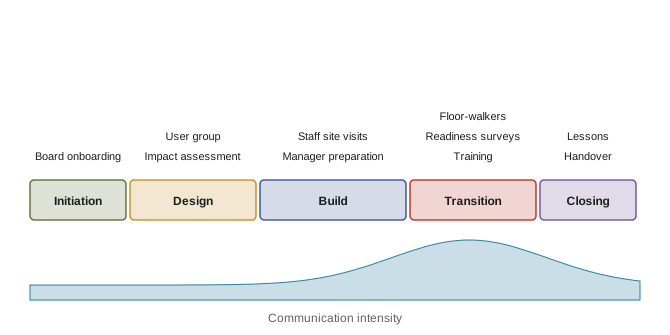
Stakeholder analysis places the program director and director of community clinics in manage closely, the union local and accessibility advisory group in keep satisfied and involved, reception and nursing staff in keep informed and involve, patients in keep informed, and neighbors in monitor with advance notice of disruption. The communication management approach uses the program's communications team for patient and public messages, so that project and program messages are consistent, while the senior user and clinic managers deliver staff messages.
| Group | Message | Channel | Sender | Feedback route |
|---|---|---|---|---|
| Clinic staff | Why the hub, what changes, when, support available | Team meetings, intranet, site visits | Senior user and clinic managers | Q and A sessions, user group |
| Union local | Changes to roles, hours and location | Formal consultation meetings | Senior user with human resources | Consultation responses |
| Patients | New location, booking changes, accessibility | Letters, website, posters, phone line | Program communications team | Phone line, patient survey |
| Accessibility advisory group | Design and service accessibility | Design review sessions | Project manager | Written advice |
| Neighbors | Construction schedule and disruption | Letters, site notice | Project support | Contact number |
Step 7: performance targets
| Target | Project target | Project tolerance |
|---|---|---|
| Cost | 4.2 million | +5 % |
| Time | Hub opens in month 14 | +1 month |
| Quality | Booking system passes acceptance tests; readiness criterion met | No critical defects; readiness as defined |
| Scope | All three clinics moved; online booking live | Online booking for some services may follow within 3 months |
| Benefits | Annual operating saving of 350,000 from year 2 | Not less than 300,000 |
| Risk | Expected loss from open threats | Not above 200,000 |
| Sustainability | Renovation emissions not above 380 tCO2e; operational energy 20 % below the three old clinics combined | +5 % on emissions; energy target no worse than 15 % below |
Step 8: an exception with people causes
Worked problem
Handling the Lakeside exception
In month 11, three things happen. Readiness is behind, as in step 4. The software forecast exceeds its cap, as in step 3. And the union local raises concerns that reception shift patterns were changed without consultation. The project manager forecasts that the stage will exceed its time tolerance by three weeks and its cost tolerance by 90,000. What should the exception report contain, and what options are realistic?
Show solution
- Cause: delayed configuration, low reception readiness and an unresolved consultation issue, which are linked because staff unsure of their shifts are less ready to learn.
- Impact: stage time and cost tolerances forecast to be exceeded; project tolerances not yet threatened, since +1 month and +5 % (210,000) remain available.
- Option A: delay go-live by three weeks, complete consultation, add training; cost 90,000.
- Option B: go live on time with reduced online booking scope and extra floor-walkers; cost 45,000; risk of poor patient experience.
- Option C: delay by six weeks to redesign shifts with the union; cost 140,000; threatens project time tolerance.
- Recommendation: Option A, because it resolves the consultation issue, meets the readiness criterion and stays within project tolerances.
Answer: The board approves Option A with an exception plan for the stage. The senior user leads consultation with the union, the software supplier's delivery director agrees a contract change with a revised cap, and the readiness criterion is retained. Because project tolerances are not threatened, the matter does not need to go to the program board, which is informed in the next highlight report.
Step 9: tailoring record and closure
The project initiation documentation records the main people-related tailoring decisions: a four-person board with two senior suppliers; a user group reporting to the senior user; use of program communications channels for patients and the public; readiness as a go-live quality criterion; joint ways of working and an escalation ladder with both suppliers; and monthly readiness and psychological safety pulses. At closure, the end project report shows performance against all seven targets, and follow-on actions hand responsibility for benefits measurement and continued staff support to the clinic director and program.
| Lesson | Evidence | Recommendation for future projects |
|---|---|---|
| Consultation must precede role changes | Union concern added three weeks | Plan formal consultation as a product before shift designs are finalized |
| Readiness criteria work | Board delayed go-live based on data, not opinion | Use measurable readiness criteria for every system rollout |
| Capped contracts need early forecasting | Cap breach seen two months ahead | Forecast capped contracts monthly against progress |
| Prepare managers first | Clinic managers led teams well at go-live | Schedule manager preparation one stage ahead of staff |
Common mistakes
MistakeChoosing a supplier's sales representative as senior supplier.
InsteadAppoint someone who can commit resources and act for the project.
MistakeTreating readiness as a formality before go-live.
InsteadSet measurable readiness criteria and act on them.
MistakeChanging roles and shifts before consulting staff representatives.
InsteadPlan consultation as a product ahead of design decisions.
MistakeWaiting for a contract cap to be reached.
InsteadForecast against the cap and raise issues early.
MistakeSending project and program messages separately to patients.
InsteadUse program channels for consistent public communication.
Summary and key terms
- Map the layers, ecosystems and affected groups before planning people activities.
- Form a board with authority, credibility, ability to delegate and availability, and onboard it.
- Contract types shape supplier behavior; agree joint ways of working and escalation early.
- Change impact assessment directs effort to the most affected groups and their leaders.
- Readiness can be a measurable quality criterion for go-live.
- Exceptions often have linked people causes, and good options address the causes.
- Record people-related tailoring and capture lessons for future projects.
- Capstone
- A final exercise that applies a whole course to one case.
- Readiness criterion
- A measurable condition that must be met before go-live.
- User group
- A group of user representatives that supports the senior user.
- Floor-walker
- A trained helper who supports staff in person after go-live.
- Consultation
- A formal process of seeking and considering the views of affected people or their representatives.
- Contract cap
- A maximum amount payable under a contract.
- Exception plan
- A plan that replaces the current stage plan after an exception.
- End project report
- The report reviewing how the project performed against its targets.
- Follow-on action
- An action recommended at closure for the business to take forward.
- Lessons report
- A report capturing lessons for the organization and future projects.
Practice problems
Work each problem on paper first, then reveal the answer to check.
Which board role should the director of community clinics hold?
Show answer
Senior user.
Why not appoint the software account manager as senior supplier?
Show answer
A sales role may not commit resources or act for the project.
390,000 spent at 55 % complete. Forecast at completion?
Show answer
About 709,000.
6 of 24 staff score 1 or 2. Percentage?
Show answer
25 %.
Which group should be prepared first: reception staff or clinic managers?
Show answer
Clinic managers, so they can lead their teams.
What is 5 % of 4.2 million?
Show answer
210,000.
Is a stage exception of 90,000 within a project tolerance of 210,000?
Show answer
Yes, so it need not go to the program board.
Who sends patient communications in the case?
Show answer
The program communications team.
Name one people-related tailoring decision in the case.
Show answer
Readiness as a go-live quality criterion.
Give one lesson from the case.
Show answer
Plan consultation before finalizing role changes.
Lesson quiz · 5 questions
Score 60% or more to complete this lesson.
Create a free account to save your progress, take quizzes and earn a certificate.