
PRIN-120 · Lesson 4 of 12 · 28 min
Project roles as people
PRIN-110 covered the principle of defined roles, responsibilities and relationships: why every project needs the business, user and supplier interests represented, which roles may be combined and why accountability must be clear. This lesson looks at the same roles from the other side. Roles are filled by real people, with their own skills, workloads, ambitions and blind spots. A perfectly drawn organization chart achieves nothing if the executive never has time for the project, the senior user lacks credibility with the users, or the project assurance role is held by someone who reports to the project manager. Here we look at how to choose, prepare and support the people who hold PRINCE2 roles.
The project management team in people terms
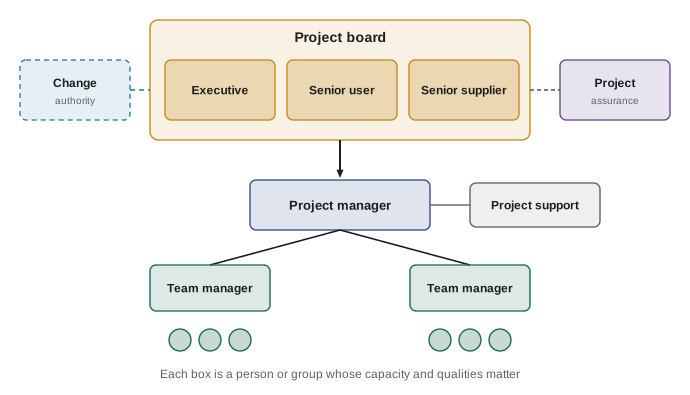
The project management team includes the project board, the project manager, team managers, project assurance, project support and, where used, a change authority. Each role demands not just a set of responsibilities but particular personal qualities. The table below summarizes what to look for when the role is filled.
| Role | Core accountability | Qualities to look for | Common people problems |
|---|---|---|---|
| Executive | Business justification; final decisions | Authority over budget, willingness to decide and to stop, strategic view | Too senior to attend; delegates silently; avoids hard calls |
| Senior user | User needs, acceptance and benefits | Credibility with users, authority to commit user resources, practical knowledge | Speaks for users without consulting them; too junior to commit staff |
| Senior supplier | Quality and feasibility of supplier products | Authority to commit supplier resources, technical judgment | Acts as a salesperson; protects own organization's interests |
| Project manager | Day-to-day management within stage tolerances | Planning, communication, judgment, resilience, integrity | Absorbs problems that should be escalated; micromanages teams |
| Team manager | Delivery of work packages | Technical leadership, estimating, team care | Overcommits; reports only good news |
| Project assurance | Independent monitoring on behalf of the board | Independence, expertise, tact | Reports to the project manager; becomes an auditor rather than an advisor |
| Project support | Administration, configuration and tools | Organization, accuracy, discretion | Treated as a dumping ground for unwanted tasks |
Choosing board members
Experienced practitioners often summarize what a good board member needs in four words: authority, credibility, ability to delegate and availability. Authority means having the power in the permanent organization to make the decisions the role requires, such as committing budget or staff. Credibility means being respected by the people the role represents, so that decisions are accepted. Ability to delegate means being willing to let the project manager manage within tolerances rather than interfering. Availability means having enough time to attend board meetings, review reports and respond to exceptions promptly.
Availability is the quality most often missing. Senior managers are busy, and project board duties compete with operational responsibilities. A board member who misses meetings or takes two weeks to respond to an exception report slows the project and undermines management by exception. When availability is a concern, it is better to raise it openly at the start and agree realistic arrangements, such as fewer but well-prepared meetings or a clearly authorized deputy, than to appoint someone who cannot fulfill the role.
Worked problem
Estimating board member time
A project has five management stages of about three months each. Each stage has one end stage assessment of 2 hours plus 3 hours of preparation, monthly highlight reports taking 30 minutes to read, and an expected one exception per two stages requiring 4 hours of work. Project initiation adds a 4-hour authorization meeting plus 6 hours of review. Closure adds 3 hours. Estimate the executive's total time commitment.
Show solution
- Stage boundaries: 5 × (2 + 3) = 25 hours.
- Highlight reports: 5 stages × 3 months × 0.5 hours = 7.5 hours.
- Exceptions: 5 ÷ 2 = 2.5 expected exceptions × 4 hours = 10 hours.
- Initiation: 4 + 6 = 10 hours. Closure: 3 hours.
- Total: 25 + 7.5 + 10 + 10 + 3 = 55.5 hours over about 15 months, or roughly 3.7 hours a month.
Answer: About 56 hours spread over 15 months seems modest, but it must be available at the right moments. Sharing this estimate with a prospective executive helps them decide honestly whether they can take the role.
Onboarding the board
Many board members have never been trained in PRINCE2 or in project governance generally. They may expect to be kept informed rather than to make decisions, or they may expect to manage the project themselves. A short onboarding session at the start of initiation pays for itself many times over. It should explain what the board is accountable for, how management by exception works, what tolerances mean, what reports they will receive, what decisions they will be asked to make and how quickly. Role descriptions, written in plain language and tailored to the project, give each board member something to refer back to.
| Onboarding topic | Key message for board members |
|---|---|
| Purpose of the board | You direct the project; you do not manage it day to day |
| Management by exception | You will hear from the project manager when a stage tolerance is forecast to be exceeded |
| Tolerances | You set stage tolerances; the business layer sets project tolerances |
| Decisions | Authorize initiation, the project, each stage and closure; respond to exceptions |
| Reports | Highlight reports between boundaries; end stage reports at boundaries; exception reports when needed |
| Assurance | You are each responsible for assurance of your interest, and may appoint others to help |
| Behavior | Welcome bad news; decide promptly; support the project manager publicly |
Users beyond the senior user
The senior user role represents the users, but one person rarely knows everything users need. Good projects involve wider user representatives in specifying requirements, defining quality criteria, reviewing products and testing. PRINCE2 7 emphasizes co-creation: building products with users rather than for them. Co-creation improves the fit of products, reduces late surprises and builds the ownership that makes adoption easier. The senior user should agree who these representatives are, make sure they have time released from their normal work and make sure their views are fed back to the board.
A practical warning: user representatives who are seconded full time to a project for many months can lose touch with day-to-day operations and become, in effect, part of the project team. Rotating representatives, or combining a small core group with a wider network of occasional reviewers, helps keep the user voice authentic.
Project assurance as a people role
Project assurance monitors the project on behalf of the board, checking that it remains viable, that the users' needs are being met and that products are of the required quality. Each board member is responsible for assurance of their own interest, and may appoint others to carry out assurance on their behalf. In people terms, assurance only works if it is independent of the project manager and trusted by both the board and the project team. Assurance providers who behave like auditors, appearing only to criticize, push the team into defensive behavior. Those who behave like critical friends, raising concerns early and helping solve them, strengthen the project.
| Assurance behavior | Effect on the team | Effect on the board |
|---|---|---|
| Critical friend: raises issues early and privately first | Team engages openly and fixes problems | Board gains confidence in reports |
| Auditor: reports findings only to the board | Team becomes defensive and hides problems | Board receives surprises late |
| Absent: no real assurance activity | Team may drift from standards unnoticed | Board relies entirely on the project manager |
| Captured: assurance reports to the project manager | Team sees assurance as part of management | Board loses independent view |
Mapping organizational roles to PRINCE2 roles
Most organizations already have their own role titles: sponsor, steering committee, product owner, delivery lead, business analyst, quality manager. PRINCE2 does not ask organizations to rename everyone. It asks them to make sure the PRINCE2 responsibilities are held by someone. A simple mapping table clarifies who holds which PRINCE2 role and avoids gaps and overlaps.
Worked problem
Mapping roles in a hybrid agile project
An organization runs a digital project with a sponsor, a steering group of three directors, a product owner from the user department, a delivery manager from the IT department, two scrum teams each with a scrum master, and a quality lead from the corporate PMO. Map these to PRINCE2 roles.
Show solution
- Executive: the sponsor, if they own the business case and the final decision. Confirm their budget authority.
- Senior user: the director responsible for the user department, possibly supported by the product owner as a user representative.
- Senior supplier: the IT director on the steering group.
- Project manager: the delivery manager, managing across both teams within stage tolerances.
- Team managers: the scrum masters or a team lead in each scrum team, depending on who plans and reports work packages.
- Project assurance: the quality lead from the PMO for business and supplier assurance; a separate user representative for user assurance.
Answer: Every PRINCE2 role is covered without renaming anyone. The mapping also reveals questions to resolve: does the sponsor actually hold budget authority, and is user assurance independent of the product owner?
Note the care needed with the product owner. In agile terms the product owner prioritizes the backlog and accepts work. In PRINCE2 terms that looks partly like the senior user and partly like a team-level role. The right mapping depends on authority: if the product owner can commit user resources and accept products on behalf of users, they may act as senior user; if not, they are better treated as a user representative reporting to the senior user.
Role clarity and role conflict
Two people problems recur on projects. Role ambiguity arises when people do not know what is expected of them. Role conflict arises when people face incompatible expectations, for example a team member whose line manager wants them on operational work while the team manager wants them on the project. Both cause stress and reduce performance. Clear role descriptions, agreed with each person and with their line manager, reduce ambiguity. Explicit agreements about time allocation, recorded in the plan and supported by the senior user or senior supplier, reduce conflict.
Worked problem
Measuring role clarity
At the end of initiation a project manager asks eight board and team members to rate the statement 'I understand what is expected of me on this project' from 1 to 5. Responses: 5, 4, 4, 2, 5, 3, 2, 4. What is the average, and what should the project manager do?
Show solution
- Sum: 5 + 4 + 4 + 2 + 5 + 3 + 2 + 4 = 29.
- Average: 29 ÷ 8 = 3.6.
- Two people scored 2 and one scored 3; three of eight are unsure of their role.
Answer: An average of 3.6 hides real uncertainty for three people. The project manager should meet those individuals, review their role descriptions with them and, if needed, involve their line managers to agree time commitments.
Common mistakes
MistakeAppointing board members for status rather than authority and availability.
InsteadCheck authority, credibility, ability to delegate and availability.
MistakeAssuming board members already know how to direct a project.
InsteadOnboard the board with tailored role descriptions and a short briefing.
MistakeRelying on the senior user alone to represent all users.
InsteadInvolve wider user representatives and co-create products with users.
MistakeLetting project assurance report to the project manager.
InsteadKeep assurance independent and accountable to the board.
MistakeRenaming organizational roles without checking responsibilities.
InsteadMap existing roles to PRINCE2 responsibilities and close gaps.
Summary and key terms
- PRINCE2 roles are held by people whose qualities and capacity matter.
- Good board members have authority, credibility, ability to delegate and availability.
- Estimating board time helps prospective members commit honestly.
- Onboarding the board explains decisions, tolerances, reports and behavior.
- Co-creation with user representatives improves fit and adoption.
- Assurance works best as an independent critical friend.
- Mapping organizational titles to PRINCE2 roles closes gaps without renaming people.
- Project management team
- The board, project manager, team managers, assurance, support and any change authority.
- Role description
- A tailored statement of a role's responsibilities, authority and expected behavior.
- Co-creation
- Developing products jointly with the people who will use them.
- User representative
- A person who contributes user knowledge without holding the senior user role.
- Project assurance
- Independent monitoring of the project on behalf of the board.
- Critical friend
- An advisor who challenges constructively and helps solve problems.
- Change authority
- A person or group given delegated authority to approve requests for change.
- Role ambiguity
- Uncertainty about what is expected of a person in a role.
- Role conflict
- Incompatible expectations placed on a person by different parties.
- Product owner
- An agile role that prioritizes the backlog and accepts work on behalf of users.
Practice problems
Work each problem on paper first, then reveal the answer to check.
Name the four qualities often used to describe a good board member.
Show answer
Authority, credibility, ability to delegate and availability.
Which quality is most often missing in senior board members?
Show answer
Availability.
Four stages with 5 hours per boundary and 6 monthly reports of 0.5 hours. Total?
Show answer
20 + 3 = 23 hours.
Who is responsible for assurance of the user interest?
Show answer
The senior user, who may appoint others to help.
Why should assurance not report to the project manager?
Show answer
It would lose its independence from the person it monitors.
What does co-creation mean?
Show answer
Developing products jointly with users.
Ratings 4, 4, 3, 5, 2. Average role clarity?
Show answer
18 ÷ 5 = 3.6.
When might a product owner act as senior user?
Show answer
When they have authority to commit user resources and accept products for users.
What is role conflict?
Show answer
Incompatible expectations from different parties, such as line and project managers.
Give one onboarding message for board members.
Show answer
You direct the project; you do not manage it day to day.
Lesson quiz · 5 questions
Score 60% or more to complete this lesson.
Create a free account to save your progress, take quizzes and earn a certificate.