
ROB-100 · Lesson 6 of 12 · 29 min
How robots move: wheels, legs, arms and wings
Robots move in astonishingly varied ways. Industrial arms swing tools along precise paths; warehouse robots glide on wheels; tracked robots climb rubble; four-legged robots trot over rough ground; humanoids walk; drones hover; underwater robots swim and space robots float. Each form of motion, called locomotion for robots that move themselves about and manipulation for robots that move objects, suits some environments and tasks and fails in others. This lesson surveys the main ways robots move and explains the basic physics behind each: how wheels steer, why legs are hard, how arms are arranged, how drones fly, and how motors, gears and power limit what any robot can do. Worked examples show how to calculate wheel speeds for a turn, the effect of a gear ratio and the thrust a drone needs.
Wheeled robots
Wheels are efficient, simple and fast on smooth, flat ground, which is why most mobile robots use them. The most common arrangement is the differential drive: two independently driven wheels on a common axle, with one or more free-rolling casters for balance. Driving both wheels at the same speed moves the robot straight; driving them at different speeds makes it turn; driving them in opposite directions spins it on the spot. Robot vacuums, many warehouse robots and countless educational robots use differential drive. Its weakness is that it cannot move directly sideways: like a person walking, it must turn to face a new direction first. Such robots are called nonholonomic, meaning they cannot move instantly in every direction their position allows.
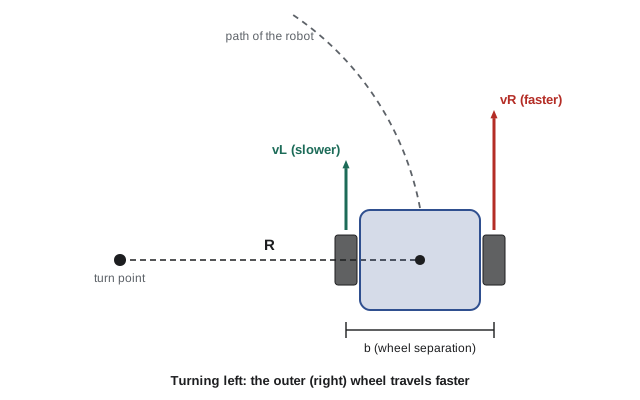
For a differential-drive robot moving forward at speed \( v \) while turning at angular velocity \( \omega \), the wheel speeds follow directly from the geometry. If the wheels are a distance \( b \) apart, the right and left wheels must travel at:
where \( R \) is the radius of the turn, measured to the robot's center. These equations are the inverse of the odometry equations in lesson 5: odometry turns measured wheel motion into robot motion, and these equations turn desired robot motion into wheel commands.
Worked problem
Wheel speeds for a turn
A differential-drive robot with wheels 0.5 m apart must drive around a curve of radius 2.0 m at 1.0 m/s, turning left. Find the wheel speeds, and the motor speed in revolutions per minute for 0.2 m diameter wheels.
Show solution
- Angular velocity: \( \omega = v / R = 1.0 / 2.0 = 0.5 \) rad/s.
- Right (outer) wheel: \( v_R = 1.0 + 0.5 \times 0.5 / 2 = 1.125 \) m/s. Left (inner) wheel: \( v_L = 1.0 - 0.125 = 0.875 \) m/s.
- Wheel circumference: \( \pi \times 0.2 \approx 0.628 \) m.
- Right wheel: \( 1.125 / 0.628 \approx 1.79 \) rev/s, about 107 rpm; left wheel about 1.39 rev/s, or 84 rpm.
Answer: Right wheel 1.125 m/s (about 107 rpm), left wheel 0.875 m/s (about 84 rpm).
Other wheel arrangements make different trade-offs. Car-like, or Ackermann, steering turns the front wheels, which is stable at speed and used by autonomous cars, but needs space to maneuver. Omnidirectional robots use mecanum wheels, with angled rollers around the rim, or omni wheels, so they can move sideways and diagonally as well as forwards, which is handy in tight factory aisles, though the rollers lose efficiency and grip on rough floors. Tracked robots spread their weight over continuous belts, giving traction on soft ground, mud, snow and rubble, which suits military, mining and bomb-disposal robots, at the cost of energy and wear because they skid when they turn.
Legged robots
Legs let robots step over obstacles, climb stairs and walk on uneven, broken ground where wheels fail. Animals show how capable legs can be. But legged locomotion is hard. A legged robot must decide where to place each foot, coordinate many joints at once, and keep its balance continuously. Engineers distinguish static stability, in which the robot's center of mass always stays over the area enclosed by its feet on the ground, called the support polygon, so it would not fall if it froze, from dynamic stability, in which the robot is balanced only because it keeps moving, as people are when walking and running. Six-legged robots can walk with static stability by always keeping three feet down in a tripod. Four-legged robots can walk slowly with static stability but trot and run dynamically. Two-legged humanoids are nearly always dynamically balanced, using their IMUs and fast control loops to adjust every step.
Commercial quadruped robots now inspect industrial plants, construction sites, mines and power stations, carrying cameras, thermal sensors and gas detectors on routes that would be tedious or hazardous for people. Humanoid robots are being piloted in warehouses and factories by several companies on the bet that a human-shaped robot can work in spaces designed for people without rebuilding them; in 2024 Agility Robotics' Digit began a commercial deployment with the logistics company GXO, moving totes, often described as the first formal commercial humanoid deployment. Humanoids remain expensive, slower than people at most tasks and limited in battery life and reliability, so it is not yet clear how widely they will be used.
Robot arms
Robot arms, or manipulators, move objects and tools rather than themselves. The arrangement of their joints defines their type and their workspace:
- Articulated arms, with six or seven revolute joints, resemble a human arm and are the most common industrial robots, used for welding, painting, machine tending and handling.
- SCARA arms (selective compliance assembly robot arm) have two horizontal revolute joints and a vertical prismatic axis, making them fast and precise for pick-and-place and assembly on a flat surface.
- Cartesian or gantry robots move along three perpendicular linear axes, giving a box-shaped workspace; 3-D printers, CNC machines and large palletizing systems use this design.
- Delta or parallel robots hang three lightweight arms from a frame above, joined at a small platform; they are extremely fast for picking light items such as food packages from a conveyor.
- Collaborative arms are lightweight articulated arms with features such as force sensing, rounded shapes and speed limits, designed for collaborative applications in which they share space with people after a risk assessment.
Arms are rated by their payload, the mass they can carry at the wrist; their reach; their speed; and their repeatability, how closely they return to the same point, often a few hundredths of a millimeter for industrial arms. Payload ratings depend on where the load's center of mass is: a load held far from the wrist creates a larger twisting moment and reduces the allowable mass.
Motors, gears, torque and speed
Whatever the form of a robot, its motion is limited by its actuators. Torque is the turning effect of a force, measured in newton-meters; it equals force times the perpendicular distance from the axis. A motor produces torque, and a gearbox multiplies it: an ideal gearbox with ratio \( n \) multiplies torque by \( n \) and divides speed by \( n \), so mechanical power, torque times angular speed, is unchanged except for friction losses, expressed as an efficiency. Engineers choose the gear ratio to match the motor's best operating speed to the load: enough torque to accelerate, climb and lift, without making the robot too slow.
Here \( n \) is the gear ratio, \( \eta \) the gearbox efficiency, \( \tau \) torque, \( \omega \) angular speed, and \( F \) the force at the rim of a wheel or pulley of radius \( r \).
Worked problem
Choosing a gear ratio
A motor produces 0.5 N·m of torque at 3,000 rpm. It drives a wheel of radius 0.1 m through a 20:1 gearbox with 85 % efficiency. Find the wheel torque, the wheel speed, the robot's top speed and the pushing force at the wheel.
Show solution
- Wheel torque: \( 20 \times 0.85 \times 0.5 = 8.5 \) N·m.
- Wheel speed: \( 3{,}000 / 20 = 150 \) rpm \( = 2.5 \) rev/s.
- Top speed: \( 2.5 \times 2\pi \times 0.1 \approx 1.57 \) m/s.
- Pushing force: \( 8.5 / 0.1 = 85 \) N.
- A 40:1 gearbox would double the force to 170 N but halve the top speed to about 0.79 m/s.
Answer: About 8.5 N·m and 150 rpm at the wheel, a top speed of about 1.57 m/s and 85 N of pushing force.
Flying robots
Drones, or uncrewed aerial vehicles, fly in two main ways. Multirotors, such as quadcopters with four propellers, hover and maneuver by varying the speed of each rotor: speeding up all four climbs, tilting the thrust by speeding up rotors on one side moves the drone sideways, and speeding up the pair of rotors spinning in one direction relative to the other pair yaws it. Multirotors are mechanically simple and can hover in place for photography, inspection and delivery, but they spend a great deal of energy just staying up, so flight times are often 20 to 45 minutes. Fixed-wing drones fly like airplanes, using wings for lift, which makes them far more efficient for long-distance mapping and survey flights, but they cannot hover and need space to take off and land. Hybrid designs take off vertically and then fly on wings. For hovering, total thrust must equal the drone's weight, and designers usually want a thrust-to-weight ratio of about two so the drone can climb, maneuver and fight wind.
Worked problem
Thrust for a quadcopter
A quadcopter has a mass of 1.5 kg including its battery and camera. The designers want a thrust-to-weight ratio of 2. What thrust must each of its four motors and propellers provide at full power, and what is the hover thrust per motor?
Show solution
- Weight: \( W = mg = 1.5 \times 9.81 \approx 14.7 \) N.
- Total thrust needed at full power: \( 2 \times 14.7 = 29.4 \) N.
- Per motor at full power: \( 29.4 / 4 \approx 7.4 \) N, about the weight of 750 g.
- Hover thrust per motor: \( 14.7 / 4 \approx 3.7 \) N, about half of full power.
Answer: About 7.4 N per motor at full power, with hover at about 3.7 N per motor.
Swimming, crawling and floating
Robots also swim, crawl and float. Remotely operated vehicles (ROVs) tethered to ships inspect pipelines, offshore platforms and shipwrecks, while autonomous underwater vehicles (AUVs) survey the sea floor and ocean conditions on their own, communicating only rarely because radio does not travel through water. Snake robots crawl through pipes and collapsed buildings. Soft robots inspired by octopuses and worms squeeze through gaps. In space, free-flying robots such as NASA's Astrobee cubes on the International Space Station use small fans to move in microgravity, and arms such as Canadarm2 move about the station by walking end over end between fixtures. Each environment shapes the design: water demands sealing and buoyancy control, space demands radiation tolerance and extreme reliability, and pipes demand small size and flexibility.
| Locomotion | Best for | Main limitations | Examples |
|---|---|---|---|
| Differential drive | Smooth indoor floors | Cannot move sideways | Robot vacuums, warehouse robots |
| Ackermann steering | Roads, higher speeds | Large turning space | Autonomous cars, delivery vans |
| Omnidirectional wheels | Tight spaces | Rough floors, efficiency | Factory mobile platforms |
| Tracks | Mud, snow, rubble | Energy use, wear | Bomb-disposal and mining robots |
| Legs | Stairs, rough terrain | Complex control, cost | Inspection quadrupeds, humanoids |
| Multirotor flight | Hovering, inspection | Short flight time | Camera and delivery drones |
| Fixed-wing flight | Long-range survey | Cannot hover | Mapping drones |
| Underwater | Ocean inspection | Communication, pressure | ROVs, AUVs |
Choosing a way of moving is therefore one of the first and most important decisions in designing a robot. Designers start from the environment and the task: the surfaces, slopes, gaps and obstacles the robot must handle, how far and how fast it must travel, how much it must carry and how long it must run. A robot that will only ever work on a smooth factory floor gains nothing from legs, while a robot inspecting a rocky hillside or a building with stairs may be useless on wheels.
Common mistakes
MistakeExpecting a differential-drive robot to move sideways.
InsteadPlan turns, because differential drive is nonholonomic.
MistakeAssuming legs are always better on rough ground.
InsteadWeigh legs' capability against their cost, complexity and energy use.
MistakeChoosing a gear ratio for torque alone.
InsteadBalance torque against the speed the task needs.
MistakeIgnoring where the load sits when checking an arm's payload.
InsteadCheck payload against the load's distance from the wrist.
MistakeDesigning a drone for a thrust-to-weight ratio of 1.
InsteadAllow about 2:1 so it can climb, maneuver and handle wind.
Summary and key terms
- Differential drive turns by running its wheels at different speeds; it is nonholonomic.
- Ackermann, omnidirectional and tracked designs suit roads, tight spaces and rough ground.
- Legged robots need static or dynamic balance; quadrupeds and humanoids are entering real work.
- Arms come in articulated, SCARA, Cartesian, delta and collaborative forms.
- Gearboxes multiply torque and divide speed, minus friction losses.
- Multirotors hover but use much energy; fixed-wing drones fly far but cannot hover.
- Underwater, crawling and space robots are shaped by their environments.
- Locomotion
- The way a robot moves itself from place to place.
- Differential drive
- Steering by driving two wheels at different speeds.
- Nonholonomic
- Unable to move instantly in every direction, such as sideways.
- Mecanum wheel
- A wheel with angled rollers that allows sideways motion.
- Support polygon
- The area enclosed by a robot's feet on the ground.
- Dynamic stability
- Balance maintained only through continuous motion and control.
- SCARA
- An arm type with horizontal revolute joints and a vertical axis.
- Payload
- The mass a robot can carry at its wrist.
- Torque
- The turning effect of a force, in newton-meters.
- Thrust-to-weight ratio
- Maximum thrust divided by weight for a flying robot.
Practice problems
Work each problem on paper first, then reveal the answer to check.
Wheels 0.4 m apart, v = 0.5 m/s, ω = 1 rad/s. Wheel speeds?
Show answer
Right 0.7 m/s, left 0.3 m/s.
Turning radius at v = 1.2 m/s and ω = 0.6 rad/s?
Show answer
2 m.
What does nonholonomic mean?
Show answer
The robot cannot move instantly in every direction.
When is a robot statically stable?
Show answer
When its center of mass is over its support polygon.
Which arm type is fastest for light pick-and-place?
Show answer
A delta (parallel) robot.
Motor 0.2 N·m, 50:1 gearbox, 90 % efficient. Output torque?
Show answer
9 N·m.
Motor at 6,000 rpm through a 30:1 gearbox. Output speed?
Show answer
200 rpm.
Force at the rim of a 0.05 m radius wheel with 5 N·m?
Show answer
100 N.
Hover thrust per motor for a 2 kg quadcopter?
Show answer
About 4.9 N.
Why do AUVs communicate rarely?
Show answer
Radio does not travel well through water.
Lesson quiz · 5 questions
Score 60% or more to complete this lesson.
Create a free account to save your progress, take quizzes and earn a certificate.