
ROB-420 · Lesson 1 of 12 · 31 min
Autonomy levels, operational design domains and system architecture
Self-driving cars, robotaxis, driverless trucks, delivery drones and autonomous shuttles are the most visible robots most people will ever meet. They are also among the hardest robots to build, because they move fast, share space with people who did not agree to be part of an experiment, and must cope with weather, traffic and road layouts that nobody can list in advance. This course brings together what you learned in earlier robotics courses, state estimation in ROB-310, perception in ROB-330, mapping and localization in ROB-340, motion planning in ROB-350 and learning in ROB-410, and applies it to vehicles on roads and in the air. This first lesson sets out the vocabulary used across the industry: the levels of driving automation, the operational design domain that limits where a system may drive, and the layered software architecture that almost every autonomous vehicle shares.
Why vocabulary matters
Words such as autopilot, self-driving and autonomous are used loosely in advertising, and the confusion has consequences. A driver who believes a car can drive itself may stop watching the road, while the system expects the driver to take over in an instant. Regulators, insurers and courts therefore need precise terms that say who, or what, is responsible for each part of the driving task at each moment. Engineers need the same precision to write requirements, test plans and safety cases. The most widely used vocabulary comes from SAE International's standard J3016, Taxonomy and Definitions for Terms Related to Driving Automation Systems for On-Road Motor Vehicles, whose current edition was published in April 2021 jointly with ISO as ISO/SAE PAS 22736. Transport Canada, the US National Highway Traffic Safety Administration (NHTSA), provincial and state regulators all refer to it.
J3016 describes the dynamic driving task, or DDT: all the real-time operational and tactical functions needed to drive, including steering, braking and accelerating, and monitoring the environment by detecting, recognizing and responding to objects and events. It excludes strategic functions such as choosing a destination or a route. The standard also defines the DDT fallback: the response when a system failure or an exit from the allowed conditions means driving cannot continue normally. Either a human driver takes over, or the system itself reaches a minimal risk condition, such as stopping in a lane or pulling onto the shoulder, in which the risk of a crash is reduced.
The six levels of driving automation
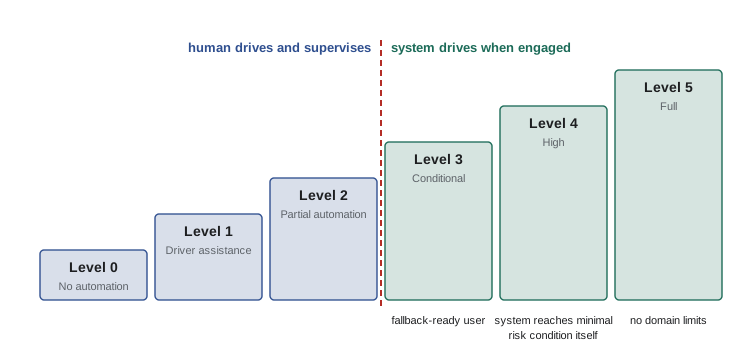
J3016 defines six levels, numbered 0 to 5. The levels describe the feature that is engaged at a given moment, not the vehicle as a whole: a car can have a Level 2 highway feature and a Level 4 parking feature. The key dividing line falls between Levels 2 and 3. At Levels 0 to 2 the human is driving whenever the features are engaged, even if their hands and feet are not moving, and must supervise constantly. At Levels 3 to 5 the automated driving system, or ADS, performs the entire dynamic driving task while engaged, so the person in the driver's seat is not driving.
| Level | Name | Who performs the DDT | Who monitors and handles fallback | Example |
|---|---|---|---|---|
| 0 | No driving automation | Human | Human | Automatic emergency braking and lane departure warnings that act only momentarily |
| 1 | Driver assistance | Human plus system for steering or speed, not both | Human | Adaptive cruise control |
| 2 | Partial driving automation | Human plus system for steering and speed together | Human, continuously | Hands-on or hands-free highway assist systems |
| 3 | Conditional driving automation | ADS within its domain | Fallback-ready user must respond to a request to intervene | Traffic-jam pilots approved on some motorways |
| 4 | High driving automation | ADS within its domain | ADS, including reaching a minimal risk condition | Robotaxis in mapped city zones, driverless trucks on set corridors |
| 5 | Full driving automation | ADS everywhere a human could drive | ADS | No production system at the time of writing (October 2026) |
Level 3 is the most delicate. The system drives and monitors the road, but a human in the seat must be receptive to a request to intervene and take over within a reasonable time. That person may read or watch a film, but cannot sleep or leave the seat. Level 4 removes the need for a fallback-ready human inside the domain: if something goes wrong, the system itself must bring the vehicle to a minimal risk condition. This is why robotaxis without a safety driver are Level 4 systems, not Level 5. They operate only in particular cities, on mapped streets, within certain weather and speed limits.
Worked problem
Classifying a feature
A pickup truck has a feature that controls steering and speed on divided highways. The driver may take their hands off the wheel, but a camera watches their eyes and the system disengages if they look away for more than a few seconds. What level is it, and who is responsible for detecting a stalled car ahead?
Show solution
- The system controls both lateral and longitudinal motion together, so it is at least Level 2.
- The driver must watch the road continuously, enforced by the eye monitor, so the human remains responsible for object and event detection and response.
- Hands-off operation does not change the level; supervision is the deciding factor.
Answer: Level 2. The human driver is responsible for noticing the stalled car and reacting, even with hands off the wheel.
The operational design domain
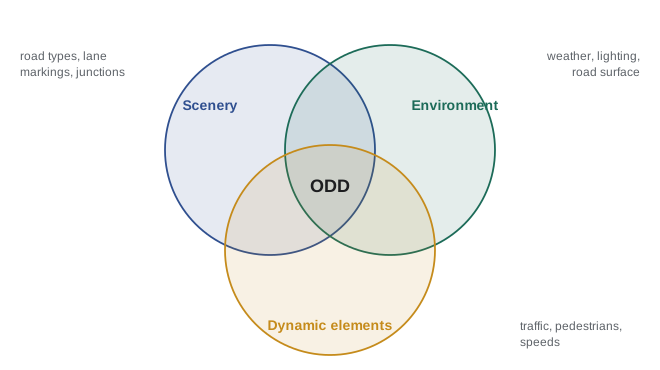
Every ADS at Levels 3 and 4 works only within an operational design domain, or ODD: the operating conditions under which the system is designed to function. J3016 lists examples such as road types, speed ranges, geographic areas, times of day, and environmental conditions like rain, fog, snow or glare. The ODD is a promise and a limit. The developer promises that the system will perform the whole driving task safely inside the ODD, and the system must recognize when it is approaching the edge of the ODD and respond, either by handing over to a fallback-ready user at Level 3 or by reaching a minimal risk condition at Level 4.
Describing an ODD precisely is an engineering task in its own right. A useful structure, used in standards such as ISO 34503 and BSI PAS 1883, groups attributes into scenery (road types, lane markings, intersections, junction types, zones such as school zones and construction), environmental conditions (weather, illumination, road surface, connectivity) and dynamic elements (traffic density, presence of pedestrians, cyclists and animals, speed of other vehicles). Each attribute is either permitted, permitted with conditions, or excluded. A robotaxi ODD might include urban arterials and residential streets up to 70 km/h, light to moderate rain, day and night, but exclude freeways, heavy snow and flooded roads.
Worked problem
Checking a trip against an ODD
An autonomous shuttle's ODD allows roads with speed limits up to 30 mph, daylight only, no precipitation heavier than light rain, and no snow cover on the road. A planned trip at 4:40 p.m. in late November in Minneapolis uses a 25 mph campus road and a 30 mph city street, with light snow forecast from 4 p.m. Sunset is around 4:35 p.m. Is the trip inside the ODD?
Show solution
- Road speeds: both roads are within the speed limit allowed by the ODD.
- Lighting: the trip starts after sunset, which violates the daylight-only condition.
- Weather: snow is excluded whether or not it is light; even before it accumulates, falling snow is not light rain.
- Two conditions fail, so the trip is outside the ODD.
Answer: No. The trip fails both the daylight and the precipitation conditions, so the shuttle should not start it, or should plan to stop before leaving the ODD.
The layered software architecture
Almost every autonomous vehicle, from a robotaxi to a delivery drone, organizes its software into a pipeline of modules, sometimes called the modular or classical stack. Sensors produce raw data. Perception turns that data into objects, free space, lanes and traffic signals. Localization estimates where the vehicle is on a map. Prediction forecasts what other agents will do over the next several seconds. Planning chooses a route, a behavior such as yielding or changing lanes, and a precise trajectory. Control converts the trajectory into steering, throttle and brake commands, or motor speeds for a drone. Underneath all of these sit the vehicle platform, the computing hardware, and the safety and monitoring functions that watch the system and trigger the fallback when something is wrong.
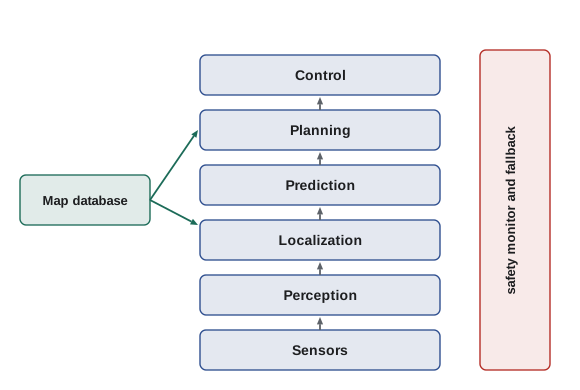
The modular structure has practical advantages. Each module has clear inputs and outputs, so teams can develop and test them separately, measure their errors and set budgets. Engineers can trace a mistake to a module: did perception miss the pedestrian, or did planning ignore a correctly detected one? Interfaces also make it easier to argue about safety, because a monitor can check, for example, that the planned trajectory never enters space perception marked as occupied. The disadvantage is that errors and uncertainty can be lost at the interfaces. If perception passes on only its best guess, prediction and planning cannot reason about how confident that guess was.
An alternative is end-to-end learning, where a single neural network, or a few tightly coupled networks, map sensor data directly to a trajectory or to controls. ROB-410 described how such policies are trained by imitation and reinforcement learning. Several developers now use hybrid designs: learned models for perception, prediction and planning trained jointly, with classical safety layers and rule checks on the output. At the time of writing, the most widely deployed driverless services still keep explicit intermediate representations, such as tracked objects and planned trajectories, because these support testing, debugging and safety arguments.
| Module | Main inputs | Main outputs | Course that covers the theory |
|---|---|---|---|
| Perception | Camera images, lidar points, radar returns | Tracked objects, free space, lanes, signals | ROB-330, this course lesson 2 |
| Localization | GNSS, IMU, wheel speeds, perception features, maps | Vehicle pose with uncertainty | ROB-310, ROB-340, lesson 3 |
| Prediction | Tracked objects, map, history | Future trajectories with probabilities | Lesson 4 |
| Planning | Pose, predictions, map, route, rules | Behavior decision and trajectory | ROB-350, lessons 4 and 5 |
| Control | Trajectory, vehicle state | Steering, throttle, brake or motor commands | ROB-300, lessons 5 and 6 |
| Safety monitor | Health of all modules, ODD checks | Fallback commands, minimal risk maneuvers | Lessons 8 and 12 |
Timing and the loop rate
An autonomous vehicle runs its stack as a set of loops at different rates. Control typically runs at 50 to 100 Hz for cars and several hundred hertz for drone attitude control, because vehicle dynamics change quickly. Planning commonly runs at 10 to 20 Hz, and perception at the rate of its sensors, often 10 Hz for spinning lidar and 20 to 30 Hz for cameras. The total time from a sensor seeing an event to the actuators responding is the end-to-end latency, and it directly affects safety: during that time the vehicle keeps moving at its current speed.
Worked problem
Distance traveled during system latency
A robotaxi drives at 30 mph. Its end-to-end latency from a pedestrian stepping out to the start of braking is 300 ms. How far does it travel before braking begins? Compare with a typical human perception-reaction time of 1.5 s.
Show solution
- Convert speed: \( 30 \text{ mph} \approx 44 \) ft/s, or about 13.4 m/s.
- System: \( 44 \times 0.3 \approx 13 \) ft before braking starts.
- Human: \( 44 \times 1.5 = 66 \) ft.
Answer: About 13 ft for the system against about 66 ft for a typical human, before either starts to brake.
Where autonomous vehicles operate today
At the time of writing (October 2026), driverless Level 4 services carry paying passengers in several US cities. Waymo reported more than 400,000 paid trips a week in early 2026 across Phoenix, the San Francisco Bay Area, Los Angeles, Austin, Atlanta and Miami, and announced expansions to further cities in Texas, Florida and elsewhere. Other companies run smaller services or testing programs, and driverless trucks carry freight on some Texas and southwestern highways. Canada has no driverless public robotaxi service at the time of writing, but Transport Canada guidelines and provincial pilots allow testing, and automated haul trucks have operated in Canadian oil sands and mines for years. Lesson 9 covers the rules in detail, and lesson 11 looks at trucking, transit, mining and agriculture. Because deployment changes month by month, treat any list of cities or fleet sizes as a snapshot and check current sources.
# Latency budget: distance travelled before braking for different speeds and latencies
speeds_kmh = [30, 50, 80, 100]
latencies_s = [0.15, 0.30, 0.50, 1.50]    # last one ~ typical human reaction
print("speed   " + "".join(f"{l*1000:>8.0f} ms" for l in latencies_s))
for v in speeds_kmh:
    ms = v / 3.6
print(f"{v:3d} km/h" + "".join(f"{ms*l:>10.1f} m" for l in latencies_s))speed 150 ms 300 ms 500 ms 1500 ms 30 km/h 1.2 m 2.5 m 4.2 m 12.5 m 50 km/h 2.1 m 4.2 m 6.9 m 20.8 m 80 km/h 3.3 m 6.7 m 11.1 m 33.3 m 100 km/h 4.2 m 8.3 m 13.9 m 41.7 m
Common mistakes
MistakeCalling a hands-free highway assist a self-driving car.
InsteadIf the human must supervise continuously, it is Level 2 and the human is driving.
MistakeDescribing a city robotaxi as Level 5.
InsteadIt is Level 4: it drives itself without a human fallback, but only inside a limited ODD.
MistakeTreating the ODD as a marketing description.
InsteadThe ODD is an engineering specification that the system must monitor and respect.
MistakeAssuming a Level 3 user can sleep or leave the seat.
InsteadA fallback-ready user must remain receptive to requests to intervene.
MistakeIgnoring end-to-end latency when judging safety.
InsteadLatency adds distance traveled before any response; budget and measure it.
Summary and key terms
- SAE J3016 (2021) defines six levels of driving automation applied to features, not whole vehicles.
- At Levels 0 to 2 the human drives and supervises; at Levels 3 to 5 the ADS performs the whole dynamic driving task while engaged.
- Level 3 relies on a fallback-ready user; Level 4 must reach a minimal risk condition itself.
- The operational design domain lists the scenery, environmental and dynamic conditions the system is designed for.
- Most autonomous vehicles use a modular stack of perception, localization, prediction, planning and control with a safety monitor.
- End-to-end and hybrid learned designs are growing, but deployed systems still keep inspectable intermediate outputs.
- End-to-end latency and loop rates directly affect stopping distance and safety.
- Dynamic driving task (DDT)
- The real-time operational and tactical functions of driving, including monitoring the road.
- Automated driving system (ADS)
- Hardware and software that perform the entire DDT on a sustained basis, at Levels 3 to 5.
- Operational design domain (ODD)
- The conditions under which a driving automation feature is designed to work.
- DDT fallback
- The response by a user or the system when the DDT cannot continue normally.
- Minimal risk condition
- A stable, stopped or otherwise reduced-risk state reached when a trip cannot continue.
- Fallback-ready user
- At Level 3, the person who must take over when the system requests it.
- Modular stack
- An architecture of separate perception, localization, prediction, planning and control modules.
- End-to-end learning
- Training one model to map sensor inputs directly to trajectories or controls.
- End-to-end latency
- Time from an event occurring to the actuators beginning to respond.
- Robotaxi
- A ride-hailing vehicle operated by an ADS without a human driver.
Practice problems
Work each problem on paper first, then reveal the answer to check.
A car controls speed only, keeping a set gap to the car ahead. What level is it?
Show answer
Level 1, driver assistance.
What separates Level 3 from Level 4?
Show answer
Level 4 must reach a minimal risk condition itself; Level 3 relies on a fallback-ready user.
Name the three groups of ODD attributes.
Show answer
Scenery, environmental conditions and dynamic elements.
Why is a robotaxi in one city not Level 5?
Show answer
Its ODD is limited to certain areas and conditions.
What is a minimal risk condition?
Show answer
A reduced-risk state, such as stopped out of traffic, reached when a trip cannot continue.
Which module turns sensor data into tracked objects?
Show answer
Perception.
Give one advantage of a modular stack.
Show answer
Errors can be traced to a module, and each module can be tested separately.
At 72 km/h, how far does a vehicle travel in 0.5 s?
Show answer
20 m.
Who monitors the road at Level 2?
Show answer
The human driver, continuously.
Name the standard that defines the levels.
Show answer
SAE J3016, also published as ISO/SAE PAS 22736.
Lesson quiz · 5 questions
Score 60% or more to complete this lesson.
Create a free account to save your progress, take quizzes and earn a certificate.