
ROB-499 · Lesson 11 of 12 · 27 min
Intellectual property, entrepreneurship and competitions
Some capstone projects end on demonstration day; others become research papers, competition entries, open-source tools or start-up companies. Whatever the path, questions about who owns the work, what can be protected, what can be shared and how further development can be funded arise sooner than most teams expect, and some of the most important decisions, such as whether to disclose a design publicly, must be made before the end of term. This lesson introduces intellectual property as it applies to student robotics projects, the main forms of protection, how to evaluate whether a capstone could become a venture, sources of funding in Canada and the United States, and robotics competitions as a path for continuing the work.
What intellectual property a capstone creates
A robotics capstone typically creates several kinds of intellectual property (IP). Software, documentation, drawings, the report, the video and the poster are protected by copyright automatically when they are created. A novel mechanism, such as a new gripper finger design, or a novel method, such as a new way of detecting litter on sand, may be patentable if it meets the legal tests. The overall appearance of a product may be protected by an industrial design registration in Canada or a design patent in the United States. The project's name and logo could be protected as trademarks if used in business. Know-how, data and unpublished designs can be protected as confidential information or trade secrets, but only as long as they are kept secret.
| Type of IP | What it protects | How it arises | Typical capstone examples |
|---|---|---|---|
| Copyright | Original expression: code, text, drawings, video | Automatically on creation | ROS 2 packages, report, CAD drawings, demonstration video |
| Patent | New, useful, non-obvious inventions | Granted after application and examination | A novel gripper mechanism or detection method |
| Industrial design or design patent | Ornamental appearance of a product | Registration or grant | A distinctive robot body shape |
| Trademark | Names, logos and marks used in trade | Use, strengthened by registration | A product or company name |
| Trade secret or confidential information | Valuable information kept secret | Kept confidential with reasonable measures | Training data, tuning parameters, supplier terms |
Who owns it?
Ownership depends on the institution's IP policy, any agreement with a sponsor or partner, and the law. Policies vary widely. Some universities leave ownership of student-created IP with the students, some claim ownership of IP created with significant university resources or as part of sponsored research, and many have specific rules for capstone and design courses. Industry sponsors commonly require, as a condition of sponsorship, that IP created in the project be assigned or licensed to them, sometimes in exchange for funding or equipment. Community partners rarely require ownership but may ask for a license to use the results.
Team members also own their contributions jointly unless they agree otherwise, which can create problems if one member later wants to commercialize a design that others co-created. The practical advice is to read your institution's policy in week 1, read any sponsor agreement before signing it, and, if the team might continue the project, write a simple agreement among members about ownership and future use. Team Tern's project had no sponsor agreement; their university's policy left ownership with the students for capstone work done without sponsored funding, but required disclosure to the technology transfer office if they intended to commercialize anything developed with university equipment.
US university IP policies commonly claim ownership of inventions made by employees, or made with significant university resources, and the Bayh-Dole Act gives universities the right to elect title to inventions made with federal funding, subject to obligations to the government. Policies for student inventions in coursework vary; some leave ownership with students unless they are employed on a funded project. Check your institution's policy and talk to its technology transfer office before disclosing or commercializing.
Patents and the danger of early disclosure
A patent gives its owner the right to exclude others from making, using or selling the invention for up to 20 years from filing, in exchange for publicly disclosing how it works. To be patentable, an invention must be new, useful and non-obvious to a skilled person, and it must be patentable subject matter. Patents are territorial: a Canadian patent has no effect in the United States, and vice versa. They are also expensive: beyond government fees, professional drafting and prosecution by a registered patent agent typically cost thousands to tens of thousands of dollars per country.
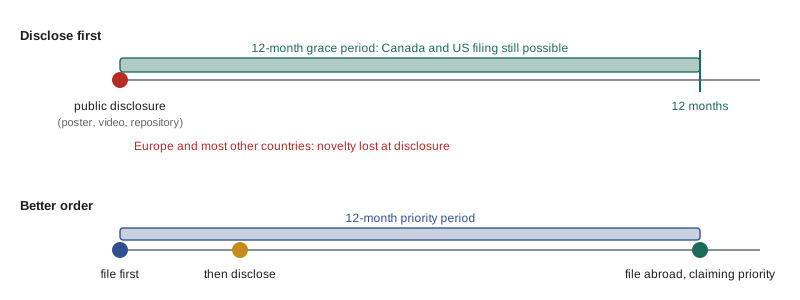
Disclosure timing is the issue that most directly affects capstones. A public disclosure, such as a showcase poster, a demonstration video online, a conference paper or an open-source repository, becomes prior art. Canada and the United States both provide a one-year grace period for disclosures made by the inventor, so an inventor can still file within 12 months of their own disclosure. Most other countries, including those in Europe, require absolute novelty, so any public disclosure before filing destroys the right to a patent there. If a team believes it has something patentable and might want protection outside North America, it should talk to its technology transfer office before the showcase, not after.
In the United States, a provisional patent application establishes a filing date without examination or claims and lasts 12 months, by which time a nonprovisional application must be filed to claim its benefit. Under the USPTO fee schedule effective January 2025, the provisional filing fee is USD 325 for a large entity, USD 130 for a small entity and USD 65 for a micro entity; nonprovisional filing, search and examination fees and attorney fees are additional. Check the current USPTO fee schedule before filing.
For most capstones, the right decision is not to patent. Many robotics capstone results are incremental, the cost is high and the commercial case is uncertain. Open publication, in a report, paper or repository, can be the better choice: it establishes the team's work as prior art, which prevents others from patenting it, and it builds reputations. The point is to make the decision deliberately, before disclosure, rather than discovering afterwards that an option was lost.
From capstone to venture
Robotics start-ups have emerged from capstone projects, but most capstones should not become companies. Useful questions for evaluating whether a project could become a venture include: Is there a customer with a painful, frequent, costly problem? Would they pay for this solution, and how much? How large is the market? What do existing solutions cost, and why would customers switch? Can the robot be made reliably at a cost that leaves a margin? Is the team committed to working on it for several years? Customer discovery, the practice of interviewing many potential customers before building more, which programs such as the US National Science Foundation's I-Corps teach, is the best way to answer these questions. Team Tern's partner said a commercial version would need to cost well under the annual cost of the staff time it saved and would need to handle cigarette butts, which raised the technical bar considerably.
Robotics ventures face particular challenges compared with software ventures: hardware is capital-intensive, iteration cycles are slow, certification and safety requirements add cost, and field reliability is hard to achieve. Many successful robotics companies start by solving a narrow problem very well in a controlled environment, then expand. A capstone team considering a venture should also weigh the alternatives: licensing the technology to an existing company, continuing it as a research project, or releasing it as open source and using it to launch careers.
# Runway for a small post-capstone robotics venture (illustrative figures, local currency)
import numpy as np
months = np.arange(1, 25)
founders_stipend = 3 * 1500               # three founders on modest part-time stipends per month
burn = founders_stipend + 1000 + np.where(months <= 6, 3000, 1500)   # + overheads + prototyping
cash0 = 50_000                            # savings, competition prizes, pre-seed
grants = {3: 15_000, 7: 60_000}           # e.g. an internship-style award, then a small innovation grant
revenue = np.where(months >= 13, 2000 * (months - 12), 0)   # paid pilots from month 13, growing
cash = cash0
for m in months:
    cash += grants.get(int(m), 0) + revenue[m - 1] - burn[m - 1]
    if m in (3, 6, 7, 12, 15, 18, 24) or cash < 0:
        print(f"month {m:2d}: cash {cash:9,.0f}")
    if cash < 0:
        print(f"cash runs out in month {m}"); break
else:
print("venture survives 24 months on this plan")month 3: cash 39,500 month 6: cash 14,000 month 7: cash 67,000 month 12: cash 32,000 month 15: cash 23,000 month 18: cash 32,000 month 24: cash 104,000 venture survives 24 months on this plan
On this plan the venture survives, but its cash falls to about 14,000 just before the second grant arrives in month 7, and it starts to grow only once paying pilots ramp up. Even this simple model makes the point that a hardware venture's survival depends on grant timing and on reaching paying pilots before cash runs out. Changing the grant month or the first revenue month by a few months can change the outcome, which is why founders track runway monthly and pursue several funding sources at once.
Funding sources
Funding for continuing a capstone ranges from small student awards to substantial government programs. University sources include entrepreneurship centers, incubators and accelerators, pitch competitions and internal innovation grants. Government programs support research partnerships, internships and small businesses. Private sources include angel investors, venture capital and crowdfunding, which is better suited to consumer products than to municipal robots.
In the United States, the National Science Foundation funds Research Experiences for Undergraduates (REU) sites and the I-Corps program for customer discovery. The Small Business Innovation Research (SBIR) and Small Business Technology Transfer (STTR) programs fund R&D at small businesses through agencies such as NSF, the Department of Defense, NASA and the Department of Energy; after lapsing on 30 September 2025, they were reauthorized on 13 April 2026 through 30 September 2031, with new national security screening requirements. The federal R&D tax credit can offset part of qualifying research spending. State programs and university accelerators add further options; check current eligibility and solicitations before applying.
Robotics competitions
Competitions offer a structured way to continue robotics work with external benchmarks, firm deadlines and a community. University-level examples include the University Rover Challenge, run by the Mars Society in the Utah desert, in which teams build Mars rover prototypes for science, delivery, equipment servicing and autonomous navigation missions; the Canadian International Rover Challenge, held near Drumheller, Alberta, which Carleton University's team won in August 2026; RoboCup, whose 2026 international event was held in Incheon, South Korea in July, with leagues for soccer, rescue, home service and industrial robots; and the Intelligent Ground Vehicle Competition for autonomous ground vehicles. Many students first encountered robotics through pre-university programs such as FIRST, and mentoring such teams is a valuable way to give back.
Competitions shape engineering in ways worth noticing. The rule book acts as the requirements document, and teams that read it carefully, including the scoring rubric and safety rules, outperform teams with better hardware. Competitions reward reliability under time pressure, which teaches lessons about margins, spares and field repairs that no lab can. They also involve logistics, such as shipping robots across borders with batteries, which must comply with dangerous goods rules, and arranging travel and funding, which teams often underestimate. Treat a competition entry as a project in its own right, with its own requirements, schedule, budget and risk register.
Worked problem
Deciding whether to disclose at the showcase
In week 12, Chloé realizes the team's method of fusing color and depth images to find partly buried cans may be novel. The public showcase is in week 13 and the video will be posted online. What should the team consider?
Show solution
- Identify the decision: once the showcase poster and video are public, the method becomes prior art; North American grace periods give 12 months to file, but absolute-novelty countries would be lost.
- Check ownership: the university policy leaves capstone IP with students, but use of university equipment requires disclosure to technology transfer before commercialization.
- Get advice quickly: contact the technology transfer office before the showcase to ask whether the method is likely patentable and worth protecting.
- Options: present the results at the showcase without the method's details, file a quick application first if advised, or disclose fully and accept that the method becomes open prior art.
- Decide as a team, record the decision and its reasons, and inform the advisor.
Answer: Make a deliberate decision before the showcase with technology transfer advice; disclosing freely is a valid choice, but it should not happen by accident.
Common mistakes
MistakeAssuming the team automatically owns everything it creates.
InsteadRead the institution's IP policy and any sponsor agreement early, and agree ownership among team members.
MistakePosting videos and code before considering patent options.
InsteadDecide deliberately about disclosure before showcases and publications; absolute-novelty countries allow no grace period.
MistakeAssuming patents are always worth getting.
InsteadWeigh cost, novelty and commercial value; open publication is often the better choice.
MistakeUsing datasets, models or CAD from the internet without checking licenses.
InsteadCheck and record third-party licenses, especially non-commercial restrictions.
MistakeStarting a company without talking to customers.
InsteadDo customer discovery interviews to test whether customers have a costly problem they would pay to solve.
MistakeTreating a competition as an add-on to the capstone.
InsteadPlan it as its own project with requirements from the rule book, schedule, budget, logistics and risks.
Summary and key terms
- Capstones create copyright automatically and may create patentable inventions, designs, trademarks and trade secrets.
- Ownership depends on institutional policy, sponsor agreements and agreements among team members.
- Public disclosure becomes prior art; Canada and the US give a 12-month inventor grace period, many countries give none.
- Patents are territorial and costly; open publication is often a deliberate, valid alternative.
- Venture potential depends on customers with costly problems, unit economics and team commitment; customer discovery tests this.
- Funding sources include university programs, NSERC, Mitacs and IRAP in Canada, and NSF, SBIR and STTR in the US.
- Competitions provide benchmarks and deadlines; the rule book is the requirements document.
- Intellectual property
- Legal rights over creations of the mind, such as inventions, works, designs and marks.
- Copyright
- Automatic protection of original expression, including code, text and drawings.
- Patent
- A time-limited right to exclude others from an invention in exchange for public disclosure.
- Prior art
- Public information that existed before a patent filing and may defeat novelty.
- Grace period
- A period after an inventor's own disclosure during which a patent can still be filed.
- Absolute novelty
- A rule under which any public disclosure before filing destroys patentability.
- Provisional application
- A US application that secures a filing date for 12 months without examination.
- Technology transfer office
- A university office that manages IP disclosure, protection and licensing.
- Customer discovery
- Interviewing potential customers to test assumptions about problems and willingness to pay.
- Runway
- The number of months a venture can operate before its cash runs out.
Practice problems
Work each problem on paper first, then reveal the answer to check.
Which IP arises automatically when Tern's code is written?
Show answer
Copyright.
Why might an industry-sponsored team be unable to open-source its code?
Show answer
The sponsor agreement may assign or license the IP to the sponsor or require confidentiality.
A team posts its gripper design online in March. Can it file a patent in Canada or the US in December?
Show answer
Generally yes, within the 12-month inventor grace period, but rights in absolute-novelty countries would already be lost.
Give two reasons a capstone team might choose not to patent.
Show answer
High cost and uncertain commercial value; open publication builds reputation and prevents others patenting the work.
What is the purpose of customer discovery?
Show answer
To test whether real customers have a costly problem and would pay for the proposed solution before investing more.
Name two challenges specific to robotics ventures compared with software ventures.
Show answer
Capital-intensive hardware and slow iteration; also certification, safety and field reliability.
In the runway model, what happens if the second grant arrives in month 10 instead of month 7?
Show answer
Cash falls to about zero in month 8 and below zero in month 9, so the venture runs out of money before the grant arrives; founders must plan several funding sources and track runway monthly.
Name one Canadian and one US program that could fund continued work.
Show answer
Canada: NSERC USRA, Mitacs Accelerate or IRAP; US: NSF REU, I-Corps, or SBIR/STTR.
Why should a competition team read the scoring rubric carefully?
Show answer
The rule book and rubric are the requirements; careful reading directs effort to what scores.
What logistics issue applies to shipping a robot with lithium batteries to a competition?
Show answer
Dangerous goods rules for transporting lithium batteries must be followed.
Lesson quiz · 5 questions
Score 60% or more to complete this lesson.
Create a free account to save your progress, take quizzes and earn a certificate.