
SLS-140 · Lesson 12 of 12 · 25 min
Lab: a week of selling in a CRM
▶ Video coming soon A video version of this lesson is on the way.
In the first week of November 2026, Grace Liu ran the final session of Ridgeline's CRM training for new sellers as a lab. Instead of a lecture, she gave Maya and two other new hires a realistic week of work: real accounts (in the training copy of the CRM, not the live system), real kinds of tasks and a few deliberate problems hidden in the data. Each day had a goal, a set of tasks and a short check at the end. This lesson walks through that week. Work through each day as if you were Maya, using whatever CRM you have access to, a free trial of one, or simply the worksheets and tables here. The skills come from lessons 1 to 11; the lab is about doing them together, in the right order, under ordinary time pressure.
The week runs from Monday, November 2 to Friday, November 6, 2026. Maya has 9 open opportunities in her pipeline worth 215,600 dollars after the October clean-up in lesson 4, and she owns 46 accounts in her territory.
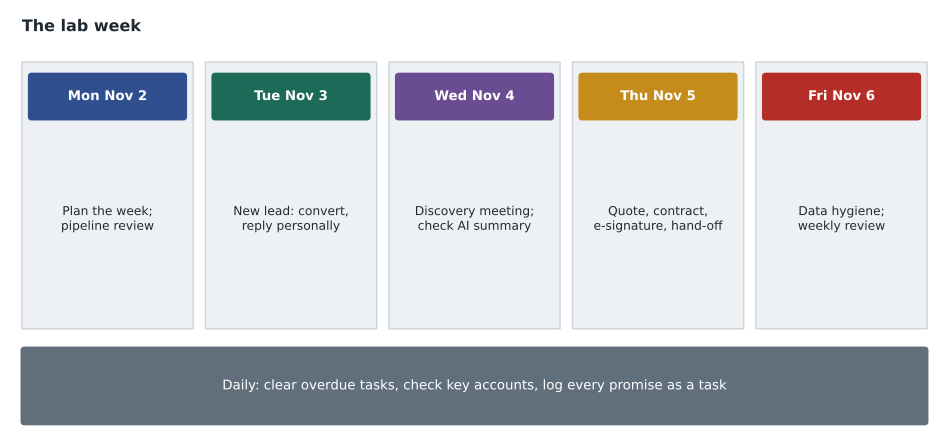
Daily habits
Before the day-by-day work, Grace set three habits that run every day of the lab, drawn from lesson 5: start the day by clearing or rescheduling overdue tasks; check new activity on key accounts; and turn every promise or request into a task with an owner and a date before the end of the day. At the end of each day, Maya was asked to have zero tasks overdue and no conversation from that day without a logged activity and, where something was learned, a note.
Monday: plan the week
Goal: know what matters this week and why.
Maya starts with her pipeline report from lesson 9: open opportunities grouped by stage, with amount, close date, next step and days in stage. She sorts by next-step date and lists the five deals that need action this week. One is the Halverson Law printer and furniture package, now in Negotiate after the call with Tom Ostrowski that Darnell joined in October. Another is Keystone Grain Equipment's room booking and video project, in Propose after the demo. A third is a deal that has quietly gone stale: a furniture refresh for a dental office, in Discover for 41 days with no activity since early October.
| Deal | Stage | Issue | Action this week |
|---|---|---|---|
| Halverson Law, printers and furniture, 2026 | Negotiate | Lease terms agreed in principle; contract not sent | Send contract for e-signature Thursday after final check |
| Keystone Grain Equipment, room booking and video rooms, 2026 | Propose | Proposal reviewed; IT contractor approval outstanding | Book a call with the IT contractor; send security summary |
| Westgate & Rowe, printer lease, 2026 | Discover | Lease ends in March; three quotes required | Discovery meeting Wednesday |
| Dental office furniture refresh, 2026 | Discover | 41 days in stage, no activity, past stage limit | Call the contact; update or close as lost |
| Northfield Family Clinic, expansion furniture, 2026 | Negotiate | Revised schedule sent; awaiting finance approval | Check in with Janet Morrow Tuesday |
Check: Maya's plan names a specific action for each deal, and she has created a task for each action with a date this week. The stale dental deal gets a task to call on Monday afternoon; when the office manager says the project is postponed until the summer, Maya closes the opportunity as lost with the reason "timing", and creates a task to check back in May 2027. Her open pipeline drops to 8 deals.
Tuesday: a new lead
Goal: turn an inbound lead into clean records and a respectful first outreach.
A lead arrives from Ridgeline's website: "P. Nandakumar, Westgate and Rowe CPAs, office admin, wants info on managed print." Grace has hidden two problems in the training data. Westgate & Rowe already exists as an account (Maya created it last week when she booked Wednesday's discovery meeting), and Priya Nandakumar already exists as a contact, with her email spelled slightly differently.
Worked problem
Handling the Westgate & Rowe lead
Apply lessons 3, 6 and 7 to the lead. What should Maya do?
Show solution
- Search accounts by name variants (Westgate, Westgate and Rowe, Westgate & Rowe) and by website domain: the account exists.
- Search contacts by surname and email domain: Priya exists, with an email that has a typing error in the existing record.
- Check which email is correct by looking at Priya's last reply: the new lead's address is correct, so update the contact record and note the correction.
- Do not convert the lead into new records. Link it to the existing contact and the existing opportunity, then mark it as converted, which keeps the lead source recorded for reporting.
- Check communication consent: Priya asked for information through the website form, which records her consent and the date.
- Do not enrol her in a generic sequence: she already has a meeting with Maya tomorrow. Instead, reply personally to confirm the meeting and say Maya will bring the managed print comparison.
- Log the reply as an activity and create a task to prepare the comparison by Wednesday morning.
Answer: No duplicates were created, the wrong email was fixed, the lead source was kept for reporting, and Priya received a personal reply instead of an automated sequence that would have ignored tomorrow's meeting.
Check: no new duplicate records; the lead is linked and converted; the contact's email is correct; consent is recorded; the reply is logged; and the preparation task exists. Maya also calls Janet Morrow at Northfield, as planned, and learns that the clinic's finance committee meets Thursday. She logs the call and moves her follow-up task to Friday.
Wednesday: a discovery meeting
Goal: capture what was learned accurately, using AI help safely.
Maya holds a 40-minute video discovery meeting with Priya Nandakumar and Westgate & Rowe's managing partner. She asks permission to record and transcribe, explaining that it helps her focus and send an accurate summary; both agree. During the meeting she jots brief notes on key points: who wants what, numbers, dates and promises.
After the meeting, the meeting tool's AI assistant produces a summary with five action items. Maya checks it against her notes, as lesson 10 taught.
| AI action item | Maya's notes | Verdict |
|---|---|---|
| Provide quote for 3 multifunction printers | 2 printers plus 1 small desktop unit for the partner's office | Correct it |
| Send comparison of 36- and 48-month lease terms | Yes, by Friday | Correct as written; add date |
| Arrange trial of scanning software | Not discussed; Maya mentioned it as an option only | Delete |
| Confirm current lease end date | March 31, 2027; Priya to send copy of lease | Correct; owner is Priya, not Ridgeline |
| Schedule follow-up meeting | Week of Nov 16, partner prefers Tuesday mornings | Correct; add preference |
Maya writes her CRM note using the structure from lesson 5, records the managing partner as a new contact with the role "decision maker", and creates three tasks (quote, lease comparison, follow-up meeting) with dates. Priya's promise to send the lease copy goes into the note and the recap email, but not as a Ridgeline task, because the owner is Priya. Maya does create a reminder task for herself to check on Friday whether it has arrived. She updates the opportunity amount from her rough estimate to the value of the likely quote and moves the stage to Propose only after confirming in the recap email that the partner wants to see a recommendation, which matches Ridgeline's exit criteria.
Check: two of the five AI action items needed correction and one needed deleting; the note is factual and would be comfortable for the customer to read; the recap email was rewritten in Maya's voice with every figure checked; tasks have owners and dates; the stage matches the exit criteria.
Thursday: paperwork
Goal: get an agreed deal signed correctly and update every record.
The Halverson Law deal is ready for signature. Tom Ostrowski agreed the 48-month lease terms by email on Monday, and Ruth Halverson confirmed the furniture selection. Maya generates the quote from the CRM, checks every line against the agreed terms, and prepares the contract from Ridgeline's standard template. She confirms with Tom who has authority to sign for the firm (Ruth, as managing partner) and sets the signing order: Ruth first, then Rob Kowalski for Ridgeline.
Worked problem
Checking the quote before sending
The agreed package is 3 multifunction printers at 189 dollars a month each on a 48-month lease, plus furniture for 6 workstations at 1,350 dollars each, plus a one-time installation fee of 900 dollars. The draft quote shows a monthly printer total of 567 dollars, furniture of 8,100 dollars and installation of 900 dollars, with a total contract value of 36,216 dollars. Is the quote right?
Show solution
- Monthly printer total: 3 times 189.
- \[3 \times 189 = 567\]
- Printer value over 48 months.
- \[567 \times 48 = 27216\]
- Furniture: 6 times 1,350.
- \[6 \times 1350 = 8100\]
- Total contract value: printers plus furniture plus installation.
- \[27216 + 8100 + 900 = 36216\]
Answer: The quote is right: 36,216 dollars total contract value before tax, matching the agreed terms. Maya updates the opportunity amount to 36,216 dollars, which replaces the earlier estimate of 26,400 dollars made before the furniture was added.
Maya sends the contract for e-signature at 10:00, tells Ruth by phone to expect it, and logs the call. Ruth signs at 2:15, Rob at 3:40. The e-signature tool attaches the signed contract and audit trail to the opportunity and moves it to Closed Won. Maya then does the hand-off that lesson 2 described: she checks that Farida Haddad, the account manager, is added to the account team, writes a hand-off note listing what was sold, the terms, promises made (delivery of the furniture before the firm's December open house) and key contacts, and creates a task for the installation team to confirm dates with the office administrator.
Check: the quote matches the agreed terms; the signer has authority; the opportunity is Closed Won with the signed copy attached; the hand-off note and tasks exist.
Friday: hygiene and review
Goal: leave the CRM better than you found it, and know where you stand.
Maya spends her last hour on the weekly routine from lesson 4. She goes through every open opportunity and checks stage, amount, close date and next step. She runs the "my accounts with missing fields" report from lesson 6 and fixes what she can: 4 accounts with no website, 7 contacts with bounced emails, 2 contacts who have left their companies. For the people who have left, she marks them inactive and creates tasks to find out who replaced them. She checks her overdue tasks (none) and sends Darnell a short note with her week's results.
Worked problem
Maya's week in numbers
Maya started the week with 9 open opportunities worth 215,600 dollars. During the week she closed the dental deal as lost (12,400 dollars), won Halverson Law (estimated at 26,400 dollars at the start of the week, closed at 36,216 dollars), and updated Westgate & Rowe from an estimate of 9,000 dollars to a likely quote of 13,800 dollars. What is her open pipeline at the end of the week, and what did she win?
Show solution
- Start: 215,600 dollars in 9 deals.
- Remove the dental deal closed as lost.
- \[215600 - 12400 = 203200\]
- Remove Halverson Law at its start-of-week estimate, because it is now won, not open.
- \[203200 - 26400 = 176800\]
- Add the increase in the Westgate & Rowe estimate.
- \[13800 - 9000 = 4800\]
- \[176800 + 4800 = 181600\]
- Won this week: Halverson Law at its final value of 36,216 dollars.
Answer: Maya ends the week with 7 open deals worth 181,600 dollars and one win worth 36,216 dollars. Her pipeline is smaller than on Monday, but every deal in it has a current stage, amount, date and next step.
The same week at Juniper & Pine
Bev ran a shorter version of the lab for Aiden in the same week, using the clienteling app. On Monday he reviewed his open interests and booked follow-ups. On Tuesday he merged a duplicate profile after checking phone, email and postal code. On Wednesday he ran a virtual design consultation, asked permission before recording it for the design team, and checked the app's AI-drafted summary against his notes (it had the sofa color wrong). On Thursday he completed a financing application on the tablet with the customer, without photographing any documents. On Friday he cleared his overdue follow-up tasks and checked his dashboard: average ticket, attach rate and profiles created. The tools were different; the habits were the same.
Scoring the lab
Grace scores the lab with a simple checklist, one point for each item, which students can use to score themselves.
| Area | Item (1 point each) |
|---|---|
| Daily habits | No overdue tasks at the end of any day; every conversation logged; every promise a task |
| Monday | Each priority deal has a specific action and dated task; stale deal updated or closed with a reason |
| Tuesday | No duplicates created; contact corrected; lead linked and converted; consent checked; personal reply sent |
| Wednesday | Recording consent obtained; AI summary checked and corrected; note follows the structure; tasks created; stage matches exit criteria |
| Thursday | Quote checked; signer authority confirmed; opportunity closed won with documents attached; hand-off note and tasks |
| Friday | All open deals current; missing-field report worked; inactive contacts marked and replacement tasks created; weekly note sent |
Maya scored 24 out of 26. She lost one point on Tuesday for not recording in the note why she had changed Priya's email address, and one on Friday for forgetting to mark one contact inactive. Grace's comment on her scoresheet was the one Darnell had given her in her first pipeline review: "If someone else picked up your accounts tomorrow, they could carry on without calling you. That's the whole point."
Common mistakes
MistakeA training lab can be done in the live CRM.
InsteadUse a training copy or sandbox so mistakes do not affect real customers or reports.
MistakeA new web lead should always be enrolled in a sequence.
InsteadCheck first: if a conversation or meeting is already under way, reply personally instead.
MistakeA customer's promise belongs on the seller's task list as if the seller owned it.
InsteadRecord the customer's promise in the note and recap, and add a reminder to check on it.
MistakeOnce a contract is signed, the seller's work in the CRM is done.
InsteadThe hand-off note, account team and installation tasks are part of closing the deal properly.
MistakeA smaller pipeline at the end of the week is a bad sign.
InsteadA smaller, accurate pipeline after wins and honest clean-up is a good sign.
Summary and key terms
- The lab week practices the course's skills together: planning from the pipeline, converting leads without duplicates, capturing meetings accurately, getting paperwork right and keeping data clean.
- Three daily habits underpin the week: clear overdue tasks, check key accounts and turn every promise into a task.
- Check AI summaries against your own notes before saving or sending anything.
- Check quotes against agreed terms, confirm signing authority and complete the hand-off when a deal closes.
- A weekly hygiene routine keeps every open deal current and fixes missing or out-of-date data.
- The test of good CRM work is whether a colleague could pick up your accounts tomorrow without calling you.
- Sandbox
- A training or test copy of a system, separate from live data.
- Hand-off note
- A note that passes a customer from one person or team to another with everything they need to know.
- Weekly review
- A regular check of every open deal's stage, amount, close date and next step.
- Lab checklist
- A list of observable actions used to score a practice exercise.
Practice problems
Work each problem on paper first, then reveal the answer to check.
Why did Maya not enrol Priya in a sequence on Tuesday?
Show answer
Priya already had a meeting booked; an automated sequence would ignore that, so a personal reply was better.
Three printers at 210 dollars a month on a 36-month lease: what is the printer value?
Show answer
3 times 210 is 630 dollars a month; 630 times 36 is 22,680 dollars.
Which of Wednesday's AI action items should be deleted, and why?
Show answer
The scanning software trial; it was not discussed as a request, Maya only mentioned it as an option.
Give two items Maya checked before sending the Halverson contract.
Show answer
Any two of: the quote matched the agreed terms; the signer had authority; the signing order was set; the customer knew to expect it.
Lesson quiz · 5 questions
Score 60% or more to complete this lesson.
Create a free account to save your progress, take quizzes and earn a certificate.