
SLS-213 · Lesson 11 of 12 · 21 min
From verbal yes to signed contract
▶ Video coming soon A video version of this lesson is on the way.
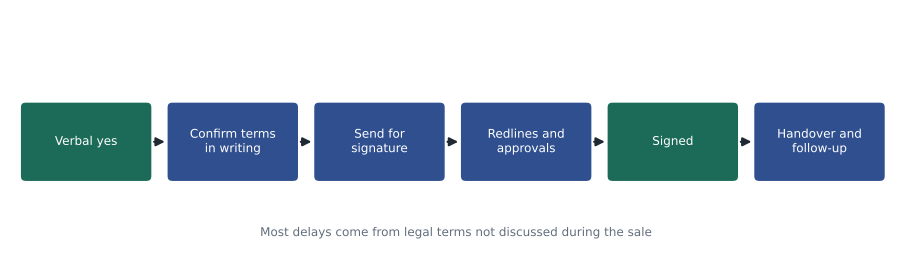
Sandra Kim said yes on the phone on Tuesday, November 10, 2026. By that afternoon, Maya had sent the managed print agreement for electronic signature. Dr. Erin Shaw signed it the same evening, and Sandra countersigned the next morning. The whole process took less than a day, because Maya had prepared the paperwork in advance, checked who at the hospital could sign, and confirmed every detail on the call. Prairie Valley's contract was a different story. The division had chosen Ridgeline on November 10, but the award was subject to approval by the board of education, and the contract still needed to be negotiated clause by clause with the division's lawyers. That process was expected to take most of November.
Many deals that are agreed are never signed, or are signed weeks later than expected, or are signed with terms nobody intended. This lesson covers the steps between a customer saying yes and a deal that is complete: what makes an agreement legally binding, how written contracts are put together, electronic signatures, the problems that arise when buyers and sellers use different terms, and how to hand a new customer over so that the relationship starts well.
When is there a contract?
A contract is an agreement the law will enforce. In the United States, contract law is mostly state law, built on common law principles, with the Uniform Commercial Code covering sales of goods in every state except Louisiana, which adopted most but not all of it. The basic ingredients are similar everywhere.
| Element | What it means | Sales example |
|---|---|---|
| Offer | A definite proposal that can be accepted | A signed quote listing devices, price and term |
| Acceptance | Clear agreement to the offer's terms | The customer signs the quote or confirms in writing |
| Consideration | Something of value exchanged by each side | The service in exchange for monthly payments |
| Intention to create legal relations | Both sides mean the agreement to be binding | Normal in commercial deals |
| Capacity and authority | The people agreeing are able and authorized to do so | The person signing has authority to commit the company |
A verbal agreement can be a binding contract, but it is hard to prove what was agreed. That is why almost every business sale ends in writing. In the US, the Uniform Commercial Code, adopted in South Dakota and every other state, requires a contract for the sale of goods priced at 500 dollars or more to be evidenced by a signed writing to be enforceable, with some exceptions. Service contracts follow general contract law, where some agreements, such as those that cannot be performed within a year, must also be in writing. Whatever the legal minimum, a seller should treat a deal as unfinished until the agreed terms are in a signed document.
What a written agreement contains
B2B sales agreements usually come in one of two forms. Smaller deals use a single order form or signed quote with the supplier's standard terms attached. Larger or repeat customers often sign a master services agreement (MSA), which sets the general legal terms once, plus separate order forms or statements of work for each purchase. Ridgeline uses both: Lakeview Veterinary Hospital signed an order form with Ridgeline's standard terms, while Prairie Valley's contract will be a full agreement drafted around the division's own template.
| Section | What it covers |
|---|---|
| Parties and term | Who is agreeing, start date, length and renewal |
| Scope | Exactly what will be supplied: devices, services, service levels |
| Price and payment | Charges, invoicing, payment terms, price changes during the term |
| Service levels and remedies | Response times, credits for missed targets |
| Liability and indemnity | Who is responsible if things go wrong, and limits on damages |
| Data and confidentiality | How customer data is handled and protected |
| Termination | How either side can end the agreement and what happens then |
| General terms | Governing law, notices, how changes are made, entire agreement |
Sellers do not need to be lawyers, but they need to know what is in their company's standard agreement, which terms they can change, and which must go to legal. Most of the delays between yes and signature come from legal terms the seller did not discuss during the sale: limits on liability, data handling, termination rights. Raising those topics early, as part of discovery and proposal, prevents a late surprise.
Redlines and approvals
When a customer's lawyer reviews an agreement, they usually send back a redline: a marked-up copy showing proposed changes. Each change is a small negotiation. Some are easy, such as correcting a name or address. Some need the seller's legal or finance team, such as changing a limit on liability or payment terms. A few may be deal-breakers.
The seller's job in this stage is to manage the process. That means sending redlines to the right people quickly, explaining the business reason behind the customer's requests, keeping a log of open issues and their status, and keeping the customer informed. It also means not agreeing to legal changes on the spot. Prairie Valley's first redline, which arrived on November 12, asked for three changes: a right to end the contract early if service levels were missed for three months in a row, a cap on annual price increases, and data to be stored in the United States. Maya logged all three and sent them to Ridgeline's contracts manager the same day.
Worked problem
Tracking a redline to signature
Prairie Valley's board meets on Tuesday, November 17, and the division wants the contract signed by Tuesday, November 24, so devices can be installed over the winter break. Ridgeline's contracts manager needs three business days to review a redline, and the division's lawyer has said she needs two business days to respond to any counter-proposal. If Ridgeline received the redline on Thursday, November 12, can the November 24 date be met with one round of counter-proposals?
Show solution
- Ridgeline's review: Friday 13, Monday 16 and Tuesday 17 (three business days), so its response goes back on Tuesday, November 17.
- Division's response: Wednesday 18 and Thursday 19 (two business days), back on Thursday, November 19.
- Final clean copy and internal approvals: Friday, November 20.
- Signatures: Monday 23 or Tuesday 24.
Answer: Yes, with one round of counter-proposals the timeline just fits, with signature on November 23 or 24. A second round would push it past the target, so Maya asked the contracts manager to resolve as much as possible in Ridgeline's first response.
Electronic signatures
Most business agreements, and many consumer ones, are now signed electronically. In the US, the federal Electronic Signatures in Global and National Commerce Act (E-SIGN, 2000) and the Uniform Electronic Transactions Act, which South Dakota has adopted, provide that a signature, record or contract cannot be denied legal effect just because it is electronic, with some exceptions such as wills. Consumer transactions under E-SIGN carry extra conditions: where the law requires information to be given to a consumer in writing, the consumer must consent to receive it electronically.
The practical lessons are the same in both countries. An electronic signature on a properly prepared agreement is as binding as ink. A casual reply to an email or text can also create a binding agreement, as the emoji case showed. Sellers should be careful about what they confirm informally, and they should make sure customers know when they are agreeing to something.
The battle of the forms
Businesses often exchange documents that contain different standard terms. A seller sends a quote with its terms on the back; the buyer sends a purchase order with its own terms; the seller ships and invoices. Whose terms apply? This problem is known as the battle of the forms.
In the US, the Uniform Commercial Code, section 2-207, deals with the battle of the forms for sales of goods. In general, a reply that accepts an offer can still form a contract even if it adds or changes terms, and between merchants the additional terms may become part of the contract unless they materially alter it or the other side objects. Results depend heavily on the facts, which is why careful businesses make sure one signed document sets out the agreed terms. For sellers, the lesson is simple: when a customer sends a purchase order, check whether its terms conflict with yours, and if they do, get them resolved before delivery.
Retail: the sales order
In retail, the written agreement is usually the sales order or bill of sale. At Juniper & Pine, it lists every item with its model number and price, delivery and installation details, protection plans, the deposit paid, the balance due and the return and exchange terms. Bev's rule was that every promise made on the floor must appear on the sales order. If Carl told the Moraleses that the range and dishwasher would arrive on November 9 and the haul-away was included, the order had to say so.
Two retail points cause frequent confusion. First, many customers believe they have a legal right to cancel any purchase within a few days. In general they do not: the FTC's Cooling-Off Rule applies to sales made at the buyer's home or at temporary locations, not in a store, and a store's own return policy is what applies to most in-store purchases. Associates should explain the store's policy clearly before the sale. Second, when a customer finances a purchase through the store's lending partner, the financing agreement is a separate contract with its own disclosure rules, under the federal Truth in Lending Act and Regulation Z. Associates must not describe financing terms beyond what the lender's materials say.
Handover and the first weeks
Signing is the end of the sale but the beginning of the relationship. The customer's experience in the first weeks decides whether they renew, buy more and refer others. A good handover includes:
- Confirming the agreed terms in a short summary the customer can read in two minutes.
- Introducing the people who will deliver the service: the installer, the service manager, the account manager.
- Passing everything the seller learned during the sale to those people, so the customer does not have to repeat themselves.
- Setting the first milestones and checking that each one happens.
- A follow-up call from the seller after the first delivery or the first month.
Customers sometimes feel buyer's remorse after a large purchase: doubt about whether they made the right choice. A short, reassuring follow-up that reminds them why they decided, and confirms the next steps, reduces it. Carl phones every appliance customer two days after delivery. Maya sent Sandra and Dr. Shaw a one-page installation plan the day after signing, with the technician's name and the January 9 date.
Worked problem
Checking the Morales sales order
Carl promised the Moraleses: four appliances at the 5,646-dollar package price; refrigerator delivered on Tuesday, October 20; range and dishwasher on Monday, November 9; microwave on November 9 as well; dishwasher installation and haul-away of three old appliances included; protection plans on the refrigerator (189 dollars) and range (149 dollars). The Moraleses paid a 25 in 100 deposit. What should the order show as the total, deposit and balance, before tax?
Show solution
- Appliances: 5,646 dollars.
- Protection plans: 189 + 149 = 338 dollars.
- Total before tax: 5,646 + 338 = 5,984 dollars.
- Deposit at 25 in 100: 5,984 × 0.25 = 1,496 dollars.
- Balance due before tax: 5,984 − 1,496 = 4,488 dollars.
Answer: The order should show 5,984 dollars before tax, a 1,496-dollar deposit and a 4,488-dollar balance, plus sales tax, with both delivery dates, the included installation and haul-away, and the two protection plans listed.
Authority matters at signature as much as during the negotiation. The person who agrees a deal is not always the person who can sign it. In a law firm, a managing partner may need a second partner's signature above a set amount; in a school division, the board may have to approve a contract before an officer can sign; in a family business, an owner may sign everything. Asking early "Who signs agreements like this, and is there a dollar limit?" prevents the common surprise of a deal agreed in principle that cannot be signed for weeks.
Common mistakes
MistakeTreating a verbal yes as the end of the sale.
InsteadGet the agreed terms into a signed document, and treat the deal as unfinished until then.
MistakeLeaving legal terms until the end.
InsteadRaise liability, data and termination topics during the sale to avoid late surprises.
MistakeAgreeing to legal changes on the spot.
InsteadLog redlines and send them to the right people; respond promptly but not hastily.
MistakeConfirming terms casually by text or email.
InsteadRemember that informal replies can be binding; confirm terms deliberately.
MistakeLeaving promises off the sales order.
InsteadPut every promise made during the sale in writing.
Summary and key terms
- A contract needs an offer, acceptance, consideration, intention to be bound, and capacity and authority.
- Verbal agreements can be binding but are hard to prove, so business deals end in writing. The UCC requires a signed writing for sales of goods of 500 dollars or more, but written terms are the norm.
- B2B agreements use order forms or master services agreements; delays come mostly from legal terms not discussed earlier.
- Redlines should be logged, routed and tracked against a timeline. E-SIGN and UETA make electronic signatures valid, with consumer consent rules, so informal replies can bind.
- The battle of the forms arises when terms conflict; resolve conflicts before delivery.
- In retail, every promise belongs on the sales order; in-store purchases generally have no legal cooling-off period, and financing is a separate contract.
- A good handover and follow-up reduce buyer's remorse.
- Contract
- An agreement the law will enforce.
- Master services agreement (MSA)
- A contract setting general legal terms for a customer relationship, with separate orders for each purchase.
- Redline
- A marked-up copy of an agreement showing proposed changes.
- Electronic signature
- A signature in electronic form, legally valid under electronic commerce laws.
- Battle of the forms
- The conflict that arises when buyer and seller exchange documents with different standard terms.
- Buyer's remorse
- Doubt or regret a customer feels after a significant purchase.
Practice problems
Work each problem on paper first, then reveal the answer to check.
Name the five basic elements of a contract.
Show answer
Offer, acceptance, consideration, intention to create legal relations, and capacity and authority.
A purchase totals 3,200 dollars before tax with a 20 in 100 deposit. What is the balance before tax?
Show answer
3,200 × 0.20 = 640 deposit; 3,200 − 640 = 2,560 dollars.
Why should sellers raise legal terms during the sale rather than after the yes?
Show answer
Because most delays between yes and signature come from legal terms that were not discussed earlier.
Lesson quiz · 5 questions
Score 60% or more to complete this lesson.
Create a free account to save your progress, take quizzes and earn a certificate.