
SLS-213 · Lesson 9 of 12 · 18 min
Closing: asking for commitment
▶ Video coming soon A video version of this lesson is on the way.
Lakeview Veterinary Hospital's printer lease was due to end in January 2027. Sandra Kim, the hospital's practice manager, had called Maya first about replacing it, which SLS-101 described as one of the small rewards of honest selling. By the start of November 2026, Maya had done the discovery, walked the office with Dr. Erin Shaw, the hospital's owner, and sent a proposal for three new multifunction devices on a five-year managed print agreement. Dr. Shaw had replied that the proposal "looked good". Then nothing happened for eight days.
At the workshop on Thursday, November 5, Maya described the situation. Darnell asked one question: "Have you asked them to sign?" She had not. She had sent the proposal, answered two questions by email and waited. "You've done the hard work," Darnell said. "Now you have to ask."
Closing is the part of the sale where the seller asks the customer for a commitment. In popular sales culture, closing has a reputation as the moment of pressure, when the salesperson uses a clever technique to push a hesitant customer over the line. This lesson takes a different view, supported by research: closing is simply asking clearly for the next commitment, at the right time, after the customer has seen enough value to say yes. Lesson 10 examines specific closing techniques and their risks.
Commitment is more than the final signature
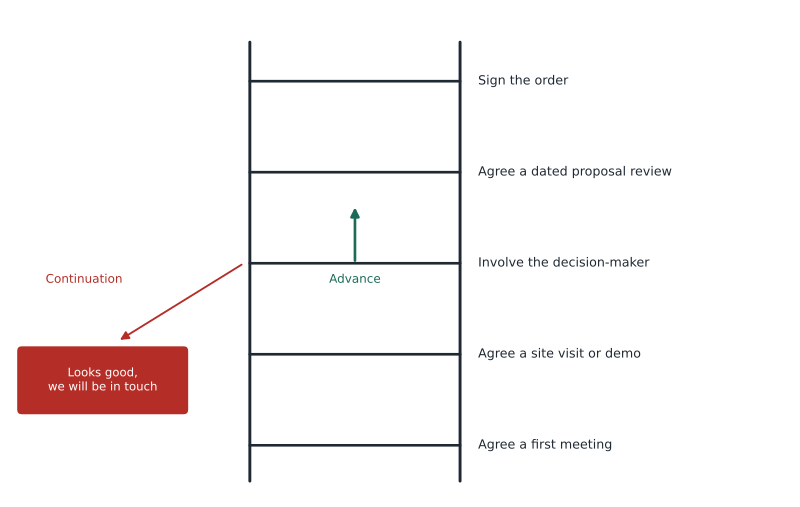
Every sale is a series of commitments, not just one. A prospect commits to a first meeting, then to a site visit, then to involving their manager, then to a trial, then to a purchase. Neil Rackham's research for *SPIN Selling* distinguished between outcomes of a sales call that move the sale forward and those that do not.
| Outcome | What it means | Lakeview Veterinary Hospital example |
|---|---|---|
| Order | The customer commits to buy | Dr. Shaw signs the managed print agreement |
| Advance | The customer commits to a specific action that moves the sale forward | Sandra agrees to a 20-minute call with Dr. Shaw and Maya on Tuesday to decide |
| Continuation | The sale goes on but no specific commitment is made | "Looks good, we'll be in touch." |
| No sale | The customer declines | The hospital decides to renew with its current supplier |
Rackham's key observation was that in large sales, a call that ends in a continuation is not a success, however friendly it felt. The goal of every call should be either an order or an advance: a specific, agreed next step with a date. Dr. Shaw's "looks good" was a continuation. Maya had been treating it as progress.
When to ask
The right time to ask for commitment is when the customer has enough information and enough confidence to decide. Asking too early produces objections, because the customer has not yet seen the value. Asking too late wastes time and can let the deal stall, as happened with Lakeview Veterinary Hospital. Most sellers err on the side of asking too late, because asking risks hearing no.
Customers often signal readiness through buying signals: things they say or do that suggest they are picturing themselves as a customer.
| Kind of signal | Examples |
|---|---|
| Questions about implementation | "How long does installation take?" "Who would train our staff?" |
| Questions about terms | "What are the payment terms?" "Is there a cancellation clause?" |
| Ownership language | "Our reception desk would have the color one." "We'd put the sofa under the window." |
| Involving others | "Let me get my partner over here." "Can you send this to our office manager?" |
| Physical signals (retail) | Sitting back on the sofa, opening the fridge again, taking measurements |
Buying signals are not commitments, and a seller should not pounce on them. But they are a cue to check readiness. A simple way to do that is a trial close: a question that asks about the customer's view without asking for the order. "How does this compare with what you were expecting?" or "Is there anything we haven't covered that you'd need to decide?" A positive answer suggests it is time to ask. A hesitant answer reveals what still needs work.
How to ask
The most effective way to ask for commitment is usually also the simplest: say clearly what the next step is and ask whether the customer is ready to take it. Rackham found that in large sales, the specific closing techniques taught in many sales courses were associated with lower success, while sellers who simply asked for a clear, appropriate commitment did well.
| Approach | Example |
|---|---|
| Summarize and ask | "We've agreed three devices, color at reception, five years at 412 dollars a month, and installation on the weekend of January 9. Are you ready to go ahead?" |
| Ask for the advance | "Would it help if Sandra, you and I spoke for 20 minutes on Tuesday to make the decision?" |
| Ask about process | "What needs to happen on your side for us to have a signed agreement by November 20?" |
| Retail: offer to write it up | "Shall I write this up for you, with delivery on the 14th?" |
A good request for commitment has three features. It is specific: the customer knows exactly what they are agreeing to. It is appropriate: it matches where the customer is in the decision, which may be an advance rather than an order. And it is comfortable to refuse: the customer does not feel trapped, which paradoxically makes a yes more likely and more durable.
After you ask: silence
After asking for commitment, stop talking. Many sellers ask, feel the silence, and fill it with more information, a reassurance or even a discount. Silence gives the customer room to think. It may feel long to the seller; to the customer it is usually just a few seconds. If the answer is a question or an objection, handle it using lesson 3's method, then ask again.
Handling the answer
There are three broad kinds of answer.
Yes. Thank the customer, confirm exactly what has been agreed, and explain what happens next: the paperwork, the dates, who will contact them. Then stop selling. Continuing to talk after a yes risks raising new doubts. Lesson 11 covers turning a yes into a signed contract.
Not yet. Find out what stands in the way, using clarifying questions. If it is an objection, handle it. If it is a genuine constraint, such as a board meeting next week, agree a specific advance: a date, a time and who will be involved.
No. Accept it gracefully. Ask, if appropriate, what led to the decision, because the answer will help with future customers. Leave the door open. A customer who says no politely to a seller who accepts it politely may come back, or refer someone else. A seller who argues with a no rarely gets a second chance.
Worked problem
Maya asks Lakeview Veterinary Hospital
On Friday, November 6, Maya phoned Dr. Erin Shaw. She summarized the proposal and asked whether the hospital was ready to go ahead. Dr. Shaw said she was, but Sandra wanted to compare the monthly cost with the old lease before signing. The old lease was 1,180 dollars a quarter plus about 95 dollars a month in toner and service calls. Maya's proposal was 412 dollars a month all-inclusive. What would Maya need to show Sandra, and what is the monthly difference?
Show solution
- Old lease as a monthly cost: 1,180 ÷ 3 = about 393.33 dollars.
- Old total monthly cost: 393.33 + 95 = about 488.33 dollars.
- New monthly cost: 412 dollars, all-inclusive.
- Difference: 488.33 − 412 = about 76.33 dollars a month lower, or about 916 dollars a year.
Answer: Maya needed to show Sandra the comparison on the same monthly basis. The new agreement would cost about 76 dollars a month, or about 916 dollars a year, less than the old lease plus toner and service. Maya asked for a 15-minute call with Sandra and Dr. Shaw on Tuesday, November 10, to walk through it. That was an advance, with a date and a decision-maker.
On the Tuesday call, Sandra asked two questions about installation and agreed to sign. Lesson 11 follows the paperwork.
Closing in retail
In retail, the commitment cycle is compressed into a single visit, but the same principles apply. A shopper commits to looking, then to trying, then to choosing a model, then to buying, then to delivery details. Bev teaches her associates to watch for buying signals and then simply offer to write it up.
On a Sunday afternoon in October, Aiden spent forty minutes with Jasmine Okeke and her partner, Lee, who were looking at sectionals. They had sat on four. They kept returning to one in a gray performance fabric. Jasmine asked whether the chaise could go on the left side, and Lee asked about delivery to a third-floor condo. Aiden recognized the signals. He answered both questions, then said, "It sounds like this one works for your space. Would you like me to write it up, with the chaise on the left?" Jasmine looked at Lee, who nodded. The whole close was one sentence.
Retail associates often avoid asking because they do not want to seem pushy. Bev's view was the opposite: "If they've sat on it three times and asked about delivery, not asking is the rude thing. They're waiting for you to make it easy."
Why sellers avoid asking
Most failures to close are failures to ask. Sellers avoid asking because they fear rejection, because they believe a good product sells itself, because they do not want to seem pushy, or because they have not planned what commitment to ask for. Each of these can be fixed. Rejection is easier to bear when the seller sees a no as information rather than a judgment. Pushiness is a matter of how you ask, not whether. And planning the commitment, as part of preparing for every call, makes the request feel natural.
Darnell asked his team to write down, before every customer meeting, the specific advance they would ask for. Maya's November notes for Keystone Grain read: "Ask Dale to confirm installation dates in the week of January 11 and introduce me to the person who will manage RoomFlow." That is a good advance: specific, appropriate and easy to agree to.
Planning the commitment for every call
Asking for the right commitment starts before the call. Rackham's research suggested that successful sellers planned the best advance they could realistically achieve in each call, and a fallback in case the customer was not ready for it. Maya began writing both in her CRM notes before each meeting. For a second meeting at a dental clinic in November, her best advance was a site visit with the clinic owner within two weeks; her fallback was an introduction to the owner by email that day. Having both ready meant she could ask confidently, and still leave with something specific if the first request was too big.
| Call | Best realistic advance | Fallback advance |
|---|---|---|
| First meeting | A site visit with the decision-maker within two weeks | Access to the information needed for a proposal |
| Site visit | Agreement to review a proposal together on a set date | Introduction to the person who will approve the budget |
| Proposal review | A signed order | A decision call with all approvers on a set date |
| Retail floor | Writing up the order today | A saved quote and a booked follow-up visit or call |
The fallback matters as much as the best case. A seller who has only one request in mind often accepts a continuation when that request is declined, because nothing else has been prepared. A seller with a fallback can still move the sale forward. In retail, Bev's associates offer to save a quote in the system and book a follow-up call when a shopper is not ready to buy that day; customers with a saved quote and a booked call come back far more often than customers who simply take a business card.
Common mistakes
MistakeTreating "looks good" as progress.
InsteadRecognize a continuation and ask for a specific advance or an order.
MistakeAsking for commitment before the customer has seen the value.
InsteadUse trial closes and buying signals to judge readiness.
MistakeFilling the silence after asking.
InsteadAsk, then stop talking and let the customer think.
MistakeContinuing to sell after a yes.
InsteadConfirm what was agreed, explain next steps and stop.
MistakeArguing with a no.
InsteadAccept it gracefully, learn from it and leave the door open.
Summary and key terms
- Closing is asking clearly for the next commitment, at the right time.
- A sale is a series of commitments, and Rackham distinguished orders, advances, continuations and no-sales; continuations are not progress.
- The right time to ask is when the customer has enough information and confidence; buying signals and trial closes help judge it.
- A good request is specific, appropriate to where the customer is, and comfortable to refuse.
- Rackham found that in large sales, simple clear requests outperformed scripted closing techniques.
- After asking, stay silent.
- Handle a yes by confirming and stopping, a not-yet by finding the obstacle and agreeing an advance, and a no gracefully.
- In retail, the cycle happens in one visit, and offering to write it up is often enough.
- Most failures to close are failures to ask, and planning the advance before every call helps.
- Closing
- Asking the customer for a commitment that moves the sale forward or completes it.
- Advance
- A specific customer commitment that moves the sale forward, such as a meeting with a decision-maker.
- Continuation
- A call outcome in which the sale goes on without a specific commitment.
- Buying signal
- Something a customer says or does that suggests readiness to buy.
- Trial close
- A question that checks the customer's readiness without asking for the order.
Practice problems
Work each problem on paper first, then reveal the answer to check.
Is "Send me the brochure and I'll look at it" an advance or a continuation?
Show answer
A continuation, unless it comes with a specific commitment such as a follow-up call on a set date.
A quarterly lease costs 900 dollars and toner adds 70 a month. What is the monthly cost?
Show answer
900 ÷ 3 = 300; 300 + 70 = 370 dollars a month.
Give an example of a trial close.
Show answer
For example: "How does this compare with what you were expecting?"
Lesson quiz · 5 questions
Score 60% or more to complete this lesson.
Create a free account to save your progress, take quizzes and earn a certificate.