
SLS-220 · Lesson 10 of 12 · 20 min
Strategic partnerships
▶ Video coming soon A video version of this lesson is on the way.
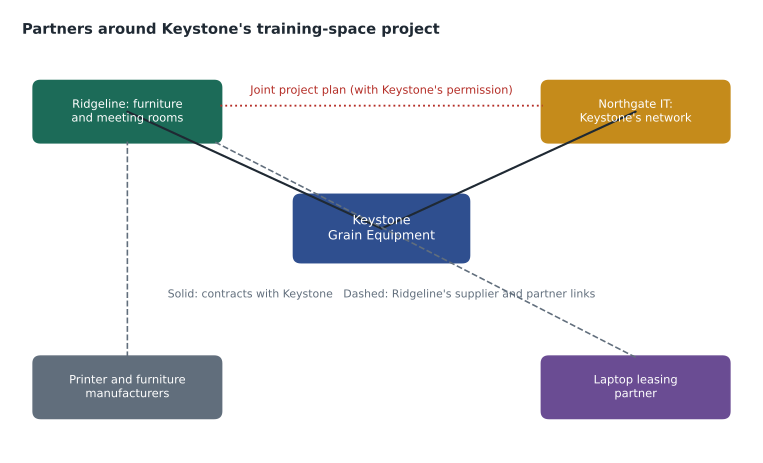
Keystone's dealer training center, the 48,000-dollar idea that would go to the owners' board in January 2027, needed more than Ridgeline could supply on its own. It needed furniture and meeting-room technology, which Ridgeline sold, and it needed changes to Keystone's network and a firewall rule for the video equipment, which Keystone's IT contractor, a small managed services firm called Northgate IT, controlled. In October, Northgate had nearly delayed the two-room order by asking questions about RoomFlow's security that nobody at Ridgeline had answered. Farida's advice to Maya was to stop treating Northgate as an obstacle. "For the training center, Northgate is a partner whether we like it or not. Better to plan that with them than around them."
A strategic partnership is a long-term relationship between two organizations that work together to create value neither could create as well alone. In key account management the word is used in two ways. The first is a partnership between the supplier and a key account itself, the partnership stage of the relationship described in lesson 1. The second is a partnership between the supplier and other companies, such as manufacturers, finance companies or service firms, that together serve the key account better. This lesson covers both.
Partnering with the customer
A supplier-customer partnership goes beyond buying and selling. The two organizations share information, plan together and agree on goals that both care about. They may share the savings or gains from changes they make together. At its best, the customer treats the supplier as an extension of its own team on a defined area of its business.
Partnerships of this kind are rarer than sales literature suggests. Many customers prefer to keep suppliers at arm's length, especially public bodies whose procurement rules require fair treatment of all suppliers. Many suppliers call every customer a partner, which empties the word of meaning. Researchers studying KAM have found that genuine partnership relationships require trust built over time, senior commitment on both sides and clear mutual benefit, and that they can be costly and slow to build. Farida reserved the word for relationships that met three tests: both sides shared information they would not share with others, both sides had agreed goals in writing, and both sides would lose something real if the relationship ended.
| Test | City facilities office | Riverbend Dental Group |
|---|---|---|
| Information shared beyond normal buying | Yes: five-year consolidation plans shared with Ridgeline | No |
| Agreed goals in writing | Yes: joint workplace plan reviewed each year | No |
| Both would lose something real if it ended | Yes: Ridgeline 318,000 dollars a year; the City its planning support and device data | Ridgeline 14,160 dollars a year; Riverbend little beyond switching effort |
| A partnership? | Yes, within procurement rules | Not yet: a good supplier relationship |
Partnering with a public body
The City showed how a partnership can work within public procurement. Ridgeline could not be given advantages in the next competition because of the relationship, and Farida never asked for any. What the partnership allowed was joint planning on the contract Ridgeline already had: shared data on print use, energy and room bookings, an annual workplace review with the facilities director, and early warning of changes such as the office consolidation. The City benefited from a supplier that understood its plans. Ridgeline benefited from knowing them in time to prepare.
Some public customers formalize this kind of relationship with gain-sharing clauses, in which savings from changes the supplier proposes are divided between the two parties for a period. Gain-sharing has to be written into the contract, usually at the time of award, and measured carefully, so that both sides agree what the saving actually was.
Worked problem
How a gain-sharing clause would work
Suppose the City's next managed print contract includes a clause under which Ridgeline receives 30 in 100 of any measured saving in the City's annual printing cost that results from changes Ridgeline proposes, for two years. Ridgeline proposes consolidating 96 devices to 82 and moving two buildings to secure release printing, which is expected to cut the City's annual printing cost from 157,440 dollars to 139,000 dollars. What would the City keep, and what would Ridgeline receive, each year?
Show solution
- Annual saving: 157,440 − 139,000 = 18,440 dollars.
- Ridgeline's share: 18,440 × 0.30 = 5,532 dollars a year.
- City's share: 18,440 − 5,532 = 12,908 dollars a year.
- Over two years: Ridgeline 11,064 dollars; the City 25,816 dollars.
Answer: The City would keep about 12,900 dollars a year and Ridgeline would receive about 5,500 dollars a year for two years. Ridgeline would lose some revenue from the smaller fleet, so the clause gives it a reason to propose the change anyway, which is the point of gain-sharing.
Partnering with other companies
No supplier makes everything its key accounts need. Ridgeline was a dealer and service company. It bought printers from a manufacturer, furniture from two manufacturers, video equipment from distributors, and arranged laptop leases through a finance company. Each of those relationships was also a kind of partnership, and the best of them made Ridgeline stronger in its key accounts.
| Partner type | What the partner provides | What Ridgeline provides | Ridgeline example |
|---|---|---|---|
| Manufacturer (vendor) partner | Products, training, certification, marketing funds, rebates, technical escalation | Sales, installation, service and local relationships | Printer and furniture manufacturers |
| Finance partner | Leases and financing for customers | Customer introductions and the equipment | Laptop leasing partner |
| Service or technology partner | Skills Ridgeline lacks, such as network management | Products and the customer relationship | Northgate IT at Keystone |
| Referral partner | Introductions to new customers | Introductions or fees in return | An office design firm that refers clients |
Manufacturer partners usually reward dealers for volume and capability. Ridgeline's printer manufacturer ran a tiered rebate program: the more Ridgeline bought in a year, the larger the rebate on every unit. Large key account wins, such as Prairie Valley's 44 devices, therefore had a value to Ridgeline beyond their own margin.
Worked problem
Reaching a rebate tier
Ridgeline's printer manufacturer pays a rebate of 2 in 100 on all purchases once a dealer buys 1.5 million dollars of equipment in a calendar year, and 3 in 100 once it buys 1.8 million dollars. By November 2026 Ridgeline has bought 1.72 million dollars. If the Prairie Valley contract is signed as planned and Ridgeline orders 44 devices costing an average of 2,100 dollars each before December 31, what would its 2026 rebate be, compared with not placing the order?
Show solution
- Without the order: 1.72 million is in the 2 in 100 tier, so the rebate is 1,720,000 × 0.02 = 34,400 dollars.
- Prairie Valley devices: 44 × 2,100 = 92,400 dollars.
- With the order: 1,720,000 + 92,400 = 1,812,400 dollars, which reaches the 3 in 100 tier.
- Rebate with the order: 1,812,400 × 0.03 = 54,372 dollars.
- Difference: 54,372 − 34,400 = 19,972 dollars.
Answer: Placing the Prairie Valley order in 2026 would raise Ridgeline's rebate by about 20,000 dollars, on top of the contract's own margin. That is useful for Ridgeline's planning, but it must never change what is right for the customer, such as the installation schedule agreed with the division.
The last sentence of the answer mattered to Farida. Partner incentives can pull a supplier toward decisions that suit the supplier rather than the customer: recommending one manufacturer's products because they carry a bigger rebate, or rushing a delivery to hit a year-end tier. In a key account, the customer will eventually notice. Ridgeline's sales code, introduced in November 2026, required that product recommendations be based on the customer's needs, and that any manufacturer incentive affecting a recommendation be disclosed to the customer on request.
Working with the customer's other suppliers
Key accounts usually have many suppliers, and some of them, like Northgate IT at Keystone, control things the supplier needs. Treating those suppliers as rivals makes projects slower and customers unhappier. Treating them as partners, within limits, usually works better.
Maya's plan for the training center, written with Farida, did three things. It asked Dale Petrie for permission to contact Northgate directly. It offered Northgate a technical session with Ridgeline's network specialist on RoomFlow's security design, answering the October questions in writing. And it proposed a joint project plan for the training center with Northgate's tasks, Ridgeline's tasks and Keystone's decisions on one page, so that Dale would see a single schedule rather than two suppliers pointing at each other.
Partnering with another supplier has limits. Ridgeline would not share its prices with Northgate, would not agree to divide Keystone's spending between them, and would not coordinate bids. Agreements between competitors or potential competitors about prices, customers or bids can be serious offenses. In the United States, bid rigging, price fixing and customer allocation between competitors are generally treated as violations of section 1 of the Sherman Act, as SLS-150 explains. Working together on a project the customer has asked for is lawful; agreeing how to compete is not. When in doubt, Ridgeline's account managers asked Leah Marchand before any joint bid or teaming arrangement.
Joint business planning
For the deepest customer partnerships, and for important vendor partners, suppliers often use a joint business plan: a plan written and owned by both organizations, setting shared goals, the actions each will take and how progress will be measured. It is the shared part of an account plan taken further.
| Section | City joint workplace plan, 2027 draft |
|---|---|
| Shared goals | Support the consolidation of two leased offices by 2028; reduce printing cost per page; improve room availability |
| City commitments | Share consolidation timeline and floor plans; nominate a room owner in each building; review data quarterly |
| Ridgeline commitments | Device and room-use reports each quarter; second winter technician; meeting-room scoping by January |
| Measures | Cost per page, room utilization and adoption, service response |
| Review | Annual workplace review in February 2027, quarterly reviews in between |
Farida had drafted it for the February 2027 workplace review, where the City would amend and agree it. The plan would not commit the City to buying anything; procurement rules would still govern every purchase. What it committed both sides to was working on the same goals with the same information.
When a partnership ends
Partnerships end for many reasons: a customer's strategy changes, a public contract goes to a new competition, a manufacturer changes its dealer network, or one side stops getting enough value. A partnership that ends badly can damage relationships far beyond the two organizations, because the people involved stay in the same industry and talk to each other. Farida's guidance for ending a partnership was the same as for any key account that leaves: honor every remaining commitment, hand over information the other side is entitled to, such as device data, reports or customer records it owns, help with the transition if asked, and keep the tone professional. The City had been told, for example, that whatever the outcome of the 2027 competition, Ridgeline would hand over eight years of device and print data in a usable format. Promising that in advance cost Ridgeline nothing and showed the City that its data was its own.
Managing partners like key accounts
Important partners deserve some of the same disciplines as key accounts: a named owner, regular reviews, a relationship map and an honest view of the relationship's health. A manufacturer partner that loses confidence in a dealer may allocate scarce products elsewhere or move territories. A finance partner that is unhappy with the quality of referrals may tighten its terms. Farida met Ridgeline's printer manufacturer's regional manager twice a year, with a short review of Ridgeline's sales, certifications, service results and key account wins and losses.
Common mistakes
MistakeCalling every customer a partner.
InsteadReserve the word for relationships with shared information, agreed goals and mutual stakes.
MistakeExpecting a partnership with a public body to bring advantages in competitions.
InsteadUse partnership for joint planning on current work and follow procurement rules for every new purchase.
MistakeLetting partner rebates shape what you recommend.
InsteadRecommend on the customer's needs and disclose incentives that affect a recommendation on request.
MistakeTreating the customer's other suppliers as rivals on every project.
InsteadPlan shared projects together with the customer's permission.
MistakeCoordinating prices or bids with another supplier.
InsteadNever agree prices, customers or bids with competitors; check teaming arrangements with the contracts manager.
Summary and key terms
- A strategic partnership is a long-term relationship in which two organizations create value together that neither could create as well alone.
- A supplier can partner with a key account itself or with other companies that help serve it.
- Genuine customer partnerships are less common than the word suggests; they involve shared information, agreed written goals and mutual stakes.
- With public bodies, partnership means joint planning on current work within procurement rules.
- Gain-sharing clauses divide measured savings between the parties.
- Manufacturer, finance, service and referral partners help a supplier serve key accounts, but their incentives must not override the customer's needs.
- Working with a customer's other suppliers on agreed projects usually serves the customer, but agreements with competitors about prices, customers or bids can be serious offenses.
- Joint business plans put shared goals, commitments and measures in one document.
- Important partners deserve key-account disciplines.
- Strategic partnership
- A long-term relationship in which two organizations create value together that neither could create as well alone.
- Gain-sharing
- A contract arrangement in which savings from the supplier's proposals are divided between supplier and customer for a period.
- Vendor partner
- A manufacturer whose products a dealer sells, often providing training, certification and rebates.
- Rebate tier
- A purchase level at which a manufacturer's rebate rate rises.
- Joint business plan
- A plan written and owned by two organizations setting shared goals, actions and measures.
- Bid-rigging
- An agreement between bidders about who will win or what they will bid, which is illegal.
Practice problems
Work each problem on paper first, then reveal the answer to check.
A gain-sharing clause gives the supplier 25 in 100 of a 20,000-dollar annual saving for three years. What does each side receive in total?
Show answer
Supplier: 5,000 a year, 15,000 over three years; customer: 15,000 a year, 45,000 over three years.
A dealer has bought 0.95 million dollars. The rebate is 1 in 100 below 1 million and 2 in 100 from 1 million. What does an extra 80,000-dollar order do to the rebate?
Show answer
Without it: 950,000 × 0.01 = 9,500 dollars. With it: 1,030,000 × 0.02 = 20,600 dollars, an increase of 11,100 dollars.
Why did Maya ask Dale Petrie before contacting Northgate IT?
Show answer
Northgate works for Keystone; contacting it directly without permission could breach Keystone's trust and its arrangements with its own supplier.
Lesson quiz · 5 questions
Score 60% or more to complete this lesson.
Create a free account to save your progress, take quizzes and earn a certificate.