
SLS-220 · Lesson 12 of 12 · 21 min
Case study: an account plan
▶ Video coming soon A video version of this lesson is on the way.
On Tuesday, November 10, 2026, Colleen Sawatzky, the procurement officer at Prairie Valley School District, told Ridgeline that it had been selected for the managed print contract at about 66,000 dollars a year, subject to approval by the board on November 17 and a signed contract. Darnell Brooks rang the bell in the sales office. Farida Haddad opened a blank account plan. By Friday morning, November 13, she and Maya had a complete draft ready for Rob Kowalski's review, and this lesson walks through it section by section.
The plan was written before Prairie Valley was a signed customer. Everything in it about 2027 is a plan: the board might not approve, the contract terms might change, and the rollout dates had still to be agreed with the division. Farida wrote it anyway. "If we wait until the contract is signed to plan the account, the first three months will be spent reacting," she said. "The plan is how we make sure the first impression is the one we intend."
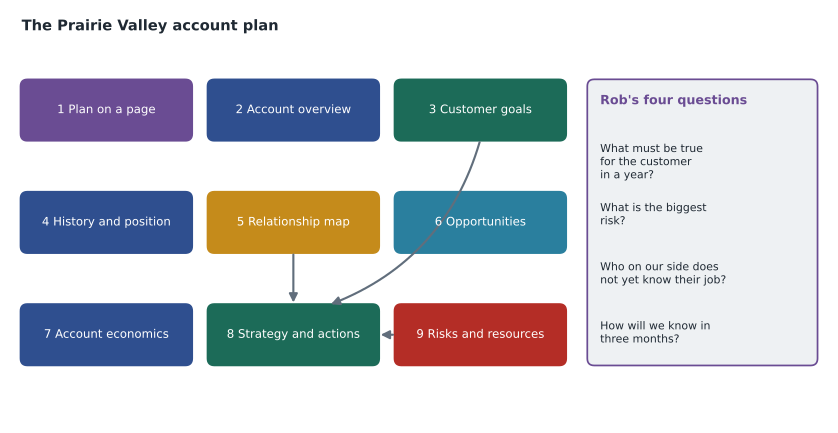
1. The plan on a page
| Element | Draft content |
|---|---|
| Objectives for fiscal 2027 | Complete the rollout to all 15 sites by the end of February 2027 with no lost teaching time; meet the four-business-hour service response on at least 95 in 100 calls every quarter; reach a health score of 75 by November 2027; agree one further project with the division by the end of fiscal 2027 |
| Top actions | Signing and handover meeting; rollout plan agreed with Patricia Klassen and Ken Fehr; pilot at Sarah Nakamura's school; first monthly report; first business review in April 2027 |
| Top risks | Board approval; Ken Fehr's retirement; disruption during the rollout; resistance from staff loyal to the old supplier |
| Executive sponsor | Rob Kowalski |
| Next review | Internal: December 2026 key account meeting. With the customer: April 2027 |
Rob's first comment was about the objectives. "There is only one revenue objective, and it is vague." Farida agreed it was deliberate. In the first year of a public contract, the priority was to deliver what had been promised, flawlessly. Growth would come from the record. The fourth objective, one further project, was there so that the team would look for the right one, not to set a target the division had not asked for.
2. Account overview
Prairie Valley is a public school district with 14 schools and a district office, serving students from kindergarten to grade 12 across a mix of urban and rural communities. Its operating budget is about 86 million dollars. Its fiscal year runs from July 1 to June 30, and its budget for the following year is built in the spring and approved by the board. Large purchases follow public procurement rules; the managed print contract was awarded through a request for proposals issued on September 14, 2026.
3. Customer goals and challenges
Farida listed the goals Ridgeline had heard during the competition, with sources. She was careful to separate what the division had said publicly or in writing from what individual people had said in meetings before the competition began.
| Goal or challenge | Source |
|---|---|
| Control costs and make spending predictable | The request for proposals; Patricia Klassen, early September 2026 |
| Reduce the number of printer models (61 to 44 devices of fewer types) | The request for proposals |
| Protect the network and student information | Ken Fehr, before the competition; the request for proposals' security section |
| No disruption to teaching | The request for proposals' implementation section; principals on the technology committee |
| Clear reporting for the board | The superintendent's office, early September 2026 |
| The right to end the contract if service fails | The superintendent's office, early September 2026 |
4. History and current position
Ridgeline's history with Prairie Valley was more than a year of relationship-building by Darnell, a successful response to the request for proposals, a presentation on October 27 and a best and final offer at the end of October. Ridgeline's first prices had been compared with two competitors; its final price was not the lowest, but it scored highest overall on the published criteria. Ridgeline had no installed base at the division and no service record there yet. Its share of the division's spending in Ridgeline's categories was zero, and would become most of the division's print spending once the contract started.
5. Relationship map
The map from lesson 3 was carried into the plan, updated with the proposed owners and first steps. The coverage score in mid-October had been about 39 in 100. The plan's objective was to raise it above 70 in 100 by the end of the rollout, chiefly by giving Ken Fehr a Ridgeline owner, building Rob's relationship with the superintendent's office and making sure that Darnell's relationships were handed over in person.
Worked problem
What would coverage be after the plan's first steps?
Using Farida's coverage measure from lesson 3, suppose that by the end of the rollout the superintendent is at strength 2 (owned by Rob), Patricia Klassen at strength 3 (owned by Farida) and Ken Fehr at strength 2 (owned by Ridgeline's network specialist). What would the coverage score be?
Show solution
- Superintendent: 2 × 1 = 2.
- Patricia Klassen: 3 × 1 = 3.
- Ken Fehr: 2 × 1 = 2.
- Total: 2 + 3 + 2 = 7, out of a maximum of 9.
- \[\frac{7}{9} = 0.778 \approx 78 \text{ in } 100\]
Answer: Coverage would rise from about 39 to about 78 in 100, above the plan's target of 70. The largest single gain comes from Ken Fehr, who moves from unowned at strength 1 to owned at strength 2.
6. Opportunities
Farida listed opportunities without forecasting them, because the division had not asked for any of them and its budget was set for the year. They were things to watch for and to raise only if they served a goal the division named.
- Meeting-room booking for the district office's shared rooms, if the office's planned reorganization goes ahead.
- Office furniture for school front offices, if the division renovates any in its capital plan.
- Secure release printing for staff rooms, if Ken Fehr's successor wants tighter control of printed student information.
None of these appeared in the fiscal 2027 revenue forecast. "If we sell anything else to Prairie Valley in the first year," Farida told Rob, "it should be because they asked."
7. Account economics
Rob asked what the account would be worth to Ridgeline, and when. Farida had prepared the numbers with Grace Liu.
Worked problem
First-year and three-year contribution
The contract brings in 66,000 dollars a year. Ridgeline's gross margin on the managed print service is estimated at 31 in 100. Cost to serve is higher in the first year because of the rollout: about 14,500 dollars in year 1 (installation crew, training, project management) and about 7,800 dollars a year after that (service, reporting, account management). What is the contribution in year 1, in year 2 and over the first three years? What share of three-year revenue is that?
Show solution
- Annual gross margin: 66,000 × 0.31 = 20,460 dollars.
- Year 1 contribution: 20,460 − 14,500 = 5,960 dollars.
- Years 2 and 3 contribution: 20,460 − 7,800 = 12,660 dollars each.
- Three-year contribution: 5,960 + 12,660 + 12,660 = 31,280 dollars.
- Three-year revenue: 66,000 × 3 = 198,000 dollars.
- \[\frac{31{,}280}{198{,}000} = 0.158 \approx 16 \text{ in } 100\]
Answer: The account contributes about 5,960 dollars in its first year and about 12,660 dollars a year after that, about 31,300 dollars over three years, or about 16 in 100 of revenue. Year 1 is thin because the rollout is expensive, which is one more reason to get it right the first time.
The figures leave out two things Farida mentioned to Rob without putting a number on them: the value of Prairie Valley as a reference for other school divisions or districts, and the effect of the order on Ridgeline's manufacturer rebate tier (lesson 10). Both were real; neither belonged in the account's own contribution, because counting them there would make the account look better than its own economics justified.
8. Strategy and actions
Farida's strategy for the first year was one sentence: "Deliver a rollout and first year so smooth that the division's staff stop thinking about printing, and give the business office reports that make its decision look wise." The action list followed from it.
| Action | Owner | Due (plan) | Done when |
|---|---|---|---|
| Signing and joint handover meeting with Darnell and Farida | Farida | Week of November 23, 2026 | Contract signed; division contacts know who does what |
| Agree the rollout plan and site schedule | Installation lead with Patricia Klassen and Ken Fehr | December 11, 2026 | Schedule signed off by the division |
| Technical session on device security with Ken Fehr | Ridgeline network specialist | December 2026 | Ken's questions answered in writing |
| Pilot installation at Sarah Nakamura's school | Installation lead with Maya | First week of January 2027 | Pilot reviewed and lessons applied |
| Meet every site contact during installation | Installation lead | January to February 2027 | Names, hours and preferences recorded |
| First monthly report to the business office | Service manager with Grace Liu | March 2027 | Report sent and explained |
| Introductory meeting with the superintendent's office | Rob | February 2027 | Meeting held; priorities recorded |
| Orientation for Ken Fehr's successor | Network specialist with Farida | When appointed | Meeting held; successor added to the map |
| First business review | Farida | April 2027 | Review held; summary sent within two days |
9. Risks and resources
| Risk | Likelihood | Impact | Response |
|---|---|---|---|
| The board does not approve on November 17 | Low | High | Nothing to do but be ready; if delayed, keep the plan and adjust dates |
| Ken Fehr's successor arrives with different priorities | High | Medium | Orientation on appointment; document every network decision now |
| Rollout disrupts teaching | Medium | High | Pilot first; avoid exam periods and busy days; install outside class time where possible |
| Staff loyal to the old supplier resist the change | Medium | Medium | Involve them in testing; train at each school; respond fast to early problems |
| Service response slips in winter | Medium | Medium | Second technician available from December, shared with the City |
| A competitor challenges the award | Low | High | Leave it to the division and its procurement process; make no public comment |
The resources section was short: the installation crew for about 19 crew-days in January and February, two days of the network specialist's time, a monthly report from Grace, about nine hours a month of Farida's time and Rob's time for two meetings a year. Rob compared it with the winter technician already planned for the City and agreed that the two accounts could share him.
Rob's review
Rob read the plan in twenty minutes and asked four questions. They are the questions any senior reviewer of an account plan should ask.
| Rob's question | Farida's answer |
|---|---|
| What does the customer need to be true in a year? | Printing works without anyone noticing, costs are predictable and the business office can show the board the savings. |
| What is the biggest thing that could go wrong? | A rollout that disrupts classes. Hence the pilot, the schedule and the site contacts. |
| Who on our side does not yet know what they have to do? | The second winter technician and the network specialist. Both will be briefed next week. |
| How will we know in three months whether this is working? | Rollout finished on time, the first monthly report delivered, no complaints from principals, coverage above 70. |
He approved the plan with two changes. He moved his own meeting with the superintendent's office from February to the week after signing, because a first meeting after the rollout had started would look like a reaction to problems rather than a commitment. And he asked Farida to add one measure to the plan on a page: the number of complaints from principals each month, with a target of zero.
What the case shows
The Prairie Valley plan used every lesson in the course. It started from the customer's goals (lessons 2 and 4), mapped the relationships and their gaps (lesson 3), planned business reviews with honest data (lesson 5), deliberately did not forecast expansion (lesson 6), put the contract's key dates in the renewal calendar from the first day (lesson 7), treated known changes of people as risks with responses (lesson 8), built in onboarding and a handover (lesson 9), recognized the manufacturer and service partners involved without letting them distort the plan (lesson 10), and planned the rollout across 15 sites (lesson 11).
Most of all, it showed the habit Farida had been teaching all fall: writing down what Ridgeline intended to do for a customer, who would do it and how everyone would know it had been done, and then reading it again every quarter. "A key account is a promise kept over years," she told Maya. "The plan is how we remember what we promised."
Common mistakes
MistakeWaiting until a contract is signed to plan the account.
InsteadDraft the plan as soon as the award is likely, so the first months are planned rather than reactive.
MistakeForecasting expansion the customer has not asked for.
InsteadList opportunities to watch, and forecast only what is grounded in the customer's plans.
MistakeCounting reference value or rebates in an account's own contribution.
InsteadKeep the account's economics to its own revenue and costs, and note other benefits separately.
MistakeWriting objectives that cannot be checked.
InsteadMake each objective measurable and dated, like rollout completion, service response and health score.
MistakeLeaving the plan unreviewed by anyone senior.
InsteadAsk a senior reviewer the four questions: customer outcome, biggest risk, unclear roles and early measures.
Summary and key terms
- The Prairie Valley account plan was drafted between the award on November 10, 2026 and a review on November 13, before the contract was signed, so that the first months would be planned.
- Its plan on a page set measurable first-year objectives focused on delivery, not growth.
- The customer's goals were recorded with sources, separating public statements from private conversations.
- The relationship map set a coverage target and owners for every high-influence stakeholder.
- Opportunities were listed but not forecast.
- Account economics showed a thin first year because of the rollout and about 16 in 100 contribution over three years, excluding reference value and rebates.
- The strategy and actions focused on a smooth rollout and good reporting, with owners and dates.
- Risks were listed with likelihood, impact and responses.
- A senior review asked four questions and added a measure of principals' complaints.
- Award
- A customer's decision to select a supplier, often subject to approval and a signed contract.
- Contribution
- Gross margin minus the cost to serve an account over a period.
- Coverage target
- The relationship coverage score an account plan aims to reach by a date.
- Risk register
- A list of risks with their likelihood, impact and planned response.
- Reference value
- The benefit a supplier gets from being able to name a customer to others.
- Senior review
- A review of an account plan by a sales leader who checks outcomes, risks, roles and early measures.
Practice problems
Work each problem on paper first, then reveal the answer to check.
A contract brings in 40,000 dollars a year at a 30 in 100 margin. Cost to serve is 9,000 dollars in year 1 and 4,000 dollars after that. What is the three-year contribution?
Show answer
Gross margin 12,000 a year; contributions 3,000, 8,000 and 8,000; total 19,000 dollars.
Why did Farida not forecast any expansion revenue from Prairie Valley in fiscal 2027?
Show answer
The division had not asked for anything else, its budget was set for the year, and the priority was to deliver the contract flawlessly.
Why did Rob move his meeting with the superintendent's office to the week after signing?
Show answer
A meeting after the rollout started could look like a reaction to problems; meeting at the start shows commitment.
Lesson quiz · 5 questions
Score 60% or more to complete this lesson.
Create a free account to save your progress, take quizzes and earn a certificate.