
SLS-250 · Lesson 1 of 12 · 19 min
Retail selling today
▶ Video coming soon A video version of this lesson is on the way.
On Monday, October 19, 2026, Aiden Laroque pinned a new name badge to his dark green shirt. For his first seven weeks at Juniper & Pine Home he had worked hourly in décor and small furniture, ringing up lamps, throws and side tables and earning a small bonus on protection plans. Now Bev Halvorsen, the store manager, had moved him to the main floor: sofas, sectionals, bedroom furniture, mattresses and, on busy days, appliances. He would earn a lower base wage plus commission on margin, the same plan as Carl Jensen, who had sold on that floor for nine years and kept every customer's details in a battered paper binder.
Bev gave Aiden a schedule for the next four weeks. Every Thursday morning before the doors opened at 10, she would run a short "floor school" for him and two other new associates. Carl would be his floor mentor. And on Saturday, November 7, Bev would shadow him for a whole shift and score him against the store's selling checklist. "In décor, customers mostly know what they want," she told him. "On this floor, people come in with a problem, a budget and a lot of worries. Your job is to help them make a decision they will be glad about in five years."
This course follows Aiden through those weeks. It builds on the year-one courses: the sales process from SLS-101, buyer behavior from SLS-110, conversation skills from SLS-120, service from SLS-130 and the clienteling tools from SLS-140. Here the focus is the retail sales floor itself: how to approach shoppers, find out what they need, know and show the product, add the right extras, close at the counter and build a client book that brings people back.
What retail selling is
Retail selling is helping individual customers, usually people buying for themselves or their household, choose and buy products, in a store, by phone or online. It differs from business-to-business selling in several ways. The buyer is usually one person or a couple rather than a committee. The sale is often completed in one visit, or in two or three visits over a few weeks for large purchases. The customer chooses when to come in, so the salesperson rarely prospects in the B2B sense. And the store itself, its layout, displays and prices, does much of the selling before any conversation starts.
Retail is also enormous. It is one of the largest employers in both countries, and sales associates and cashiers are among the most common jobs. SLS-101 gave the wage picture: retail salespersons earn a median of about 17 dollars an hour in both countries, with commission sellers of furniture, appliances, vehicles and electronics often earning considerably more. Many store managers, buyers and regional leaders started on the sales floor.
| Retail floor (Juniper & Pine) | Business sales (Ridgeline) | |
|---|---|---|
| Who buys | A person or household | An organization, often several decision makers |
| Who starts contact | Usually the customer, by walking in or browsing online | Usually the seller, by prospecting |
| Length of sale | Minutes to a few weeks | Weeks to months |
| Size of sale | Tens to a few thousand dollars | Thousands to hundreds of thousands of dollars |
| Role of the environment | Large: layout, displays, prices and stock do much of the selling | Small: the seller and the proposal carry the sale |
| Repeat business | Built through service, client books and loyalty | Built through account management and renewals |
How shoppers buy now
Very few furniture or appliance shoppers walk into a store cold. Most have looked online first: at the store's website, at competitors, at review sites and at videos. Some arrive with a screenshot of a product and a price from another retailer. Others have narrowed the choice to two models and want to see, touch and test before deciding. SLS-110 described this "research online, buy in store" pattern and its reverse, "showrooming", where shoppers test in store and then buy online.
For the salesperson, this changes the job in three ways. First, customers often know the specifications already, so reciting them adds little; what they need is help applying the information to their own home and life. Second, customers can check claims instantly on their phones, so every statement must be accurate. Third, the store competes not only with other stores but with the convenience of buying from a sofa at home. A visit has to be worth the drive: a better decision, a better experience, the chance to try the product, expert advice and confidence about delivery and service.
Bev puts it bluntly at her pre-shift huddles: "If all you do is read the tag to them, they could have stayed home."
What a retail salesperson actually does
A day on the main floor at Juniper & Pine mixes selling with many other tasks. Associates greet and help shoppers, but they also follow up with past customers, answer phone and online enquiries passed from the website, check stock and delivery dates, write up orders, arrange financing applications with the partner lender, keep their area tidy and the price tags correct, learn new products, and help with deliveries that go wrong. On a Saturday, selling dominates; on a quiet Tuesday morning, follow-up, product study and client-book work fill most of the time. Lesson 11 looks at how to use quiet periods well.
| Activity | Hours | Share of week |
|---|---|---|
| Helping shoppers on the floor | 19 | about 56 in 100 |
| Writing orders, checking stock and delivery | 5 | about 15 in 100 |
| Follow-up calls, texts and client-book notes | 4 | about 12 in 100 |
| Product training and study | 3 | about 9 in 100 |
| Huddles, tidying and price checks | 3 | about 9 in 100 |
The shares add to 101 in 100 because of rounding. The point Bev drew from the table was that less than three fifths of Aiden's paid time was spent in front of customers, so the quality of those conversations matters a great deal.
The retail selling process
The steps of retail selling follow the general sales process from SLS-101, adapted to a floor where customers arrive on their own schedule. Juniper & Pine trains a seven-step version, and this course follows it.
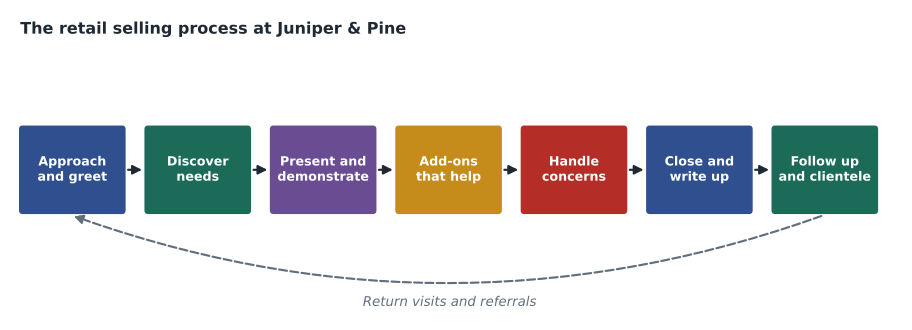
The steps are not a script. A customer who walks in knowing exactly which mattress they want needs a quick confirmation, a test and a smooth write-up, not a twenty-minute discovery conversation. A couple furnishing their first home may need two visits and an hour each time. Skilled salespeople move through the steps in the order the customer needs and skip what does not help.
How retail selling is measured
Stores track a small set of numbers that describe how well the floor is selling. Aiden will meet them throughout the course, and lesson 11 uses them to plan his days.
| Measure | How it is calculated | What it tells you |
|---|---|---|
| Traffic | Number of shopping groups (people shopping together) who enter | How many chances the store had |
| Conversion rate | Transactions divided by shopping groups | How many of those chances became sales |
| Average transaction value (ATV) | Sales dollars divided by transactions | How large each sale is |
| Units per transaction (UPT) | Items sold divided by transactions | How many items each sale includes |
| Attachment rate | Sales that include a given add-on divided by eligible sales | How often a related product or service is added |
| Sales per hour | Sales dollars divided by hours worked | How productive each associate's time is |
Sales dollars equal traffic times conversion times average transaction value. This simple relationship shows why stores pay attention to all three: a store can grow sales by bringing in more shoppers, by helping more of them buy, or by helping each buyer leave with a more complete solution.
Worked problem
Where could the furniture floor grow?
In a typical week, Juniper & Pine's furniture department sees about 600 shopping groups. About 90 of them buy, and the average transaction is 1,150 dollars. What are weekly sales and the conversion rate? Bev's goal for the holiday season is to raise conversion to 17 in 100 with the same traffic and average transaction. What would weekly sales be?
Show solution
- Weekly sales today: transactions times average transaction value.
- \[90 \times 1150 = 103\,500\]
- Conversion rate today: transactions divided by shopping groups.
- \[90 \div 600 = 0.15\]
- At 17 in 100, transactions would be 600 times 0.17.
- \[600 \times 0.17 = 102\]
- New weekly sales: 102 transactions times 1,150 dollars.
- \[102 \times 1150 = 117\,300\]
Answer: Today the department sells about 103,500 dollars a week at a conversion rate of 15 in 100. Raising conversion to 17 in 100 would add 12 sales and about 13,800 dollars a week without a single extra shopper.
Twelve more sales a week sounds modest, but it means helping two more shopping groups a day decide. Bev's view is that most of those extra sales are lost today not because the store lacks the right product, but because shoppers leave without being greeted, without being asked what they need, or without being helped to decide.
Ethics on the floor
Commission selling creates real temptations: steering customers to higher-margin products they do not need, overstating what a product can do, pushing protection plans with fear, or promising delivery dates the warehouse cannot meet. SLS-150 covers the law; this course returns to the practical ethics at each step. Juniper & Pine's rule is simple and is printed on the back of every associate's badge: "Sell what you would buy if you were them."
The rule is also good business. Furniture and appliances are bought rarely, so a household that feels well treated comes back years later for the next room and tells friends and family. A household that feels pushed leaves a review, returns the product within the return window, or never comes back. Carl's binder is full of customers on their third or fourth purchase with him, and he attributes most of his income to repeat and referred customers rather than to anyone he met for the first time that week.
Where retail selling leads
Many people treat a sales-floor job as temporary, but the skills it builds are the foundation for most careers in retail and beyond. Associates who learn to read customers, know products deeply and keep accurate records often move into specialist roles, such as appliance specialist or design consultant, then into department lead and assistant manager positions, and later into store management, buying or regional roles. Bev herself started on the décor floor of another store, became a mattress specialist and was managing a department within four years. Others move sideways into business-to-business sales, as Maya Chen did when she left Juniper & Pine's appliance floor for Ridgeline. The retail track of this program follows that path: after this course come visual merchandising, store operations, retail math, omnichannel selling, high-ticket sales, loyalty marketing and finally sales leadership.
The course also uses Ridgeline Workplace Solutions, the business-to-business company from year one, as an occasional comparison, because seeing how Maya handles a similar problem with an organization often makes the retail version clearer.
Common mistakes
MistakeRetail selling is just answering questions and ringing up sales.
InsteadGood retail selling means understanding the customer's situation and helping them make a decision they will be glad about, then following up.
MistakeCustomers who have researched online do not need a salesperson.
InsteadThey often need help applying what they read to their own home and confidence about the decision, delivery and service.
MistakeConversion rate is sales dollars divided by shoppers.
InsteadConversion rate is transactions divided by shopping groups. Sales dollars divided by transactions is the average transaction value.
MistakeEvery customer should go through all seven steps.
InsteadThe steps are a guide. Move through them in the order the customer needs and skip what does not help.
MistakeCommission sellers should always steer to the highest-margin product.
InsteadSteering customers to products they do not need loses returns, reviews and repeat business. Sell what you would buy in their place.
Summary and key terms
- Retail selling helps individual customers choose and buy, usually in one or a few visits, with the store environment doing much of the work.
- Most shoppers research online first, so salespeople add value by applying information to the customer's situation, demonstrating products and giving confidence.
- A retail associate's day mixes selling with order writing, follow-up, product study and store tasks.
- Juniper & Pine's seven-step process runs from approach and greeting to follow-up and clienteling, adapted to each customer.
- Sales equal traffic times conversion rate times average transaction value; units per transaction and attachment rate describe how complete each sale is.
- Ethical selling is also good business in retail, because furniture and appliance customers come back and refer others when they are treated well.
- Shopping group
- One person or several people shopping together, counted as one chance to make a sale.
- Conversion rate
- Transactions divided by shopping groups.
- Average transaction value (ATV)
- Sales dollars divided by the number of transactions.
- Units per transaction (UPT)
- Items sold divided by the number of transactions.
- Attachment rate
- The share of eligible sales that include a particular add-on product or service.
- Showrooming
- Testing products in a store and then buying them elsewhere, usually online.
Practice problems
Work each problem on paper first, then reveal the answer to check.
Name two ways retail selling differs from business-to-business selling.
Show answer
Any two of: the buyer is a household rather than an organization; customers usually start the contact; sales are shorter and smaller; the store environment does much of the selling.
A department sees 400 shopping groups and makes 52 sales. What is its conversion rate?
Show answer
52 divided by 400 is 0.13, or 13 in 100.
The same department sells 59,800 dollars from those 52 sales. What is the average transaction value?
Show answer
59,800 divided by 52 is 1,150 dollars.
Why does Bev say that reading the tag to customers is not enough?
Show answer
Customers can read specifications online; they need help applying them to their own situation, plus a demonstration and confidence.
Lesson quiz · 5 questions
Score 60% or more to complete this lesson.
Create a free account to save your progress, take quizzes and earn a certificate.