
SLS-250 · Lesson 11 of 12 · 19 min
Selling in busy and quiet periods
▶ Video coming soon A video version of this lesson is on the way.
Retail traffic is uneven. At Juniper & Pine, a Saturday afternoon can bring more shoppers through the furniture entrance in one hour than a Tuesday morning brings in four. On Saturday, October 24, Aiden counted 31 shopping groups between 11 and noon; on Tuesday, October 27, he counted 6 between 10 and noon. The skills needed for each are different. On a busy afternoon, the challenge is giving every shopper enough attention without leaving anyone stranded. On a quiet morning, the challenge is using the time well instead of waiting by the door.
This lesson covers both. It shows how stores plan staffing from traffic patterns, how associates share the floor fairly when it is busy, how to serve several customers at once without being rude, how to prepare for peak periods such as the holiday season, and how to turn quiet hours into future sales.
Traffic patterns
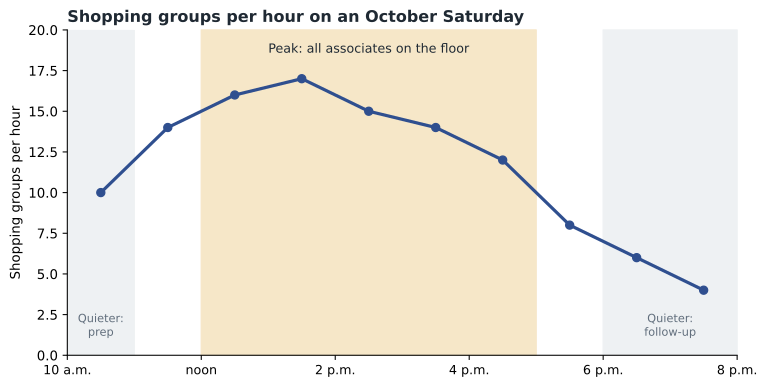
Most furniture and appliance stores see the same broad pattern: weekends busier than weekdays, afternoons busier than mornings, evenings busier on weeknights when stores stay open late, and big spikes around holidays, long weekends, sales events and paydays. Juniper & Pine counts traffic with a door counter and adjusts for groups and staff, then uses the counts to schedule associates.
| Period | Weekday | Saturday | Sunday |
|---|---|---|---|
| 10 to noon | 5 | 24 | 12 |
| Noon to 2 | 9 | 33 | 27 |
| 2 to 5 | 11 | 41 | 30 |
| 5 to close | 14 | 18 | 9 |
The counts explain why Bev schedules her strongest sellers on Saturday afternoons and uses weekday mornings for training, follow-up and floor resets. They also explain why the store's numbers, lesson 1's conversion rate and average transaction, should be read by period: a low conversion rate on a busy Saturday may mean associates could not reach everyone, while a low rate on a quiet Tuesday may mean something else.
Worked problem
How many associates does Saturday afternoon need?
On Saturdays between 2 and 5, the furniture floor averages 41 shopping groups. Bev estimates that a good main-floor conversation takes about 15 minutes on average, counting quick help and long consultations together, and that about 3 in 4 groups will want a conversation if offered one. Each associate can realistically spend about 45 minutes of each hour with customers, after counter time and breaks. How many associate-hours are needed over the three hours, and how many associates is that?
Show solution
- Groups wanting a conversation.
- \[41 \times 0.75 = 30.75\]
- Customer minutes needed over the three hours.
- \[30.75 \times 15 = 461.25\ \text{minutes}\]
- Customer minutes one associate can give in three hours.
- \[3 \times 45 = 135\ \text{minutes}\]
- Associates needed.
- \[461.25 \div 135 \approx 3.4\]
Answer: About 3.4 associates are needed, so Bev schedules four on the furniture floor on Saturday afternoons, plus the appliance specialist. With three, about one shopping group in five who wanted help would likely not get a full conversation.
Staffing models like this are estimates, not precise forecasts. They depend on assumptions about conversation length and demand that change with the season and the product. Their value is in making the trade-off visible: too few associates lose sales, too many cost wages and leave associates competing for customers.
Sharing the floor fairly
In commission stores, busy periods test teamwork. Lesson 2 introduced the up system that decides who greets the next arriving customer. Juniper & Pine adds a few rules for busy times. An associate who is with a customer keeps that customer, and colleagues help rather than take over. A customer who returns asking for a particular associate goes to that associate if they are working, or is helped by a colleague who records the original associate on the sale under the store's split rules. Associates do not pass on "difficult" customers or cherry-pick shoppers who look likely to spend more, which is unfair to colleagues and to customers alike.
Clear rules prevent the friction that commission can create. Carl, who has seen several systems in nine years, says the best floors are the ones where everyone knows the rules and nobody has to argue about them on a busy Saturday.
Serving several customers at once
Even with good staffing, there are moments when one associate has two or three groups needing attention. The aim is to make every group feel looked after while giving each the time it needs. Several habits help. Acknowledge new arrivals immediately and say when you will be free, as lesson 2 described. Give customers who are testing something a task and time: lying on mattresses, measuring with the store's tape, browsing fabric samples or using the room planner. Check back at a set time and keep the promise. Ask a colleague to take over if a customer is waiting too long. And never abandon a customer mid-decision to greet someone else.
| Situation | What Aiden did |
|---|---|
| A couple testing mattresses when a man arrives at the recliners | Told the couple, "Take your time, I'll be back in five minutes," and greeted the man |
| The man wants to measure his space first | Lent him a tape and the store's measuring card; offered to hold the recliner for 48 hours |
| A woman at the counter waiting to finish a sofa order | Asked a colleague to start her paperwork, then joined to complete and read back the order |
| The couple ready to decide | Returned at five minutes as promised, completed discovery questions on the base and moved to the counter |
Preparing for peak periods
The weeks before the holidays are the busiest of the year for most furniture and appliance stores. In Canada, Black Friday has become a large sales event in late November, alongside Boxing Day after Christmas; in the United States, the Thanksgiving weekend, including Black Friday, has long been one of the busiest shopping periods. In 2026, Black Friday falls on November 27.
At Juniper & Pine, holiday preparation starts in early November and is written as a plan that associates review at floor school.
| When | Plan |
|---|---|
| By November 13 | Every associate knows the advertised items, their stock levels and the rain check procedure |
| By November 20 | Floor reset by Noura Saleh's team; advertised items placed where they can be found easily |
| Week of November 23 | Extra associates and a second counter terminal scheduled; breaks staggered |
| November 27 to 30 | Up system with a "quick help" role for associates answering fast questions; delivery calendar checked hourly |
| December | Delivery cut-off dates for Christmas explained at every sale; follow-up calls moved to quiet mornings |
Peak periods also raise the stakes for honesty. Advertised prices, stock limits and delivery dates must be stated accurately even when the floor is packed, and lesson 8's rules on advertised items and rain checks apply with special force. Promising Christmas delivery that the warehouse cannot meet creates exactly the kind of complaint SLS-130 described.
Using quiet periods well
Quiet periods are where tomorrow's sales are built. Associates who wait by the door on a quiet Tuesday miss most of what that time can do. Juniper & Pine gives associates a list of productive tasks for quiet hours, with follow-up calls at the top.
| Task | Why it matters |
|---|---|
| Follow-up calls and messages from the client book | Lesson 10's rhythm and planned needs create appointments and repeat sales |
| Responding to website enquiries and booking appointments | Online leads cool quickly; a fast reply wins visits |
| Product study and testing new arrivals | Builds the knowledge lesson 4 described |
| Checking tags, stock and the floor | Prevents price errors and missing items on busy days |
| Preparing quotes and swatches for customers who are deciding | Makes the next visit easy and quick |
| Practicing with a colleague | Role-playing discovery, demonstrations and objections |
Aiden's weekday mornings changed after Carl showed him what a quiet hour could do. On Tuesday, November 3, between 10 and 12, he made 14 follow-up calls and texts, booked 3 appointments for that weekend, answered 4 website enquiries and prepared two quotes. Two of the appointments became sales on Saturday.
Appointments
Appointments are a bridge between quiet and busy periods. A customer who books a time on a Saturday morning gets the associate's full attention and avoids waiting, and the associate can prepare: pull the customer's profile, set aside swatches, check stock and delivery dates. Many stores, Juniper & Pine included, let customers book appointments online or by text. Appointments are especially useful for large projects such as a whole room or a kitchen of appliances, and for customers who need accessibility support or more time.
Taking care of yourself on busy days
Long, busy days on a sales floor are physically and mentally tiring. Associates stand and walk for hours, lift and move products, and spend much of the day concentrating on other people's needs. Tired associates make more mistakes at the counter and are less patient with customers. Juniper & Pine schedules breaks so that every associate gets them even on peak days, keeps water and a seat at the back of the sales desk, and expects associates to ask for help with heavy lifting rather than struggle alone. Bev also reminds the team that it is normal to feel drained after a difficult customer conversation, and that taking a short break before greeting the next customer is better than carrying frustration onto the floor.
Reviewing the day
At the end of each shift, associates spend a few minutes reviewing: finishing notes in the client book, checking that every order is complete, noting promised follow-ups as tasks and jotting down one thing that went well and one thing to try next time. On busy days this review is easy to skip and most valuable, because more happened. Aiden's end-of-day review after the first busy Saturday caught a delivery address he had not finished entering and a promise to call a customer back about a fabric sample. Both would have been missed by Monday.
Working with online leads on quiet days
Website enquiries often arrive in the evening and at weekends, when the floor is busy, and wait until a quiet morning for a reply. Juniper & Pine aims to reply to every enquiry within one business day. Associates who pick up enquiries reply personally, answer the question asked, offer an appointment and record the contact in the customer's profile. A fast, helpful reply on a Tuesday morning often becomes a Saturday appointment, which is how quiet periods feed busy ones.
Bev tracks the time from enquiry to first reply each week. In October the average was 31 hours; after associates started using the first hour of quiet mornings for replies, it fell to 9 hours by mid-November.
Finally, associates should look at their own numbers by period too. Aiden's figures for his first three weeks showed a conversion rate of about 21 in 100 on weekday evenings but only 14 in 100 on Saturday afternoons. Talking it through with Bev, he realized he was spending too long with early Saturday customers and missing later ones. Shorter discovery on busy afternoons, and more use of appointments, became his next goals.
Common mistakes
MistakeQuiet periods are downtime.
InsteadThey are the best time for follow-up, enquiries, product study and preparation.
MistakeMore associates on the floor is always better.
InsteadStaffing should match traffic; too many associates cost wages and compete for customers.
MistakeTake the customers most likely to spend the most.
InsteadFollow the up system and split rules; cherry-picking is unfair to colleagues and customers.
MistakeLeave a deciding customer to greet a new arrival.
InsteadAcknowledge the new arrival briefly and return to the deciding customer.
MistakePromise holiday delivery to close the sale.
InsteadState delivery dates and cut-offs accurately, even when the floor is packed.
Summary and key terms
- Traffic varies by day, time and season, and stores schedule associates from traffic counts.
- Staffing estimates make the trade-off between lost sales and wage costs visible.
- Clear up and split rules keep commission floors fair and friction-free on busy days.
- When serving several groups, acknowledge, give customers useful tasks, check back on time and ask colleagues for help.
- Holiday peaks need written plans, accurate advertising and stock information, and honest delivery promises.
- Quiet periods are for follow-up, online enquiries, product study, floor checks, preparation and practice; appointments connect the two.
- Traffic count
- The number of shopping groups entering the store or department in a period.
- Staffing model
- An estimate of how many associates are needed from traffic, demand and conversation time.
- Split rule
- A store rule for sharing credit on a sale when more than one associate helped the customer.
- Cherry-picking
- Choosing only the customers who seem likely to spend most, contrary to the store's rotation.
- Appointment selling
- Booking customers for a set time so they get an associate's full, prepared attention.
Practice problems
Work each problem on paper first, then reveal the answer to check.
If 30 groups arrive in three hours, 4 in 5 want a conversation lasting 15 minutes, and each associate can give 45 minutes an hour, how many associates are needed?
Show answer
24 groups times 15 minutes is 360 minutes; each associate gives 135 minutes; 360 divided by 135 is about 2.7, so three associates.
Name three productive tasks for a quiet weekday morning.
Show answer
Any three of: follow-up calls, answering online enquiries, product study, checking tags and stock, preparing quotes, practicing with a colleague.
Why should conversion rate be read by period?
Show answer
A low rate at a busy time may mean associates could not reach everyone, which has a different cause and fix than a low rate at a quiet time.
What should an associate do when two groups need help at once?
Show answer
Acknowledge the new group, say when they will be free, give the first group something useful to do, check back on time and ask a colleague if needed.
Lesson quiz · 5 questions
Score 60% or more to complete this lesson.
Create a free account to save your progress, take quizzes and earn a certificate.