
SLS-253 · Lesson 3 of 12 · 22 min
Markdowns
▶ Video coming soon A video version of this lesson is on the way.
The Labor Day weekend sale had ended on September 7, 2026, and by the third numbers morning, on September 28, Bev had the results. The store had sold more sectionals in five days than in the previous three weeks. It had also given away more margin than anyone had expected. Bev put two numbers on the whiteboard: the dollars of markdowns taken during the sale, and the dollars of markdowns taken on the clearance accent chairs at the back of the store, which had been reduced three times since July. "Both of these are markdowns," she said. "One of them was a decision. The other one was a mistake we've been paying for since spring."
What a markdown is
A markdown is a reduction in the selling price of merchandise after it has been ticketed. The markdown in dollars is the difference between the old price and the new one, multiplied by the number of units sold at the lower price. Markdowns are one of the main ways retail margin is lost, and one of the main tools a store has for selling goods that are not moving.
Retailers distinguish several kinds of markdown, because they have different causes and are managed differently.
- Permanent markdowns, often called clearance markdowns, lower the price for good, usually to sell slow, discontinued, damaged or end-of-season goods.
- Promotional markdowns lower the price for a limited time, such as a holiday weekend sale, after which the price returns to regular. When the sale ends, the reduction on the unsold units is reversed with a markdown cancellation.
- Point-of-sale markdowns are reductions given at the register: price matches, price adjustments, coupons, damaged-box allowances and negotiated discounts.
- Employee discounts are usually tracked separately from markdowns, but they reduce margin in the same way.
Every kind of markdown reduces the margin the store actually earns. A department that tickets its goods at a 52 in 100 markup but takes heavy markdowns may end the season with a margin in the low forties or worse.
Two ways to express a markdown percentage
Like markup, a markdown percentage can be calculated on different bases, and the two are used for different purposes. The off-retail percentage is the reduction as a share of the original price. It is what the customer sees on the ticket: "25 in 100 off". The markdown percentage of net sales is the total markdown dollars for a period divided by the net sales for the same period. It is the figure buyers and managers use to plan and control markdowns, because it can be compared with sales, expenses and margin.
Worked problem
The Labor Day sectional sale
During the five-day Labor Day sale, a sectional regularly priced at 2,999 dollars was offered at 2,549 dollars. Juniper & Pine sold 14 of them at the sale price. What was the off-retail percentage, the markdown in dollars and the sale revenue?
Show solution
- Reduction per unit = 2,999 − 2,549 = 450 dollars.
- \[\text{Off-retail percentage} = \frac{450}{2{,}999} \approx 0.150\]
- Markdown dollars = 450 × 14 = 6,300 dollars.
- Sale revenue = 2,549 × 14 = 35,686 dollars.
Answer: The sale was 15 in 100 off retail. It generated 35,686 dollars of sales and cost 6,300 dollars of markdowns. After the sale, the price returned to 2,999 dollars, and the markdown on the sectionals still in stock was canceled.
The cost of a slow mistake
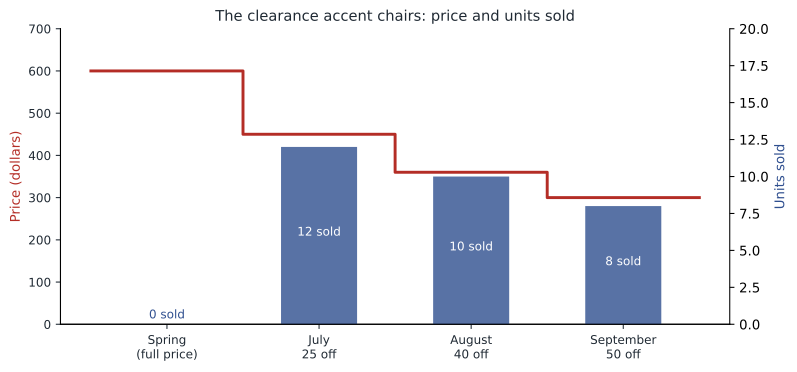
The clearance chairs told a different story. In the spring of 2026, Noura had bought 30 accent chairs in a mustard velvet that looked striking in the catalog. Each cost the store 288 dollars and was ticketed at 600 dollars, a markup of 52 in 100 on retail. Almost nobody bought one at full price. By July the chairs were in the clearance corner, and they went through three markdowns before the last one sold in late September.
Worked problem
Clearing the mustard chairs
The 30 chairs sold as follows: 12 at 25 in 100 off (450 dollars), 10 at 40 in 100 off (360 dollars) and 8 at 50 in 100 off (300 dollars). Each cost 288 dollars. Find the markdown dollars, net sales, markdown percentage of net sales and the gross margin rate the store earned. Compare with the margin it planned.
Show solution
- Markdown dollars = 12 × 150 + 10 × 240 + 8 × 300 = 1,800 + 2,400 + 2,400 = 6,600 dollars.
- Net sales = 12 × 450 + 10 × 360 + 8 × 300 = 5,400 + 3,600 + 2,400 = 11,400 dollars.
- \[\text{Markdown percentage} = \frac{6{,}600}{11{,}400} \approx 0.579\]
- Cost of the chairs = 30 × 288 = 8,640 dollars.
- \[\text{Gross margin rate} = \frac{11{,}400 - 8{,}640}{11{,}400} = \frac{2{,}760}{11{,}400} \approx 0.242\]
- Planned: 30 × 600 = 18,000 dollars of sales and 18,000 × 0.52 = 9,360 dollars of gross margin.
Answer: The chairs produced 11,400 dollars of sales instead of 18,000, with markdowns equal to about 57.9 in 100 of the sales actually made, and a gross margin of 2,760 dollars (about 24.2 in 100) instead of the 9,360 dollars planned. The buying mistake cost the store about 6,600 dollars of margin.
The markdown percentage of net sales, 57.9 in 100, is much larger than the off-retail percentage of any single markdown. That is because the markdown dollars are compared with sales that are themselves reduced by the markdowns. Measured against the original retail value of the chairs, the markdowns were 6,600 ÷ 18,000, or about 36.7 in 100. Both figures are correct; they answer different questions. Planning systems use the share of net sales.
From initial markup to maintained markup
Lesson 2 introduced initial markup, the markup when goods are first ticketed. Maintained markup is the markup the store actually keeps after all reductions: markdowns, employee discounts and shrink. In dollars, it is net sales minus the cost of the goods sold, before cash discounts from suppliers and workroom costs are taken into account. As a share of net sales, maintained markup can be found from the initial markup and the total reductions.
Here R is total reductions as a share of net sales, and both markups are on retail. The formula is the planning formula from lesson 2 rearranged. A department that tickets goods at an initial markup of 52 in 100 and takes reductions equal to 11 in 100 of net sales maintains a markup of 0.52 × 1.11 − 0.11 = 0.4672, or about 46.7 in 100.
Worked problem
How much markup did upholstery keep?
Juniper & Pine's upholstery department tickets its goods at an average initial markup of 52 in 100 on retail. In 2025 its markdowns were 8 in 100 of net sales, employee discounts 0.5 in 100 and shrink 0.8 in 100. What was its maintained markup?
Show solution
- Total reductions R = 0.08 + 0.005 + 0.008 = 0.093.
- \[\text{Maintained markup} = 0.52 \times 1.093 - 0.093 = 0.56836 - 0.093 = 0.47536\]
- That is about 47.5 in 100.
Answer: Upholstery maintained a markup of about 47.5 in 100. After supplier cash discounts and workroom costs, its gross margin was 46 in 100, as lesson 4 explains.
Why markdowns are not always bad
Bev was careful not to tell the group that markdowns are simply waste. Many are deliberate and profitable. A promotion like the Labor Day sale brings shoppers into the store who buy other things at full price. A timely markdown on slow goods frees cash and floor space for goods that sell faster. Clearing last year's mattress models before the new ones arrive avoids paying to store and handle them. In each case the question is whether the markdown earns more than it costs.
The most expensive markdowns are the late ones. Goods that are not selling tend to sell even less as they age: they look dated, they get scratched on the floor and the season that suited them passes. A small markdown taken early, while the goods still have some appeal, often clears more units at a better average price than a deep markdown taken months later. Retail buyers have a saying: your first markdown is your cheapest. The mustard chairs sat at full price for three months before anyone acted, and by then the only customers left were bargain hunters.
| Cause of the markdown | Example at Juniper & Pine | How to prevent it |
|---|---|---|
| Buying error | The mustard chairs: wrong color, too many units | Test new styles in small quantities; review sell-through after four weeks |
| Pricing error | A dining set ticketed above a nearly identical competitor model | Shop competitors before setting prices |
| Selling or display problem | A bedroom set hidden behind a column | Review slow sellers with merchandising before marking down |
| Damage | A scratched floor-model dresser | Careful handling; repair where possible |
| End of season or model change | Last year's washers when the new models arrive | Plan the changeover and stop reordering in time |
| Promotion | The Labor Day sectional sale | Plan promotions with a margin budget and measure the results |
Price claims and the law
When a store advertises a sale, it usually shows a regular price and a lower sale price. In the US, the FTC's Guides Against Deceptive Pricing say a former price used in a comparison must be the actual, bona fide price at which the item was openly offered for a reasonably substantial period in the recent, regular course of business, honestly and in good faith. State consumer protection laws, including South Dakota's deceptive trade practices law, can also apply. Juniper & Pine keeps its own simpler rule: an associate or sign may show a "was" price only if the item was sold at that price for the previous 90 days.
A store that inflates regular prices so that its sale prices look like bigger bargains is not only breaking the law; it is training customers not to trust its tickets. Honest reference prices are part of what makes markdowns work.
Managing markdowns as a budget
Well-run retailers plan markdowns in advance, the same way they plan sales. Each department gets a markdown budget, expressed as a share of planned net sales, and the buyer tracks markdowns against it each week. Overspending the budget early in a season is a signal that something is wrong with the assortment. Underspending is not always good news: it can mean slow goods are being left at full price when they should be cleared.
Upholstery's markdown budget for 2026 was 8 in 100 of net sales. By the end of September, the department had used 6.1 in 100 of the year's planned sales, much of it on the Labor Day sale and the mustard chairs. Bev and Noura agreed that the department could afford one more promotion before the end of the year, but not a second clearance event, and that the spring 2027 buy would test new colors in smaller quantities.
Floor models and special orders
Furniture stores have two kinds of markdown that apparel and grocery stores rarely face. The first is the floor-model sale. A sofa that has been on display for a season has been sat on, moved and occasionally scuffed, and it usually cannot be sold as new. Juniper & Pine sells its floor models "as is" at 20 to 40 in 100 off when the display is replaced, and records the reduction as a markdown. Because every display eventually becomes a floor model, the department plans for these markdowns in its budget rather than treating them as a surprise.
The second is the special-order cancellation. A customer who orders a sofa in a fabric the store does not stock sometimes cancels or refuses delivery. If the supplier will not take it back, the store owns a sofa in a fabric chosen by one customer, and it usually has to be marked down to sell. Juniper & Pine reduces that risk by taking a deposit on special orders and explaining the cancellation terms in writing at the time of sale.
Common mistakes
MistakeMixing up the off-retail percentage and the markdown percentage of net sales.
InsteadUse off-retail for tickets and customers; use markdown dollars over net sales for planning.
MistakeForgetting to cancel a promotional markdown when the sale ends.
InsteadRecord a markdown cancellation for the units still in stock.
MistakeWaiting too long to take the first markdown.
InsteadReview sell-through early and act while goods still have appeal.
MistakeUsing an inflated regular price to make a sale look better.
InsteadShow a regular price only if it meets the legal tests and the store's rule.
MistakeTreating every markdown as waste.
InsteadJudge each markdown by whether it earns more than it costs.
Summary and key terms
- A markdown is a reduction in price after goods are ticketed; markdown dollars are the price reduction times the units sold at the lower price.
- Markdowns can be permanent, promotional, at the point of sale, or employee discounts.
- The off-retail percentage is the reduction as a share of the original price; the markdown percentage used in planning is total markdown dollars divided by net sales.
- Late markdowns on slow goods are usually the most expensive.
- Maintained markup is the markup kept after reductions: initial markup × (1 + R) − R, where R is reductions as a share of net sales.
- Promotions and timely clearance can be profitable when they earn more than they cost. Under the FTC's pricing guides, a former price must be a bona fide price offered for a reasonably substantial period. Retailers manage markdowns with a budget tracked against sales.
- Markdown
- A reduction in selling price after goods are ticketed.
- Promotional markdown
- A temporary price reduction that is reversed when the promotion ends.
- Markdown cancellation
- Reversing a temporary markdown on goods still in stock when the price returns to regular.
- Off-retail percentage
- A markdown expressed as a share of the original price.
- Markdown percentage
- Total markdown dollars for a period divided by net sales for the period.
- Maintained markup
- The markup actually kept after markdowns, discounts and shrink.
- Markdown budget
- The planned level of markdowns for a department, as a share of planned net sales.
Practice problems
Work each problem on paper first, then reveal the answer to check.
A bed regularly 1,000 dollars is sold at 750 dollars. What is the off-retail percentage?
Show answer
250 ÷ 1,000 = 0.25, or 25 in 100.
A department has net sales of 400,000 dollars and markdowns of 36,000 dollars. What is its markdown percentage?
Show answer
36,000 ÷ 400,000 = 0.09, or 9 in 100.
A department has an initial markup of 50 in 100 and reductions of 10 in 100 of net sales. What is its maintained markup?
Show answer
0.50 × 1.10 − 0.10 = 0.45, or 45 in 100.
Lesson quiz · 5 questions
Score 60% or more to complete this lesson.
Create a free account to save your progress, take quizzes and earn a certificate.