
SLS-253 · Lesson 7 of 12 · 26 min
GMROI
▶ Video coming soon A video version of this lesson is on the way.
By the end of October, the group had looked at margin and turn separately. Appliances had the lowest margin but the fastest turn. Décor had the highest margin but the slowest turn. On October 26, 2026, Tessa asked the question everyone had been circling: "So which department is actually doing best?" Bev wrote five letters on the whiteboard: GMROI. "Margin tells you what you make on each sale," she said. "Turn tells you how often you make it. This tells you what you make on the money you've put into the stock."
What GMROI measures
Gross margin return on inventory investment (GMROI) is the gross margin a department earns in a year for each dollar of inventory, at cost, that it holds on average. A GMROI of 2.0 means that every dollar the store has tied up in that department's stock produces two dollars of gross margin a year. It is the closest thing a retailer has to a return on investment for merchandise, and it is widely used to compare departments, categories, suppliers and individual products.
GMROI combines the two things a buyer controls most directly: how much margin each sale earns and how much inventory is needed to make the sales. Because the denominator is inventory at cost, it measures the return on the cash actually spent on stock.
Worked problem
Upholstery and appliances
In 2025, upholstery earned a gross margin of 1.656 million dollars on an average inventory at cost of 0.78 million dollars. Appliances earned 0.777 million dollars of gross margin on an average inventory of 0.70 million dollars. Find each department's GMROI.
Show solution
- \[\text{Upholstery GMROI} = \frac{1.656}{0.78} \approx 2.12\]
- \[\text{Appliances GMROI} = \frac{0.777}{0.70} = 1.11\]
Answer: Each dollar of upholstery inventory earned about 2.12 dollars of gross margin in 2025; each dollar of appliance inventory earned about 1.11 dollars. Appliances turn much faster, but their margin is so low that the return on their inventory is about half that of upholstery.
The two parts of GMROI
GMROI can be broken into a margin part and a speed part. Multiplying and dividing by net sales gives:
The first part is the gross margin rate from lesson 4. The second is the sales-to-stock ratio, net sales divided by average inventory at cost, which is closely related to stock turn. It can also be written using turn at cost from lesson 6, because net sales equals cost of goods sold divided by one minus the margin rate:
Here g is the gross margin rate as a decimal. The decomposition shows that a department can earn a good GMROI in two very different ways: with high margins and slow turn, like a jeweller, or with thin margins and very fast turn, like a grocer. It also shows the two levers for improving it: raise the margin, or sell the same amount with less inventory.
Worked problem
Breaking down upholstery's GMROI
Upholstery had a gross margin rate of 46 in 100, net sales of 3.6 million dollars and an average inventory at cost of 0.78 million dollars. Show its GMROI as margin rate times sales-to-stock ratio, and check it using turn at cost.
Show solution
- Sales-to-stock ratio = 3.6 ÷ 0.78 ≈ 4.615.
- GMROI = 0.46 × 4.615 ≈ 2.12.
- Turn at cost = 1.944 ÷ 0.78 ≈ 2.492.
- \[\text{GMROI} = 0.46 \times \frac{2.492}{0.54} \approx 2.12\]
Answer: Both routes give a GMROI of about 2.12: a margin of 46 in 100 on sales of about 4.6 times the average inventory.
GMROI across the store
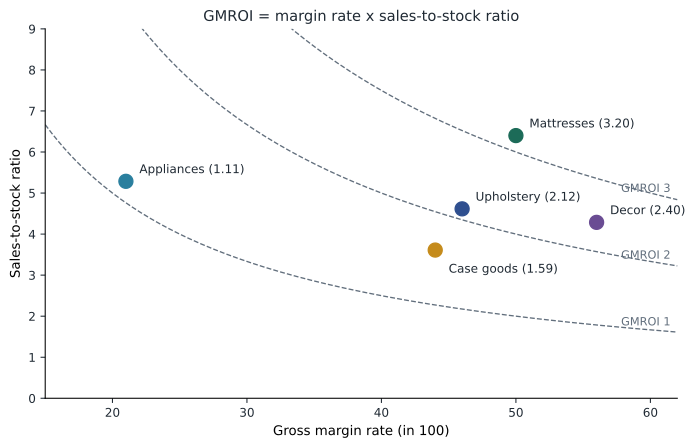
| Department | Gross margin rate | Sales-to-stock ratio | GMROI |
|---|---|---|---|
| Mattresses | 50 in 100 | 6.4 | 3.20 |
| Décor and accessories | 56 in 100 | about 4.29 | 2.40 |
| Upholstery | 46 in 100 | about 4.62 | about 2.12 |
| Case goods | 44 in 100 | about 3.61 | about 1.59 |
| Appliances | 21 in 100 | about 5.29 | 1.11 |
| Store total | about 39.4 in 100 | about 4.66 | about 1.83 |
Mattresses lead the store. Store-label mattresses carry keystone markup, the department needs only a few models on display with stock in the warehouse, and most mattresses sell within four months. Décor comes second despite its slow turn, because its margin is so high. Case goods are near the bottom: their margin is respectable, but bulky dining and bedroom sets sit in stock a long time. Appliances are last.
What the ranking does and does not say
Tessa's first reaction was that the store should shrink appliances and grow mattresses. Bev agreed that the numbers pointed that way, but cautioned against reading GMROI alone. Three things matter alongside it.
- Traffic and cross-selling. Many customers come to Juniper & Pine for a refrigerator or a washer and leave having bought something else as well. Appliance customers also become furniture customers years later. A low-GMROI department can support high-GMROI sales elsewhere.
- Operating costs. GMROI uses gross margin, before operating expenses. Appliances need delivery crews, installation and haul-away, which add cost; mattresses need very little. Décor needs more labor to keep tidy and restocked. A full picture compares departments after the costs they cause.
- Space. GMROI measures return on inventory dollars, not on floor space. A department can earn a good GMROI on very little inventory while using a large part of the showroom. Lesson 8 adds space to the picture.
GMROI is best used to compare like with like: one sofa against another, one supplier against another, this year's case goods against last year's. Large differences between similar items are usually a clear signal. Differences between very different departments are a reason to ask questions, not an automatic answer.
GMROI at the item level
Buyers use GMROI to decide which items deserve a place in the assortment. An expensive item with a high margin is not always a good investment if it sells slowly and the store must hold several in stock.
Worked problem
Two sofas
Juniper & Pine carries two sofas from the same manufacturer. Sofa X sells for 1,499 dollars, costs 780 dollars and sold 40 units in the past year; the store kept an average of 6 in stock. Sofa Y sells for 3,499 dollars, costs 1,640 dollars and sold 8 units; the store kept an average of 4 in stock. Find each sofa's annual gross margin and GMROI.
Show solution
- Sofa X: margin per unit = 1,499 − 780 = 719 dollars; annual margin = 719 × 40 = 28,760 dollars.
- Sofa X: average inventory at cost = 6 × 780 = 4,680 dollars; GMROI = 28,760 ÷ 4,680 ≈ 6.15.
- Sofa Y: margin per unit = 3,499 − 1,640 = 1,859 dollars; annual margin = 1,859 × 8 = 14,872 dollars.
- Sofa Y: average inventory at cost = 4 × 1,640 = 6,560 dollars; GMROI = 14,872 ÷ 6,560 ≈ 2.27.
Answer: Sofa Y earns more than two and a half times as much margin per sale, but Sofa X earns nearly twice as much margin in total and about 6.15 dollars of margin per dollar of inventory, against about 2.27 for Sofa Y. If floor space is tight, Sofa X is the better investment.
Sofa Y still has a place. It sets the top of the price range, it shows customers the quality the store can offer and it occasionally sells to a customer who would not have bought anything cheaper. But the store might hold one on display and order it as needed, rather than keeping four in the warehouse, which would raise its GMROI considerably.
Improving GMROI
The decomposition gives buyers a clear set of levers.
| Lever | How it works | Example at Juniper & Pine |
|---|---|---|
| Raise initial markup | Higher margin on each sale | Negotiate better costs with suppliers; add store-label products |
| Cut markdowns | Keep more of the initial markup | Buy new styles in smaller test quantities |
| Reduce average inventory | Same sales with less stock | Order more often in smaller lots; display one and stock fewer |
| Speed up sales | More sales on the same stock | Better placement, displays and associate knowledge |
| Drop low-GMROI items | Free inventory dollars for better ones | Replace a slow dining set with a faster-selling one |
| Use special orders | Sell items without stocking them | Offer slow, high-end finishes by order only |
Worked problem
Leaner décor
Décor earned 0.504 million dollars of gross margin in 2025 on an average inventory of 0.21 million dollars, a GMROI of 2.4. Noura believes she could carry the same sales with an average inventory of 0.16 million dollars by cutting slow lines and ordering more often. What would the GMROI become?
Show solution
- \[\text{GMROI} = \frac{0.504}{0.16} = 3.15\]
Answer: Décor's GMROI would rise from 2.4 to 3.15, close to the mattress department's, without any change in prices or sales, and 50,000 dollars of cash would be released.
Bev ended the session by asking each person to name one change in their own area that would raise GMROI. Aiden suggested showing customers the fabric samples for special orders more often, so the store could sell finishes it did not have to stock. Marcus proposed ordering the slowest dining sets only when a customer bought one. Noura committed to the leaner décor plan. Tessa asked whether the website could sell more of the special-order fabrics, which led directly to the omnichannel course.
GMROI by supplier
Buyers also use GMROI to compare suppliers. Two suppliers of similar products can earn very different returns once their prices, delivery speed, minimum orders and willingness to take back slow stock are taken into account. A supplier that delivers in one week lets the store hold less stock than one that takes eight, which raises GMROI even if the margin is a little lower.
Worked problem
Two mattress suppliers
Juniper & Pine buys mattresses from two suppliers. In 2025, Supplier A's mattresses earned 520,000 dollars of gross margin on an average inventory at cost of 140,000 dollars. Supplier B's earned 280,000 dollars on an average inventory of 110,000 dollars. Compare their GMROI.
Show solution
- Supplier A: 520,000 ÷ 140,000 ≈ 3.71.
- Supplier B: 280,000 ÷ 110,000 ≈ 2.55.
Answer: Supplier A's mattresses return about 3.71 dollars of margin per dollar of inventory, Supplier B's about 2.55. Supplier A ships store-label mattresses within a week of order, so the store keeps little stock; Supplier B's branded mattresses need six weeks and a deeper stock to avoid running out.
The comparison gave Noura a concrete request for Supplier B: shorter lead times, or the right to return slow sizes. Either would let the store carry less stock and raise the return on the line.
Who pays for the inventory?
GMROI measures the return on the full cost of the inventory, but the store does not always pay for all of it. Suppliers commonly give payment terms, such as 60 or 90 days to pay an invoice, so part of the stock on the floor at any time has not yet been paid for. In effect, the supplier is financing that part of the inventory. If Juniper & Pine's mattress department holds an average of 250,000 dollars of inventory at cost, and on average owes its mattress suppliers 160,000 dollars, the store's own money tied up in mattress stock is only about 90,000 dollars.
Some suppliers go further and offer consignment, where the supplier owns the goods until they are sold, or vendor-managed inventory, where the supplier monitors the store's stock and decides when to replenish it. These arrangements reduce the store's investment and risk, usually in exchange for a lower margin. GMROI on its own does not capture these differences, so buyers look at payment terms and return rights alongside it when choosing suppliers. A product with a slightly lower GMROI on generous terms can be a better investment for the store than one with a higher GMROI that must be paid for on delivery.
Bev also reminded the group that GMROI is calculated on gross margin, so a supplier who charges for freight, or who requires the store to assemble and inspect every piece, may look better on GMROI than it really is. Landed cost (lesson 2) and workroom costs (lesson 4) belong in the margin before GMROI is compared.
Common mistakes
MistakeUsing inventory at retail in the GMROI denominator.
InsteadDivide gross margin by average inventory at cost.
MistakeJudging an item by its margin per sale alone.
InsteadConsider how fast it sells and how much stock it needs.
MistakeCutting a low-GMROI department without considering traffic and cross-selling.
InsteadLook at what the department brings to the rest of the store.
MistakeComparing GMROI between very different departments as if it settled the question.
InsteadUse it to compare similar items, suppliers and years, and to prompt questions.
MistakeRaising GMROI by cutting stock so far that sales are lost.
InsteadBalance inventory reductions against availability.
Summary and key terms
- GMROI is gross margin dollars divided by average inventory at cost: the yearly margin earned for each dollar invested in stock.
- It equals the gross margin rate times the sales-to-stock ratio, or g × turn at cost ÷ (1 − g), so high margin with slow turn and thin margin with fast turn can earn the same return.
- Juniper & Pine's 2025 GMROIs ranged from 3.20 for mattresses to 1.11 for appliances, with the store at about 1.83.
- GMROI ignores operating costs, traffic and space, so it is best used to compare similar items, suppliers and periods.
- At the item level, a cheaper, faster-selling product can earn a much higher GMROI than an expensive slow one.
- GMROI rises when margins rise, markdowns fall, inventory falls or sales speed up.
- GMROI
- Gross margin return on inventory investment: gross margin dollars divided by average inventory at cost.
- Sales-to-stock ratio
- Net sales divided by average inventory at cost.
- Special order
- An item the store does not stock but orders from the supplier when a customer buys it.
Practice problems
Work each problem on paper first, then reveal the answer to check.
A category earns 120,000 dollars of gross margin on an average inventory at cost of 50,000 dollars. What is its GMROI?
Show answer
120,000 ÷ 50,000 = 2.4.
A department has a margin rate of 40 in 100 and a sales-to-stock ratio of 5. What is its GMROI?
Show answer
0.40 × 5 = 2.0.
A department with a margin rate of 50 in 100 turns its stock 3 times a year at cost. What is its GMROI?
Show answer
0.50 × 3 ÷ 0.50 = 3.0.
Lesson quiz · 5 questions
Score 60% or more to complete this lesson.
Create a free account to save your progress, take quizzes and earn a certificate.