
SLS-254 · Lesson 1 of 12 · 25 min
From multichannel to omnichannel
▶ Video coming soon A video version of this lesson is on the way.
On Wednesday, September 30, 2026, Tessa Yellowbird pulled two chairs up to the e-commerce desk in the back office at Juniper & Pine Home and opened three screens: the store's website, the order system and the shared inbox where customers write in. Aiden Laroque had been with the store for a month, selling décor and small furniture. Bev Halvorsen, the store manager, had asked Tessa to spend some time each week that fall teaching him how the website and the store work together, because more and more of the customers he met on the floor had already "met" the store online. "Most people who walk through our doors have looked us up first," Tessa told him. "Some of them have already decided what they want. Some have put it in a cart and walked away. And some are here to pick up something they bought last night. If we treat the store and the website as two different businesses, we confuse all of them."
This course is about selling wherever the customer is: on the store's own website, on online marketplaces, on social media, in live video, in chat and messaging, and on the sales floor, often all in the same purchase. SLS-250 taught how associates sell face to face. SLS-251 showed how the store itself sells. SLS-253 taught the numbers retailers buy and sell by. This course connects those skills to the digital channels that now shape almost every retail purchase. Each lesson follows Tessa's sessions with Aiden through the fall of 2026, from this first afternoon to the plan they presented to Bev and the owners on Wednesday, November 11.
What a channel is
A channel is a route by which a customer can find, buy or receive a product. A store is a channel. So are a website, a phone line, a catalog, an online marketplace such as Amazon, a social media shop, a live video stream and a chat window. Some channels mainly help customers discover and compare products. Others are where the sale is completed. Still others are about how the product reaches the customer: carried out of the store, delivered by the store's own crew, shipped by a parcel carrier or picked up at a counter.
Retailers have always used more than one channel. Department stores ran catalogs for a century before the internet. What has changed is that customers now move between channels within a single purchase, often within a single day, and expect the retailer to keep up. A shopper may see a sofa in a friend's social media post, look it up on the store's website on her phone, read reviews, visit the store on Saturday to sit on it, ask a question by chat on Sunday evening and order it online on Monday for delivery. Each step happened in a different channel, but to her it was one purchase from one store.
Three stages: single, multi and omni
Retail writers often describe three stages in how retailers use channels. The labels are loose, and real retailers mix features of each, but they give a useful way to see where a business stands.
| Approach | What it looks like | Typical problem |
|---|---|---|
| Single-channel | One way to buy, usually the store | Customers who want to research or buy online go elsewhere |
| Multichannel | Several channels, each run separately, with its own stock, prices, staff and targets | Channels compete with each other; customers meet different prices, stock and policies |
| Cross-channel | Some links between channels, such as buying online and picking up in store | Links work for some products and processes but not others |
| Omnichannel | One business seen through many channels, with shared stock information, prices, customer records and policies | Hard and costly to build; needs systems and people to work together |
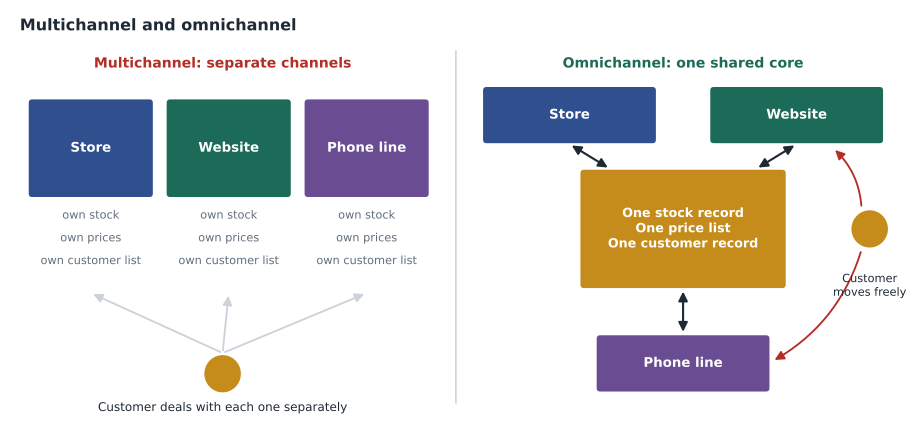
The key difference between multichannel and omnichannel is not the number of channels. It is whether the channels are joined up. In a multichannel business the website team and the store team may treat each other as rivals: an online sale does not count toward the store's target, so associates have little reason to help a customer who mentions she saw something online, and the website does not know what is on the store's shelves. In an omnichannel business the customer, the stock and the sale are shared, and staff in every channel are rewarded for the customer buying, wherever the final click or signature happens.
Where Juniper & Pine stood in the fall of 2026
Tessa used a simple exercise to show Aiden where the store was on that scale. She listed what a customer could do in each channel and whether the channels shared information. Juniper & Pine had launched online ordering in 2020, when the store was closed to shoppers for several weeks. Since then the website had grown into a real part of the business. In 2025 orders placed on the website came to about 1.36 million dollars of the store's 12.40 million dollars in net sales, about 11 in 100. Most of those orders were small furniture, décor and mattresses; large furniture and appliances were still sold mostly in person, though many of those customers had researched online first.
| Channel | What customers can do | Joined up with the store? |
|---|---|---|
| Website | Browse, read reviews, order, choose delivery or pick-up, chat | Partly: prices match, but stock shown online is updated only once a night |
| Store | See, touch, try, get advice, buy, arrange delivery and financing | Associates can see web orders but not abandoned carts |
| Phone and email | Ask questions, order, change deliveries | Notes are kept in the service system, not the clienteling app |
| Social media | See posts and short videos, follow links to the website | Links go to product pages; no shopping inside the apps |
| Text messages | Delivery updates and follow-ups from associates, with consent | Linked to the clienteling app |
The weak point was clear. Stock shown online was updated once a night from the store's inventory system. During the day the website could show an item as available when the last one had sold that morning on the floor. In October 2026, 37 of the 225 web orders had a stock problem: the item turned out to be out of stock, on a hold for another customer or the floor model only. Each of those orders needed a phone call, an apology and, often, a refund. Tessa called it "the promise gap": the website promised something the store could not deliver.
Worked problem
How big was the promise gap?
In October 2026 Juniper & Pine received 225 web orders. Of these, 37 had a stock problem, and 21 of those 37 were canceled and refunded. What share of web orders had a stock problem, and what share of all web orders were lost because of it?
Show solution
- Share of orders with a stock problem:
- \[37 \div 225 \approx 0.164\]
- That is about 16 in 100 orders.
- Share of all web orders canceled because of stock:
- \[21 \div 225 \approx 0.093\]
Answer: About 16 in 100 web orders had a stock problem, and about 9 in 100 were lost to cancellation. Each lost order was a customer who had already decided to buy, which made the promise gap one of the most expensive problems on the website.
Why joined-up channels matter
There are three practical reasons to join up channels. The first is that customers expect it. A shopper who sees a price online expects the same price in the store, and a shopper who buys online expects to be able to return the item to the store. When channels disagree, customers feel tricked, even when nobody meant to mislead them. Canadian and US advertising law also expects the price and availability a store advertises, in any channel, to be accurate.
The second reason is that each channel makes the others stronger. Research by retailers and consultants has consistently found that customers who shop in more than one channel tend to spend more over time than single-channel customers, though the studies come mostly from retailers' own data and the direction of cause is not always clear: it may be that loyal, high-spending customers simply use more channels. Juniper & Pine's own records showed the same pattern. Customers in the clienteling app who had both an online order and a store purchase in the past two years had spent an average of 2,940 dollars, against 1,610 dollars for store-only customers.
The third reason is cost. A store that knows exactly what it has can sell the last unit of a product online instead of marking it down, ship a parcel from the nearest stock instead of the warehouse, and avoid the refunds and phone calls caused by false promises. Joining channels costs money, but disconnected channels also cost money, in quieter ways.
Worked problem
Comparing customer spending across channels
Juniper & Pine's clienteling app holds 14,200 customer households who bought in the past two years. Of these, 2,130 bought both online and in the store and spent an average of 2,940 dollars each. The other 12,070 bought only in the store and spent an average of 1,610 dollars each. What share of households are cross-channel, and what share of total spending do they account for?
Show solution
- Share of households that are cross-channel:
- \[2{,}130 \div 14{,}200 = 0.15\]
- Spending by cross-channel households:
- \[2{,}130 \times 2{,}940 = 6{,}262{,}200\]
- Spending by store-only households:
- \[12{,}070 \times 1{,}610 = 19{,}432{,}700\]
- Share of total spending from cross-channel households:
- \[6{,}262{,}200 \div (6{,}262{,}200 + 19{,}432{,}700) \approx 0.244\]
Answer: Cross-channel households are 15 in 100 of customers but about 24 in 100 of spending. The comparison does not prove that using the website makes people spend more; bigger spenders may simply use more channels. It does show that these customers matter too much to serve badly in either channel.
Showrooming and webrooming
Two shopping habits show why channels cannot be treated separately. Showrooming is looking at a product in a store and then buying it online, often from a cheaper seller. Webrooming, sometimes called ROPO (research online, purchase offline), is the reverse: researching online and then buying in a store. Furniture and appliances are classic webrooming categories. Customers want to read reviews and compare prices online, but they also want to sit on a sofa, open a fridge door and talk to someone before spending thousands of dollars.
Both habits are opportunities as well as threats. A store that is easy to research online wins webroomers, because its products appear in their searches and its prices are clear before they visit. A store that matches its own website prices, offers expert help and makes delivery easy can turn showroomers into buyers, because the online alternative is not as attractive once delivery charges, return policies and waiting times are counted. SLS-250 showed Aiden handling a customer who had found a similar sectional online; this course looks at the same moment from the website's side.
To find out how common webrooming was in its own store, Juniper & Pine ran a short survey at the counter over two weeks in September 2026. Of 400 customers asked, 252 said they had looked at the store's website before coming in, and 88 said they had looked at another retailer's website for the same product. The store's monthly net sales are a little over one million dollars, so the website was influencing a large share of store sales even when the final purchase happened at the counter.
Worked problem
Estimating web-influenced store sales
In the September survey, 252 of 400 store customers had looked at Juniper & Pine's website before visiting. Store sales in October 2026, not counting web orders, were about 1,030,000 dollars. If the survey share holds for October, roughly how much of October's store sales came from customers who looked at the website first?
Show solution
- Share of store customers who looked at the website:
- \[252 \div 400 = 0.63\]
- Estimated web-influenced store sales:
- \[1{,}030{,}000 \times 0.63 \approx 648{,}900\]
Answer: About 649,000 dollars of October's store sales, roughly six times the value of the month's web orders, came from customers who had looked at the website first. This is a rough estimate: it assumes the survey customers were typical and that buyers who looked online spent the same as those who did not.
Who owns the customer?
The hardest part of omnichannel retail is usually not technology but incentives. At Juniper & Pine, associates on the main floor are paid a base wage plus commission on the margin of the furniture and appliances they sell. Until 2026, a sale completed on the website earned no commission for anyone, even when the customer had spent an hour with an associate in the store the week before. Associates naturally preferred customers to buy in person, and some quietly discouraged customers from "going home to think about it and order online".
Many retailers have changed their pay plans to fix this. Common approaches include crediting an associate when a customer they served buys online within a set number of days, letting associates place web orders for customers on a tablet, and paying store teams partly on total store-area sales, including web orders picked up or delivered from the store. Each approach has costs and loopholes. Bev and Tessa's plan for 2027, which lesson 12 describes, uses a mix of the first two.
The building blocks of omnichannel
Joined-up retail rests on a handful of shared foundations. Inventory visibility means every channel can see what stock exists and where, close to real time. Consistent pricing and promotions means the same product has the same price and offer everywhere, or any differences are clearly explained. A single customer view means the store can recognize a customer across channels, with their consent, and see their history. Flexible fulfillment means a product can be delivered to the customer by whichever route makes sense: carried out, picked up, delivered or shipped. And shared policies mean returns, exchanges and warranties work the same way whichever channel the customer bought through. The rest of this course works through each of these foundations, starting with how online shoppers make up their minds.
Common mistakes
MistakeOmnichannel means having a lot of channels.
InsteadIt means the channels are joined up, with shared stock, prices, customer records and policies.
MistakeA web sale takes business away from the store.
InsteadMost web orders are fulfilled by the store, and most store customers research online first. The channels feed each other.
MistakeCustomers who say they saw it online are just price shopping.
InsteadMost are webrooming: they researched online and came in to see, touch and get advice before buying.
MistakeIf the website and store prices differ, the customer will not notice.
InsteadCustomers often check prices on their phones in the store. Inconsistent prices damage trust and can raise legal questions.
MistakeJoining up channels is mainly a technology project.
InsteadSystems matter, but pay plans, policies and habits often decide whether channels work together.
Summary and key terms
- A channel is any route by which customers find, buy or receive a product, and customers now move between channels within a single purchase.
- Multichannel businesses run channels separately; omnichannel businesses share stock, prices, customer records and policies across them.
- Disconnected channels create a promise gap, such as stock shown online that is not really available, which costs sales and trust.
- Cross-channel customers often spend more, though the cause may run both ways.
- Showrooming and webrooming show that the website and the store influence each other's sales.
- Incentives decide whether staff support joined-up selling, so pay plans and credit rules matter as much as systems.
- Channel
- A route by which a customer can find, buy or receive a product.
- Multichannel
- Selling through several channels that are run separately.
- Omnichannel
- Selling through several channels that share stock, prices, customer information and policies.
- Showrooming
- Looking at a product in a store, then buying it online.
- Webrooming
- Researching a product online, then buying it in a store; also called ROPO.
- Inventory visibility
- The ability of every channel to see what stock exists and where, close to real time.
Practice problems
Work each problem on paper first, then reveal the answer to check.
A store had 180 web orders in a month, and 27 had a stock problem. What share had a stock problem?
Show answer
27 divided by 180 is 0.15, or 15 in 100.
Give one difference between a multichannel and an omnichannel retailer.
Show answer
In a multichannel business each channel has its own stock, prices or customer records; in an omnichannel business these are shared.
Why might cross-channel customers spend more without the website causing it?
Show answer
Loyal, high-spending customers may simply be more likely to use several channels, so the link may run the other way.
Why can a commission plan stop associates from supporting online sales?
Show answer
If only store sales earn commission, associates have a reason to discourage customers from buying online later.
Lesson quiz · 5 questions
Score 60% or more to complete this lesson.
Create a free account to save your progress, take quizzes and earn a certificate.