
SLS-254 · Lesson 6 of 12 · 23 min
Ship from store and returns
▶ Video coming soon A video version of this lesson is on the way.
At the start of the session on Wednesday, November 4, 2026, Tessa walked Aiden past the loading door to a corner of the stockroom he had never paid much attention to: two packing tables, a roll of kraft paper, a shelf of boxes in six sizes and a scale connected to a label printer. "This is our warehouse," she said, half joking. Juniper & Pine has no separate distribution center. Every web order that leaves the building, whether a parcel of cushions going to a cabin three hours away or a sectional going across town on the delivery truck, starts in the store. Next to the packing tables was a cage labeled RETURNS, holding a lamp with a cracked shade, two unopened boxes of throws and a dining chair with a torn shipping label. "And this," Tessa said, "is what happens when the promise goes wrong. Shipping and returns are two halves of the same job."
This lesson covers ship from store, using the store's stock and staff to fulfill online orders, and the rules and practices for delivery promises and returns. It draws on SLS-130's work on the delivery experience and SLS-252's on inventory, and focuses on what is different when the customer bought on a screen.
Ship from store
Large chains often ship online orders from regional warehouses. Smaller retailers, and increasingly large ones too, ship from their stores, because the stock is already there and a store close to the customer can deliver faster. Ship from store turns part of the stockroom into a small fulfillment center. It has three advantages: one pool of stock serves both channels, so the last unit of a product can be sold online instead of sitting on a shelf; delivery is quick for nearby customers; and the store does not pay for a separate warehouse. It also has drawbacks: picking and packing compete with selling for staff time, store stock is less accurate than warehouse stock, and stockrooms are not designed for packing.
Juniper & Pine ships in two ways. Small décor and boxed items go by parcel carrier. Furniture, mattresses and appliances go by the store's own delivery crew to customers within about 90 miles, with longer routes once a week. In October 2026 the store shipped 25 parcels and made 82 web-order home deliveries, alongside several hundred deliveries a month for sales made in the store.
Juniper & Pine books parcels through a shipping platform that compares the US Postal Service with private carriers such as UPS and FedEx, choosing the cheapest option that meets the delivery promise. The platform also prints labels and sends tracking links to customers automatically.
Worked problem
Choosing a carrier
A parcel of two cushions weighs 3 kilograms boxed. One carrier quotes 17.40 dollars with delivery in 3 business days; another quotes 13.90 dollars with delivery in 5 business days. The product page promised delivery in 3 to 5 business days, and the order total is 96 dollars with free shipping. Which carrier should Tessa choose, and how much of the order value does shipping take?
Show solution
- Both carriers meet the promise of 3 to 5 business days, so choose the cheaper one:
- \[13.90 < 17.40\]
- Shipping as a share of the order:
- \[13.90 \div 96 \approx 0.145\]
Answer: The 13.90-dollar carrier meets the promise, and shipping takes about 14 or 15 in 100 of the order value, a significant cost on a small order. If the promise had been "in 3 business days", only the faster carrier would do, which is why promises should not be tighter than the store can routinely keep.
Delivery promises and the law
A delivery date on a product page or order confirmation is a promise, and both countries have rules about keeping it.
Under the FTC's Mail, Internet, or Telephone Order Merchandise Rule, a seller must have a reasonable basis for any shipping time it states, or, if it states none, expect to ship within 30 days (50 days if the customer applies for the store's credit to pay). If the seller cannot ship on time, it must tell the customer before the deadline, give a revised date and offer the choice to cancel for a full refund. Refunds for canceled orders are due within seven working days for card payments, or within one billing cycle for the store's own credit account. South Dakota law adds no separate delivery rule for this kind of sale, but its deceptive trade practices law applies to delivery promises that are knowingly false.
In practice, the store's own standard is stricter than the law. Juniper & Pine sends a tracking link for every parcel, calls or texts a delivery customer two days before the delivery window, and contacts the customer the same day if any order will miss its promised date, with the choice of a new date or a full refund.
Why returns matter more online
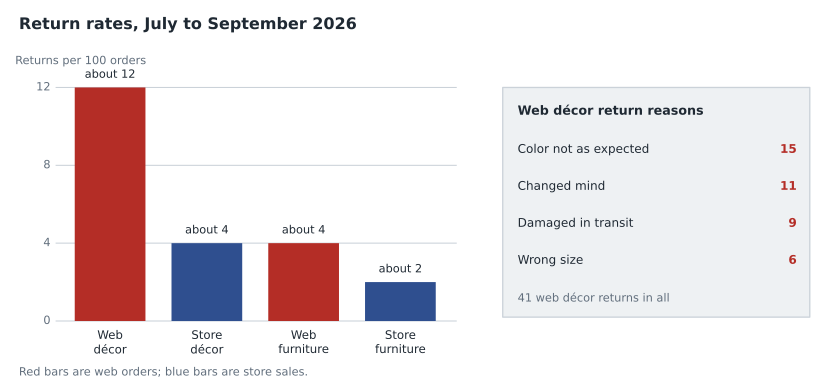
Customers return more of what they buy online than of what they buy in stores, because they could not see, touch or measure the product before buying. Return rates vary enormously by category: clothing bought online is often returned at very high rates, while furniture and appliances are returned far less often because they are expensive to send back. For Juniper & Pine, the difference between channels was clear in its own data.
| Channel and category | Orders | Returned | Return rate |
|---|---|---|---|
| Web orders, décor (parcel and pick-up) | 340 | 41 | about 12 in 100 |
| Store sales, décor | 4,150 | 166 | 4 in 100 |
| Web orders, furniture | 214 | 9 | about 4 in 100 |
| Store sales, furniture | 1,880 | 38 | about 2 in 100 |
Worked problem
What do returns cost?
In the quarter, 41 web décor orders were returned. The average returned order was worth 96 dollars. Each return cost the store about 9 dollars in return shipping (for parcels; pick-up returns cost nothing to ship), 5 dollars in handling and inspection, and, because some items could not be sold as new, an average markdown loss of 20 in 100 of the item's value. About 25 of the 41 returns came back by parcel. What did the returns cost in total?
Show solution
- Return shipping:
- \[25 \times 9 = 225\]
- Handling:
- \[41 \times 5 = 205\]
- Markdown loss:
- \[41 \times 96 \times 0.20 = 787.20\]
- Total cost of returns:
- \[225 + 205 + 787.20 = 1{,}217.20\]
Answer: The returns cost about 1,217 dollars in the quarter, on top of the lost sales. Since web décor revenue in the quarter was about 32,640 dollars (340 orders at 96 dollars), returns cost about 3.7 in 100 of revenue. Cutting the "color not as expected" returns, the most common reason, was worth working on.
Reducing returns before they happen
The cheapest return is the one that never happens. Most online returns trace back to information the customer did not have: the true color, the real size, how soft or firm a cushion is, or that a lamp shade is sold separately. Tessa's analysis of the quarter's 41 web décor returns found that 15 were for color not matching the photo, 11 were changes of mind, 9 were damaged in transit and 6 were the wrong size.
Each reason pointed to a fix. Color returns led to the daylight photo rule in lesson 3 and a note on pages for colors that photograph differently, such as rust and sage. Damage in transit led Marcus to change the packing standard for ceramics and glass, with corner protectors and a drop test of a sample box. Size returns led to adding a "shown with" note, such as "cushion shown on a 224 cm sofa", and a photo with a hand for scale. Changes of mind are harder to prevent and are a normal part of selling; a clear, fair return policy is the right response to them.
Return policies across channels
Customers expect to return an online purchase to the store, and to get the same policy whichever way they bought. Juniper & Pine applies its 30-day return policy to web orders and store sales alike, counting from delivery or pick-up; mattresses fall under the 90-night comfort exchange; and special orders, custom upholstery and final-sale clearance items cannot be returned, which the product page and receipt say clearly. Web orders can be returned in the store or by parcel; parcel returns of non-defective items cost the customer the return shipping fee, deducted from the refund, while returns in the store are free.
No South Dakota or federal law requires a store to accept returns of goods that are not defective; a return policy is the store's choice, and the FTC Act requires that it be described truthfully. Products that are defective or not as described remain the seller's responsibility under warranty law, including implied warranties under the Uniform Commercial Code unless properly disclaimed.
Returns are also where some fraud happens: returning stolen goods for a refund, returning a used item, or "wardrobing" décor for an event and returning it. Marcus's rules are simple: refunds go back to the original payment method, returns without a receipt get store credit at the lowest recent price, and the system flags customers with unusually many returns for a manager's review. These rules protect the store without treating every customer as a suspect.
Worked problem
Is the return fee worth it?
Last quarter, 25 web décor returns came back by parcel at 9 dollars each. If the store charged a 9-dollar return fee for parcel returns of non-defective items, and 18 of the 25 were not defective, how much of the return shipping cost would the fee recover?
Show solution
- Fees collected on non-defective parcel returns:
- \[18 \times 9 = 162\]
- Total parcel return shipping cost:
- \[25 \times 9 = 225\]
- Share recovered:
- \[162 \div 225 = 0.72\]
Answer: The fee would recover 162 of the 225 dollars, or 72 in 100. It would also nudge local customers to return in the store, where the visit might lead to an exchange. The store absorbs the cost of returns for defects, damage and its own mistakes, which is fair and, for defects, legally required.
Packing orders that arrive whole
A parcel that arrives damaged costs the store twice: once for the replacement and again in the customer's trust. Stores that ship from store learn quickly that packing is a skill. Juniper & Pine's packing table follows a few rules. Choose the smallest box that leaves room for protection on every side, because a box with empty space lets items move and break, and a box that is too large costs more to ship. Wrap fragile items separately and keep them from touching each other or the sides of the box. Fill empty space so nothing moves when the box is shaken gently. Seal every seam, and put the label on the largest flat side, with no old labels or barcodes showing.
Box size matters for cost as well as safety. Parcel carriers usually charge by dimensional weight when a parcel is light for its size: they calculate a weight from the box's length, width and height and bill for whichever is greater, the actual weight or the dimensional weight. A lampshade in an oversized box can cost far more to ship than its weight suggests. The store keeps six box sizes so the packer can choose one that fits.
Handling a return at the counter
Most of the store's web returns come back to the counter, not by mail, because customers live nearby. The counter associate thanks the customer, checks the item and its condition against the policy, and asks one open question: "Can I ask what didn't work about it?" The answer goes into the return note, because it is the store's best information about what the product page got wrong. Where it helps, the associate offers an exchange or shows an alternative on the floor, without pressure. A customer who returns a cushion in the wrong shade and leaves with the right one is a sale kept, and a customer whose return was quick and friendly is likely to order again.
Common mistakes
MistakePromise the fastest delivery time the carrier advertises.
InsteadPromise what the store can routinely keep; a slightly longer promise kept builds more trust than a short one missed.
MistakeA missed delivery date is only a service problem.
InsteadIn both countries, late delivery can give the customer a legal right to cancel and a refund within a set time.
MistakeReturns are a cost of doing business; there is nothing to learn from them.
InsteadReturn reasons show which photos, descriptions and packing need fixing.
MistakeOnline and store purchases can have different return policies without telling anyone.
InsteadCustomers expect one policy, and any differences must be disclosed before the sale.
MistakeA no-returns policy removes the store's responsibility for defects.
InsteadStatutory or implied warranties still apply to defective goods.
Summary and key terms
- Ship from store uses store stock and staff to fulfill online orders, giving one pool of stock and fast local delivery at the cost of staff time and stockroom space.
- Delivery promises should be ones the store can routinely keep, and carriers can be chosen by price among those that meet the promise.
- The FTC's Mail, Internet, or Telephone Order Merchandise Rule sets deadlines, notices and refund duties for late orders.
- Online purchases are returned more often than store purchases, and returns cost shipping, handling and markdowns.
- Return reasons point to fixes in photos, descriptions, size information and packing.
- One fair return policy across channels, clearly disclosed, serves customers; warranties for defects apply whatever the policy says.
- Ship from store
- Fulfilling online orders from a store's stock and staff instead of a warehouse.
- Parcel carrier
- A company that delivers small packages, such as a postal service or courier.
- Delivery promise
- The delivery date or time range a store states to the customer.
- Return rate
- The share of orders, or of units sold, that customers return.
- Markdown loss
- The value lost when a returned item can no longer be sold at full price.
- Statutory warranty
- A warranty set by law that the seller cannot remove by contract.
Practice problems
Work each problem on paper first, then reveal the answer to check.
A store had 500 web orders and 35 returns. What was the return rate?
Show answer
35 divided by 500 is 0.07, or 7 in 100.
Two carriers both meet a 3-to-5-day promise; one costs 15 dollars and the other 12. Which should the store pick and why?
Show answer
The 12-dollar carrier, because both keep the promise and it costs less.
Give one way to reduce returns caused by color.
Show answer
Show a daylight photo of each color with minimal editing, and note colors that photograph differently.
Why should refunds go back to the original payment method?
Show answer
It prevents people from turning stolen or fraudulently bought goods into cash or a different payment.
Lesson quiz · 5 questions
Score 60% or more to complete this lesson.
Create a free account to save your progress, take quizzes and earn a certificate.