
SLS-257 · Lesson 2 of 12 · 21 min
Designing a loyalty program
▶ Video coming soon A video version of this lesson is on the way.
At the second Friday meeting, on September 25, 2026, Tessa arrived with a stack of loyalty cards and apps she had collected from other businesses: a grocery points card, a coffee shop punch card, a hardware store's member price tag, an airline app and the national furniture chain's new app. She spread them on the table. "Every one of these is a loyalty program," she said, "and they work in completely different ways. Before we argue about points, we need to decide what we want the program to do." Aiden had kept his tally from the week: of 41 customers he had asked, 23 said they had shopped at Juniper & Pine before, but the sales system recognized only 11 of them, because the others had paid cash, used a different phone number or never given a name.
This lesson explains the main types of loyalty program, the design choices every program has to make, how a store accounts for the points it gives away, and the rules on making points expire. It ends with the first full estimate of what a program would cost Juniper & Pine in its first year.
What a loyalty program is
A loyalty program is a structured offer that gives customers benefits for identifying themselves and coming back. Its benefits can be financial, such as points, discounts and member prices, or non-financial, such as early access, free services and recognition. Almost every program also has a second purpose that customers notice less: it links purchases to a person, so the store can see who buys what, how often and through which channel. Aiden's tally showed why that matters. A store that cannot recognize half of its returning customers cannot thank them, remind them or learn from them.
The main types of program
| Type | How it works | Suits | Watch out for |
|---|---|---|---|
| Points | Customers earn points on spending and redeem them for rewards | Stores with repeat purchases across many categories | The cost of points and the work of explaining their value |
| Punch or stamp card | A reward after a set number of purchases, such as the tenth coffee free | Frequent, similar purchases | Little customer data unless digital |
| Member prices | Members pay a lower price on selected items | Price-sensitive shoppers; simple to understand | Non-member prices can look inflated |
| Tiers | Higher spending unlocks better benefits, such as a "Plus" level | A small group of high-spending customers | Customers who drop a tier can feel punished |
| Paid membership | Customers pay a fee for benefits such as free delivery | Stores with frequent delivery or service needs | Members expect clear value for the fee |
| Coalition | Many businesses share one currency, such as a national points program | Small stores that want a known program | The store shares the customer relationship and data |
| Perks and experiences | Free services, events, birthday gifts, early access | Stores whose strength is service | Hard to value; must be delivered well |
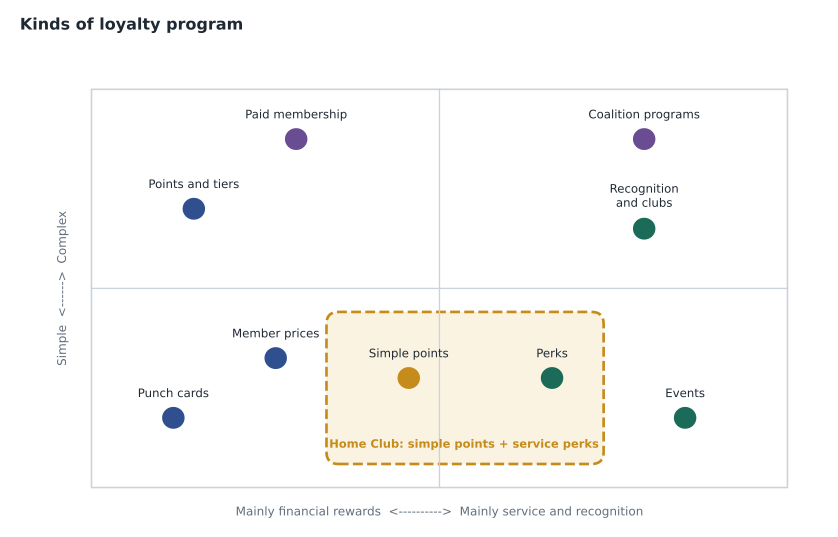
Real programs combine types. A hardware chain may give points plus member prices. A coffee shop's app may be a digital punch card with a birthday drink. For Juniper & Pine, Tessa ruled out two options early. A paid membership made little sense when most households bought big items only every few years. A coalition program, joining a national points currency, would give instant recognition but would hand the customer data and much of the relationship to the coalition operator, and the fees were high for a single store.
Six design choices
Every program, however simple, has to answer six questions. Tessa wrote them on the whiteboard and the group worked through them one by one.
What do members earn? The earn rate is how much reward a member collects per dollar spent, such as one point per dollar. What can they get? The burn rate or reward value is how much a point is worth when redeemed. Together they set the effective reward rate: the share of spending that comes back to the member. A program that gives one point per dollar and a 10-dollar reward for every 500 points gives back 2 dollars for every 100 dollars spent, or 2 in 100. What else do members get? Non-financial benefits, such as early access to sales or a free design consultation, often matter more to customers than the points and cost less to provide.
How do customers join and identify themselves? The easier the sign-up, the more members, but the store needs enough information to recognize them: usually a phone number or email address, with consent to contact them handled separately (lesson 6). Do points expire? Expiry rules must be fair, clearly disclosed and lawful, as the next section explains. What does it cost and how will we know if it works? Every program needs a budget and a way to measure the extra sales it creates, not just the sales members make.
Worked problem
Working out the effective reward rate
Juniper & Pine's draft design, which Tessa called Home Club, gives 1 point for every dollar spent before tax, and a 10-dollar reward certificate for every 500 points. What is the effective reward rate, and what would a member earn on a 1,499-dollar sofa?
Show solution
- Value of one point:
- \[10 \div 500 = 0.02 \text{ dollars}\]
- Effective reward rate:
- \[1 \text{ point per dollar} \times 0.02 = 0.02\]
- Points earned on the sofa:
- \[1{,}499 \text{ points}\]
- Value of those points when redeemed:
- \[1{,}499 \times 0.02 = 29.98\]
Answer: The effective reward rate is 2 in 100. The sofa earns 1,499 points, worth about 30 dollars, but the member can only redeem in blocks of 500, so the purchase brings two 10-dollar certificates (1,000 points) with 499 points left over toward the next one. Customers judge rewards by what they can actually use, so the redemption step should be small enough that ordinary shoppers reach it.
Juniper & Pine's draft: Home Club
By the end of the meeting the group had a first draft. Home Club would be free to join at the counter, on the website or on an associate's tablet. Members would earn 1 point per dollar on most purchases, receive a 10-dollar certificate for every 500 points, and get three service perks: a free in-home measuring visit before a furniture purchase, early access to the store's two big sales each year, and a reminder of their product warranties and care instructions after each large purchase. Members who spent 3,000 dollars or more in a year would move to Home Club Plus, which added free standard delivery on their next delivered purchase, worth 79 dollars.
Bev pushed back on one idea Tessa had floated: bonus points on appliances. Appliances earn a gross margin of only about 21 in 100, against 39.4 in 100 for the store as a whole, so a reward of 2 in 100 already takes almost a tenth of the appliance margin. The group agreed that appliance purchases would earn points at the normal rate but never at a bonus rate, and that delivery, installation and protection plans would earn points like any other purchase.
Points are a promise, and a liability
Every point a store issues is a promise to give something later. Accounting rules treat it that way. Under ASC 606, the US revenue standard, a store that gives points with a sale must set aside part of the sale price as a contract liability, sometimes called deferred revenue, until the points are redeemed or expire. The amount is based on the points' value and on how many are expected to be redeemed. The store's accountant would set the exact method, but the business point is simple: points are not free to give away, and a growing balance of unredeemed points is money the store owes its customers.
Not every point is redeemed. Some members never reach a reward, lose interest, move away or forget. The share of points never redeemed is called breakage. Breakage lowers the real cost of a program, and some businesses have been tempted to design programs that are hard to redeem on purpose. That is a mistake for a store that wants loyalty: a reward nobody can use builds resentment, not loyalty, and regulators and courts look harshly at rules that make benefits hard to claim. Juniper & Pine planned on an illustrative breakage rate of 30 in 100 for budgeting, to be replaced by the real figure after the first year.
Can points expire?
No federal US law sets rules on loyalty points expiry. The federal gift card rules from the 2009 CARD Act, which generally require gift cards to last at least five years, exclude loyalty, award and promotional cards as long as their expiry terms are clearly disclosed. States have their own gift card and unclaimed property laws, some of which can reach loyalty rewards, so a store should check the law in each state where it operates. Whatever the rules, the FTC Act requires that a program's terms, including any expiry, be described truthfully and clearly. Tessa proposed a rule that would be fair in any province or state: Home Club points would not expire because of time alone, but an account with no purchases or redemptions for 24 months would lose its points, with an email or text reminder sent 60 days before. Reward certificates would be valid for 12 months from the date they were issued, printed clearly on each one.
Worked problem
Estimating the first-year cost of Home Club
Tessa estimated that 4,000 households would join in the first year and spend 3.0 million dollars at the store, earning 1 point per dollar. Points are worth 2 cents each when redeemed, and she assumed 30 in 100 of points would never be redeemed. The loyalty software would cost 650 dollars a month, printed materials and staff training 4,200 dollars, and launch advertising 6,000 dollars. What is the expected first-year cost, and how many dollars of extra sales would the program need at a 39.4 in 100 gross margin to break even?
Show solution
- Value of all points issued:
- \[3{,}000{,}000 \times 0.02 = 60{,}000\]
- Expected cost of points after breakage:
- \[60{,}000 \times (1 - 0.30) = 42{,}000\]
- Software for a year:
- \[650 \times 12 = 7{,}800\]
- Total first-year cost:
- \[42{,}000 + 7{,}800 + 4{,}200 + 6{,}000 = 60{,}000\]
- Extra sales needed to cover it:
- \[60{,}000 \div 0.394 \approx 152{,}284\]
Answer: The program would cost about 60,000 dollars in its first year, and it would need about 152,000 dollars of extra sales, sales that would not have happened without it, just to break even. That is about 5 in 100 of the 3.0 million dollars members were expected to spend. The Home Club Plus delivery perk is not yet in this estimate; lesson 12 adds it. Bev wrote "152,000 extra" on the whiteboard and underlined it: the program would succeed or fail on that number, not on how many people joined.
Keeping the program simple
The most common design failure in retail loyalty is complexity. Programs with several currencies, rotating bonus categories, tiers with long names and rules that change every season confuse customers and staff alike. If an associate cannot explain the program in two sentences at the counter, many customers will not join, and those who do will not understand what they have. Tessa's test for Home Club was a sentence Aiden could say without notes: "You get a point for every dollar, and every 500 points is a 10-dollar certificate. Members also get a free measuring visit and early access to our two big sales." Aiden tried it three times and got it right on the third.
Common mistakes
MistakeDesign the rewards first and work out the purpose later.
InsteadDecide what the program must achieve and how it will be measured, then design rewards that serve that goal.
MistakePoints are free marketing.
InsteadIssued points are a liability: part of each sale is owed to the customer until the points are used or lapse.
MistakeHigh breakage means a successful program.
InsteadRewards customers cannot use breed resentment; breakage should come from natural lapse, not from rules designed to block redemption.
MistakePoints can always be made to expire after a year.
InsteadExpiry rules must be disclosed truthfully, and expiry based on time alone feels unfair to customers and invites complaints.
MistakeBonus points on every category will drive the most sales.
InsteadRewards cost the same in dollars on low-margin items, such as appliances, and can wipe out their margin.
Summary and key terms
- A loyalty program gives benefits for identifying oneself and coming back, and also links purchases to customers.
- Main types include points, punch cards, member prices, tiers, paid memberships, coalitions and perks; most programs combine them.
- Six design choices: what members earn, what rewards are worth, other benefits, how customers join, expiry and cost.
- The effective reward rate is the share of spending returned; Home Club's 1 point per dollar and 10 dollars per 500 points give 2 in 100.
- Issued points are a contract liability, and breakage is the share never redeemed.
- No federal law governs points expiry; terms must be disclosed truthfully, and some state laws can apply.
- Loyalty program
- A structured offer that gives customers benefits for identifying themselves and returning.
- Earn rate
- The amount of reward a member collects per dollar spent.
- Effective reward rate
- The share of a member's spending returned as rewards.
- Tier
- A level of membership, reached by spending more, that unlocks extra benefits.
- Breakage
- The share of issued points or rewards that is never redeemed.
- Contract liability
- An amount received from customers that the business still owes in goods, services or rewards.
Practice problems
Work each problem on paper first, then reveal the answer to check.
A program gives 2 points per dollar and a 5-dollar reward for every 1,000 points. What is the effective reward rate?
Show answer
Each point is worth 0.005 dollars, and 2 points per dollar is 0.01, or 1 in 100.
Why might a single store avoid joining a coalition points program?
Show answer
It shares the customer relationship and data with the coalition and usually pays significant fees.
A program issues points worth 40,000 dollars and expects 25 in 100 breakage. What is the expected cost of the points?
Show answer
40,000 times 0.75 is 30,000 dollars.
Give one expiry rule that is fair to customers and easy to disclose clearly.
Show answer
Points that lapse after a long period with no account activity, with clear notice, rather than simply because time has passed.
Lesson quiz · 5 questions
Score 60% or more to complete this lesson.
Create a free account to save your progress, take quizzes and earn a certificate.