
SLS-257 · Lesson 6 of 12 · 24 min
Email and text marketing
▶ Video coming soon A video version of this lesson is on the way.
On Friday, October 23, 2026, Tessa projected the store's email account onto the meeting room wall. The list held 6,200 addresses. Below them was the October 15 email, "Fall living rooms", with its numbers: 6,040 delivered, 151 people clicked, 21 unsubscribed. Then she opened a second list, much shorter: 1,450 phone numbers of customers who had agreed at the counter to receive texts about deliveries and offers. "These two lists are the only marketing channels we own," she said. "Search, social media and radio can change their rules or prices overnight. These people asked to hear from us. If we waste that permission, we lose it."
This lesson is about email and text marketing: messages a store sends directly to customers who have agreed to receive them. These are the store's owned channels, cheap to use and highly targeted, and they are also among the most tightly regulated parts of marketing. The lesson covers what makes a good marketing email or text, how to judge results, and the consent and content rules in South Dakota, which differ sharply between the two countries.
Why email and text matter
Email remains one of the most cost-effective marketing tools for a store, because sending one more message costs almost nothing and the people receiving it have already shown interest. Text messages are more immediate: most are read within minutes, which suits time-sensitive messages such as a delivery window or the last day of a sale, and makes them intrusive if overused. Both work best for customers who already know the store: they turn one purchase into a relationship by reminding, informing and inviting at the right moments. Neither is a good way to reach strangers, and in Canada the law largely prevents using them that way.
Messages fall into two groups. Transactional messages relate to something the customer has already done: an order confirmation, a delivery window, a warranty registration, a receipt. Commercial or marketing messages promote products, offers or events. The law treats them differently, and customers do too: people welcome a text saying their sofa will arrive between 2 and 4 p.m. and resent a text about a cushion sale at 9:45 at night.
The rules in South Dakota
In the United States, marketing email is governed by the federal CAN-SPAM Act, which does not require advance consent but sets strict rules for every commercial email. The header and sender information must be accurate, the subject line must not mislead, and the message must be identified as an advertisement unless the recipient has given affirmative consent. Every message must include the sender's valid physical postal address and a clear way to opt out, which must keep working for at least 30 days after sending, and opt-out requests must be honored within 10 business days. A business stays responsible even if a vendor sends the email for it. The FTC can seek civil penalties of up to 53,088 dollars per violating email, the level set in 2025 and left unchanged for 2026. Marketing text messages fall under the Telephone Consumer Protection Act (TCPA). Marketing texts sent with automated systems need the customer's prior express written consent, and telemarketing messages may not be sent before 8 a.m. or after 9 p.m. in the recipient's local time. Since April 11, 2025, businesses have had to honor opt-out requests made by any reasonable means within 10 business days. On September 30, 2026, the FCC adopted further changes: an opt-out reply to a marketing text revokes consent to all future telemarketing calls and texts from that sender, and senders may designate standard reply words such as stop, quit, end, revoke, opt out, cancel and unsubscribe; those rules take effect after publication in the Federal Register. Consumers can sue under the TCPA for 500 to 1,500 dollars per message, which is why TCPA class actions are common.
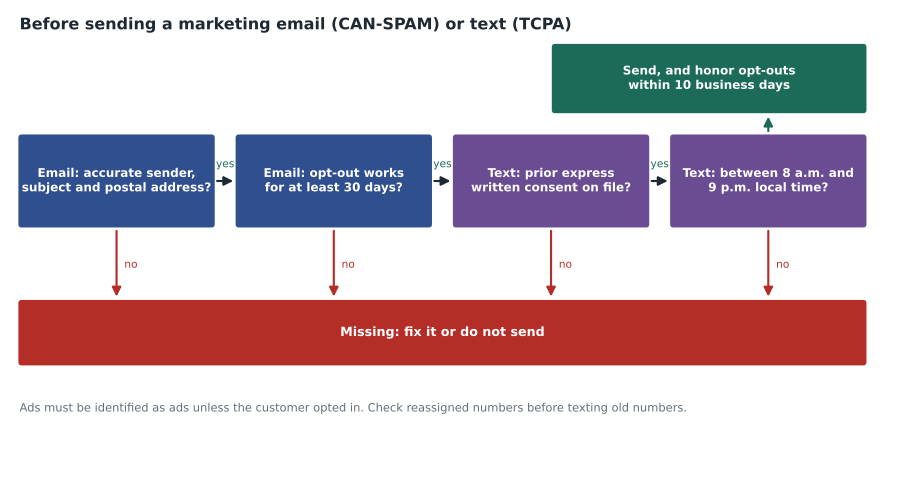
For Juniper & Pine, the store's own policy went further than CAN-SPAM. Although the law does not require consent for marketing email, the store sent marketing email only to customers who had ticked a box at the counter or on the website, because unwanted email damages trust and lowers deliverability. All 6,200 addresses on the list had opted in, and the 1,450 text subscribers had given written consent at the point of sale, recorded with the date and the wording they agreed to.
Worked problem
How long is a text opt-in valid?
A customer gave written consent to marketing texts on March 3, 2025, and has not replied STOP. Under the TCPA, written consent does not expire on a fixed date, but Juniper & Pine's policy is to remove numbers that have not received or responded to any message in 18 months. Of the 1,450 text subscribers, 140 joined more than 18 months ago and have never clicked a link or replied. What should Tessa do about them?
Show solution
- The law sets no expiry, but the store's policy is stricter.
- The 140 inactive numbers are a risk: phone numbers are reassigned, and a text to a number that now belongs to someone else can lead to a TCPA claim.
Answer: Tessa planned to send the 140 inactive numbers a single message asking whether they still wanted texts, with any reply other than yes treated as no, and to check the numbers against the FCC's reassigned numbers database before the next campaign. Removing inactive numbers reduces cost and legal risk with almost no loss of sales.
What makes a good marketing email
Within the law, good marketing email follows a few habits. It is expected: customers know they will receive it and roughly how often. It is relevant: a household that just bought a sofa should hear about rugs and cushions, not sofas. It has one main purpose, such as an event, a new collection or a useful guide, with one clear action. It is written for a phone screen, because most email is opened on phones: a short subject line, one strong image, large buttons and text that makes sense even if the images do not load. And it is honest: the subject line matches the content, offers state their conditions, and "last chance" means last chance.
Frequency is a judgment. Too few messages and customers forget why they signed up; too many and they unsubscribe or stop opening. Juniper & Pine's plan for 2027 was one main email every two weeks, a few event invitations a year sent only to the relevant customers, and texts reserved for deliveries, appointment reminders and no more than one offer a month. Tessa also planned a short welcome series for new subscribers, three emails over three weeks introducing the store's services, because new subscribers are most interested when they first sign up.
Reading the results
Email platforms report several measures. Delivery rate is the share of messages that reached an inbox server. Open rate was once the main measure, but it has become unreliable: since 2021, Apple's Mail Privacy Protection loads images automatically for many users, which makes many messages look opened whether or not anyone read them. Click rate, the share of delivered messages whose recipients clicked a link, is more meaningful. Unsubscribe rate shows when messages are unwanted. What matters most is what customers did afterward: purchases, appointments booked, event replies.
Worked problem
Results of the Fall living rooms email
The October 15 email went to 6,200 addresses. It was delivered to 6,040, 151 recipients clicked a link, and 21 unsubscribed. Over the next week, 19 purchases totaling 11,780 dollars were linked to the email, through its links or through customers who named it in the store. The email platform costs 180 dollars a month, and Tessa spent about four hours on the email, valued at 32 dollars an hour. Calculate the delivery, click and unsubscribe rates, the revenue per delivered email and the gross margin on the linked sales at 39.4 in 100.
Show solution
- Delivery rate:
- \[6{,}040 \div 6{,}200 \approx 0.974\]
- Click rate:
- \[151 \div 6{,}040 = 0.025\]
- Unsubscribe rate:
- \[21 \div 6{,}040 \approx 0.0035\]
- Revenue per delivered email:
- \[11{,}780 \div 6{,}040 \approx 1.95\]
- Gross margin on linked sales, and the email's costs (a month of the platform shared across two emails, plus time):
- \[11{,}780 \times 0.394 \approx 4{,}641 \qquad 90 + 4 \times 32 = 218\]
Answer: About 97 in 100 messages were delivered, 2.5 in 100 recipients clicked, and about 3.5 in 1,000 unsubscribed. The email was linked to about 1.95 dollars of sales per delivered message and about 4,600 dollars of gross margin, against costs of a few hundred dollars. As with every campaign, some of those buyers would have bought anyway, so the true effect is smaller; lesson 11 shows how holding back a small random group answers that question.
Keeping the list healthy
A list loses value if it fills with old addresses and people who never engage. Email services judge senders partly by how recipients respond, and since 2024 the largest providers have required bulk senders to authenticate their email and make unsubscribing easy, with messages from careless senders more likely to land in spam folders. Good habits keep the list useful: remove addresses that bounce, stop emailing people who have not opened or clicked anything for a long period after one attempt to re-engage them, never buy or rent lists, and make signing up and leaving equally easy. A smaller list of interested customers is worth more than a large list of strangers.
Writing a text message
Texts are short, personal and read within minutes, which makes them powerful and easy to overuse. Juniper & Pine's rules for marketing texts were strict. Send no more than two a month. Name the store at the start. Say one thing: an event, a member offer or a reminder. Include a short link only when it helps. Tell customers how to stop, for example by replying STOP, and make sure that works. Never send marketing texts late in the evening or early in the morning, whatever the law allows. And keep service texts, such as delivery windows, separate from marketing, so that customers who stop marketing texts still receive their delivery updates.
Tessa tested a text for Design Night on the 1,450 text subscribers: "Juniper & Pine: Design Night is Thu Oct 22, 6:30 p.m. Free talk on fall rooms, limited spots. RSVP at the link. Reply STOP to opt out." It drew 38 RSVPs from a list less than a quarter the size of the email list. Two people replied STOP. Texts, she concluded, should be kept for messages that are timely and genuinely useful.
Welcome messages and list fatigue
The most valuable email a store sends is often the first one. A customer who has just agreed to hear from the store is paying attention, and a short welcome series can set expectations and earn trust. Tessa's plan for 2027 was three emails over two weeks: a welcome that says what the store will send and how often, a practical guide such as how to measure a room for a sofa, and an invitation to the next event. None contained a discount. Offers would come later, and sparingly.
The opposite problem is fatigue. Each extra email brings some sales and costs some attention, and at some point the unsubscribes and ignored messages outweigh the sales. In 2025, the store had sent up to three emails a week around Black Friday, and its unsubscribe rate in those weeks was three times its normal level. For 2026, the plan was no more than two emails a week even at the busiest time, with customers able to choose fewer.
Worked problem
What does list fatigue cost?
In a normal month, 0.3 in 100 of the 6,200 email subscribers unsubscribe. In a heavy month, the rate rises to 0.9 in 100. If each subscriber is worth about 1.95 dollars of sales per email and the store sends about 50 emails a year, roughly how much yearly email sales are lost from the extra unsubscribes in one heavy month?
Show solution
- Extra unsubscribes in the heavy month:
- \[6{,}200 \times (0.009 - 0.003) = 37.2 \approx 37\]
- Yearly email sales those subscribers would have produced:
- \[37 \times 1.95 \times 50 \approx 3{,}608\]
Answer: One heavy month costs about 3,600 dollars of yearly email sales, and more over the following years. That loss is invisible in the heavy month's own report, which shows only the extra sales the emails produced.
Common mistakes
MistakeEmail anyone whose address we have; they can always unsubscribe.
InsteadCAN-SPAM rules still apply, the store's own opt-in policy is safer, and marketing texts need prior express written consent under the TCPA.
MistakeA text is just a short email, so the same rules apply.
InsteadTexts fall under the TCPA, with written consent, quiet hours and opt-out rules, and consumers can sue per message.
MistakeJudge an email by its open rate.
InsteadPrivacy features make opens unreliable; use clicks, unsubscribes and resulting purchases.
MistakeA bigger list is always better.
InsteadInactive and bought addresses harm deliverability and trust; a smaller engaged list performs better.
MistakeCount every purchase by an email recipient as caused by the email.
InsteadSome would have bought anyway; a holdout group shows the true effect.
Summary and key terms
- Email and text are owned channels that work best for customers who already know the store; transactional and marketing messages are treated differently.
- CAN-SPAM sets content and opt-out rules for marketing email; the TCPA requires written consent, quiet hours and prompt opt-outs for marketing texts.
- Good marketing email is expected, relevant, focused on one purpose, written for phones and honest.
- Click rate, unsubscribe rate and resulting purchases are better measures than open rate.
- Healthy lists are kept clean, authenticated and never bought.
- Linked sales overstate an email's effect; a holdout group gives the true figure.
- Owned channel
- A marketing channel the business controls directly, such as its email and text lists.
- Transactional message
- A message about something the customer has already done, such as an order or delivery.
- Commercial email
- An email whose primary purpose is advertising or promoting a product or service, covered by CAN-SPAM.
- Prior express written consent
- A signed or electronically recorded agreement to receive marketing calls or texts, required under the TCPA for automated marketing texts.
- Click rate
- The share of delivered messages whose recipients clicked a link.
- Welcome series
- A short sequence of emails sent to new subscribers.
Practice problems
Work each problem on paper first, then reveal the answer to check.
An email was delivered to 5,000 addresses and 110 recipients clicked. What was the click rate?
Show answer
110 divided by 5,000 is 0.022, or 2.2 in 100.
Name two things every US marketing email must contain under CAN-SPAM.
Show answer
Any two of: a valid physical postal address, a clear opt-out method, accurate sender information, and identification as an advertisement unless the recipient opted in.
Why is open rate a weak measure of an email's success?
Show answer
Privacy features load images automatically, so many messages look opened whether or not they were read.
Give two habits that keep an email list healthy.
Show answer
Remove bounced addresses, re-engage or remove long-inactive subscribers, and never buy lists.
Lesson quiz · 5 questions
Score 60% or more to complete this lesson.
Create a free account to save your progress, take quizzes and earn a certificate.