
VIS-110 · Lesson 6 of 12 · 26 min
Natural light through the day and the year
The sun is the oldest and most powerful light source an image maker uses, and it is free, but it is not under our control. Its direction, height, color, quality and intensity change continuously through the day, through the seasons and with weather, latitude and surroundings. Landscape and documentary photographers plan their work around these changes; cinematographers schedule exterior scenes for particular times of day and use large tools to modify sunlight; and every image maker benefits from reading natural light accurately. This lesson covers the sun's path and elevation, how light changes from sunrise to sunset, golden hour and blue hour, overcast and weather, light in shade and from the sky, seasonal and latitude effects, window light indoors, and the tools used to plan and modify natural light.
The sun's path
Each day the sun rises roughly in the east, climbs to its highest point at solar noon (when it is due south in the Northern Hemisphere, which may differ from clock noon by an hour or more because of time zones and daylight saving time), and sets roughly in the west. Its maximum height depends on latitude and season. At solar noon, the sun's elevation above the horizon is approximately:
where δ, the solar declination, varies from about +23.4° at the June solstice through 0° at the equinoxes to −23.4° at the December solstice. In summer, the sun rises north of east and sets north of west, staying high for a long day; in winter it rises south of east, stays low and sets south of west after a short day.
Worked problem
Noon sun height through the year
Chicago lies at about 41.9° N. What is the sun's elevation at solar noon at the June and December solstices?
Show solution
- June: 90 − 41.9 + 23.4 = 71.5°.
- December: 90 − 41.9 − 23.4 = 24.7°.
- In summer the noon sun is high, creating short shadows and harsh top light on faces; in winter, even at noon, the sun is low enough for long shadows and more flattering side light.
Answer: About 71° in June and 25° in December. Winter light in the northern United States can be attractive all day, but days are short.
Light through the day
As the sun moves, its light changes in several ways at once:
- Direction and height: low sun gives side and backlight with long shadows and strong modeling; high sun gives top light, short shadows and deep eye sockets.
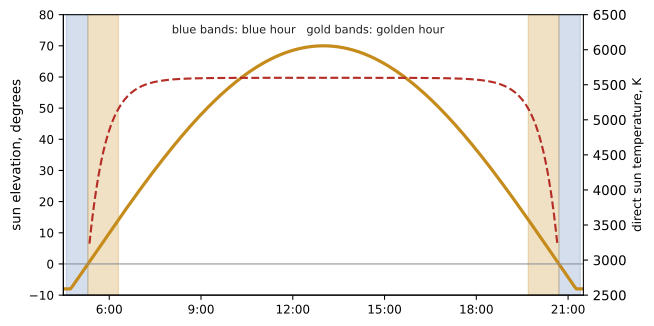
- Color: at low elevations sunlight passes through much more atmosphere, which scatters blue (Lesson 2), so it becomes warmer, from about 5,500 K near midday to 3,000 K or lower near the horizon, while the shade lit by blue sky stays cool. Mixed warm sun and cool shade gives strong color contrast.
- Intensity: direct sunlight is weaker at low elevations, reducing contrast between sunlit and shaded areas.
- Quality: the sun remains a hard source all day on clear days, but near the horizon haze can soften it.
Midday light on clear days is often considered harsh for portraits and landscapes because of top light and high contrast, though it suits some subjects, such as graphic architecture, tropical water and strong-color images. Many photographers prefer the hours after sunrise and before sunset, when low, warm, directional light reveals texture and shape.
Golden hour and blue hour
Golden hour is the period shortly after sunrise and before sunset when the sun is low, roughly below about 6° to 10° elevation, giving warm, directional light with long shadows. Blue hour is the period of twilight when the sun is just below the horizon (roughly between 4° and 8° below), and the sky provides soft, cool light; the sky glows deep blue, and city lights and lit windows balance well with the sky, making it popular for cityscapes and architecture. Despite the names, their length varies greatly with latitude and season: near the equator the sun rises and sets steeply and both periods last only minutes; at high latitudes in summer the sun moves at a shallow angle and golden light can last for hours, while around the summer solstice in far northern regions twilight may continue through the night.
Overcast and weather
Clouds transform sunlight. A thin layer of high cloud slightly softens and cools the sun. A complete overcast turns the whole sky into one enormous soft source, with low contrast, soft shadows and even, cool light, around 6,500 K to 7,500 K, ideal for portraits, product shots outdoors and woodland scenes, though often flat for landscapes. Broken clouds create changing patches of sun and shade, dramatic for landscapes but challenging for continuity in filmmaking, where consecutive shots of a scene must match. Fog and mist scatter light, lowering contrast, simplifying backgrounds and creating atmosphere; rain darkens and saturates surfaces and adds reflections; snow acts as a giant reflector, filling shadows from below and fooling meters (Lesson 11).
Shade and skylight
Subjects in open shade, such as the shadow of a building with open sky above, are lit by skylight, which is soft and cool (often 7,000 K to 10,000 K or more under a clear blue sky). Open shade is a classic portrait location on sunny days: even, flattering light without squinting. The color of light in shade is influenced by surroundings: shade under trees picks up green; shade beside a red brick wall picks up warmth. Camera white balance must be set for shade, or the images will look blue (Lesson 7).
Seasons and latitude
Latitude and season change the length of the day, the height of the sun, and how long the useful low-angle periods last. In summer at higher latitudes, long days give extended golden hours but harsh high sun at midday; in winter, short days give low sun all day, long shadows and frequent warm light, with less time to shoot. Snow, ice and frozen landscapes add reflections and cold blue shadows. Image makers also consider seasonal factors such as foliage color, leaf cover (which changes the light in forests), haze from humidity or smoke, and the position of sunrise and sunset relative to the location.
In the United States, the range is large: around the June solstice, Seattle (about 47.6° N) has about 16 hours of daylight and long twilight, while Miami (25.8° N) has about 13.7 hours; in northern Alaska, the sun does not set for weeks in summer and does not rise for weeks in winter.
Window light
Indoors, windows are natural softboxes. A window facing away from the direct sun (north-facing in the Northern Hemisphere) gives soft, consistent skylight through the day, which is why painters and photographers have long valued north light studios. Windows with direct sun give hard, warm patches that move through the day. Window light falls off quickly with distance into the room (it behaves like a large source, falling off less steeply than the inverse square law at close range but noticeably over a few meters), so subjects near a window are much brighter than the room behind them, creating natural modeling and dark backgrounds. Sheer curtains diffuse direct sun; white walls and reflectors fill shadows; black fabric adds negative fill. Mixing window daylight with warm interior lamps creates color contrast that can be embraced or corrected with gels (Lesson 7).
Planning and modifying natural light
Image makers plan natural light with tools such as sun-position apps and websites, which show the sun's direction and elevation for any place and time, augmented-reality views of the sun's path over a location, weather forecasts including cloud cover, and scouting visits at the planned time of day. Film productions build schedules around the sun, shooting wide shots of exterior scenes when the light is best and using tools to maintain consistency for close-ups:
- Large silks and scrims overhead to soften and reduce direct sun on actors.
- Reflectors and bounce boards to fill shadows.
- Negative fill to add contrast under overcast skies.
- Neutral density filters on cameras to control exposure in bright sun.
- Lights such as HMIs and large LED fixtures to supplement or replace sunlight, for example to extend golden hour or to fake continuous sun when clouds pass.
Worked problem
Scheduling an exterior portrait
A portrait must be shot outdoors in an open field in summer. The client wants warm, directional light with a flattering face and no squinting. The shoot window is 2 hours. When and how should it be scheduled?
Show solution
- Check sunset time and the sun's direction with a sun-position tool for the date and location.
- Schedule the shoot to end around sunset, starting about two hours before, so the last hour is golden hour.
- In the first hour, with the sun still fairly high, position the subject with the sun behind as a rim light and use a large reflector or bounce for soft fill on the face.
- In golden hour, turn the subject toward the low warm sun at about 45° for directional key light; the low angle and lower intensity reduce squinting.
- Have a plan for clouds: a reflector and a battery LED with warm gel can supplement the fill.
Answer: Schedule the two hours ending at sunset, using backlight with fill early and low sun as key in golden hour, with a contingency for clouds.
Recording natural light conditions
For photographers and cinematographers, keeping notes on natural light at locations, the time, weather, sun position, readings and how the light looked, builds a personal reference that improves planning. On productions, scouting photographs taken at the planned shooting time are invaluable for the director, gaffer and production designer. Some crews use time-lapse cameras left at a location for a day to show exactly how light moves across it, which is especially useful for interiors where direct sun moves across walls and floors.
Natural light also has strong emotional associations that audiences recognize instantly: the low gold of evening suggests endings, nostalgia or romance; the cool blue of early morning suggests freshness or loneliness; harsh midday light suggests heat and exposure; and overcast light suggests calm, melancholy or ordinariness. Choosing the time of day for a scene is therefore a storytelling decision, and cinematographers sometimes recreate a particular natural light with artificial sources when the schedule does not allow shooting at the right time.
Finally, natural light and artificial light are often combined. Even when shooting mainly in daylight, a small reflector or LED can lift a face, and many apparently natural-light images in advertising and film rely on subtle additional light that viewers never notice.
Common mistakes
MistakeAssuming solar noon equals 12:00 on the clock.
InsteadCheck solar noon with a sun-position tool.
MistakeExpecting golden hour to last the same everywhere.
InsteadAccount for latitude and season.
MistakeShooting portraits in harsh midday sun without modification.
InsteadUse shade, backlight with fill, or overhead silks.
MistakeLeaving white balance on daylight in open shade.
InsteadSet white balance for the cooler shade light.
MistakeIgnoring changing clouds in scheduling.
InsteadPlan for continuity with modifiers and lights.
Summary and key terms
- Solar noon elevation ≈ 90° − latitude + declination; it changes greatly through the year.
- Low sun is warmer, weaker and more directional; high sun gives top light and hard contrast.
- Golden hour and blue hour vary in length with latitude and season.
- Overcast skies are huge soft sources; fog, rain and snow change contrast and color.
- Open shade gives soft, cool skylight colored by surroundings.
- Windows act as large soft sources with rapid falloff into the room.
- Plan with sun-position tools and weather, and modify with silks, reflectors, negative fill, ND and lights.
- Solar noon
- The time the sun reaches its highest point.
- Solar declination
- The sun's angle north or south of the celestial equator.
- Golden hour
- Low-sun period with warm, directional light.
- Blue hour
- Twilight with soft, cool skylight.
- Overcast
- Complete cloud cover acting as a soft source.
- Open shade
- Shade lit by open sky.
- Skylight
- Light from the sky rather than the direct sun.
- North light
- Soft, consistent light from windows facing away from the sun.
- Silk
- A large diffusion fabric used to soften sunlight.
- Continuity
- Consistency of light and other details between shots.
Practice problems
Work each problem on paper first, then reveal the answer to check.
Compute noon sun elevation at 50° N at an equinox.
Show answer
40°.
Why is solar noon different from clock noon?
Show answer
Time zones and daylight saving time.
Why is low sun warmer?
Show answer
Longer paths through the atmosphere scatter away blue.
What is blue hour good for?
Show answer
Cityscapes and architecture with balanced sky and artificial lights.
Why does golden hour last longer at high latitudes in summer?
Show answer
The sun moves at a shallow angle to the horizon.
Describe overcast light.
Show answer
Soft, low contrast, cool and even.
What color temperature is open shade under blue sky?
Show answer
Often 7,000 K to 10,000 K or more.
Why are north-facing windows valued?
Show answer
They give soft, consistent skylight.
Name four tools to modify sunlight on set.
Show answer
Silks, reflectors, negative fill, ND filters, supplementary lights.
How should a portrait be lit with the sun still high?
Show answer
Use the sun as backlight with soft fill on the face.
Lesson quiz · 5 questions
Score 60% or more to complete this lesson.
Create a free account to save your progress, take quizzes and earn a certificate.