
AI-101 · Lesson 1 of 5 · 35 min
What counts as intelligence
Artificial intelligence is everywhere in the news, and the phrase is used for almost anything a computer does that seems clever: a chatbot that writes essays, a phone that unlocks when it sees your face, a car that keeps itself in its lane, a bank system that flags a suspicious purchase. Some of these systems are remarkably capable; others are simple rules dressed up in a fashionable name. To study AI seriously, we first need to say what it is, what it is not, and how we would know whether a machine is "intelligent" at all.
This chapter introduces the main definitions of AI, the idea of an intelligent agent, the difference between AI, machine learning and deep learning, the two broad ways of building intelligent systems (writing down knowledge and learning from data), and the debate about narrow and general intelligence. Along the way it gives you a vocabulary that the rest of the degree builds on.
Four ways to define AI
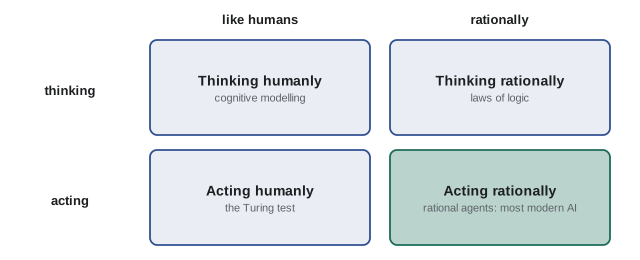
There is no single agreed definition. A widely used textbook, Russell and Norvig's Artificial Intelligence: A Modern Approach, sorts definitions along two questions: are we trying to imitate humans, or to act well by some objective standard? And do we care about thinking, or only about behaviour?
- Thinking humanly: build systems that think the way people do. This is the goal of cognitive science, which tests computer models against psychological experiments.
- Acting humanly: build systems that behave indistinguishably from people. The Turing test is the classic example.
- Thinking rationally: build systems that reason correctly, following the laws of logic.
- Acting rationally: build systems that act to achieve the best expected outcome, given what they know. This is the rational agent approach.
Most of modern AI follows the last view. It does not require a machine to be human-like, only to make good decisions toward a goal. A route planner that finds the fastest drive across a city is acting rationally even though it does not think like a taxi driver.
The Turing test
In 1950 the British mathematician Alan Turing published "Computing Machinery and Intelligence", which opened with the question "Can machines think?" Turing argued the question was too vague to answer and replaced it with a game. A human judge holds text conversations with two hidden partners, one a person and one a machine. If the judge cannot reliably tell which is which, the machine passes.
The test was brilliant because it replaced an argument about definitions with an observable experiment. But it has well-known weaknesses. It rewards imitation, including imitating human mistakes. It tests only conversation, not perception, physical action or planning. And it can be passed by tricks: chatbots since the 1960s have fooled some people some of the time with canned responses. Today's large language models hold fluent conversations that many people cannot distinguish from a human, yet experts still disagree sharply about what that says about their intelligence. Passing a conversation test turns out to be neither necessary nor sufficient for the kinds of intelligence engineers care about.
Intelligent agents
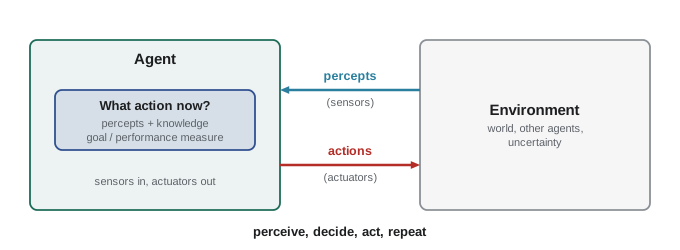
An agent is anything that perceives its environment through sensors and acts on it through actuators. A person is an agent (eyes and ears; hands and voice). A robot vacuum is an agent (bump sensors and a camera; wheels and brushes). A software agent might perceive a stream of network traffic and act by blocking connections.
An agent's behaviour is described by its agent function: a mapping from everything it has perceived so far to an action. A rational agent chooses the action expected to maximize its performance measure, given what it has perceived and what it knows. Notice the parts of that definition:
- The performance measure says what counts as success. It is set by the designer, not the agent: a thermostat succeeds if the room stays comfortable with little energy, a chess program if it wins.
- "Expected" matters because the agent may not know the outcome of its actions for certain. Rational is not the same as all-knowing.
- What the agent has perceived matters because the agent can only use the information it has.
Worked problem
Describing an agent
Describe an automated building-temperature controller as an agent: its performance measure, environment, actuators and sensors.
Show solution
- Performance measure: keep occupied rooms within a comfort band (say 21 to 24 °C) while using as little energy as possible.
- Environment: the building, its occupants, outdoor weather, sun on the windows.
- Actuators: heating and cooling valves, fan speeds, dampers.
- Sensors: room temperature and humidity sensors, occupancy sensors, outdoor temperature, the clock and calendar.
Answer: Writing the four parts out (often abbreviated PEAS: performance, environment, actuators, sensors) clarifies the problem before anyone chooses an algorithm. A controller that only reads room temperature cannot pre-cool before a hot afternoon; adding a weather forecast as a sensor changes what it can do
Kinds of environments
How hard an agent's job is depends on its environment. Designers ask several questions:
- Fully or partially observable? A chess program sees the whole board; a self-driving car cannot see around corners.
- Deterministic or stochastic? In chess the same move always has the same effect; in traffic, other drivers are unpredictable.
- Static or dynamic? A crossword waits for you; the road does not.
- Discrete or continuous? Chess has a finite set of moves; steering angles are continuous.
- Single agent or multi-agent? A puzzle has one agent; markets, games and traffic have many, some cooperating and some competing.
Board games were early AI favourites partly because they are observable, deterministic and discrete. Real engineering environments, such as power grids, factories and roads, are usually partially observable, stochastic, dynamic and continuous, which is why they remained hard for much longer.
AI, machine learning and deep learning
Three terms are often used interchangeably but mean different things:
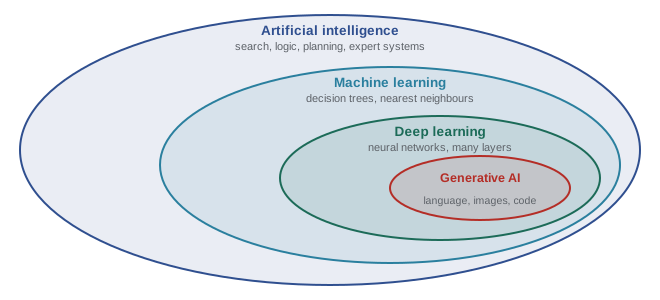
- Artificial intelligence is the whole field: any technique that lets a machine perceive, reason, learn, decide or act in ways we would call intelligent.
- Machine learning (ML) is the part of AI in which systems improve their performance from data or experience instead of being explicitly programmed with rules.
- Deep learning is the part of machine learning that uses neural networks with many layers. Almost all of the striking AI progress since about 2012, in image recognition, speech, translation and language models, has come from deep learning.
- Generative AI is a recent label for deep learning systems that produce new content: text, images, audio, video or code.
Two ways to build intelligence: rules and learning
For most of AI's history there have been two broad approaches.
Writing down knowledge
In symbolic AI, people write down knowledge explicitly, as facts, rules or search problems, and the computer reasons with them. An expert system for diagnosing a pump might contain rules like "if vibration is high and bearing temperature is rising, suspect bearing wear". A planning system might represent actions with their preconditions and effects, and search for a sequence of actions that reaches a goal.
Search is one of the oldest and most useful AI techniques: represent the problem as states connected by actions, then systematically explore them.
Worked problem
Search for a shortest route
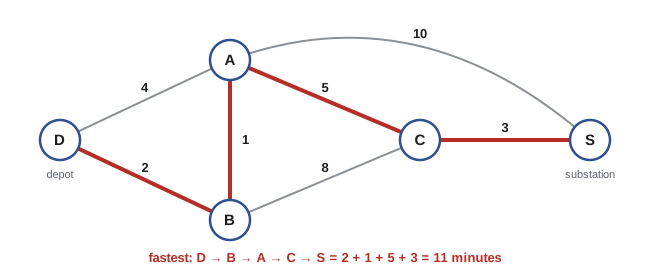
A maintenance technician must drive from the depot D to a substation S. Roads (with times in minutes): D–A 4, D–B 2, B–A 1, A–C 5, B–C 8, C–S 3, A–S 10. Find the fastest route by systematically expanding the closest unexplored location first (uniform-cost search, the idea behind Dijkstra's algorithm).
Show solution
- Start: D at 0. Neighbours: A at 4, B at 2.
- Expand B (2): A via B costs 2 + 1 = 3, better than 4, so A = 3; C via B = 10.
- Expand A (3): C via A = 3 + 5 = 8, better than 10, so C = 8; S via A = 13.
- Expand C (8): S via C = 8 + 3 = 11, better than 13, so S = 11.
- Expand S (11): the goal is reached with the lowest cost among unexplored options, so the answer is final.
Answer: Fastest route D → B → A → C → S, 11 minutes. The direct-looking route through A to S takes 13. The algorithm finds the best answer without trying every possible route, which matters when there are millions
Symbolic methods are precise, explainable and need no training data. Their weakness is that real-world knowledge is enormous, messy and full of exceptions. Nobody can write rules that recognize a cat in a photograph or understand a sarcastic sentence.
Learning from data
In the machine learning approach, the system is shown examples and finds the patterns itself. Instead of writing rules for recognizing a failing pump, you give it thousands of past readings labelled "failed" or "healthy", and it learns a function that separates them. Lesson 3 shows how this works.
Learning handles messy, high-dimensional problems such as images, speech and language that defeated hand-written rules. Its weaknesses mirror the strengths of symbolic AI: it needs lots of data, it can learn the wrong patterns from biased or unrepresentative data, and the resulting models are often hard to explain.
Modern systems often combine the two. A navigation app uses search over a road graph with travel times predicted by machine learning. A language model, a learned system, can be connected to a calculator or a database, which are exact symbolic tools.
What makes a task hard for a machine?
Tasks that seem hard to people are often easy for computers, and the reverse. This observation, known as Moravec's paradox after the roboticist Hans Moravec, holds up remarkably well. Computers beat world champions at chess in 1997, but robots that can fold laundry or tidy a kitchen as well as a child are still a research problem. Skills that evolution polished over hundreds of millions of years, like seeing, walking and handling objects, feel effortless to us but are computationally enormous; skills learned recently, like arithmetic and formal logic, feel hard to us but are easy to mechanize.
Worked problem
Easy or hard for AI?
Rank these tasks by how hard they have historically been for AI, from easiest to hardest: (a) multiplying two 20-digit numbers, (b) beating a grandmaster at chess, (c) transcribing clear speech, (d) folding a crumpled T-shirt with a robot hand.
Show solution
- (a) has always been trivial for computers: exact rules, tiny computation.
- (b) was solved by search and evaluation functions by 1997 (IBM's Deep Blue).
- (c) became reliable only with deep learning in the 2010s.
- (d) involves perception of a deformable object, uncertainty and fine motor control; it remains an active research problem.
Answer: a, b, c, d. The order is almost the reverse of how hard these tasks feel to a person, which is Moravec's paradox
Narrow and general intelligence
Every AI system in use today was built for a particular set of tasks, sometimes a very broad set. A chess engine cannot drive a car; a medical imaging model cannot write an email. This is often called narrow AI. Artificial general intelligence (AGI) refers to hypothetical systems that match or exceed humans across essentially all cognitive tasks, able to learn new tasks as flexibly as people do.
Large language models blur the line. One model can write code, summarize law, explain chemistry and plan a trip, so it is far broader than earlier systems, yet it can also make basic mistakes that no expert would. Researchers disagree, sometimes strongly, about how close current methods are to general intelligence, whether scaling them up will be enough, and how soon. Because the stakes are high, governments and companies now invest in measuring AI capabilities carefully, a theme of AI-430.
A useful habit for an engineer is to avoid arguing about labels and ask concrete questions instead: What tasks can this system do? How reliably, measured how? Under what conditions does it fail? What happens when it fails?
Measuring intelligence: benchmarks
Because "intelligence" is hard to define, the field measures progress with benchmarks: fixed sets of tasks with agreed scoring. ImageNet (classifying 1.2 million images into 1000 categories) drove progress in computer vision; question-answering, coding and mathematics benchmarks now track language models. Benchmarks are powerful because they let people compare methods fairly. They are also limited: models can be tuned to a benchmark without becoming generally better, test questions can leak into training data, and popular benchmarks tend to saturate (top systems approach perfect scores) within a few years of being created. A benchmark measures performance on that benchmark, nothing more.
Worked problem
Reading a benchmark result
A model scores 92% on a 500-question science benchmark. A second model scores 94%. Each question is scored right or wrong. Is the second model clearly better?
Show solution
- The difference is 2 percentage points, or 10 questions out of 500.
- A rough standard error for a proportion near 0.93 on 500 questions is \(\sqrt{0.93 \times 0.07/500} \approx 0.011\), about 1.1 points for each score.
- The standard error of the difference is about \(\sqrt{2} \times 1.1 \approx 1.6\) points, so a 2-point gap is only about 1.2 standard errors: not convincing on its own (STAT-252 covers this properly).
Answer: Not clearly. The gap could be noise. Before concluding, check other benchmarks, repeated runs, whether the questions might have appeared in either model's training data, and whether the benchmark measures what you actually need
Common mistakes
MistakeTreating "AI" as one technology.
InsteadAI is a field with many techniques: search, logic, probabilistic reasoning, machine learning and deep learning. Ask which technique a system uses.
MistakeAssuming a system that converses fluently understands like a person.
InsteadFluent language and reliable reasoning are different things. Test the specific capabilities you rely on.
MistakeAssuming tasks that are hard for people are hard for machines, and vice versa.
InsteadRemember Moravec's paradox: perception and physical manipulation have been harder for AI than chess or arithmetic.
MistakeDefining success vaguely.
InsteadWrite down the performance measure, environment, actuators and sensors before choosing a method.
MistakeTaking a benchmark score as proof of general ability.
InsteadA benchmark measures performance on that benchmark. Check for small differences within noise, training-data contamination and relevance to your task.
Summary and key terms
- AI can be defined by thinking or acting, humanly or rationally. Most modern AI builds rational agents that act to maximize an expected performance measure.
- Turing's 1950 imitation game replaced "can machines think?" with an observable test, but conversation alone is a weak measure of intelligence.
- An agent perceives through sensors and acts through actuators. Describe a problem with PEAS: performance measure, environment, actuators, sensors.
- Environments differ in observability, determinism, dynamics, continuity and number of agents.
- AI ⊃ machine learning ⊃ deep learning; generative AI is a visible part of deep learning.
- Symbolic AI writes knowledge down (rules, search, logic); machine learning learns patterns from data. Modern systems often combine both.
- Moravec's paradox: perception and motor skills are hard for machines; formal reasoning is comparatively easy.
- Today's systems are narrow, some very broadly so. AGI is debated. Benchmarks measure progress but have limits.
- Artificial intelligence
- The field of building machines that perceive, reason, learn, decide or act in ways we would call intelligent.
- Rational agent
- An agent that acts to maximize its expected performance measure given what it has perceived and knows.
- Agent
- Anything that perceives its environment through sensors and acts on it through actuators.
- Performance measure
- The criterion, set by the designer, by which an agent's success is judged.
- Turing test
- Turing's 1950 imitation game: a machine passes if a judge cannot reliably tell it from a person in text conversation.
- Machine learning
- The part of AI in which systems improve from data or experience instead of being explicitly programmed.
- Deep learning
- Machine learning with neural networks of many layers.
- Generative AI
- AI systems that produce new text, images, audio, video or code.
- Symbolic AI
- Approaches that represent knowledge explicitly as symbols, rules and logic, and reason with them.
- Search
- Systematic exploration of states connected by actions to find a path to a goal.
- Moravec's paradox
- The observation that perception and motor skills are harder for AI than abstract reasoning.
- Artificial general intelligence (AGI)
- Hypothetical AI matching or exceeding humans across essentially all cognitive tasks.
- Benchmark
- A fixed set of tasks with agreed scoring, used to compare AI systems.
Practice problems
Work each problem on paper first, then reveal the answer to check.
Classify each as thinking humanly, acting humanly, thinking rationally or acting rationally: (a) a theorem prover, (b) a chatbot designed to pass as a human, (c) a model of human memory tested against experiments, (d) a delivery-route optimizer.
Show answer
(a) thinking rationally; (b) acting humanly; (c) thinking humanly; (d) acting rationally.
Give a PEAS description for a spam filter.
Show answer
Performance: catch spam while rarely blocking real mail. Environment: incoming email, senders, users. Actuators: moving messages to the spam folder or inbox. Sensors: message text, headers, sender reputation, user feedback.
Is the environment of a self-driving car fully observable, deterministic, static and discrete? Explain each.
Show answer
No on all four: partially observable (hidden objects, sensor limits), stochastic (other road users), dynamic (the world changes while it decides), continuous (positions, speeds, steering).
Name two weaknesses of the Turing test.
Show answer
It rewards imitation rather than competence; it tests only text conversation; it can be passed by tricks; passing it does not guarantee reliability.
In the route example, the road B–A closes. What is the new fastest route from D to S?
Show answer
D → A (4) → C (9) → S (12), or D → B → C (10) → S (13), or D → A → S (14). Fastest: D → A → C → S, 12 minutes.
Is a calculator AI? Is a program that learns to recommend songs from listening history AI? Machine learning?
Show answer
A calculator follows fixed exact procedures; it is usually not called AI. The song recommender is AI and, since it improves from data, machine learning.
Give one advantage of symbolic AI over machine learning and one advantage the other way.
Show answer
Symbolic: explainable and needs no training data. Machine learning: handles messy, high-dimensional inputs like images and speech that are impossible to describe with rules.
Explain Moravec's paradox in your own words with an example.
Show answer
Skills that feel easy to people (seeing, walking, picking things up) are hard for machines, while skills that feel hard (chess, arithmetic) are easy. Example: AI beat chess champions decades before robots could reliably fold laundry.
Two models score 71% and 75% on a 2000-question benchmark. Is the difference likely to be noise?
Show answer
Standard error of each ≈ √(0.73 × 0.27/2000) ≈ 0.0099; of the difference ≈ 1.4 points. A 4-point gap is about 2.9 standard errors, so unlikely to be noise (though contamination and relevance still need checking).
Why might an engineer prefer to ask "what tasks can it do reliably?" rather than "is it intelligent?"
Show answer
Because the answer to the first is testable and decides whether the system is safe and useful for a job; the second is a debate about definitions.
Lesson quiz · 5 questions
Score 60% or more to complete this lesson.
Create a free account to save your progress, take quizzes and earn a certificate.