
BUS-101 · Lesson 7 of 12 · 28 min
Marketing: understanding and reaching customers
Marketing is far more than advertising. It is the whole process of understanding what customers need, designing offerings that meet those needs, pricing them, making them available and communicating their value, so that the business can build profitable relationships with customers. This lesson explains the marketing concept, market research, segmentation, targeting and positioning, the marketing mix (the four Ps), consumer buying behaviour, digital marketing and how to measure marketing results, including customer lifetime value.
The marketing concept
Businesses have taken different approaches to the market over time. A production orientation focuses on making goods efficiently and assumes they will sell. A sales orientation focuses on persuading people to buy what the firm already makes. A marketing orientation, or the marketing concept, starts with the customer: find out what customers want, deliver it better than competitors and earn a profit by doing so. The marketing concept rests on three ideas: a customer focus, coordination of the whole organization around customer needs, and a focus on long-term profitable relationships rather than single sales.
Relationship marketing builds on this idea. It is usually far cheaper to keep an existing customer than to win a new one, and loyal customers tend to buy more, cost less to serve and recommend the business to others. That is why so many firms invest in loyalty programs, customer service and personalized communication.
Market research
Good marketing decisions rest on information. Market research is the systematic gathering and analysis of information about customers, competitors and markets. Secondary data has already been collected by someone else, such as government statistics, industry reports, trade association data and a firm's own sales records; it is cheap and fast but may not answer the specific question. Primary data is collected for the purpose at hand, through surveys, interviews, focus groups, observation, experiments such as A/B tests on a website, and analysis of customer behaviour online.
Statistics Canada is a rich free source of secondary data on population, income, household spending and industries, and many provinces and industry associations publish further data.
The research process follows five steps: define the problem, plan the research, collect the data, analyze it and act on the findings. The most common error is starting at step three, collecting data without a clear question it is meant to answer.
Segmentation, targeting and positioning
Few products appeal to everyone. Marketers divide a market into segments, groups of customers with similar needs or behaviour, then choose which segments to serve and decide how to position the offering in their minds. Markets can be segmented by:
- Geographic variables: country, region, city size, climate, urban or rural.
- Demographic variables: age, gender, income, education, occupation, family life stage.
- Psychographic variables: lifestyle, values, personality and interests.
- Behavioural variables: usage rate, loyalty, benefits sought and occasion of purchase.
A useful segment is measurable, large enough to be profitable, reachable and distinct in its response to marketing. Targeting means choosing segments to serve: a firm can use undifferentiated marketing (one offer for all), differentiated marketing (different offers for several segments), concentrated or niche marketing (one segment served very well) or micromarketing (tailoring to individuals or neighbourhoods).
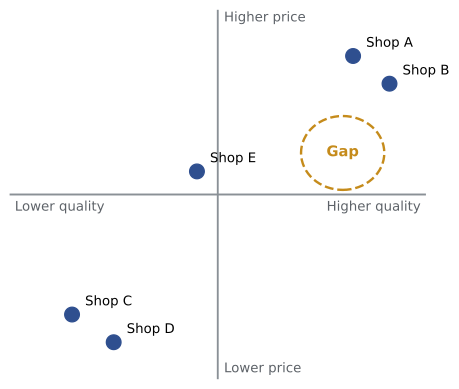
Positioning is the place a product occupies in customers' minds relative to competitors. A positioning statement says who the target is, what need the product meets, what category it competes in and why it is different. Perceptual maps plot competitors on two attributes customers care about, such as price and quality, to reveal gaps.
The marketing mix: the four Ps
Once a target and position are chosen, the firm designs a marketing mix, the set of controllable tools it uses to deliver value. The traditional mix is the four Ps:
- Product: the good or service, including features, quality, design, branding, packaging, warranties and support.
- Price: what customers pay, including list price, discounts, financing and payment terms.
- Place (distribution): how the product reaches customers, including channels, intermediaries, locations, inventory and logistics.
- Promotion: how the firm communicates, including advertising, personal selling, sales promotion, public relations, social media and content.
The four Ps must fit together and fit the positioning. A luxury watch with a discount price sold in a dollar store sends a confusing message. Service businesses often add three more Ps: people (staff who deliver the service), process (how the service is delivered) and physical evidence (the setting and tangible cues that signal quality).
Product and the product life cycle
Products pass through a life cycle of introduction, growth, maturity and decline. In introduction, sales are low, costs are high and the focus is on building awareness. In growth, sales rise quickly and competitors enter. In maturity, sales level off, competition is intense and firms fight for share with features, price and promotion. In decline, sales fall and firms must decide whether to cut costs, reposition, or withdraw the product. Not every product follows the pattern neatly, but the life cycle helps managers anticipate how strategy needs to change.
A brand is a name, symbol or design that identifies a seller's products and distinguishes them from competitors. Strong brands carry brand equity: customers will pay more for them, trust new products launched under the name and stay loyal. Brand equity is built by delivering consistently on a clear promise.
Pricing
Price is the only element of the mix that produces revenue; the others create costs. Three broad approaches are common. Cost-based pricing adds a markup to cost; it is simple but ignores what customers will pay. Competition-based pricing sets prices relative to rivals. Value-based pricing starts from customers' perceived value and works backward, and usually earns the most. Pricing strategies for new products include skimming (a high initial price to capture early adopters, then lower prices over time) and penetration (a low initial price to gain share quickly). Psychological pricing, such as $19.99 rather than $20, bundles and discounts are common tactics.
Worked problem
Markup and margin
A hardware store buys a cordless drill for $84 and wants a markup of 50 % on cost. What is the selling price, and what is the gross margin as a percentage of the selling price? If instead the store wants a 40 % margin on selling price, what price should it charge?
Show solution
- Price with 50 % markup on cost = $84 × 1.50 = $126.
- Gross profit per drill = $126 − $84 = $42.
- Margin on selling price = $42 ÷ $126 = 33.3 %.
- For a 40 % margin, cost must be 60 % of price: price = $84 ÷ 0.60 = $140.
- Check: ($140 − $84) ÷ $140 = $56 ÷ $140 = 40 %.
Answer: A 50 % markup gives a price of $126 but only a 33.3 % margin. To earn a 40 % margin the store must charge $140. Markup is measured on cost; margin is measured on price, so the same dollar profit gives a smaller margin percentage.
Place: distribution channels
A distribution channel is the path a product takes from producer to final customer. In a direct channel the producer sells straight to customers, through its own stores, sales force or website. Indirect channels use intermediaries such as wholesalers, who buy in bulk and sell to retailers, retailers, who sell to consumers, and agents or brokers, who arrange sales without owning the goods. Intermediaries add value by breaking bulk, holding inventory, providing assortment and credit, and reaching customers the producer could not reach efficiently. Many firms now use an omnichannel approach that lets customers move seamlessly between stores, websites, apps and marketplaces.
Promotion and digital marketing
The promotion mix includes advertising (paid, non-personal messages through media), personal selling (direct, face-to-face or virtual selling, important for complex or expensive products), sales promotion (short-term incentives such as coupons, contests and samples), public relations (building goodwill and earning media coverage) and direct and digital marketing. Integrated marketing communications means coordinating all of these so they deliver one consistent message.
Digital marketing now takes the majority of advertising spending in both countries. Its main tools include search engine optimization and paid search ads, social media marketing and influencers, email marketing, content marketing such as articles, videos and podcasts, and display and video advertising. Digital channels are highly measurable, which allows marketers to test and refine campaigns quickly.
Marketers must respect privacy and anti-spam law. Canada's Anti-Spam Legislation (CASL) requires consent before sending commercial electronic messages, along with sender identification and an unsubscribe mechanism, and the Personal Information Protection and Electronic Documents Act (PIPEDA) governs how private-sector organizations collect, use and disclose personal information, with Quebec, Alberta and British Columbia having their own private-sector laws. The Competition Act prohibits false or misleading advertising, including drip pricing.
Measuring marketing
Marketing should be measured like any other investment. Common metrics include customer acquisition cost (CAC), the marketing and sales cost of winning one new customer; conversion rate, the share of visitors or leads who buy; return on ad spend; retention or churn rate; and customer lifetime value (CLV), the profit a customer is expected to generate over the whole relationship.
Worked problem
Customer lifetime value and acquisition cost
A meal-kit company earns $45 of gross profit per customer per month. On average, 6 % of customers cancel each month, so customers stay about 1 ÷ 0.06 ≈ 16.7 months. A social media campaign cost $36,000 and won 600 new customers. Is the campaign worthwhile?
Show solution
- Customer acquisition cost = $36,000 ÷ 600 = $60 per customer.
- Expected lifetime = 1 ÷ 0.06 ≈ 16.7 months.
- CLV ≈ $45 × 16.7 ≈ $750 of gross profit (ignoring discounting).
- Ratio of CLV to CAC = $750 ÷ $60 = 12.5.
- A common rule of thumb is that CLV should be at least three times CAC; 12.5 is far above that.
Answer: Each customer costs $60 to acquire and brings about $750 of gross profit, so the campaign is clearly worthwhile. Cutting monthly churn from 6 % to 4 % would raise lifetime to 25 months and CLV to about $1,125.
Worked problem
A/B test
An online store tests two versions of a product page. Version A was shown to 5,000 visitors and produced 150 orders; version B was shown to 5,000 visitors and produced 190 orders. Average gross profit per order is $28. Which version wins, and what is the extra gross profit per 10,000 visitors?
Show solution
- Conversion rate A = 150 ÷ 5,000 = 3.0 %.
- Conversion rate B = 190 ÷ 5,000 = 3.8 %.
- Relative improvement = (3.8 − 3.0) ÷ 3.0 ≈ 26.7 %.
- Extra orders per 10,000 visitors = 10,000 × (3.8 % − 3.0 %) = 80.
- Extra gross profit = 80 × $28 = $2,240 per 10,000 visitors.
Answer: Version B converts 3.8 % against 3.0 % and adds about $2,240 of gross profit per 10,000 visitors. With samples this size the difference is likely to be real, but a statistical test should confirm it before rolling out.
Marketing ethics matters as much as marketing skill. Customers who feel misled by hidden fees, fake scarcity or exaggerated claims tell others, and regulators in both countries have stepped up action against deceptive practices online.
Common mistakes
MistakeThinking marketing is just advertising.
InsteadMarketing covers research, product, price, place and promotion around a target customer.
MistakeTrying to appeal to everyone.
InsteadChoose target segments and position clearly against competitors.
MistakeConfusing markup with margin.
InsteadMarkup is on cost; margin is on selling price.
MistakeSetting prices from cost alone.
InsteadStart from customer value and competition; use cost as the floor.
MistakeJudging campaigns by clicks or likes.
InsteadMeasure acquisition cost, conversion, retention and lifetime value.
Summary and key terms
- The marketing concept puts customer needs at the centre of the business.
- Market research uses secondary and primary data to answer a clearly defined question.
- Segmentation, targeting and positioning decide whom to serve and how to stand out.
- The four Ps are product, price, place and promotion, designed to fit together.
- Products move through introduction, growth, maturity and decline.
- Markup is measured on cost; margin is measured on selling price.
- Lifetime value compared with acquisition cost shows whether marketing pays.
- Marketing concept
- The philosophy of meeting customer needs better than competitors, at a profit.
- Market segment
- A group of customers with similar needs or behaviour.
- Positioning
- The place a product occupies in customers' minds relative to competitors.
- Marketing mix
- The controllable tools of product, price, place and promotion.
- Product life cycle
- The stages of introduction, growth, maturity and decline.
- Brand equity
- The added value a brand name gives a product.
- Penetration pricing
- A low initial price used to gain market share quickly.
- Distribution channel
- The path a product takes from producer to customer.
- Customer acquisition cost
- Marketing and sales spending divided by new customers won.
- Customer lifetime value
- The profit a customer is expected to generate over the relationship.
Practice problems
Work each problem on paper first, then reveal the answer to check.
Give one example each of primary and secondary data.
Show answer
Primary: a customer survey; secondary: census data.
Name the four bases of segmentation.
Show answer
Geographic, demographic, psychographic and behavioural.
Cost $60, markup 25 % on cost. Price?
Show answer
$75.
Cost $60, desired margin 25 % of price. Price?
Show answer
$80.
Which pricing strategy suits a new gadget aimed at enthusiasts willing to pay more?
Show answer
Skimming.
A campaign costs $10,000 and wins 250 customers. CAC?
Show answer
$40.
Gross profit $20 a month, churn 5 % a month. Approximate CLV?
Show answer
About $400 (20 months × $20).
What does a wholesaler do?
Show answer
Buys in bulk from producers and sells to retailers or businesses.
In which life cycle stage is competition usually most intense?
Show answer
Maturity.
What are the three extra Ps for services?
Show answer
People, process and physical evidence.
Lesson quiz · 5 questions
Score 60% or more to complete this lesson.
Create a free account to save your progress, take quizzes and earn a certificate.