
CHEM-103 · Lesson 1 of 5 · 40 min
Stoichiometry and the mole
Every chemical process an engineer designs, from a natural gas furnace to a fertilizer plant to a water treatment system, starts with the same question: how much? How much fuel and air does the burner need? How much ammonia will a tonne of hydrogen make? How much lime must be added to soften a day's water supply? Stoichiometry is the arithmetic that answers these questions, and the mole is its unit.
This chapter defines the mole and molar mass, shows how to balance chemical equations, and builds the step-by-step method for converting between masses, moles, gas volumes and solution concentrations. It then covers limiting reactants, percent yield, empirical formulas and titration, all with industrial examples.
Atoms, molecules and the mole
Atoms are far too small to count individually. A single drop of water contains about \(10^{21}\) molecules. Chemists therefore count in bundles called moles. One mole is exactly \(6.022\,140\,76 \times 10^{23}\) particles, a number called Avogadro's number, \(N_A\). The particles can be atoms, molecules, ions or electrons, whichever the problem is about.
The mole is useful because of how it was chosen: one mole of a substance has a mass in grams equal to its formula mass in atomic mass units. Carbon-12 atoms have a mass of 12 u, so a mole of carbon-12 weighs 12 g. The mass of one mole is the molar mass \(M\), in g/mol, found by adding the atomic masses from the periodic table.
Worked problem
Molar mass and counting molecules
Find the molar mass of water, and the number of molecules in 10.0 g of it.
Show solution
- H₂O: \(2(1.008) + 16.00 = 18.02\) g/mol.
- \(n = 10.0/18.02 = 0.555\) mol.
- \(N = 0.555 \times 6.022 \times 10^{23} = 3.34 \times 10^{23}\) molecules.
Answer: 18.02 g/mol; 3.34 × 10²³ molecules
Some molar masses you will use often: methane CH₄ 16.04, propane C₃H₈ 44.10, carbon dioxide CO₂ 44.01, oxygen O₂ 32.00, nitrogen N₂ 28.01, ammonia NH₃ 17.03, calcium carbonate CaCO₃ 100.09 and iron(III) oxide Fe₂O₃ 159.69 g/mol.
Percent composition
The mass fraction of an element in a compound comes straight from the molar mass. This is how metallurgists decide how much metal an ore can yield.
Worked problem
Iron in hematite
Hematite ore is 60% Fe₂O₃ by mass. How much iron can be recovered from 1.00 tonne of ore?
Show solution
- Mass fraction of Fe in Fe₂O₃: \(2(55.85)/159.69 = 0.699\).
- Fe₂O₃ in the ore: \(0.60 \times 1000 = 600\) kg.
- Iron: \(0.699 \times 600 = 420\) kg.
Answer: About 420 kg of iron per tonne of ore, before process losses
Balancing chemical equations
A chemical equation must obey conservation of mass: every atom on the left must appear on the right. Balancing means choosing whole-number coefficients so each element balances. The coefficients count moles (or molecules), never grams.
A practical order of work: balance the element that appears in the fewest compounds first, leave free elements (such as O₂) until last, and adjust for any fractions at the end by multiplying through.
Worked problem
Burning propane
Balance the combustion of propane: C₃H₈ + O₂ → CO₂ + H₂O.
Show solution
- Carbon: 3 on the left, so 3 CO₂.
- Hydrogen: 8 on the left, so 4 H₂O.
- Oxygen on the right: \(3(2) + 4(1) = 10\) atoms, so 5 O₂.
Answer: C₃H₈ + 5 O₂ → 3 CO₂ + 4 H₂O. You solved the same problem as a linear system in Linear Algebra
Worked problem
Smelting iron
In a blast furnace, carbon monoxide reduces iron(III) oxide to iron. Balance Fe₂O₃ + CO → Fe + CO₂.
Show solution
- Iron: 2 Fe on the right.
- Each CO picks up one O to become CO₂. Fe₂O₃ has 3 O to give, so 3 CO and 3 CO₂.
Answer: Fe₂O₃ + 3 CO → 2 Fe + 3 CO₂
The stoichiometry method
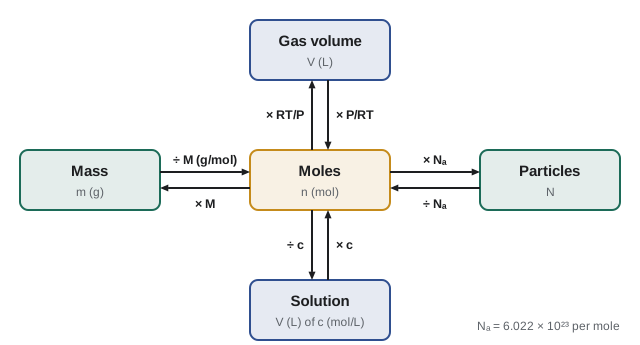
Every stoichiometry problem follows the same road: convert what you know to moles, use the mole ratio from the balanced equation, then convert moles to what you want.
Worked problem
CO₂ and air from burning propane
A furnace burns 1.00 kg of propane. How much CO₂ does it release, how much O₂ does it need, and what mass of air is that? (Air is 23.2% O₂ by mass.)
Show solution
- Moles of propane: \(1000/44.10 = 22.68\) mol.
- CO₂: \(3 \times 22.68 = 68.03\) mol, or \(68.03 \times 44.01 = 2994\) g.
- O₂: \(5 \times 22.68 = 113.4\) mol, or \(113.4 \times 32.00 = 3628\) g.
- Air: \(3.628/0.232 = 15.6\) kg.
Answer: 3.0 kg of CO₂ and 3.6 kg of O₂, which means 15.6 kg of air per kg of fuel. That ratio is the stoichiometric air–fuel ratio burner designers start from
Notice that burning 1 kg of fuel produces 3 kg of CO₂. The extra mass is oxygen taken from the air. This is why emission factors for fuels look surprisingly large.
Limiting reactants and yield
Reactants are rarely supplied in exactly the ratio the equation needs. The one that runs out first is the limiting reactant, and it sets how much product can form. The others are in excess.
To find the limiting reactant, convert each reactant to moles and compare with the mole ratio. Whichever would make less product limits the reaction.
Worked problem
Making ammonia
The Haber process makes ammonia: N₂ + 3 H₂ → 2 NH₃. A reactor is charged with 50.0 kg of N₂ and 10.0 kg of H₂. Find the limiting reactant, the maximum mass of NH₃, and the mass of excess reactant left over.
Show solution
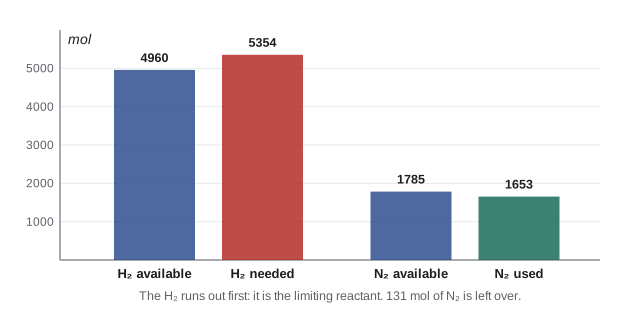
- Moles: N₂ \(= 50\,000/28.01 = 1785\) mol; H₂ \(= 10\,000/2.016 = 4960\) mol.
- Reacting all the N₂ would need \(3 \times 1785 = 5355\) mol of H₂. Only 4960 mol is available, so H₂ is limiting.
- NH₃ formed: \(\tfrac23 \times 4960 = 3307\) mol, or \(3307 \times 17.03 = 56.3\) kg.
- N₂ used: \(\tfrac13 \times 4960 = 1653\) mol. Left over: \(1785 - 1653 = 131\) mol, or 3.7 kg.
Answer: H₂ limits; at most 56.3 kg NH₃; 3.7 kg N₂ remains
Percent yield
The amount calculated from the limiting reactant is the theoretical yield. Real processes give less, because of side reactions, incomplete conversion and losses in separation. The percent yield is
If the reactor above produced 45.0 kg of ammonia, the yield would be \(45.0/56.3 = 79.9\%\). Industrial ammonia converters convert only about 15% to 25% of the feed per pass, so unreacted gas is separated and recycled, and the overall yield of the plant ends up well above 95%.
Empirical and molecular formulas
Laboratory analysis gives the mass percentage of each element in a compound. Converting those percentages to a mole ratio gives the empirical formula, the simplest whole-number ratio of atoms.
Worked problem
From analysis to formula
A hydrocarbon is 85.6% carbon and 14.4% hydrogen by mass. Its molar mass is 56.1 g/mol. Find its empirical and molecular formulas.
Show solution
- Take 100 g: 85.6 g C and 14.4 g H.
- Moles: C \(= 85.6/12.01 = 7.13\); H \(= 14.4/1.008 = 14.3\).
- Divide by the smaller: C : H = 1 : 2.00. Empirical formula CH₂ (14.03 g/mol).
- Molecular formula: \(56.1/14.03 = 4.0\), so C₄H₈.
Answer: Empirical CH₂; molecular C₄H₈ (butene, a petrochemical feedstock)
Solutions and concentration
Most industrial reactions happen in solution. The usual concentration unit is molarity, moles of solute per litre of solution:
The dilution equation holds because adding water does not change the number of moles of solute. To make 2.0 L of 0.50 M sulfuric acid from 12 M stock, you need \(V_1 = (0.50)(2.0)/12 = 0.083\) L, or 83 mL of stock. Tip: always add acid to water, never water to acid, because the heat released can make concentrated acid boil and spatter.
Environmental and water engineers often use mass concentrations instead: milligrams per litre (mg/L), which for dilute water solutions is the same as parts per million (ppm).
Titration
A titration measures an unknown concentration by adding a solution of known concentration until the reaction is just complete, shown by an indicator colour change or a pH meter. At that equivalence point the moles of the two reactants match the equation's ratio.
Worked problem
Acid–base titration
A 25.0 mL sample of hydrochloric acid needs 18.4 mL of 0.100 M sodium hydroxide to neutralize it (HCl + NaOH → NaCl + H₂O). What is the acid's concentration?
Show solution
- Moles of NaOH: \(0.100 \times 0.0184 = 1.84 \times 10^{-3}\) mol.
- The ratio is 1 : 1, so the sample held \(1.84 \times 10^{-3}\) mol HCl.
- \(c = 1.84 \times 10^{-3}/0.0250 = 0.0736\) M.
Answer: 0.0736 M HCl
Plant laboratories run titrations daily to check boiler water alkalinity, the acidity of process streams and the strength of cleaning solutions.
Mass balances
Stoichiometry is one half of the most important tool in chemical and environmental engineering: the mass balance. For any process unit, a tank, a reactor or a whole plant, mass is conserved:
For a process running steadily, accumulation is zero. Applied to total mass, nothing is generated or consumed. Applied to individual chemical species, the generation and consumption terms come from the reaction stoichiometry. Engineers draw a box around the unit, label every stream entering and leaving, and write one balance per unknown.
Worked problem
Neutralizing acidic mine water
A mine discharges 500 m³ per day of water containing 200 mg/L of sulphuric acid. It is neutralized with hydrated lime: H₂SO₄ + Ca(OH)₂ → CaSO₄ + 2 H₂O. How much lime is needed per day, and how much calcium sulphate sludge forms (dry basis)?
Show solution
- Acid per day: 200 mg/L is 200 g/m³, so \(200 \times 500 = 100\,000\) g = 100 kg. Moles: \(100\,000/98.08 = 1020\) mol.
- The ratio is 1 : 1, so 1020 mol of Ca(OH)₂ (74.09 g/mol) is needed: 75.5 kg per day.
- CaSO₄ (136.14 g/mol): \(1020 \times 136.14 = 138.8\) kg per day.
Answer: About 76 kg of lime per day in theory; plants add 10% to 20% more because lime does not react completely. The 139 kg of sludge per day must be thickened, stored and disposed of, often the larger cost
Common mistakes
MistakeUsing mass ratios from the balanced equation, e.g. "1 g propane needs 5 g O₂".
InsteadCoefficients are mole ratios. Convert to moles, apply the ratio, then convert back.
MistakeChanging subscripts to balance an equation (writing H₂O₂ instead of 2 H₂O).
InsteadOnly change coefficients. Subscripts define the substance.
MistakeChoosing the reactant with the smaller mass as the limiting reactant.
InsteadCompare moles against the mole ratio. Light molecules like H₂ can limit even when their mass is small.
MistakeForgetting that diatomic gases are O₂, N₂, H₂, Cl₂ (molar mass 32, 28, 2.016, 70.9).
InsteadUse the molar mass of the molecule, not of the single atom.
MistakeUsing millilitres in c = n/V.
InsteadMolarity is per litre: convert mL to L.
Summary and key terms
- A mole is 6.022 × 10²³ particles; molar mass M (g/mol) converts mass to moles: n = m/M.
- Balanced equations conserve atoms; coefficients are mole ratios.
- Stoichiometry: given quantity → moles → mole ratio → moles → wanted quantity.
- The limiting reactant runs out first and sets the theoretical yield; percent yield = actual/theoretical × 100%.
- Empirical formulas come from mass percentages converted to mole ratios.
- Molarity c = n/V; dilution keeps moles constant: c₁V₁ = c₂V₂. Titration finds unknown concentrations.
- Mole
- 6.022 × 10²³ particles of a substance.
- Avogadro's number
- N_A = 6.022 × 10²³ per mole.
- Molar mass
- The mass of one mole, in g/mol.
- Stoichiometry
- The quantitative relationships between reactants and products.
- Limiting reactant
- The reactant that is used up first and limits the product.
- Theoretical yield
- The maximum product possible from the limiting reactant.
- Empirical formula
- The simplest whole-number ratio of atoms in a compound.
- Molarity
- Moles of solute per litre of solution.
- Titration
- Finding a concentration by reacting with a solution of known concentration.
Practice problems
Work each problem on paper first, then reveal the answer to check.
Find the molar mass of calcium carbonate, CaCO₃, and the number of moles in 250 g.
Show answer
40.08 + 12.01 + 3(16.00) = 100.09 g/mol. n = 250/100.09 = 2.50 mol.
Balance: Al + O₂ → Al₂O₃.
Show answer
4 Al + 3 O₂ → 2 Al₂O₃.
Balance the combustion of methane and find the mass of CO₂ from 1.00 kg of CH₄.
Show answer
CH₄ + 2 O₂ → CO₂ + 2 H₂O. 1000/16.04 = 62.3 mol CH₄ gives 62.3 mol CO₂ = 2.74 kg.
Heating limestone makes lime: CaCO₃ → CaO + CO₂. How much CO₂ does a cement kiln release per tonne of limestone calcined?
Show answer
44.01/100.09 × 1000 = 440 kg of CO₂ per tonne, before any fuel is burned.
20.0 g of H₂ reacts with 100 g of O₂ to make water (2 H₂ + O₂ → 2 H₂O). Which is limiting, and how much water forms?
Show answer
H₂: 9.92 mol needs 4.96 mol O₂; there is 3.125 mol O₂, so O₂ limits. Water = 2 × 3.125 = 6.25 mol = 113 g.
A plant should make 2.00 t of product but makes 1.74 t. What is the percent yield?
Show answer
87.0%.
A compound is 40.0% C, 6.7% H and 53.3% O by mass, with molar mass 180 g/mol. Find its formulas.
Show answer
Moles per 100 g: C 3.33, H 6.65, O 3.33, so CH₂O (30.03). 180/30 = 6, giving C₆H₁₂O₆ (glucose).
How many grams of NaCl are needed to make 500 mL of 0.150 M solution?
Show answer
0.150 × 0.500 = 0.0750 mol × 58.44 = 4.38 g.
What volume of 6.0 M HCl is needed to make 250 mL of 0.40 M HCl?
Show answer
V₁ = (0.40)(0.250)/6.0 = 0.0167 L = 16.7 mL.
20.0 mL of 0.150 M H₂SO₄ is titrated with 0.200 M NaOH (H₂SO₄ + 2 NaOH → Na₂SO₄ + 2 H₂O). What volume of base is needed?
Show answer
Acid: 3.00 × 10⁻³ mol, needs 6.00 × 10⁻³ mol NaOH. V = 6.00 × 10⁻³/0.200 = 0.0300 L = 30.0 mL.
Lesson quiz · 5 questions
Score 60% or more to complete this lesson.
Create a free account to save your progress, take quizzes and earn a certificate.