
CHEM-103 · Lesson 3 of 5 · 41 min
Thermochemistry
Most of the world's energy still comes from chemical reactions: burning natural gas, oil, coal and wood. Engineers who design furnaces, boilers, engines and reactors need to know how much heat a reaction releases or absorbs, and how much it takes to heat, melt or boil the materials involved. Thermochemistry provides those numbers.
This chapter covers heat and temperature, specific heat and calorimetry, phase changes, the enthalpy of reaction, Hess's law and standard enthalpies of formation, and applies them to fuel heating values, home heating and industrial energy use.
Energy, heat and the system
Energy is the capacity to do work or transfer heat, measured in joules. Heat (\(q\)) is energy transferred because of a temperature difference; work (\(w\)) is energy transferred by a force acting through a distance, such as a gas pushing a piston. Temperature is not energy: it measures the average kinetic energy of the particles, and it tells you which way heat will flow.
To keep track, chemists divide the world into the system (the reaction or material you are studying) and the surroundings (everything else). The sign convention is from the system's point of view:
- \(q > 0\): heat flows into the system (endothermic, the surroundings cool).
- \(q < 0\): heat flows out of the system (exothermic, the surroundings warm).
The first law of thermodynamics says energy is conserved: the change in a system's internal energy is the heat added minus the work it does, \(\Delta U = q - w\) in the convention engineers usually use. You will study the first law in full in thermodynamics; this chapter focuses on heat.
Specific heat and sensible heat
Heat that changes a material's temperature is called sensible heat. The amount needed is
where \(c\) is the specific heat capacity in J/(g·K) or kJ/(kg·K). A change of 1 K equals a change of 1 °C, so either can be used for \(\Delta T\). Water has an unusually high specific heat, 4.184 J/(g·K), which is why it is the standard heat-transfer fluid in boilers and cooling systems, and why lakes moderate the climate around them. Typical values: steel about 0.49, aluminium 0.90, concrete about 0.88, air (constant pressure) 1.005, and engine oil about 2.0 J/(g·K).
Worked problem
Boiling a kettle
How much heat is needed to raise 2.0 kg of water from 15 °C to 95 °C? How long would a 1500 W kettle take, if all its power went into the water?
Show solution
- \(q = (2000)(4.184)(95 - 15) = 669\,000\) J = 669 kJ.
- Time: \(669\,000/1500 = 446\) s, about 7.4 minutes.
Answer: 669 kJ; about 7.4 min. In practice some heat is lost to the kettle body and the air, so it takes a little longer
Calorimetry
A calorimeter measures heat by watching a temperature change in a well-insulated container. If no heat is lost, the heat lost by hot objects equals the heat gained by cold ones: \(\sum q = 0\).
Worked problem
Identifying a metal
A 50.0 g metal sample is heated to 100.0 °C and dropped into 200.0 g of water at 20.0 °C in an insulated cup. The final temperature is 22.4 °C. Find the specific heat of the metal.
Show solution
- Heat gained by water: \((200.0)(4.184)(22.4 - 20.0) = 2008\) J.
- Heat lost by metal: \((50.0)\,c\,(100.0 - 22.4) = 3880\,c\).
- Equate: \(c = 2008/3880 = 0.518\) J/(g·K).
Answer: 0.52 J/(g·K), consistent with titanium (0.52). Iron and steel are a little lower, about 0.45 to 0.49
Phase changes and latent heat
When a substance melts, boils or condenses, it absorbs or releases heat without changing temperature, because the energy goes into breaking or forming the bonds between molecules. This is latent heat:
For water, the latent heat of fusion (melting) is 334 kJ/kg and the latent heat of vaporization at 100 °C is 2257 kJ/kg. Boiling a kilogram of water takes more than five times as much energy as heating it from 0 °C to 100 °C.
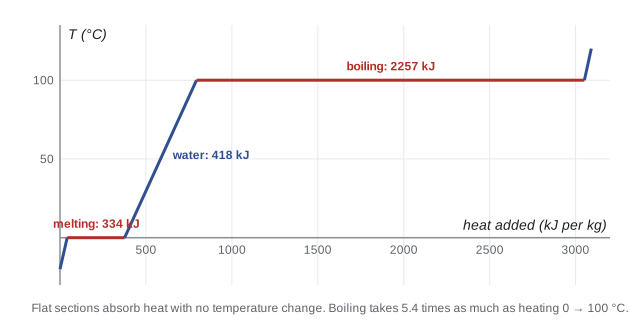
Latent heat is what makes steam such an effective way to carry energy around a plant: condensing 1 kg of steam delivers 2257 kJ at a constant temperature, ideal for heating process vessels evenly. It is also why steam burns are so severe, and why evaporative coolers and cooling towers work so well.
Worked problem
Making steam
How much heat turns 1.00 kg of water at 20 °C into steam at 100 °C?
Show solution
- Heat the water: \((1.00)(4.184)(80) = 335\) kJ.
- Boil it: \((1.00)(2257) = 2257\) kJ.
- Total: \(335 + 2257 = 2592\) kJ.
Answer: About 2.59 MJ per kg; 87% of it is the latent heat
Enthalpy of reaction
Most reactions happen at constant pressure, open to the atmosphere or in a process vessel. The heat absorbed or released at constant pressure is the change in enthalpy, \(\Delta H\). For an exothermic reaction \(\Delta H < 0\); for an endothermic one \(\Delta H > 0\).
A thermochemical equation attaches \(\Delta H\) to a balanced equation, per mole of reaction as written:
Three rules follow from enthalpy being a state function (it depends only on the current state, not on how it was reached):
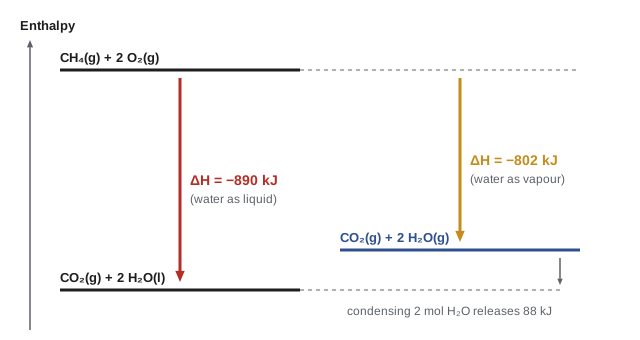
- \(\Delta H\) scales with the amount: burning 2 mol of methane releases 1780 kJ.
- Reversing a reaction reverses the sign of \(\Delta H\).
- Physical states matter: forming water vapour instead of liquid releases less heat, because vapour still holds its latent heat.
Hess's law
Because enthalpy is a state function, the enthalpy change for a reaction is the same whether it happens in one step or several. This is Hess's law, and it lets you calculate \(\Delta H\) for reactions that are hard to measure directly by combining ones that are easy to measure.
Worked problem
Enthalpy of forming carbon monoxide
Burning carbon to CO cleanly is hard to measure, because some CO₂ always forms. Use these to find \(\Delta H\) for C + ½ O₂ → CO: (1) C + O₂ → CO₂, \(\Delta H = -393.5\) kJ; (2) CO + ½ O₂ → CO₂, \(\Delta H = -283.0\) kJ.
Show solution
- Keep (1) as written. Reverse (2): CO₂ → CO + ½ O₂, \(\Delta H = +283.0\) kJ.
- Add: C + O₂ + CO₂ → CO₂ + CO + ½ O₂. Cancel CO₂ and ½ O₂: C + ½ O₂ → CO.
- \(\Delta H = -393.5 + 283.0 = -110.5\) kJ.
Answer: −110.5 kJ per mole of CO. Burning carbon only to CO releases less than a third of the available heat, one reason incomplete combustion wastes fuel as well as producing a poison
Standard enthalpies of formation
The most practical form of Hess's law uses tabulated standard enthalpies of formation, \(\Delta H_f^\circ\): the enthalpy change when one mole of a compound forms from its elements in their standard states (at 25 °C and 1 bar). Elements in their standard states, such as O₂(g), N₂(g) and C(graphite), have \(\Delta H_f^\circ = 0\) by definition. Then for any reaction:
Some values in kJ/mol: CO₂(g) −393.5, H₂O(l) −285.8, H₂O(g) −241.8, CH₄(g) −74.8, C₃H₈(g) −103.8, CO(g) −110.5, NH₃(g) −45.9, CaCO₃(s) −1207.6, CaO(s) −634.9.
Worked problem
Heat of combustion of propane
Use enthalpies of formation to find \(\Delta H\) for C₃H₈(g) + 5 O₂(g) → 3 CO₂(g) + 4 H₂O(l), and the heat released per kilogram of propane.
Show solution
- Products: \(3(-393.5) + 4(-285.8) = -1180.5 - 1143.2 = -2323.7\) kJ.
- Reactants: \(-103.8 + 5(0) = -103.8\) kJ.
- \(\Delta H = -2323.7 - (-103.8) = -2219.9\) kJ per mole of propane.
- Per kilogram: \(2219.9 \times 1000/44.10 = 50\,300\) kJ = 50.3 MJ/kg.
Answer: −2220 kJ/mol, or about 50.3 MJ per kg of propane
Higher and lower heating values
Fuel energy is quoted two ways. The higher heating value (HHV) assumes the water in the flue gas condenses to liquid, recovering its latent heat. The lower heating value (LHV) assumes it leaves as vapour.
Worked problem
Heating values of methane
Find the HHV and LHV of methane in MJ/kg.
Show solution
- With liquid water: \(\Delta H = -393.5 + 2(-285.8) - (-74.8) = -890.3\) kJ/mol.
- With water vapour: \(\Delta H = -393.5 + 2(-241.8) - (-74.8) = -802.3\) kJ/mol.
- Divide by 16.04 g/mol: HHV \(= 55.5\) MJ/kg; LHV \(= 50.0\) MJ/kg.
Answer: HHV 55.5 MJ/kg, LHV 50.0 MJ/kg. A high-efficiency condensing furnace cools its exhaust enough to condense the water vapour, capturing most of that 10% difference
Estimating with bond energies
When formation data are missing, \(\Delta H\) can be estimated from average bond energies: energy is absorbed to break bonds in the reactants and released when bonds form in the products. For methane combustion, breaking four C–H bonds (413 kJ each) and two O=O bonds (495 kJ each) absorbs 2642 kJ, while forming two C=O bonds (799 kJ each) and four O–H bonds (463 kJ each) releases 3450 kJ, giving \(\Delta H \approx -808\) kJ. That is within 1% of the true value for gaseous water, −802 kJ. Bond energies are averages, so the estimate is usually good to about 10%.
Adiabatic flame temperature
If a fuel burns with no heat lost, all the heat of combustion goes into warming the products. The temperature they reach is the adiabatic flame temperature, the upper limit for a furnace or engine, and it is set by an energy balance: heat released = heat absorbed by the products.
Worked problem
How hot is a natural gas flame?
Methane burns with exactly the stoichiometric amount of air, starting at 25 °C. Estimate the adiabatic flame temperature using average heat capacities over the temperature range: CO₂ 54.6, H₂O(g) 43.9 and N₂ 33.4 J/(mol·K).
Show solution
- Per mole of CH₄, the products are 1 CO₂, 2 H₂O(g) and \(2 \times 3.773 = 7.55\) N₂ (air carries 3.773 mol N₂ per mol O₂).
- Heat released (LHV, because the water stays as vapour): 802.3 kJ.
- Heat capacity of the products: \(54.6 + 2(43.9) + 7.55(33.4) = 394\) J/K.
- \(\Delta T = 802\,300/394 = 2030\) K, so \(T \approx 298 + 2030 = 2330\) K.
Answer: About 2330 K (2060 °C). The measured value is closer to 2220 K, because at these temperatures some CO₂ and H₂O split apart, absorbing energy. Excess air, which adds more nitrogen to heat, lowers the flame temperature further
Flame temperature matters for equipment life and emissions. Nitrogen oxides (NOₓ), which contribute to smog, form rapidly above about 1800 K, so low-NOₓ burners deliberately spread out or cool the flame.
Energy in engineering practice
Worked problem
Heating a house with natural gas
A house in Edmonton needs 100 GJ of heat over a winter. Natural gas delivers about 37.7 MJ per cubic metre (HHV), and the furnace is 95% efficient. How much gas is burned?
Show solution
- Fuel energy needed: \(100\,000\) MJ \(/0.95 = 105\,300\) MJ.
- Gas: \(105\,300/37.7 = 2790\) m³.
Answer: About 2800 m³ of gas, or 105 GJ on the bill. Alberta utilities bill natural gas by the gigajoule for this reason
Worked problem
Energy to make lime
Find \(\Delta H\) for CaCO₃(s) → CaO(s) + CO₂(g), and the minimum heat needed per tonne of limestone.
Show solution
- \(\Delta H = (-634.9) + (-393.5) - (-1207.6) = +179.2\) kJ/mol. Endothermic.
- Per tonne: \(10^6/100.09 = 9991\) mol, so \(9991 \times 179.2 = 1.79 \times 10^6\) kJ = 1.79 GJ.
Answer: +179 kJ/mol; at least 1.8 GJ per tonne, all of which must come from burning fuel in the kiln. Together with the CO₂ released by the reaction itself, this is why cement is one of the most carbon-intensive materials
Common mistakes
MistakeMixing up the sign convention: writing ΔH > 0 for combustion.
InsteadExothermic reactions release heat: ΔH is negative.
MistakeUsing kJ/mol values without multiplying by the coefficients.
InsteadMultiply each ΔH°f by the number of moles in the balanced equation.
MistakeGiving O₂ or N₂ a non-zero enthalpy of formation.
InsteadElements in their standard states have ΔH°f = 0.
MistakeIgnoring the physical state of water.
InsteadH₂O(l) and H₂O(g) differ by 44 kJ/mol; check which the problem needs (HHV or LHV).
MistakeForgetting latent heat when a substance changes phase.
InsteadAdd q = mL for each melting or boiling step along the way.
Summary and key terms
- Heat flows from hot to cold; q > 0 means the system absorbs heat (endothermic).
- Sensible heat q = mcΔT; water's c = 4.184 J/(g·K) is unusually high.
- Calorimetry: heat lost by hot objects = heat gained by cold ones.
- Latent heat q = mL changes phase at constant temperature; water: 334 kJ/kg to melt, 2257 kJ/kg to boil.
- ΔH is the heat at constant pressure; it scales with amount and changes sign when reversed.
- Hess's law: ΔH is path independent, so equations and their ΔH values can be added.
- ΔH°rxn = Σ n ΔH°f(products) − Σ n ΔH°f(reactants).
- Fuels have higher (liquid water) and lower (vapour) heating values.
- Heat
- Energy transferred because of a temperature difference.
- Specific heat capacity
- Heat needed to raise 1 g (or 1 kg) by 1 K.
- Calorimetry
- Measuring heat from temperature changes.
- Latent heat
- Heat absorbed or released during a phase change at constant temperature.
- Enthalpy (ΔH)
- Heat transferred at constant pressure.
- Exothermic
- Releasing heat; ΔH < 0.
- Endothermic
- Absorbing heat; ΔH > 0.
- Hess's law
- The enthalpy change of a reaction is independent of path.
- Enthalpy of formation
- ΔH to form 1 mol of a compound from its elements in standard states.
- Heating value
- Heat released by burning a unit mass or volume of fuel (HHV or LHV).
Practice problems
Work each problem on paper first, then reveal the answer to check.
How much heat raises a 5.0 kg steel part (c = 0.49 J/(g·K)) from 20 °C to 220 °C?
Show answer
q = 5000 × 0.49 × 200 = 490 000 J = 490 kJ.
A 400 W heater warms 3.0 L of oil (density 0.88 kg/L, c = 2.0 kJ/(kg·K)) for 10 minutes. Ignoring losses, how much does the temperature rise?
Show answer
q = 400 × 600 = 240 kJ. m = 2.64 kg. ΔT = 240/(2.64 × 2.0) = 45 K.
How much heat melts 2.0 kg of ice at 0 °C and warms it to 25 °C?
Show answer
2.0 × 334 + 2.0 × 4.184 × 25 = 668 + 209 = 877 kJ.
250 g of water at 80 °C is mixed with 150 g at 20 °C in an insulated container. What is the final temperature?
Show answer
250(80 − T) = 150(T − 20), so T = (20 000 + 3000)/400 = 57.5 °C.
Given C + O₂ → CO₂, ΔH = −393.5 kJ, find ΔH for 2 CO₂ → 2 C + 2 O₂.
Show answer
Reverse and double: +787.0 kJ.
Use enthalpies of formation to find ΔH for N₂ + 3 H₂ → 2 NH₃ (ΔH°f NH₃ = −45.9 kJ/mol).
Show answer
2(−45.9) − 0 = −91.8 kJ. The Haber process is exothermic.
Find the heat released by burning 1.00 m³ of methane at 25 °C and 101.3 kPa (HHV basis).
Show answer
n = 1000/24.47 = 40.9 mol × 890.3 = 36 400 kJ = 36.4 MJ (close to the 37.7 MJ/m³ utilities quote, which uses a slightly different reference state and includes heavier hydrocarbons).
Using ΔH°f values, find the LHV of propane in MJ/kg.
Show answer
3(−393.5) + 4(−241.8) + 103.8 = −2043.9 kJ/mol; 2043.9/44.10 = 46.3 MJ/kg.
Estimate ΔH for H₂ + Cl₂ → 2 HCl from bond energies H–H 436, Cl–Cl 243, H–Cl 431 kJ/mol.
Show answer
Break: 436 + 243 = 679. Form: 2 × 431 = 862. ΔH ≈ −183 kJ (the measured value is −184.6 kJ).
A furnace rated 80% efficient (HHV) is replaced with a 96% unit. By what percentage does fuel use fall for the same heat delivered?
Show answer
Fuel ∝ 1/η: 0.80/0.96 = 0.833, a 16.7% reduction.
Lesson quiz · 5 questions
Score 60% or more to complete this lesson.
Create a free account to save your progress, take quizzes and earn a certificate.