
CINE-101 · Lesson 3 of 12 · 24 min
Lenses, focus and focus pulling
In still photography, focus is set once and the picture is taken. In video, subjects move, the camera moves, and the focus must follow them continuously, often with a depth of field only a few centimetres deep. Keeping images sharp is one of the hardest technical tasks on any set, important enough that professional crews assign a dedicated person, the focus puller, to do nothing else. This lesson covers how lenses for video differ from photographic lenses, how focal length and sensor size shape the image, depth of field in motion, manual focus techniques including marks and rack focus, autofocus for video, and stabilization.
Lenses for video
Any lens that fits the camera can record video, but some characteristics that do not matter for stills become important when the image moves:
- Focus breathing: many lenses change their field of view slightly as focus changes. In a still photograph this is invisible, but during a focus change in video the frame appears to zoom in or out. Lenses designed for video minimize breathing.
- Parfocal zooms: a true parfocal zoom stays in focus as it zooms; many photographic zooms do not, so zooming during a shot requires refocusing.
- Smooth, long focus throw: cinema lenses turn through a large angle (often 270° or more) from closest focus to infinity, allowing precise adjustment. Many photographic lenses use focus-by-wire, which may not repeat positions exactly.
- Stepless aperture: a de-clicked aperture ring allows smooth exposure changes during a shot.
- Consistency: cinema lens sets have matched colour, contrast, front diameter and gear positions, so that switching lenses does not change the look or require re-rigging accessories.
Cinema lenses are marked in T-stops rather than f-stops. An f-stop is a geometric ratio (focal length divided by aperture diameter), while a T-stop measures the light actually transmitted, accounting for losses in the glass. Two lenses at T2.8 give the same exposure; two lenses at f/2.8 may differ by a fraction of a stop, which would be visible when cutting between them.
Focal length, sensor size and the story
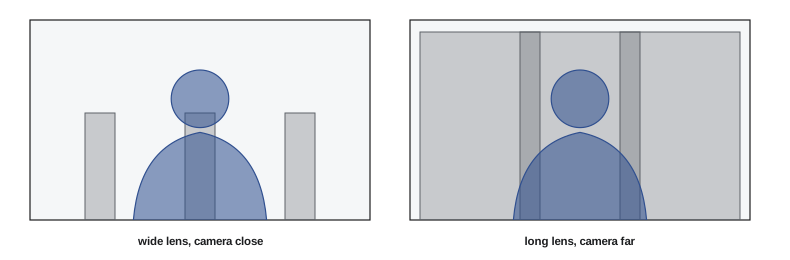
As in photography (PHOT-101, Lesson 2), focal length determines the angle of view, and camera position determines perspective. In filmmaking these choices also carry emotional meaning:
- Wide lenses used close to a subject exaggerate depth and movement, distort faces near the edges of the frame and place the viewer close to the action, conveying intimacy, energy or unease. Moving toward or away from the camera looks fast.
- Normal focal lengths (about 35 to 50 mm on a full-frame sensor) give a natural relationship between subject and background.
- Long lenses compress distance, flatten faces flatteringly, isolate subjects from busy backgrounds and make movement toward the camera appear slow, as in the classic shot of a character running toward the lens without seeming to get closer.
Sensor size changes the field of view for a given focal length. Many cinema cameras use a Super 35 sensor (about the size of APS-C), on which a 35 mm lens gives roughly the field of view of a 50 mm lens on full frame. When following a recommendation such as "use a 50 mm lens for medium shots", check which sensor size it assumes.
Depth of field in motion
Shallow depth of field is popular because it separates subjects from backgrounds and gives a "cinematic" look, but in video it creates a moving target. The depth of field depends on aperture, focal length, subject distance and sensor size, as in photography (PHOT-101, Lesson 3). What changes is that the subject may move through it.
Worked problem
How deep is the focus?
An actor stands 2 m from a full-frame camera with a 50 mm lens at f/2. Using a circle of confusion of 0.03 mm, how deep is the zone of acceptable focus, and what does this mean for the actor's movement?
Show solution
- Hyperfocal distance: H = f² / (N c) + f = 50² / (2 × 0.03) + 50 ≈ 41,700 mm.
- Near limit: s H / (H + (s − f)) = 2,000 × 41,700 / (41,700 + 1,950) ≈ 1,910 mm.
- Far limit: s H / (H − (s − f)) = 2,000 × 41,700 / (41,700 − 1,950) ≈ 2,100 mm.
Answer: The zone of focus is only about 19 cm deep, from about 1.91 to 2.10 m. If the actor leans forward 10 cm or sways back, their eyes go soft unless the focus follows. Stopping down to f/4 roughly doubles the depth; moving the camera back or using a shorter lens also increases it. For moving subjects, choose a depth of field the focus puller can realistically hold, not just the shallowest the lens allows.
The circle of confusion used for video is often stricter than for prints, because large screens and 4K resolution reveal softness. When in doubt, judge focus with magnification on a monitor rather than trusting calculations alone.
Manual focus and focus marks
Professional focus pulling is done manually, using a follow focus: a geared wheel that drives the lens's focus ring, with a marking disc on which the focus puller writes positions. The method is:
- During rehearsal, measure the distance from the camera's sensor plane (marked on most camera bodies with a ⦶ symbol) to each position the actor will occupy, using a tape measure or laser distance meter.
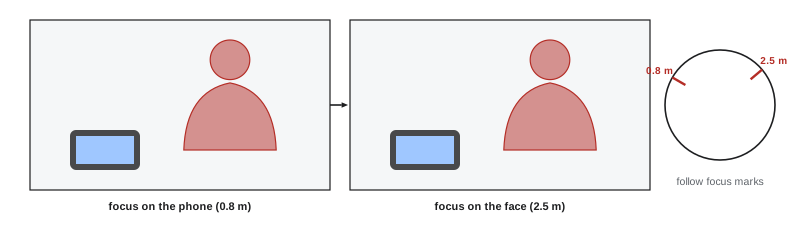
- Mark those positions on the floor for the actor with tape (an actor's "mark"), and mark the corresponding distances on the follow focus disc.
- During the take, the focus puller watches the actor and turns the wheel from mark to mark in time with their movement, often while standing beside the camera rather than looking at a monitor, judging distance by eye and experience.
Wireless follow focus systems let the focus puller work from a distance with a handheld unit, using a monitor. Focus aids on the camera help: peaking (coloured outlines on in-focus edges) and magnification. Peaking is useful but crude at high resolution; magnifying the image before a take is more reliable for critical focus.
Rack focus
A rack focus (or pull focus) shifts focus from one subject to another during a shot, directing the viewer's attention: from a phone on a table to the face of the person who has just read the message, or from a foreground character to someone entering in the background. A rack focus should be motivated by the story, timed with the action or dialogue, and smooth, neither too abrupt nor so slow that the viewer notices the mechanism. With shallow depth of field, the effect is strong; with deep focus, it hardly registers.
Autofocus for video
Modern mirrorless cameras have autofocus systems that track faces and eyes reliably, and for one-person crews, documentaries, events and gimbal work they are often the best choice. To use autofocus well:
- Choose continuous autofocus with face or eye detection, and select the subject deliberately (for example by touching it on the screen) rather than letting the camera choose.
- Set the transition speed and tracking sensitivity: slower, smoother transitions look more natural on screen, and lower sensitivity prevents focus jumping to a passing object.
- Avoid situations that confuse autofocus: low contrast, several faces at similar distances, foreground objects crossing the frame, and very shallow depth of field with fast movement.
Autofocus cannot decide what the story needs. A focus puller chooses whom to keep sharp and when to shift; a camera chooses what its algorithm finds. For deliberate rack focus and for scenes where the focus must not hunt, switch to manual.
Stabilization
Small shakes that would not matter in a still photograph become distracting jitter in video. Stabilization reduces them: optical stabilization moves an element in the lens, in-body stabilization (IBIS) moves the sensor, and electronic or digital stabilization crops and shifts the image, sometimes with a visible loss of resolution or a wobbling "jello" effect on fast movements. Stabilization helps handheld work, but it does not replace a tripod or gimbal (Lesson 6), and on a tripod it should usually be turned off, because some systems drift when the camera is still.
Anamorphic and specialty lenses
Anamorphic lenses squeeze a wide field of view horizontally onto the sensor, to be stretched back in post-production, producing a wide aspect ratio, oval out-of-focus highlights and characteristic horizontal flares associated with many feature films. Macro lenses focus very close for details; probe lenses reach into tiny spaces; tilt-shift lenses tilt the plane of focus. These are creative tools for later courses; at this level, a few good primes or a quality zoom, used with care, are all you need.
Lens care on set
Lenses are precise and expensive. Change them out of wind and dust, with the camera facing down, and keep caps on whenever a lens is off the camera. Clean front elements only when needed, first with a blower, then with lens tissue and cleaning fluid applied to the tissue, never to the glass. Check the rear element and the sensor for dust before an important shoot, because a speck on the sensor shows as a soft dark spot in every shot, especially at small apertures against bright skies. Support long lenses with a lens support rather than letting their weight hang on the camera mount, and never carry a camera by a lens.
Practising focus
Focus pulling is a physical skill, learned by repetition. A simple exercise: place two objects at different distances, mark both on the follow focus or lens, and practise racking between them in time with a count, first slowly and then quickly, checking the result on a magnified monitor. Then have a friend walk slowly toward the camera from a measured mark and try to keep their eyes sharp throughout, without looking at the monitor, judging distance by eye. Recording these exercises and reviewing them on a large screen shows how forgiving or unforgiving each aperture and focal length is, which builds the judgement needed on set. Experienced focus pullers also develop the habit of watching the actor, not the lens, and anticipating movement from rehearsal.
Common mistakes
MistakeShooting at the widest aperture regardless of movement.
InsteadChoose a depth of field the focus can realistically follow.
MistakeRelying on peaking alone at 4K.
InsteadCheck critical focus with magnification before the take.
MistakeLetting autofocus choose the subject.
InsteadSelect the subject deliberately, or pull focus manually for story-driven focus.
MistakeMixing lenses with different T-stop behaviour and colour in one scene.
InsteadUse matched lenses, or test and correct the differences.
MistakeLeaving stabilization on when the camera is on a tripod.
InsteadTurn it off to prevent drift.
Summary and key terms
- Video lenses minimize focus breathing, stay parfocal, have long focus throws and stepless apertures.
- T-stops measure transmitted light, so lenses at the same T-stop match exposure.
- Focal length and camera position shape perspective and emotional tone.
- Shallow depth of field in motion demands precise focus; 50 mm at f/2 and 2 m gives about 19 cm.
- Focus pullers measure distances, mark positions and follow actors with a follow focus.
- Rack focus redirects attention and should be motivated and well timed.
- Autofocus with face tracking is powerful but cannot decide what the story needs; stabilization helps but does not replace support.
- Focus breathing
- A change in field of view when focus changes.
- Parfocal
- A zoom lens that keeps focus while zooming.
- T-stop
- An aperture value based on measured light transmission.
- Follow focus
- A geared device for turning a lens's focus ring precisely.
- Focus puller
- The camera assistant who keeps the image in focus.
- Mark
- A floor position for an actor, measured for focus.
- Rack focus
- A focus change from one subject to another during a shot.
- Peaking
- A focus aid that outlines sharp edges in colour.
- IBIS
- In-body image stabilization, moving the sensor to cancel shake.
- Super 35
- A cinema sensor size similar to APS-C.
Practice problems
Work each problem on paper first, then reveal the answer to check.
Why is focus breathing a problem in video?
Show answer
The frame appears to zoom during focus changes.
What is the difference between an f-stop and a T-stop?
Show answer
An f-stop is a geometric ratio; a T-stop measures transmitted light.
On Super 35, which full-frame focal length does a 35 mm lens roughly match?
Show answer
About 50 mm.
Why does a long lens make a running actor seem to approach slowly?
Show answer
It compresses distance, so changes in distance produce little change in size.
Roughly how deep is focus for 50 mm at f/4 at 2 m, compared with f/2?
Show answer
About twice as deep, roughly 38 cm.
From where are focus distances measured?
Show answer
From the sensor plane, marked on the camera body.
What makes a good rack focus?
Show answer
Story motivation, timing with action or dialogue, and smooth speed.
Name two situations that confuse autofocus.
Show answer
Low contrast, several faces at similar distances, foreground objects crossing, fast movement with shallow focus.
Why turn off stabilization on a tripod?
Show answer
Some systems drift when the camera is still.
How should a front lens element be cleaned?
Show answer
Blower first, then tissue with fluid applied to the tissue, only when needed.
Lesson quiz · 5 questions
Score 60% or more to complete this lesson.
Create a free account to save your progress, take quizzes and earn a certificate.