
CINE-220 · Lesson 2 of 12 · 25 min
Tungsten fixtures
For most of film history, tungsten incandescent lights were the workhorses of the studio and location. Although LEDs have taken over much of their work, tungsten fixtures remain in use for their beautiful, continuous spectrum, smooth dimming, reliability and low cost, and many lighting concepts, names and conventions come from them. Understanding tungsten fixtures also helps cinematographers understand light quality, beam control and power. This lesson covers how tungsten-halogen lamps work, their colour, Fresnel fixtures and the classic studio range, open-face fixtures, PARs and beam control, ellipsoidal spotlights, soft lights and space lights, scrims and other accessories, dimming and its colour shift, and safety and handling.
How tungsten-halogen lamps work
A tungsten lamp produces light by heating a coiled tungsten filament with electric current until it glows. The light is continuous across the visible spectrum, closely resembling the light of a black body at about 3,200 K, which gives excellent colour rendering with a CRI close to 100. Most film lamps are tungsten-halogen, also called quartz lamps: the filament is enclosed in a small quartz envelope containing a halogen gas, which recycles evaporated tungsten back onto the filament, keeping the envelope clear and the colour temperature stable over the lamp's life. Lamps are rated in watts, with common film sizes from 150 W to 20,000 W. Tungsten lamps are inefficient: only a few per cent of the energy becomes visible light, roughly 20 to 30 lumens per watt, with the rest emitted as heat. A 10 kW tungsten light therefore needs substantial power and produces intense heat.
Tungsten colour
Professional tungsten lamps are designed to produce light at about 3,200 K, the reference colour temperature for "tungsten" balance in film and video. Household incandescent bulbs are warmer, about 2,700 to 2,900 K. Because daylight is about 5,600 K, tungsten light looks orange when mixed with daylight unless corrected with blue gel, colour temperature blue (CTB), which costs a substantial amount of light: full CTB passes only about a third of the light, a loss of about 1.5 stops (Lesson 6). This inefficiency is one reason HMIs and LEDs took over daylight work. Tungsten's warmth is also loved for night interiors, firelight and nostalgic looks.
Fresnel fixtures
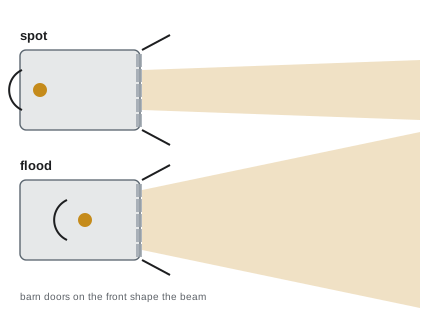
The Fresnel is the classic studio light. A lamp sits in a housing with a spherical reflector behind it and a Fresnel lens in front: a lens with stepped concentric rings that bends light like a thick lens with a fraction of the weight. Moving the lamp and reflector toward or away from the lens changes the beam angle, a control called spotting and flooding. At spot, the beam is narrow and intense; at flood, it is wide and less intense. Fresnels produce a smooth, even beam with a soft edge and a single, clean shadow, and they can be shaped precisely with barn doors, the hinged metal flaps on the front. Fresnels are traditionally known by their power in kilowatts, and by nicknames from the Mole-Richardson and other ranges:
| Nickname | Typical wattage | Lens diameter | Common use |
|---|---|---|---|
| Inky / Mini | 100–250 W | About 3 in | Small accents, eye lights, tabletop |
| Tweenie | 650 W | About 4.5 in | Small kickers and accents |
| Baby | 1 kW | About 6 in | Key, back and kicker in small sets |
| Junior | 2 kW | About 8–10 in | Key and fill through diffusion |
| Senior | 5 kW | About 14 in | Through-window and large keys |
| Tener | 10 kW | About 20 in | Large sets, through windows |
| Twenty (20K) | 20 kW | About 24 in | Simulating sun on stages |
A "baby" version of a fixture has a smaller housing than the standard version for the same wattage, such as the Baby Baby 1K or Baby Junior 2K, making it easier to rig. Even when LED Fresnels replace tungsten units, crews often describe them by the tungsten equivalent, such as "an LED that replaces a 2K".
Open-face fixtures
Open-face fixtures have no lens: the lamp sits in front of a reflector, sometimes with a spot-flood adjustment that moves the lamp relative to the reflector. They are lighter, cheaper and more efficient than Fresnels, giving more light for the same wattage, but they produce a harder light with less even beams, multiple shadows from the lamp and reflector, and less precise control with barn doors. Common open-face lights include the Redhead (800 W) and Blonde (2 kW) from the Arri and Ianiro tradition, the Mole-Richardson Mickey (1 kW) and Mighty Mole (2 kW), and the small, versatile Lowel lights used on documentaries and interviews. Open-face lights are ideal for bouncing off walls, ceilings and boards, and for pushing through large diffusion frames, where their raw efficiency matters more than beam quality.
PAR fixtures
A PAR (parabolic aluminized reflector) lamp combines the filament, a precise parabolic reflector and a front lens in a single sealed unit, like a car headlight. The beam is intense and roughly parallel, and the lens on the front determines its spread: very narrow spot (VNSP), narrow spot (NSP), medium flood (MFL) and wide flood (WFL). PARs are often grouped in multi-lamp fixtures, such as Maxi-Brutes with 9 or 12 lamps of 1,000 W each, and Dino or Wendy lights with 24 to 36 lamps, used to light large exteriors at night and to simulate sunlight through windows. Single PAR cans are common in theatre and concert lighting. PAR beams are oval in shape for most lenses, and the oval can be rotated by turning the lamp.
Ellipsoidal and specialty spotlights
Ellipsoidal reflector spotlights (ERS), known by trade names such as Source Four and Leko, use an ellipsoidal reflector and a lens train to produce a sharply defined beam that can be shaped with internal shutters and gobos, metal or glass templates that project patterns such as window frames, leaves or blinds. They come in different lens angles, such as 19, 26, 36 and 50 degrees, and can be focused from hard to soft edges. Ellipsoidals are invaluable for precise accents, light on a picture frame or a slash of light across a wall, and for projecting patterns that would otherwise need cookies and flags (Lesson 8). Follow spots, used in live events and some musical numbers, are powerful ellipsoidal-type fixtures operated by hand to follow performers.
Soft lights and space lights
Soft lights produce diffuse illumination directly. A traditional tungsten soft light hides its lamps inside a curved white reflector box, so that only bounced light emerges, creating a large, soft source; sizes include the 2 kW Zip and the 4 kW and 8 kW studio softs. Chinese lanterns, paper globes containing a bulb, give cheap, soft, omnidirectional light popular for close-ups and dinner scenes. Space lights are cylindrical silk-skirted fixtures containing six or more lamps, hung from studio ceilings in grids to create soft overhead ambience over large sets; tungsten space lights of 6 kW are classic, now often replaced by LED equivalents. Overhead soft boxes, built from frames with diffusion and lamps above, provide controlled top light over tables and set areas.
Scrims, barn doors and accessories
Tungsten fixtures accept standard accessories. Barn doors shape and cut the beam. Wire scrims, circular metal mesh screens that slot into the front of the light, reduce intensity without changing colour or softness: a single scrim, usually with a green rim, reduces light by about half a stop, and a double scrim, with a red rim, by about one stop. Half scrims cover only half the beam, useful for reducing light on the near part of a subject or set, such as the floor close to the light. Snoots narrow the beam into a circle, and gel frames hold colour or diffusion in front of the lens. Safety cables secure accessories and fixtures to stands and rigging.
Worked problem
Reducing a key light by one and a half stops
A 2K Fresnel key is 1.5 stops too bright on an actor. The DP wants to keep it in the same position and keep its softness unchanged. How can the electrician reduce it?
Show solution
- Adding a double scrim reduces light by about 1 stop.
- Adding a single scrim as well reduces it by about another half stop, a total of 1.5 stops.
- Alternatively, flood the Fresnel a little, spreading the beam and lowering intensity on the actor, then fine-tune with a scrim.
- Dimming would also work but would warm the colour (see below), so scrims are preferred when colour must stay constant.
Answer: Add a double and a single scrim, or flood the light and fine-tune with scrims, keeping colour and softness the same.
Dimming and colour shift
Tungsten lights can be dimmed smoothly with dimmers that reduce the voltage. As voltage drops, the filament cools and the light becomes warmer: a lamp dimmed to half its light output is typically several hundred kelvin warmer, and at low levels it becomes deep orange. The relationship is approximately that each 1 % reduction in voltage lowers colour temperature by about 10 K near full voltage, while light output falls much faster than voltage. This warm shift can be beautiful for practicals, candlelit scenes and sunset effects, and dimmed tungsten practicals glow attractively in the frame. But dimming the key light changes its colour, so cinematographers often reduce tungsten keys with scrims, nets, distance or flooding instead. Modern LED fixtures with variable colour temperature can emulate the tungsten dimming curve if desired.
Handling and safety
Tungsten lights run extremely hot: the housing of a 2K can burn skin instantly, and lamps can reach several hundred degrees. Electricians wear gloves, keep fixtures away from flammable materials, and hang diffusion and gels at safe distances, using heat-resistant materials. Lamps must never be touched with bare fingers, because skin oils create hot spots on the quartz that cause failure, sometimes explosive. Fixtures should be allowed to cool before moving, and lamps are sensitive to vibration and knocks while hot. Safety glass or mesh on open-face fixtures protects against shattering lamps. Large fixtures need stable stands, sandbags and safety cables. And the power draw of tungsten lights, about 8.3 amps for a 1 kW at 120 volts, adds up quickly, requiring careful power planning (Lesson 11).
Why tungsten still matters
Tungsten remains valuable even in an LED era. Its continuous spectrum renders skin and colours beautifully, its dimming warmth is natural, and its fixtures are rugged, inexpensive to rent and familiar to every crew. Many productions still use tungsten Fresnels for punchy, hard keys and practicals, and LED fixtures are frequently compared with tungsten as the reference for colour quality. Understanding tungsten makes it easier to understand every other source.
Lamp types, bases and specifications
Tungsten lamps are identified by codes, often three-letter ANSI codes such as BTL, BTN, CYX or FEL, that specify the wattage, voltage, base, filament and life. Fixtures accept specific bases, such as bipost, mogul bipost or two-pin types, and specific lamps; installing the wrong lamp can overheat the fixture or give poor beam quality. Lamp specifications include rated life, typically 150 to 750 hours for high-output film lamps, and colour temperature. Lower-voltage lamps on 240-volt circuits, common in many countries, draw half the current of 120-volt lamps for the same wattage, which is one reason productions abroad use different lamps and fixtures. The best boy electric keeps spare lamps for every fixture type on the truck.
Practical bulbs
Practical lamps in the frame, such as table lamps, sconces and ceiling fixtures, are often fitted with tungsten bulbs chosen for their colour and dimmability, or with LED bulbs designed for film and television that offer controlled colour temperature, high CRI and flicker-free dimming. Household LED bulbs vary widely in colour and may flicker on camera when dimmed, so they are often replaced. Tungsten practical bulbs of 40 to 150 watts, dimmed, give a warm, familiar glow that audiences associate with home.
Common mistakes
MistakeTouching quartz lamps with bare fingers.
InsteadHandle lamps with gloves or the packaging.
MistakeDimming the key and changing its colour.
InsteadUse scrims, nets, flooding or distance.
MistakeUsing open-face lights for precise beam shaping.
InsteadUse Fresnels or ellipsoidals for control.
MistakePlacing gels or diffusion too close to hot lamps.
InsteadKeep safe distances and use heat-resistant materials.
MistakeCorrecting large tungsten units to daylight with full CTB.
InsteadUse HMIs or LEDs for daylight balance.
Summary and key terms
- Tungsten-halogen lamps give continuous 3,200 K light with excellent colour but low efficiency.
- Fresnels spot and flood with a soft-edged beam and clean shadows.
- Open-face lights are efficient but harder and less controllable.
- PARs produce intense, near-parallel beams in different lens spreads.
- Ellipsoidals project sharp beams and gobo patterns.
- Scrims reduce light without changing colour; dimming warms tungsten.
- Tungsten fixtures are hot and power-hungry and require careful handling.
- Tungsten-halogen
- Incandescent lamp with halogen gas in a quartz envelope.
- Fresnel
- Fixture with a stepped lens and spot-flood control.
- Spot and flood
- Narrowing or widening a beam.
- Barn doors
- Hinged flaps that shape a beam.
- Open-face
- Fixture without a lens.
- PAR
- Sealed parabolic reflector lamp with a fixed beam.
- Ellipsoidal
- Spotlight with shutters and gobo capability.
- Gobo
- Template projecting a pattern.
- Scrim
- Wire mesh that reduces light without changing colour.
- Space light
- Overhead soft fixture for large sets.
Practice problems
Work each problem on paper first, then reveal the answer to check.
Colour temperature of professional tungsten lamps?
Show answer
About 3,200 K.
Approximate efficiency of tungsten?
Show answer
About 20–30 lumens per watt.
What does spotting a Fresnel do?
Show answer
Narrows and intensifies the beam.
Nickname of a 1 kW Fresnel?
Show answer
Baby.
Nickname of a 5 kW Fresnel?
Show answer
Senior.
Name two advantages of open-face lights.
Show answer
Lighter, cheaper, more efficient.
What determines a PAR lamp's beam spread?
Show answer
Its front lens.
What does a double scrim do?
Show answer
Reduces light by about one stop.
What happens to tungsten colour when dimmed?
Show answer
It becomes warmer.
Current drawn by a 1 kW lamp at 120 V?
Show answer
About 8.3 A.
Lesson quiz · 5 questions
Score 60% or more to complete this lesson.
Create a free account to save your progress, take quizzes and earn a certificate.