
CINE-220 · Lesson 9 of 12 · 25 min
Lighting people for motion: three-point and beyond
Faces are at the heart of most films and television, and lighting them well is the cinematographer's most important everyday task. Three-point lighting, with key, fill and back light, provides a foundation, but lighting for motion adds challenges that stills lighting rarely faces: actors move, turn and walk through the set; scenes are covered from several angles; two or more people share the frame; and every shot must cut with the others. This lesson covers three-point lighting for the moving image, key placement and the side of the face, upstage and downstage lighting, fill approaches, back light, kickers and edge light, eye lights, lighting moving actors, lighting for multiple cameras and coverage, cross-lighting two-shots, and lighting diverse skin tones.
Three-point lighting for motion
The classic three-point arrangement places a key light at about 30 to 45 degrees to one side of the camera and slightly above eye level, a softer fill near the camera on the opposite side, and a back light behind the subject on the side opposite the key. It gives faces shape, controls contrast and separates subjects from backgrounds. In film and television, three-point lighting is a starting point rather than a formula. Most cinematographers now build lighting around motivated sources (CINE-221), use larger, softer sources than the classic studio style, and often omit or reduce fill and back light to create more naturalistic images. But the concepts of key, fill and separation remain the language in which every lighting setup is discussed.
Placing the key: the far side of the face
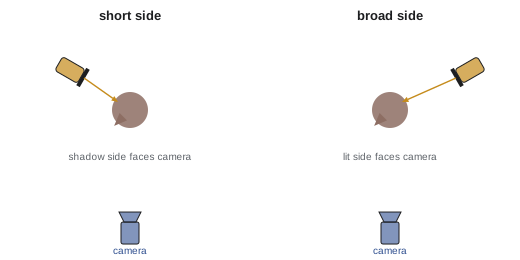
One of the most widely used principles in narrative lighting is to place the key on the far side of the face, the side away from the camera, often called short-side or upstage lighting. If an actor faces slightly camera left, the key comes from camera left, lighting the side of the face that turns away from the lens, while the side nearer the camera falls into gentle shadow. This creates a strong sense of shape and depth, with the shadow side toward the viewer, and flatters most faces. Lighting from the near side (broad lighting) puts the lit side toward the camera, which flattens and widens the face and looks more like television news or broad comedy. Short-side lighting also tends to keep the light out of the lens and off the background, and works naturally when the source is motivated by a window or lamp in the direction the actor faces.
Fill approaches
Fill controls how dark the shadows are. Options include:
- A soft light or bounce near the camera, filling evenly; the classic approach.
- Ambient fill from a large overhead or room bounce, raising overall levels softly, common in naturalistic lighting.
- Bounce from the set: light reflecting off walls, tables and floors, sometimes enough without additional fill.
- No fill, with negative fill to deepen shadows, for dramatic, low-key scenes.
The amount of fill is measured as the ratio between key side and shadow side (Lesson 10). With modern cameras' wide dynamic range, cinematographers often use less fill than in the film era, relying on the camera to hold shadow detail and shaping contrast in grading. Fill should not create its own visible shadows or catchlights that compete with the key.
Back light, kickers and edge
Back light separates subjects from the background by outlining hair and shoulders. It is usually placed behind the subject on the side opposite the key, high enough to avoid flaring the lens, and flagged off the camera. Its intensity relative to the key depends on the hair colour and the background: dark hair against a dark background needs more back light; blonde hair needs much less. A kicker is a light from behind and to the side, skimming the cheek and jaw on the shadow side, adding a sculpted edge that lifts the face from the background. Edge light can also be motivated by practicals or windows behind the actor. Too much back light looks artificial and dated, so contemporary lighting often uses subtle edges or relies on background brightness differences for separation.
Eye lights
Catchlights, reflections of light sources in the eyes, bring faces to life; eyes without catchlights can look lifeless. A key light at the right angle usually creates a natural catchlight. When it does not, for example with a high or side key, a small, soft eye light near the camera, such as a small LED panel, a ring of light around the lens or a soft bounce, can add a catchlight without significantly lighting the face. The shape of the catchlight reveals the source: a window, a soft box or a round lantern each reflect differently. Multiple catchlights from several sources can look unnatural, so eye lights should be subtle.
Lighting moving actors
When actors move through a set, lighting must work along the entire path. Strategies include:
- Large, soft sources that cover a wide area evenly, so that the actor stays in similar light as they move.
- Keying from overhead or from the direction of travel, so that light remains consistent as the actor turns.
- Passing through pools of light deliberately: placing lights to create bright and dark areas, so that the actor walks in and out of light, which adds rhythm and realism.
- Using nets and scrims to even the light where an actor comes closer to a source, compensating for the inverse square law.
- Placing actors' marks where the light is best for key moments, such as a stop at the window for an important line.
- Using dimmer cues to change light levels as actors move, for example raising a lamp as an actor approaches it.
Walking the actor's path with a meter, or watching a stand-in walk it on a monitor, reveals hot spots and dark areas before shooting.
Worked problem
Evening out light on a walk toward the camera
An actor walks from 6 m to 2 m from a soft key placed beside the camera. At 6 m the face reads correctly; at 2 m it is much brighter. How much brighter, and how can it be evened out?
Show solution
- If the source behaves roughly as a point source, the change is \(2\log_2(6/2) = 2\log_2 3 \approx 3.2\) stops brighter.
- Move the key farther from the path and higher, so the ratio of distances along the walk is smaller.
- Use a large soft source farther away, which falls off more gently, or add a graduated net or half scrim to reduce the near part of the beam.
- Alternatively, dim the light with a cue as the actor approaches, if the colour stays constant (LED).
Answer: About 3 stops brighter; reduce the change with a more distant or larger source, nets on the near part of the beam, or a dimmer cue.
Lighting for coverage and multiple cameras
A scene is usually covered with a master shot and closer coverage, and each angle may need lighting adjustments: light that works in the wide shot may be too flat or too hot in the close-up. A common approach is to light the master broadly and refine for each close-up, bringing in sources closer to the actors, adding negative fill and eye lights, while keeping the overall direction, colour and contrast consistent. Shooting with two or more cameras simultaneously, such as an A camera on one actor and a B camera on the other, saves time but makes lighting harder, because every light must work for both angles and stay out of both frames. Cinematographers often favour soft overhead or side sources and keying from the actors' far sides, so that each camera sees short-side lighting.
Cross-lighting two-shots
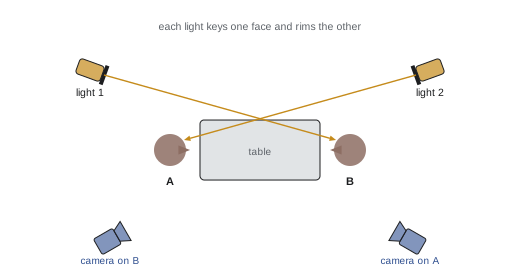
In a two-shot or over-the-shoulder setup, a classic technique is cross-lighting: two keys placed so that each lights one actor from the far side of their face, and each also acts as a back light or edge light for the other actor. For two actors facing each other, the light behind actor A lights actor B's face from the short side and rims actor A, and vice versa. This creates shape for both, separation, and consistent lighting when the coverage cuts between them. Cross-lighting needs careful flagging to keep the lights out of the lens and off the backs of the actors' heads where not wanted.
Lighting diverse skin tones
Skin tones vary enormously in brightness, saturation and reflectance, and good cinematography lights every person well. Darker skin reflects less light and often has a beautiful sheen that responds to larger soft sources and specular highlights, while lighter skin can be overexposed easily. When actors with very different skin tones share a frame, light them individually, adding light to darker skin or reducing it on lighter skin with nets and flags, rather than choosing one exposure that underexposes some and clips others (CINE-202). Warmer or neutral sources often complement darker skin, and green or magenta casts are particularly unflattering. Testing with the cast before production, and discussing with actors how they like to be lit, shows respect and produces better images. Historically, film stocks and lighting practices were calibrated around lighter skin, and contemporary cinematographers such as Bradford Young and others have shown how deliberate lighting celebrates darker skin.
Hair, makeup and costume
Lighting works with hair, makeup and costume. Shiny skin reflects hot spots that makeup can powder down; heavy makeup can look flat under hard light; light-coloured costumes can reflect light onto faces or clip, while dark costumes may need extra light to show detail. Hairstyles affect how back light and kickers read. Communicating with the hair, makeup and costume departments, for example about a reflective costume or a dark hat that shades the eyes, prevents problems on the day.
Lighting from above
Overhead soft light, from a large soft box or bounce above the action, is a common contemporary approach, especially for scenes with movement and multiple cameras. It gives even, natural light that does not cast shadows of actors onto walls, keeps lights out of frame, and resembles skylight or overhead room lighting. Pure top light can create shadows in the eye sockets, so cinematographers often combine it with a soft fill from below or the front, a bounce from a table, or a slight angle toward the actors' faces. Overhead sources with grids or skirts control spill on the walls, keeping the background darker than the actors.
Lighting the eyes and face in hats and glasses
Hats shade the eyes, and glasses reflect lights. Lower keys, bounce from below or the front, and small fill sources reach under hat brims without lighting the whole scene. For glasses, raise the key or move it farther to the side so that its reflection falls outside the lenses, angle the glasses slightly with the actor's permission, and check on the monitor during blocking, since reflections change as actors move their heads.
Working with stand-ins
Stand-ins should match the actors' height, skin tone and hair colour as closely as possible, and wear similar colours, so that lighting set on them works when the actors return. Cinematographers check the lighting again briefly with the actors in place, since small differences, such as reflective skin, can change the result.
Common mistakes
MistakeKeying from the near side by default.
InsteadKey from the far side of the face for shape.
MistakeOverusing back light.
InsteadUse subtle edges suited to hair and background.
MistakeLighting only the start mark of a moving actor.
InsteadLight the whole path and check with a stand-in.
MistakeLights in both cameras' frames.
InsteadPlan multi-camera lighting from soft, high or far-side sources.
MistakeChoosing one exposure for very different skin tones.
InsteadLight each person individually.
Summary and key terms
- Three-point lighting is a foundation, adapted to motivated, naturalistic styles.
- Keying the far side of the face gives shape and depth.
- Fill can come from soft sources, ambience, set bounce or be removed.
- Back lights and kickers separate subjects; use them subtly.
- Eye lights add life to the eyes.
- Light moving actors along their whole path.
- Cross-lighting, coverage planning and individual lighting of skin tones keep scenes consistent and flattering.
- Short-side lighting
- Keying the side of the face away from the camera.
- Broad lighting
- Keying the side of the face nearer the camera.
- Upstage
- Away from the camera; the far side.
- Fill
- Light that controls shadow density.
- Back light
- Light behind the subject that outlines it.
- Kicker
- Edge light skimming the shadow side.
- Catchlight
- Reflection of a light in the eyes.
- Coverage
- Set of shots covering a scene.
- Cross-lighting
- Keys that light one actor and rim another.
- Mark
- Floor position for an actor.
Practice problems
Work each problem on paper first, then reveal the answer to check.
Where does the classic key sit?
Show answer
30–45 degrees to one side, slightly above eye level.
What is short-side lighting?
Show answer
Keying the far side of the face.
Why does broad lighting look flatter?
Show answer
The lit side faces the camera.
Name two fill approaches.
Show answer
Soft source near camera, ambient overhead, set bounce, no fill.
What does a kicker do?
Show answer
Skims the cheek on the shadow side.
Why add an eye light?
Show answer
To create a catchlight.
Stops brighter from 6 m to 3 m for a point source?
Show answer
2 stops.
Name two strategies for moving actors.
Show answer
Large soft sources, pools of light, nets, marks, dimmer cues.
What is cross-lighting?
Show answer
Two keys each lighting one face and rimming the other.
How should very different skin tones be handled?
Show answer
Light each person individually.
Lesson quiz · 5 questions
Score 60% or more to complete this lesson.
Create a free account to save your progress, take quizzes and earn a certificate.