
CINE-230 · Lesson 12 of 12 · 25 min
The grip department, rigging safety and capstone
Behind every camera move, rigged light and secured set piece is the grip department. Grips build the support systems that hold cameras and lights where the cinematographer needs them, from dolly track and cranes to overhead frames, car rigs and scaffolding. Their work is physical, technical and safety-critical: grips handle heavy loads, work at height, rig over people and around moving vehicles. This final lesson covers the structure of the grip department, essential grip equipment for camera support, rigging principles and hardware, working at height and fall protection, load ratings and safety factors, the regulatory and industry safety framework, set communication and culture, and the capstone, a complete movement and rigging plan for a scene.
The grip department
In North American film and television, the grip department is led by the key grip, who works with the director of photography and gaffer to plan camera support and light control, supervises the crew and is responsible for the safety of grip work. The best boy grip, second in command, manages crew, equipment, orders and paperwork. The dolly grip pushes and operates the dolly and often cranes. Company grips carry out rigging, set up flags and frames, lay track and assist with all grip tasks. Rigging grips work ahead of the shooting crew, preparing complex rigs on upcoming sets, such as overhead truss, scaffolding and car rigs. Larger productions may have crane grips, technocrane technicians and specialist rigging crews. Grips work closely with the electric department, which handles lighting and power, and with the camera department.
In Canada, grips on union productions are generally members of IATSE locals that represent film and television crews in their regions, such as IATSE Local 873 in Ontario, Local 891 in British Columbia, Local 212 in Alberta and Local 514 in Quebec, under collective agreements that define classifications, rates and working conditions. Non-union productions and smaller regions may use other agreements or independent crews.
Essential grip equipment for camera support
Grips maintain a large inventory, much of it covered in CINE-220 for light control. For camera support, essential items include:
- Apple boxes, wedges, cribbing and sandbags for levelling and stability.
- Dollies, track, dance floor and sliders.
- Speed rail: aluminium tubing joined with clamps and fittings to build custom frames and mounts.
- Clamps and grip heads: mafer clamps, cardellini clamps, pipe clamps, grip heads and C-clamps for attaching equipment to structures.
- Rigging plates, pipe and truss for overhead and structural rigs.
- Ladders, platforms and scaffolding for elevated camera and lighting positions.
- Ratchet straps, rope, wire rope and safety cables for securing loads.
- Car rigging kits with suction cups, hostess trays and hood mounts (Lesson 11).
Grips must know the purpose, load rating and inspection requirements of every item.
Rigging principles
Rigging means supporting loads from structures, often overhead. Core principles include:
- Know the load: the weight of the camera, light or object, plus any dynamic forces from movement, wind or vibration.
- Know the structure: whether the beam, truss, ceiling, wall or vehicle can safely carry the load, which may require engineering advice or venue approval.
- Use rated hardware: every clamp, shackle, sling and fitting has a working load limit (WLL), and must be used within it.
- Redundancy: overhead loads have a primary support and an independent secondary safety, such as a safety cable, so that a single failure does not drop the load.
- Inspection: equipment is checked before each use and removed from service if damaged.
- Competence: complex rigging is designed and carried out by qualified people.
A common rule of thumb is never to rig anything over a person's head that is not secured by a safety, and to clear the area beneath while rigging and striking.
Load ratings and safety factors
The working load limit of a component is the maximum load it is rated to carry in normal service, set well below its breaking strength by a safety factor, or design factor. For example, a shackle with a minimum breaking strength of 5,000 kg and a design factor of 5 has a working load limit of 1,000 kg. Different types of equipment have different design factors, set by standards and manufacturers. Loads must be calculated including dynamic effects: a camera on a vehicle mount sees forces several times its weight when braking or hitting bumps, and a load that drops even a short distance onto a sling creates a shock load far greater than its static weight.
Worked problem
Checking a rigging point
A grip rigs a 25 kg remote head and camera from a truss using a clamp with a WLL of 100 kg and a safety cable with a WLL of 60 kg. Movement of the head and occasional bumps could create dynamic loads up to twice the static weight. Is the rig acceptable?
Show solution
- Static load: 25 kg; dynamic load up to 2 × 25 = 50 kg.
- Primary clamp WLL 100 kg is twice the dynamic load.
- Safety cable WLL 60 kg exceeds the dynamic load, so it could hold the load if the clamp failed, provided it is rigged with minimal slack to avoid shock loading.
- Confirm that the truss itself is rated for the point load, and inspect all components.
Answer: Acceptable if the truss is rated for the load and the safety is rigged with minimal slack; both clamp and safety exceed the dynamic load.
Working at height and fall protection
Grips often work at height: on ladders, scaffolding, aerial work platforms, truss and set walls. Falls are one of the most common causes of serious injury and death in the industry. Preventing falls starts with eliminating work at height where possible, for example by assembling rigs on the ground and lifting them into place; then using collective protection such as guardrails on platforms and scaffolds; and, where these are not possible, personal fall protection: harnesses with lanyards or self-retracting lifelines attached to rated anchor points, used by trained workers. A fall arrest system must stop a fall before the worker hits the ground or an obstruction, so clearance below must be calculated.
For example, with a 1.8 m lanyard allowing 1.8 m of free fall, 1.1 m of deceleration distance, about 1.5 m from the harness D-ring to the worker's feet, 0.3 m of harness stretch and a 1 m safety margin, the clearance needed below the anchor level is roughly 1.8 + 1.1 + 1.5 + 0.3 + 1.0 = 5.7 m, which is why short lanyards or self-retracting lifelines are used at lower heights. Rescue plans for suspended workers are required, because suspension in a harness can quickly become dangerous.
In Canada, occupational health and safety is regulated provincially and territorially. Each jurisdiction sets requirements for fall protection, typically requiring protection at heights of about 3 m (10 ft) or more, or lower where hazards exist below; Ontario, for example, applies its Occupational Health and Safety Act and regulations and has published safety guidelines specific to the film and television industry, and British Columbia's WorkSafeBC regulation and the industry association Actsafe provide guidance for motion picture work. Employers must provide training, equipment and supervision, and workers have the right to refuse unsafe work.
Set communication and safety culture
Most accidents on set involve breakdowns in communication or pressure to work faster than is safe. Good safety culture includes daily safety meetings, especially before stunts, vehicles, cranes and work at height; clear announcements of hazardous operations, such as "flying in" a rig or "crane moving"; respecting the authority of the key grip, safety officer and stunt coordinator to stop work; reporting near misses; and allowing time for safe setup even under schedule pressure. Every crew member has the right and responsibility to speak up when something seems unsafe. Fatigue from long hours increases the risk of errors, both on set and when driving home, so productions should manage hours and provide rest.
The hierarchy of controls
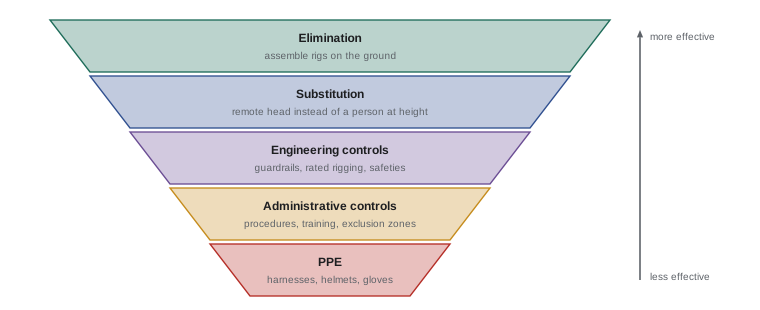
Safety professionals use the hierarchy of controls to choose the most effective protections. From most to least effective: eliminate the hazard, for example by shooting a scene without a vehicle stunt or by rigging on the ground; substitute a safer method, such as a remote head or drone instead of a person on a high platform; use engineering controls, such as guardrails, rated rigging and safety cables; use administrative controls, such as procedures, training, signage, exclusion zones and rehearsals; and finally use personal protective equipment, such as harnesses, helmets, gloves and steel-toed boots. Good grip practice applies controls at every level, rather than relying on protective equipment alone.
Capstone: a movement and rigging plan
The capstone asks you to design the camera movement and grip plan for a scene of your choice, such as a three-page dramatic scene, a commercial or a music video sequence. Your plan should include:
- A breakdown of the scene with the emotional purpose of each shot and the motivation for each camera move.
- A shot list specifying each move, lens, support system and reasons for the choice, including at least one static, one dolly or slider, one crane or jib, and one body-mounted or gimbal move.
- Floor plans showing camera positions, track or dance floor, actor marks and the reach or swing zones of cranes.
- Calculations: track length, crane counterweight or reach, gimbal or arm payloads, and pan rates or move timings.
- An equipment list and crew plan for the grip department.
- A risk assessment covering every hazard identified, the controls chosen using the hierarchy of controls, and the relevant safety regulations and guidelines in your jurisdiction.
If possible, shoot a test of one move, document it with behind-the-scenes photos, and reflect on what worked and what you would change.
Grip department workflow
A typical shooting day for grips begins with unloading the truck, building the first setups and laying track or rigging as needed. During shooting, grips move equipment between setups, adjust flags and frames, push dollies and operate cranes. Rigging crews may be preparing tomorrow's sets at another location. At wrap, everything is struck, packed and loaded. The best boy keeps track of equipment, orders expendables such as tape and wedges, arranges rentals and manages timesheets. Efficient grip departments organize their truck so that equipment can be found and returned quickly, and they anticipate the director of photography's needs for upcoming setups.
Inspection, tagging and records
Professional grip departments inspect equipment regularly and keep records for items such as slings, shackles, chain motors, harnesses and cranes, which may require periodic inspection by competent persons under regulations and manufacturer requirements. Damaged equipment is tagged and removed from service. Rigging plans for large or complex rigs are documented, sometimes with engineering sign-off, and kept on file during the production.
Learning the grip trade
Many grips begin as day players or trainees, learning equipment and safety practices from experienced crew, and progress through company grip, dolly grip and best boy roles to key grip. Training in rigging, fall protection, aerial work platforms and first aid is commonly required, and unions and industry associations offer courses and safety certifications.
Common mistakes
MistakeRigging overhead without a secondary safety.
InsteadUse primary and independent safety supports.
MistakeIgnoring dynamic and shock loads.
InsteadCalculate loads with dynamic factors and avoid slack.
MistakeUsing harnesses without clearance calculations.
InsteadCalculate fall clearance and plan rescue.
MistakeRelying only on PPE.
InsteadApply the hierarchy of controls from elimination down.
MistakeStaying silent about unsafe work.
InsteadSpeak up and stop work when needed.
Summary and key terms
- The key grip leads the department with the best boy, dolly grip and company and rigging grips.
- Grips use apple boxes, speed rail, clamps, truss, scaffolding and straps for camera support.
- Rigging requires known loads, rated structures and hardware, redundancy and inspection.
- WLL equals breaking strength divided by the design factor; include dynamic loads.
- Fall protection requires planning, anchors, clearance and rescue.
- Provincial OHS rules in Canada and OSHA in the US govern work at height.
- Safety culture and the hierarchy of controls protect everyone on set.
- Key grip
- Head of the grip department.
- Best boy grip
- Second in charge of the grip department.
- Rigging grip
- Grip who prepares rigs ahead of shooting.
- Speed rail
- Aluminium tubing for building rigs.
- Working load limit
- Maximum rated load in service.
- Design factor
- Ratio of breaking strength to working load limit.
- Shock load
- Sudden load from a drop or jerk.
- Safety cable
- Secondary support preventing a fall.
- Fall clearance
- Distance needed below a worker to arrest a fall.
- Hierarchy of controls
- Ranking of safety measures by effectiveness.
Practice problems
Work each problem on paper first, then reveal the answer to check.
Who leads the grip department?
Show answer
The key grip.
What do rigging grips do?
Show answer
Prepare rigs ahead of the shooting crew.
Name three grip rigging items.
Show answer
Speed rail, clamps, truss, straps, safety cables.
WLL of a component breaking at 4,000 kg with a design factor of 5?
Show answer
800 kg.
Dynamic load at three times a 15 kg static load?
Show answer
45 kg.
Why rig safeties with minimal slack?
Show answer
To avoid shock loading.
Name the five levels of the hierarchy of controls.
Show answer
Elimination, substitution, engineering, administrative, PPE.
Why calculate fall clearance?
Show answer
So the arrest happens before hitting anything below.
What fall protection height threshold applies where you work?
Show answer
About 3 m in many provinces (Canada); 4 ft general industry, 6 ft construction (US OSHA).
Name three capstone components.
Show answer
Shot list, floor plans, calculations, equipment list, risk assessment.
Lesson quiz · 5 questions
Score 60% or more to complete this lesson.
Create a free account to save your progress, take quizzes and earn a certificate.