
CINE-230 · Lesson 5 of 12 · 25 min
Track, levelling and dance floor
Most locations are not smooth, level stage floors. Grass, gravel, sloping streets, old wooden floors and rough concrete would make a dolly bounce, drift and squeak. Grips solve this by laying track or dance floor: smooth, level surfaces on which a dolly can glide. Laying track well is a core grip skill, and the quality of the track determines the quality of the move. This lesson covers types of track, track gauge and sections, straight and curved layouts, levelling with wedges, cribbing and apple boxes, checking track, dance floor, track length calculations, laying track on difficult surfaces, and track for small dollies and sliders.
Types of track
Camera track is made of steel or aluminium tubes held at a fixed spacing, called the gauge, by cross ties or sleepers. Straight sections are commonly made in lengths such as 4 ft and 8 ft (about 1.2 m and 2.4 m), with shorter pieces for fine adjustment, and curved sections in standard radii, often joined to make circles or arcs. Many dollies run on track with a gauge of about 24.5 inches (roughly 62 cm), although other gauges exist, especially for smaller dollies and portable systems, so the track must match the dolly's wheels. Steel track is heavy, rigid and very smooth; aluminium track is lighter and faster to lay but more prone to flexing; plastic and PVC pipe track serves very light dollies. Portable track systems, such as rolling skateboard track or tubular track that clamps together, suit small productions and light cameras.
| Track type | Strengths | Limitations |
|---|---|---|
| Steel straight and curved | Very smooth, rigid, durable | Heavy, slow to move |
| Aluminium | Lighter, faster to lay | Can flex and dent |
| Portable tube or PVC track | Cheap, very light | For light dollies only |
| Dance floor | Free movement in any direction | Needs level base, more material |
| Rail on vehicles or rigs | Long or specialized moves | Specialist rigging |
Laying straight track
Laying track begins with planning the move: where the dolly starts and ends, with extra length for run-up and stopping, and where the track can be placed out of shot. Grips mark the line, lay out the sections, join them and then level them. Joints between sections must be perfectly flush, because even a fraction of a millimetre of step produces a bump that the lens magnifies, especially with long lenses or close framing. Track joints are usually staggered so that the two rails do not join at the same point. Track ends are fitted with end stops to prevent the dolly running off. The finished track should be straight, level and solid, with no movement when a grip stands or jumps on it.
Levelling with wedges, cribbing and apple boxes
Track must be level along its length and across its width, unless a slope is deliberately part of the shot. Grips level track using:
- Wedges: tapered wooden shims, inserted under track ties and tapped in to raise the track precisely. Wedges come in sets and are the main levelling tool.
- Cribbing: stacks of wooden blocks under the track to raise it over larger dips, such as on a slope.
- Apple boxes: standard wooden boxes in full, half, quarter and pancake heights, used for raising track over steps, levelling dolly positions and many other tasks. A full apple box is 20 × 12 × 8 inches.
- Track levelling legs or jacks: adjustable supports in some systems.
A long spirit level or digital level checks the rails, placed along each rail and across both. On uneven ground, grips raise the track to the level of its highest point, so that everything else is shimmed up rather than dug down. Wedges must be positioned under ties, not under the track tubes between ties, and must be secure so they cannot work loose as the dolly passes.
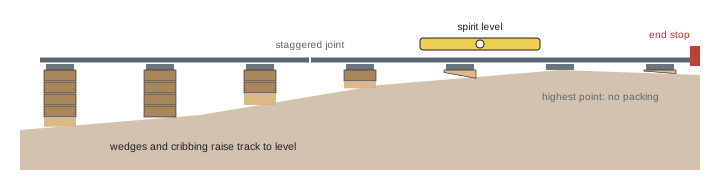
Checking the track
After laying and levelling, grips check the track by rolling the dolly along it, feeling for bumps, and by riding on it while watching through a long lens, which reveals tiny irregularities. Common problems include joints that are not flush, wedges that compress under the dolly's weight, track sections that are bent, and ground that sinks, especially on soft soil, sand or grass that has been rained on. Grips walk the track before every take on long days, re-tapping wedges as needed. Some grips spray the rails or wheels lightly with appropriate lubricant or wipe them clean to keep the roll smooth and silent; squeaky wheels can ruin sound recording.
Curved track and circles
Curved track sections allow arcing moves around a subject, such as circling two characters in conversation. Curved sections have standard radii, and combining them produces circles or S-curves. Curved track takes more space and time to lay, and the dolly must be set to follow the curve. The radius should be chosen so that the subject stays at a consistent distance and framing during the arc. A common alternative for small arcs is to lay straight track tangentially and combine the dolly move with a pan, which can approximate an arc for short moves.
Here \(L_{\text{arc}}\) is the length of track needed for an arc of radius \(r\) and angle \(\theta\) in radians. For example, a 90° arc (π/2 rad) at a radius of 3 m needs about 4.7 m of curved track.
Dance floor
Dance floor is a smooth, flat surface laid over the ground or floor, made from plywood sheets topped with a smooth covering such as hardboard, melamine or vinyl, levelled like track and taped at the joints. On dance floor, a dolly can move freely in any direction, including complex curves, crab moves and repositioning between takes, which is invaluable for scenes with fluid blocking. Dance floor takes more material and time than track and must be laid over a level or levelled base, often on top of risers or platforms on uneven ground. It must be kept clean, since grit causes bumps, and actors and crew should avoid walking on it in street shoes when possible. Some studios have permanently smooth floors that serve as dance floor.
How much track?
Planning track length starts with the camera's travel distance and adds room for the dolly to start and stop smoothly, the length of the dolly itself, and a safety margin before the end stops.
Worked problem
Track for a tracking shot
A shot tracks alongside an actor walking 6 m down a hallway. The dolly is about 1.3 m long. The grip wants 0.5 m of run-up, 0.5 m of stopping distance and 0.3 m of margin at each end. Track comes in 8 ft (2.44 m) sections. How many sections are needed?
Show solution
- Total length: 6 + 1.3 + 0.5 + 0.5 + 2 × 0.3 = 8.9 m.
- Number of 2.44 m sections: 8.9 / 2.44 ≈ 3.65, so 4 sections (9.76 m).
- Check that the track fits within the hallway and out of frame, and plan where the extra length will sit.
Answer: About 8.9 m, so four 8 ft sections.
Track on difficult surfaces
Different surfaces need different approaches. On grass and soil, lay plywood strips or boards under the ties to spread the load, and expect settling; check frequently. On sand and snow, spread the load widely with boards and check constantly, as the base shifts. On slopes, crib up the downhill side heavily, and secure the dolly with brakes and ropes if necessary, never relying only on friction. On stairs and steps, build platforms with apple boxes, steel decks or scaffolding. On delicate floors in historic or private locations, protect the floor with layout board or padding under all wedges and cribbing. On public streets, keep track out of traffic and pedestrian routes unless they are controlled by permits and traffic control. Outdoor track exposed to sun can expand and shift; on long days, recheck joints.
Track for small dollies and sliders
Smaller productions often use lightweight dollies on portable track: skateboard wheels running on tubing or flat track, and spider dollies attached to tripod legs. These systems are quick to set up and carry, and suit lighter camera packages, but they are more sensitive to joints and levelling and can flex under heavy loads. The same principles apply: level the track, keep joints flush, add run-up and stop distance, and test with a long lens. For very short moves, a slider (Lesson 6) may be faster than laying track at all.
Working with the camera team
Track laying is a collaboration. The director and cinematographer decide the move, the key grip and dolly grip plan the track, the camera operator checks frames at the start and end of the move to confirm the track is not in shot, and the focus puller takes measurements once the track is set. Because laying long track can take an hour or more, efficient productions plan track positions in advance, lay track while lighting is being set, and design moves that reuse the same track for several shots, for example by turning the camera around on the same track for the reverse angle.
Track on stages and sets
Studio stages usually have smooth floors, so track is often unnecessary, but sets built on raised platforms, uneven set floors or dressed surfaces such as gravel or grass mats may still need track. On stages, grips can lay track quickly because the base is level, and they often use dance floor for scenes with fluid blocking. Set designers and grips coordinate so that floors can carry the weight of dollies and cranes, and so that track can be hidden or kept out of shot. In some productions, the floor of the set is built at a height that allows the dolly to run in a trench, so the lens can sit very low without special mounts.
Track and sound
Dolly moves must be silent when sound is recorded. Squeaking wheels, clicking joints and creaking wedges can ruin a take. Grips listen for noises during rehearsals and fix them by tightening joints, replacing worn wheels, adding padding under ties, and keeping rails and wheels clean. On wooden floors, track can transmit footsteps from crew walking nearby, so crew should stand still during takes. The sound department may ask for a moment of silence after laying track to check for noise.
Track inspection and maintenance
Track sections are inspected for dents, bends and damaged connectors before use, because a damaged section can cause bumps that no amount of levelling will fix. Steel track should be kept clean and lightly protected from rust; aluminium track should be checked for dents. Damaged sections are tagged and removed from service. Wedges and cribbing wear and split over time and should be replaced when they no longer hold their shape.
Common track layouts
Grips use a few standard layouts repeatedly. A straight run parallel to the action covers walking shots and lateral tracks. An L-shaped or angled layout lets a dolly change direction at a corner, with a pivot or turntable at the junction. A circle or partial circle of curved track surrounds a table for dinner-scene moves. Two parallel runs allow two dollies to work side by side for multi-camera coverage. Planning the layout with the director of photography before unloading saves time and lifting.
Grips also photograph complex track layouts once they are finished, so that the same layout can be rebuilt quickly if the production returns to the location for pickups or reshoots.
Common mistakes
MistakeLeaving joints slightly stepped.
InsteadMake joints perfectly flush and stagger them.
MistakeDigging down to level track.
InsteadRaise track to the highest point with wedges and cribbing.
MistakeWedging between ties.
InsteadPlace wedges under the ties and secure them.
MistakeForgetting run-up and stopping room.
InsteadAdd dolly length, run-up, stop and margin.
MistakeNever rechecking track on soft ground.
InsteadWalk and test the track before takes.
Summary and key terms
- Track is steel, aluminium or portable tubing at a fixed gauge.
- Straight sections join flush with staggered joints and end stops.
- Wedges, cribbing and apple boxes level track to the highest point.
- Check track by rolling and viewing through a long lens.
- Curved track needs length r θ; dance floor allows free movement.
- Track length adds dolly length, run-up, stop and margin to the move.
- Difficult surfaces need load spreading, cribbing and frequent checks.
- Track gauge
- Spacing between the rails.
- Tie
- Cross member holding the rails apart.
- Wedge
- Tapered shim for levelling.
- Cribbing
- Stacked blocks for raising track.
- Apple box
- Standard wooden box for raising and levelling.
- Pancake
- The thinnest apple box.
- End stop
- Block preventing the dolly from leaving the track.
- Dance floor
- Smooth flat floor laid for free dolly movement.
- Run-up
- Distance for the dolly to reach speed.
- Layout board
- Protective floor covering.
Practice problems
Work each problem on paper first, then reveal the answer to check.
Common straight track section lengths?
Show answer
4 ft and 8 ft.
Why stagger joints?
Show answer
So both rails do not join at the same point.
Why raise track to the highest point?
Show answer
Shimming up is easier and more stable than digging.
Dimensions of a full apple box?
Show answer
20 × 12 × 8 inches.
How do grips check track smoothness?
Show answer
Roll the dolly and view through a long lens.
Arc length for 60° at 4 m radius?
Show answer
About 4.2 m.
What does dance floor allow?
Show answer
Free movement in any direction.
Track for a 4 m move, 1.2 m dolly, 0.4 m run-up and stop, 0.2 m margins?
Show answer
6.4 m.
How do you lay track on grass?
Show answer
Boards under ties to spread load; recheck.
How can track be reused?
Show answer
Shoot reverse angles on the same track.
Lesson quiz · 5 questions
Score 60% or more to complete this lesson.
Create a free account to save your progress, take quizzes and earn a certificate.