
CINE-302 · Lesson 12 of 12 · 25 min
Working with the VFX team: reviews, turnover and the final image
Visual effects succeed or fail on collaboration. The cinematographer creates the photography that VFX artists will extend, replace and integrate, often months after the shoot, and the final image that audiences see is a combination of both. A cinematographer who understands the VFX process, communicates clearly with the VFX supervisor, delivers plates with complete data and stays involved through post-production protects the look of the film. One who treats VFX as someone else's problem risks seeing the photography altered in ways that do not match their intent. This final lesson brings the course together: the relationship between the cinematographer and the VFX supervisor through each phase of production, how VFX reviews and notes work, the technical turnover of plates and metadata to vendors, colour pipeline handoffs with LUTs and CDLs, the digital intermediate and finishing, credit and professional conduct, and a capstone exercise in which you write a complete VFX shooting plan for a sequence.
The cinematographer and the VFX supervisor
The production VFX supervisor represents the visual effects work across the whole film, from script breakdown to final delivery, and is the cinematographer's main partner on effects shots. In pre-production they agree on the methods for each sequence, the look and lighting of digital environments, the cameras and lenses, the colour pipeline and the data to capture. On set, the VFX supervisor or their on-set team watches effects shots, advises on framing, lighting and markers, and records data, while the cinematographer remains responsible for the photography. Good relationships rest on mutual respect and early involvement: the VFX supervisor needs the cinematographer's plans in time to design methods, and the cinematographer needs the supervisor's requirements before lighting and camera choices are locked. Disagreements are normal, for example when a screen colour conflicts with costumes, or when lighting a set for mood conflicts with what keying needs, and are best resolved through tests and conversation with the director.
| Phase | Cinematographer | VFX supervisor |
|---|---|---|
| Pre-production | Lighting plans, camera and lens choices, tests | Methods, budgets, data requirements, previs |
| Shoot | Photography, exposure, lighting for integration | On-set guidance, data capture, references |
| Post-production | Reviews of key shots, look approvals | Vendor management, reviews, delivery |
| Finishing | Grading with the colourist | Final versions, deliverables, archive |
Reviews and notes
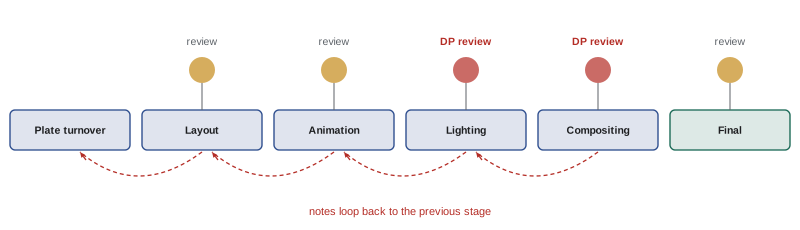
VFX shots progress through versions: early blocking and layout, animation, lighting, compositing and final. Directors, VFX supervisors and editors review versions in screening rooms or with remote review tools, watching shots in sequence context and giving notes. Cinematographers are invited to review key shots, especially those where photography is extended or replaced, to confirm that light direction, contrast, depth of field, lens character, grain and colour match the intended look. Useful notes are specific and actionable: rather than "it looks fake", say "the key light on the CG building comes from the left, but the plate key is from the right" or "the background is sharper than our lens would render at T2". Notes should reference the plate photography and agreed looks. Reviews take place in a calibrated environment, ideally with the show LUT or a working grade, so that judgements about colour and contrast reflect the final viewing conditions.
Turnover: delivering plates and data
Turnover is the handoff of plates and supporting material from editorial to the VFX vendor once the edit is locked or a shot is approved for work. A turnover package typically includes:
- The plates, usually as camera original raw files or high-quality scene-referred image sequences, most commonly OpenEXR files in an agreed colour space such as ACES2065-1, with handles of several frames at each end for adjustment.
- Edit references: a reference movie of the cut, an EDL or XML specifying the frames used, and any temp effects.
- Colour information: the show LUT, CDL values or a look file for each shot so that the vendor sees the plate as editorial and the director did.
- Camera and lens metadata: camera settings, lens data, frame rate, shutter, focus distances and tracking data recorded on set (Lessons 6 and 7).
- VFX data: HDRIs, LiDAR scans, reference photographs, marker survey, notes from the on-set data wrangler, and any previs or postvis.
Plates are pulled from the camera originals by editorial or the post house, following specifications agreed with the vendor; errors here, such as the wrong colour transform, missing handles or mislabelled frame ranges, cause delays and extra cost. The cinematographer's camera reports and the DIT's logs (CINE-202 Lesson 12) feed directly into turnover, so complete, accurate on-set documentation saves money later.
Worked problem
Storage for a turnover
A sequence of 40 VFX shots averages 5 seconds each at 24 fps, with 8 frames of handles at each end. Plates are 4.5K 16-bit half-float OpenEXR files with three channels, uncompressed, at 4608 × 2592 pixels. How much storage does the turnover need?
Show solution
- Frames per shot: 5 × 24 + 2 × 8 = 136; total frames: 40 × 136 = 5,440.
- Bytes per frame: 4608 × 2592 × 3 channels × 2 bytes ≈ 71.7 MB.
- Total: 5,440 × 71.7 MB ≈ 390 GB.
- With lossless compression, often around half this size, about 200 GB.
Answer: About 390 GB uncompressed, or roughly 200 GB with lossless compression.
Colour pipeline handoffs
A consistent colour pipeline ensures that the look the cinematographer creates on set reaches the vendors and returns intact for the final grade. In many productions using ACES (CINE-202 Lesson 10), plates are converted to ACES2065-1 EXR files for interchange; vendors work in ACEScg for compositing and rendering; and shots are returned in ACES2065-1 for conform and grading. The show look is communicated as a LUT, an ASC CDL per shot, or an ACES Metadata File (AMF) that records the input transform, look and output transform, so that every vendor sees the same image. Critical rules are to never bake a creative look into plates sent for VFX work, to keep scene-referred data for compositing, and to deliver finals without the look applied so the colourist can grade them alongside the rest of the film. Test the round trip early: send a test plate through the vendor pipeline and back to the grading suite to confirm that it matches the original exactly.
| Item | Format or practice | Purpose |
|---|---|---|
| Plates | OpenEXR in ACES2065-1 or camera raw | Scene-referred source for VFX |
| Working space | ACEScg | Linear compositing and rendering |
| Look | LUT, CDL or AMF | Shared viewing of the intended look |
| Finals | OpenEXR, no look applied | Grading with the rest of the film |
| Metadata | Camera, lens, tracking, timecode | Matchmove, lens distortion, conform |
The digital intermediate and finishing
In the digital intermediate (DI), the colourist conforms the final edit using the camera originals and the returned VFX shots, and grades the film under the cinematographer's supervision. VFX shots must sit seamlessly among non-VFX shots: the colourist may add secondary corrections, mattes supplied by the vendor to isolate CG elements, and final grain or texture to unify the look. Vendors often deliver mattes or separate layers for key elements so the colourist can adjust them without returning the shot. Late VFX deliveries are common, so DI schedules include time for slotting in final versions and regrading. The cinematographer should attend the grade, comparing VFX shots against plates and adjacent shots, and flagging any that need further work while there is still time to fix them.
Professional conduct and credit
VFX artists, supervisors and coordinators work under heavy schedules, and the cinematographer's attitude affects the whole collaboration. Respect for the VFX team, attention to their requirements on set, and acknowledgement of their contribution to the final image build trust. Cinematographers should also understand their role in shared authorship: when much of a shot's image is created digitally, the cinematographer's guidance on lighting, lensing and colour helps maintain a consistent visual language. Professional societies, including the Canadian Society of Cinematographers and the American Society of Cinematographers, discuss the cinematographer's place in virtual production and VFX through technical committees and publications, and the topic continues to evolve as tools change.
Capstone: write a VFX shooting plan
Choose a short sequence of five to ten shots that includes at least three VFX methods from this course, for example a green screen driving scene, a set extension in a historical street, and an LED volume interior with a window view. Write a VFX shooting plan of about six to ten pages that includes:
- A breakdown of every shot with VFX method, complexity tier and estimated cost range (Lessons 1 and 2).
- Previs or techvis notes for the most complex shots, with lens, camera height and distances (Lesson 3).
- Plate and element lists, including clean plates, reference passes and any tiled backgrounds (Lesson 4).
- A lighting and screen plan for blue or green screen shots, with target levels and spill control (Lesson 5).
- Marker layout and spacing calculations, survey and lens grid plans (Lesson 6).
- A data capture schedule for HDRIs, LiDAR and references, with responsibilities (Lesson 7).
- Any motion control or repeatable moves, and digital environments or doubles, with consent forms noted (Lessons 8 and 9).
- For volume shots: frustum, moiré and brightness checks, lighting states and colour calibration (Lessons 10 and 11).
- A turnover and colour pipeline specification, with formats, colour spaces, handles and metadata (this lesson).
Exchange plans with a classmate and review each other's work as a VFX supervisor would: identify missing data, unrealistic methods or risks to the schedule, and revise.
Communication tools
VFX collaboration relies on shared documents and systems. Shot tracking databases list every shot with its status, version, notes and deadlines (Lesson 2). Review tools allow directors and supervisors to draw on frames and attach notes to specific frames, so that comments reach the right artist. Lookbooks and reference decks show the intended look of environments, creatures and lighting. The cinematographer can contribute reference frames from tests, lighting diagrams and notes about lens character to these documents early, so that vendors build CG elements that match the photography from the start rather than adjusting late in the schedule.
When plates must be reshot
Sometimes a plate cannot support the intended effect: a key is impossible because of heavy spill, a track fails because the camera moved without parallax, or a creative change requires a different angle. The production then chooses between expensive fixes in post and additional photography. Pickup days for VFX plates are common, often with a smaller crew, and the original camera reports, lens data and lighting diagrams become essential for matching the original photography. Cinematographers who keep thorough notes make these pickups faster and more seamless.
Archiving
At the end of a production, plates, VFX data, assets and final shots are archived according to the studio's or broadcaster's specifications. Long-term archives may be requested for sequels, remastering or future formats, so files should be organized with clear naming, complete metadata and documented colour transforms.
Calculating turnover deliveries
Storage and transfer time are practical limits on turnovers. Uncompressed half-float EXR plates at 4K and above take tens of megabytes per frame, and a large sequence can exceed a terabyte. Productions agree compression settings, such as lossless PIZ or ZIP compression in OpenEXR, and transfer methods, such as secure high-speed file transfer services or physical drives, in advance. Transfer time can be estimated by dividing the total size by the available bandwidth: at a sustained 1 Gbit/s, roughly 125 MB/s, a 390 GB turnover takes about 52 minutes, while at 100 Mbit/s it takes nearly nine hours. Checksums confirm that every file arrived intact, just as on set.
Security
VFX vendors handle unreleased material, so productions require secure facilities, controlled access, watermarked review copies and encrypted transfers. Many studios audit vendors against content security standards before awarding work. Cinematographers should follow the same rules with test footage and reference frames, and never post unreleased images on social media.
Common mistakes
MistakeTreating VFX as someone else's problem.
InsteadStay involved from planning through the grade.
MistakeVague notes such as "it looks fake".
InsteadGive specific notes referencing light, lens and colour.
MistakeBaking a creative look into VFX plates.
InsteadDeliver scene-referred plates with the look as metadata.
MistakeIncomplete camera reports and lens data.
InsteadDocument on set to support turnover.
MistakeSkipping the colour round-trip test.
InsteadTest vendor pipeline matching before production.
Summary and key terms
- The cinematographer and VFX supervisor collaborate from planning to finishing.
- Reviews of key shots let the cinematographer protect light, lens and colour.
- Turnover delivers plates with handles, edit references, colour and metadata.
- Scene-referred EXR plates and ACES workflows keep colour consistent.
- Looks travel as LUTs, CDLs or AMF files, never baked in.
- The DI integrates VFX shots with mattes, grain and final grading.
- A VFX shooting plan brings together every method and data requirement.
- Production VFX supervisor
- Leads VFX across the whole film.
- Version
- Iteration of a VFX shot for review.
- Turnover
- Handoff of plates and data to a VFX vendor.
- Handles
- Extra frames beyond the cut at each end.
- OpenEXR
- High dynamic range image format for VFX.
- ACES2065-1
- ACES interchange colour space.
- AMF
- ACES Metadata File describing transforms and looks.
- Conform
- Rebuilding the edit from original media.
- Matte
- Mask isolating an element for grading or compositing.
- Digital intermediate
- Final conform and grading of the film.
Practice problems
Work each problem on paper first, then reveal the answer to check.
Who leads VFX across the whole film?
Show answer
The production VFX supervisor.
Give an example of a useful VFX note.
Show answer
The CG key light comes from the left; the plate key is from the right.
What is turnover?
Show answer
Handoff of plates and data to the vendor.
Why include handles?
Show answer
To allow adjustment of the edit and transitions.
Frames for a 3 s shot at 24 fps with 8-frame handles?
Show answer
88 frames.
Common plate format for VFX?
Show answer
OpenEXR in ACES2065-1.
Working space for compositing in ACES?
Show answer
ACEScg.
Why not bake the look into plates?
Show answer
VFX needs scene-referred data; the look is applied as metadata.
What do vendor mattes allow?
Show answer
Colourists to adjust elements without returning the shot.
What should a shooting plan include for volume shots?
Show answer
Frustum, moiré and brightness checks, lighting states and calibration.
Lesson quiz · 5 questions
Score 60% or more to complete this lesson.
Create a free account to save your progress, take quizzes and earn a certificate.