
CINE-320 · Lesson 10 of 12 · 25 min
Archival and found footage: rights and practice
Few documentaries are built entirely from new footage. Historical films depend on archival film, photographs, newspapers and recordings; contemporary films use news clips, home movies, surveillance video, phone footage and social media posts; and many films quote other films, television, music and artworks to make their arguments. The cinematographer is involved in this material more than one might expect: shooting photographs and documents on a rostrum or copy stand, matching new footage to archival textures, filming screens and artworks that appear in scenes, and recording the found material that participants share. This lesson covers sources of archival footage, licensing, public domain, fair dealing in Canada and fair use in the United States, incidental capture, authenticity and verification, and the ethics of altering archival material and generating synthetic images. It is an awareness-level guide; clearance decisions should be made with a qualified media lawyer.
Sources of archival material
- Commercial footage libraries and news archives, which license clips for fees that depend on use, territory and term.
- Public and national archives, such as Library and Archives Canada, the US National Archives and Records Administration, provincial and state archives, and broadcaster archives like those of the CBC and public television stations.
- Film boards and institutes, such as the National Film Board of Canada, whose collection includes decades of documentary footage.
- University, museum and community archives, including oral history collections and Indigenous community archives with their own access protocols.
- Private and family collections: home movies, photographs and letters supplied by participants.
- User-generated content: phone videos, livestreams and social media posts.
Licensing archival footage
Licensing gives the production the right to use material for specified purposes. Key terms include the media (all media, television, streaming, festival only), the territory (worldwide or specific countries), the term (perpetuity or a number of years) and the duration used, often charged per second with a minimum per clip. Festival-only licences are cheaper and are often used for early versions, with full rights purchased once a film is sold, a strategy known as step deals. Licences from archives may cover only the archive's own rights; underlying rights in music, performances or artworks within the footage may need separate clearance.
Worked problem
Budgeting archival licences
A feature documentary uses 3 minutes of commercial news footage licensed at $70 per second for all media, worldwide, in perpetuity, with a 10-second minimum per clip across 15 clips, and 2 minutes of public archive footage at $25 per second. The archive researcher charges $4,000, and the producer adds 15 % for unforeseen clearances. What is the archival budget?
Show solution
- News footage: \( 180 \times 70 = 12{,}600 \) dollars. With 15 clips, the minimum is \( 15 \times 10 \times 70 = 10{,}500 \) dollars, which is below the actual use, so 12,600 dollars applies.
- Public archive: \( 120 \times 25 = 3{,}000 \) dollars.
- Subtotal with research: \( 12{,}600 + 3{,}000 + 4{,}000 = 19{,}600 \) dollars.
- Contingency: \( 0.15 \times 19{,}600 = 2{,}940 \) dollars.
Answer: About $22,540 for archival licences and research.
Archival costs often surprise first-time producers. They can be reduced by choosing footage carefully, negotiating step deals, using public domain material and relying on fair dealing or fair use where it legitimately applies.
Public domain
Works whose copyright has expired, or that were never protected, are in the public domain and can be used without permission, although archives may still charge for access to their copies. Public domain rules differ between countries, and a work in the public domain in one country may still be protected in another, which matters for international distribution.
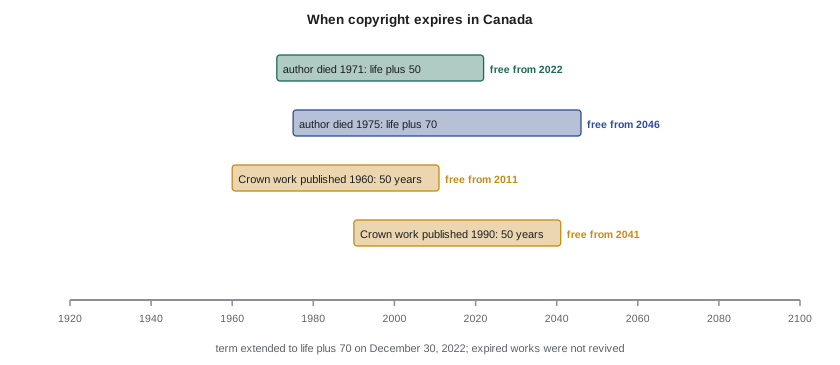
In Canada, the general term of copyright is the life of the author plus 70 years, extended from life plus 50 years on December 30, 2022. The extension did not revive expired copyrights, so works by authors who died in 1971 or earlier are generally in the public domain in Canada, while works by authors who died in 1972 or later will be protected for 70 years after death. Crown copyright in works prepared or published by or under the direction of the government lasts 50 years from first publication. Determining the author of older films can be complex, so check carefully.
Fair dealing and fair use
Both countries allow some uses of copyrighted material without permission, but the frameworks differ.
In Canada, fair dealing allows use of a work without permission if two tests are met. First, the use must be for an enumerated purpose: research, private study, education, parody or satire (section 29), criticism or review (section 29.1), or news reporting (section 29.2). Criticism, review and news reporting require mention of the source and, if given in the source, the author or performer. Second, the dealing must be fair. In CCH Canadian Ltd. v. Law Society of Upper Canada (2004), the Supreme Court set out factors to assess fairness: the purpose of the dealing, its character, the amount used, alternatives to the dealing, the nature of the work and the effect of the dealing on the work. Later decisions emphasized that fair dealing is a user's right to be interpreted generously.
Documentary uses that may qualify include quoting a news broadcast to criticize its coverage, reviewing a film or song by showing excerpts, and satirizing a public figure. Using a song simply as background music, or footage merely as illustration, is unlikely to qualify. Productions document their reasoning, and insurers may require a legal opinion.
| Use | Typical route | Notes |
|---|---|---|
| Historical news footage as illustration | Licence | Fair dealing or fair use unlikely without commentary |
| Clip critiqued or analyzed on screen | Fair dealing (criticism) or fair use | Document reasoning and credit the source |
| Music playing incidentally in a scene | Incidental use or licence | Avoid deliberately featuring it |
| Government footage | Public domain (US federal) or Crown licence (Canada) | Rules differ by country |
| Family home movies | Materials release from owner | Confirm who holds rights |
| Social media video | Licence from creator | Verify authenticity and identity |
Incidental capture in the field
When filming observationally, cameras capture copyrighted material constantly: posters, artworks, television screens, music playing in shops and logos. Incidental inclusion is often permitted. Canada's Copyright Act section 30.7 allows incidental and not deliberate inclusion of a work, and the US best practices statement treats incidental capture as a strong fair use situation. Problems arise when a work is deliberately featured. Practical habits for camera operators include framing around prominent artworks and logos when they are not part of the story, asking for music to be turned off during interviews, noting what was playing in observational scenes so it can be cleared or replaced, and avoiding staging scenes in front of copyrighted works.
Shooting archival material
Cinematographers often film photographs, documents and objects for documentaries, sometimes on a copy stand or rostrum with even, glare-free lighting from two sides at 45 degrees and polarizing filters to control reflections. High-resolution scans are preferable when available, but filming allows movements and textures. Moving across still photographs, a technique associated with Ken Burns, gives life to historical images; it should respect the photograph's content and not create false impressions. When matching new footage to archival textures, such as shooting on film or adding grain, be careful not to mislead viewers into thinking new material is archival.
Authenticity, verification and synthetic media
User-generated footage and leaked videos require verification: confirming who filmed them, where and when, and whether they have been edited or misattributed. Open-source investigation techniques, such as checking metadata, comparing landmarks, weather and shadows, and searching for earlier versions, are now standard in investigative documentary.
Generative AI raises new questions. Synthetic images, voices and re-creations can be mistaken for real archival material. In 2024, the US-based Archival Producers Alliance published best practices for using generative AI in documentaries, emphasizing transparency with audiences, disclosure of synthetic material, preserving the integrity of primary sources and caution about creating material that could be mistaken for historical records. Many broadcasters and festivals in both countries now require disclosure of AI-generated content. The cinematographer and director should agree early on rules for any synthetic or reconstructed imagery.
Restoration and alteration
Archival footage is often restored: cleaned, stabilized, given added colour, upscaled or retimed to modern frame rates. Restoration can make history vivid, but alterations such as added colour, frame interpolation or sound added to silent footage change the record. Ethical practice is to disclose significant alterations, keep original materials, and avoid changes that distort meaning. Speed correction, for example converting 16 or 18 fps silent film to natural motion rather than the jerky fast motion of incorrect projection, can increase authenticity; adding invented colour or sound effects should be done transparently.
Working with an archival producer
On archive-heavy documentaries, an archival producer or researcher finds, licenses and manages archival material. They search libraries and archives, negotiate prices, track every clip used in the cut, request high-resolution masters and confirm that licences cover the intended distribution. They also keep a cue sheet of archival material with timecodes, sources and rights, which is essential for E&O insurance and for future sales. The cinematographer works with the archival producer when matching new footage to archival textures, filming photographs and documents and planning sequences that combine new and old material.
Rights in footage you shoot
Copyright also applies to the footage the cinematographer creates. Crew agreements should state who owns the footage, usually the production company, and whether the cinematographer may use excerpts in a showreel. Freelancers who shoot material that later appears in other productions should check their agreements, and productions that buy footage from freelancers, stringers or participants need written licences or assignments. Clear chain of title, the documented sequence of rights from creators to the production, is required by distributors and insurers.
International distribution
Because copyright and fair dealing or fair use differ between countries, a use that is lawful in one country may not be in another. A documentary relying on US fair use may face claims in countries without an equivalent defence, and a Canadian fair dealing analysis may not satisfy a US insurer. Productions planning international distribution therefore assess clearance for each major territory, and distributors may require licences for material that would be fair use domestically.
Respecting archival subjects
People in archival footage often cannot consent: they may have died, or the footage may have been shot without their knowledge decades ago. Ethical use of archive therefore considers how subjects and their descendants would view their portrayal, especially for images of suffering, violence, colonial encounters or medical conditions. Some archives and communities set conditions on the use of sensitive material, and productions should honour them. Contextualizing archive accurately, identifying sources on screen or in credits, and avoiding misleading juxtapositions are part of the same responsibility.
Formats and technical quality
Archival material arrives in many formats: film prints and negatives, videotape of varying quality, low-resolution web video and phone footage in vertical frames. Request the best available source, such as a new film scan rather than a dub of a dub, and record the source format so that the editor and colourist know what they are working with. Decide early how the film will present different aspect ratios and frame rates, whether by pillarboxing older 4:3 material or by cropping, which can cut off important information and should be done with care.
Common mistakes
MistakeAssuming archival footage is free because it is old.
InsteadCheck copyright status, public domain rules and archive access terms.
MistakeUsing music as background and claiming fair dealing or fair use.
InsteadLicense music unless the use genuinely fits fair dealing or fair use.
MistakeLicensing only festival rights and forgetting to budget for upgrades.
InsteadPlan step deals and budget for full rights.
MistakeUsing user-generated video without verification.
InsteadVerify source, date, location and integrity before use.
MistakePresenting synthetic or restored images as unaltered archival.
InsteadDisclose AI generation and significant restoration choices.
Summary and key terms
- Archival sources include libraries, public archives, film boards, private collections and user content.
- Licences specify media, territory, term and duration, often per second with minimums.
- Canada's term is life plus 70 years since December 30, 2022, without reviving expired works.
- In the US, works published in 1930 or earlier were in the public domain by 2026, and federal government works are unprotected.
- Canadian fair dealing requires an enumerated purpose and a fair dealing; US fair use weighs four factors.
- Incidental capture is usually acceptable; deliberately featuring works needs clearance.
- Verification, transparency about AI and disclosure of restoration protect documentary credibility.
- Archival footage
- Existing film or video used in a new production.
- Licence
- Permission to use material on specified terms.
- Step deal
- A licence that starts limited and can be upgraded later.
- Public domain
- Works no longer protected by copyright.
- Crown copyright
- Copyright held by government in Canada.
- Fair dealing
- Canadian exception for enumerated purposes when the dealing is fair.
- Fair use
- US defence weighing four statutory factors.
- Incidental inclusion
- Unintentional capture of a work in the background.
- Verification
- Confirming the origin and integrity of footage.
- Synthetic media
- Images or sound generated or altered by AI.
Practice problems
Work each problem on paper first, then reveal the answer to check.
Name three archival sources.
Show answer
Commercial libraries, public archives, film boards, family collections, social media.
What four terms define an archival licence?
Show answer
Media, territory, term and duration.
Cost of 90 seconds at $60 per second?
Show answer
$5,400.
Canada's copyright term since December 30, 2022?
Show answer
Life plus 70 years.
Are US federal government works protected by copyright?
Show answer
No.
Name Canada's fair dealing purposes.
Show answer
Research, private study, education, parody, satire, criticism, review, news reporting.
Name the four US fair use factors.
Show answer
Purpose and character, nature of the work, amount used, market effect.
What should you do about music playing in a shop scene?
Show answer
Note it and keep it incidental, or clear or replace it.
Why verify user-generated video?
Show answer
To confirm authenticity, origin and integrity.
What did the Archival Producers Alliance's 2024 guidance emphasize?
Show answer
Transparency and disclosure about generative AI.
Lesson quiz · 5 questions
Score 60% or more to complete this lesson.
Create a free account to save your progress, take quizzes and earn a certificate.