
CINE-320 · Lesson 11 of 12 · 25 min
Drones and specialty capture
Documentary cinematographers increasingly reach beyond the handheld camera for images that reveal scale, time or hidden worlds: aerial views from drones, time-lapses of cities and seasons, macro images of insects and textures, underwater sequences, thermal images at night, and footage from cameras mounted on vehicles, animals or people. Used well, specialty capture expands what a documentary can show and gives editors powerful transitions and establishing shots. Used carelessly, it becomes decoration, costs time and money, and in the case of drones can break the law or endanger people. This lesson covers drone regulations and planning in Canada and the United States, time-lapse calculations, and other specialty techniques, with attention to ethics.
Drones in documentary
Small camera drones have transformed documentary aerial cinematography. Shots that once required a helicopter can be captured by a single operator in minutes: a landscape revealing a remote community, a car travelling along a coastal road, a protest seen from above, or a slow push over a farm at dawn. Drones also allow intimate aerial perspectives, low over water or through forests, that helicopters could never achieve.
Drone footage has limitations. Battery life is short, typically 20 to 45 minutes per flight; wind, rain and cold restrict flying; noise disturbs wildlife, subjects and communities; and regulations limit where and how drones can fly. Overuse of aerial establishing shots is a common cliché. The best documentary drone work is motivated: it shows something the story needs, such as scale, isolation, geography or the relationship between people and land.
Drone regulations
Commercial documentary drone flights are regulated aviation activities. Rules change frequently, so always check the current regulations, airspace maps and any local restrictions before flying.
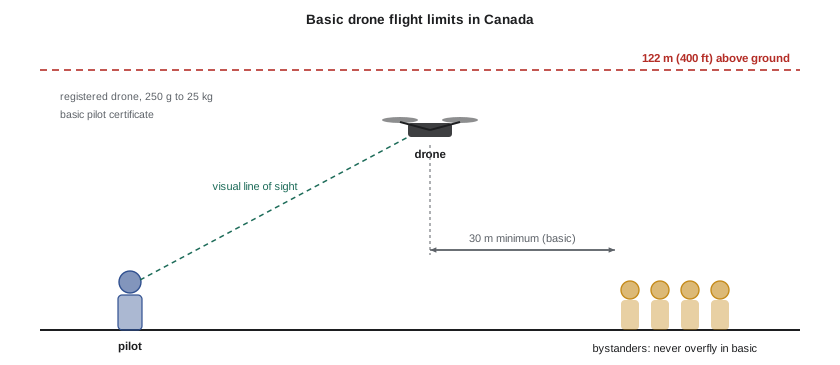
In Canada, drones are regulated by Transport Canada under Part IX of the Canadian Aviation Regulations. Drones weighing from 250 g up to 25 kg must be registered and marked, and pilots need a drone pilot certificate. A basic certificate, obtained by passing an online exam (minimum age 14), allows flights in uncontrolled airspace at least 30 m horizontally from bystanders and never over them. An advanced certificate, which requires a more difficult online exam and a flight review (minimum age 16), allows flights in controlled airspace with permission from NAV CANADA and flights near or over bystanders when the drone has the appropriate manufacturer safety declaration. Pilots must keep the drone within visual line of sight, generally fly no higher than 122 m (400 ft) above ground, carry their certificate and registration, and respect airport and heliport distances and restrictions over emergency sites and advertised events.
Updated rules that took effect on November 4, 2025 added a Level 1 Complex Operations certificate for certain lower-risk beyond visual line of sight and extended visual line of sight flights, and new provisions for medium drones up to 150 kg, among other changes. Drones under 250 g do not need registration or a pilot certificate, but pilots must still fly safely and must not endanger people or aircraft. Flying in national parks is prohibited without permission from Parks Canada, and provinces and municipalities may restrict take-off and landing on their land.
| Topic | Canada (Transport Canada) | United States (FAA Part 107) |
|---|---|---|
| Registration | 250 g to 25 kg | Over 250 g, under 55 lb |
| Pilot qualification | Basic or advanced certificate | Remote Pilot Certificate with recurrent training |
| Minimum age | 14 basic, 16 advanced | 16 |
| Altitude | Generally 122 m (400 ft) above ground | Generally 400 ft above ground |
| Controlled airspace | Advanced certificate and NAV CANADA authorization | Authorization, often through LAANC |
| Near or over people | Advanced certificate and compliant drone | Operations over people categories |
| Remote identification | Registration marking | Remote ID broadcast required |
| National parks | Permission from Parks Canada | Prohibited without NPS permission |
Planning a drone shoot
A drone shoot plan covers the purpose of each shot, the location and airspace, the pilot's qualifications, a site survey for obstacles, people and take-off areas, weather, battery planning, a visual observer, emergency procedures and permissions from landowners. Many documentary productions hire a specialist drone operator, often with a separate camera operator controlling the gimbal on larger aircraft, rather than adding drone piloting to the DP's responsibilities.
Worked problem
Battery planning for a drone sunrise
A drone has a rated flight time of 34 minutes per battery, but the operator plans to land with 30 % remaining and expects cold morning air to reduce capacity by another 15 %. The director wants coverage of a 75-minute window around sunrise. How much usable flight time does each battery give, and how many batteries are needed if two minutes per flight are spent taking off, positioning and landing?
Show solution
- Capacity after cold losses: \( 34 \times 0.85 \approx 28.9 \) minutes.
- Usable before the 30 % reserve: \( 28.9 \times 0.70 \approx 20.2 \) minutes.
- Shooting time per battery: \( 20.2 - 2 \approx 18 \) minutes.
- Batteries needed for continuous coverage: \( 75 \div 18 \approx 4.2 \), so five batteries, or fewer if the drone can land between key moments.
Answer: About 18 minutes of shooting per battery; carry five batteries, kept warm, for the full window.
Time-lapse
Time-lapse compresses long events into seconds by taking frames at intervals. The key calculation links the event duration, the desired clip length and the playback frame rate:
For example, compressing a 60-minute sunset into a 10-second clip at 24 fps requires \( 10 \times 24 = 240 \) frames, so the interval is \( 3{,}600 \div 240 = 15 \) seconds. Fast-moving subjects, such as traffic or crowds, look good with intervals of 1 to 3 seconds; clouds, 3 to 10 seconds; sunsets and shadows, 10 to 30 seconds; and construction or plant growth, minutes to hours. Use manual exposure and white balance to avoid flicker, or exposure ramping tools for day-to-night transitions, and lock focus. Shooting raw stills allows grading and resizing. Motion-control sliders and pan-tilt heads add movement, and hyperlapse moves the camera between frames over longer distances.
Other specialty techniques
- Macro and close-up: specialized lenses or extension tubes reveal small subjects such as insects, textures and mechanisms; depth of field is extremely shallow, and focus stacking or careful stopping down helps.
- Underwater: housings, dome ports and underwater lights, with trained divers, safety planning and attention to colour loss at depth.
- Thermal and infrared: cameras that see heat or near-infrared light, used for wildlife at night, search and rescue, and revealing energy loss or hidden activity.
- Night and low-light: high-ISO cameras, image intensifiers and infrared illumination for nocturnal subjects.
- Vehicle, body and animal mounts: suction mounts, car rigs, helmet and chest mounts, and miniature cameras on animals under scientific supervision.
- Phones and action cameras: discreet capture in restricted spaces, participatory filmmaking by subjects themselves and point-of-view shots.
- 360-degree and immersive: cameras that capture every direction for virtual reality and immersive documentary.
Covert and hidden cameras
Hidden cameras can expose wrongdoing that could not otherwise be shown, and they have an important place in investigative documentary. They also raise serious legal and ethical issues. Recording laws (Lesson 9) restrict secret audio recording in some jurisdictions; trespass and privacy laws apply; and broadcasters' journalistic standards usually allow hidden cameras only when there is prima facie evidence of wrongdoing in the public interest, when the information cannot be obtained openly, and with senior editorial approval. Covert footage of people who are not the subject of the investigation should be blurred.
Ethics of specialty images
Specialty images can mislead as well as reveal. Slow motion can make ordinary events look dramatic, drones can make surveillance look beautiful, and time-lapse can imply rhythms that do not exist. Thermal footage of people can be intrusive. Drone flights over private homes, Indigenous lands, sacred sites or vulnerable communities require consent and sensitivity. Before adding a specialty shot, ask what it shows the audience that is true and important, and whether the people and places depicted would agree that it is fair.
Drone shooting technique
Good drone footage follows the same principles as good camera work on the ground: motivated movement, steady framing and a clear subject. Slow, continuous moves read better than fast, erratic ones; reveal shots that start close and rise to show context, orbits around a subject, and slow pushes toward a location are common. Use the drone's cinematic or tripod modes to limit speed, set manual exposure and white balance, and shoot at the same frame rate and colour profile as the main cameras so that aerials intercut cleanly. ND filters on the drone camera keep shutter speeds near 180 degrees, avoiding the jittery look of very short exposures. Plan each flight with a shot list so that battery time is spent on the shots the edit needs, and review footage between flights.
Weather, wildlife and communities
Wind is the most common reason drone flights are cancelled. Most small drones struggle in sustained winds above about 35 to 40 km/h (about 20 to 25 mph), and gusts near buildings, cliffs and trees are unpredictable. Rain and snow can damage drones that are not weather sealed, and cold shortens battery life sharply. Wildlife can be disturbed or provoked by drones; many jurisdictions protect wildlife from harassment, and nesting birds and marine mammals require particular distance. Communities may feel surveilled by drones, so tell people nearby what you are doing and why, and fly over private property only with permission.
Choosing specialty techniques wisely
Specialty techniques consume time, money and attention. Before committing, list the shots the story needs, estimate the time each technique requires, including setup, safety and post-production, and compare it with the value it adds. A single well-chosen time-lapse or macro sequence can be more powerful than many decorative ones. Specialists, such as underwater camera operators, drone pilots and wildlife cinematographers, bring skills and safety training that a general documentary crew may lack, and hiring them for key days is often the most efficient choice.
Insurance and documentation for drone work
Commercial drone operations need appropriate liability insurance, and many locations, broadcasters and production insurers require proof of coverage before flights. Keep a flight log with dates, locations, pilots, aircraft, battery cycles and any incidents, and maintain the aircraft according to the manufacturer's recommendations. Incidents that cause injury or significant damage may have to be reported to the aviation regulator: Transport Canada and the FAA both set reporting requirements for serious accidents. Documenting site surveys, permissions and risk assessments also supports E&O and production insurance claims if something goes wrong.
Phones and participant footage
Participants increasingly film their own lives on phones, and productions sometimes give them cameras to record moments when the crew is absent. Such footage can be uniquely intimate, but it needs guidance: show participants how to hold the phone horizontally if the film will be delivered in a horizontal format, how to lock exposure and focus, how to record clear sound close to the speaker, and how to back up their recordings. Agree in writing how the material will be used and who owns it, and treat participants' recordings with the same care for privacy and consent as footage shot by the crew. The technical quality may be lower than the main camera, but the intimacy and access often outweigh it, and colourists can help integrate phone footage into the visual approach.
Common mistakes
MistakeAdding drone shots without a story purpose.
InsteadUse aerials to show scale, geography or relationships the story needs.
MistakeFlying commercially without the right certificate or authorization.
InsteadCheck current Transport Canada or FAA rules, airspace and permissions before every flight.
MistakePlanning drone time from rated battery life.
InsteadAllow for cold, reserves and positioning time and keep batteries warm.
MistakeUsing automatic exposure for time-lapse.
InsteadLock exposure, white balance and focus, or use controlled ramping.
MistakeUsing hidden cameras casually.
InsteadUse covert recording only with a clear public-interest justification, legal advice and editorial approval.
Summary and key terms
- Drones offer powerful aerial perspectives but have short flight times and strict rules.
- Canada requires registration and basic or advanced certificates for drones from 250 g to 25 kg.
- The US requires Part 107 certification, registration and Remote ID for most commercial drones.
- Drone plans cover purpose, airspace, site survey, weather, batteries and emergencies.
- Time-lapse interval equals event duration divided by clip length times playback rate.
- Macro, underwater, thermal, mounts, phones and 360 capture extend what documentary can show.
- Specialty and covert images must be justified and fair to the people and places shown.
- Drone
- A remotely piloted aircraft system used for aerial filming.
- Visual line of sight
- Keeping the drone visible to the pilot without aids.
- Basic operation
- A Canadian drone category in uncontrolled airspace away from bystanders.
- Advanced operation
- A Canadian drone category allowing controlled airspace and flights near people.
- Part 107
- The FAA's rules for small commercial drones.
- Remote ID
- Broadcast identification required for most US drones.
- LAANC
- A US system for near-instant controlled airspace authorization.
- Time-lapse
- A technique capturing frames at intervals to compress time.
- Hyperlapse
- A time-lapse with camera movement between frames.
- Covert recording
- Filming or recording without the subject's knowledge.
Practice problems
Work each problem on paper first, then reveal the answer to check.
Minimum horizontal distance from bystanders for basic operations in Canada?
Show answer
30 m.
Altitude limit in both countries?
Show answer
Generally 400 ft (122 m) above ground.
Recurrent training interval for US remote pilots?
Show answer
Every 24 calendar months.
Interval for a 30-minute event in a 5-second clip at 24 fps?
Show answer
15 seconds.
Frames needed for a 12-second clip at 25 fps?
Show answer
300 frames.
Usable minutes from a 30-minute battery with 30 % reserve?
Show answer
21 minutes.
Name three specialty techniques.
Show answer
Macro, underwater, thermal, mounts, phones, 360.
When do broadcasters allow hidden cameras?
Show answer
With public-interest evidence, no open alternative and editorial approval.
Why keep drone batteries warm?
Show answer
Cold reduces capacity.
Where are drones prohibited without permission in both countries?
Show answer
National parks.
Lesson quiz · 5 questions
Score 60% or more to complete this lesson.
Create a free account to save your progress, take quizzes and earn a certificate.