
CINE-330 · Lesson 1 of 12 · 28 min
The commercial industry and production process
Commercials and music videos are where many cinematographers learn to work fast, try new tools and build a reel. A thirty-second spot may have more lighting, camera movement and visual effects per second than any other kind of filmmaking, and a music video may let a young director of photography try a look that no feature producer would approve. Both forms are short, tightly scheduled and paid for by a client who has a specific goal: selling a product, building a brand or promoting an artist. This course is about the craft of shooting that work well. It builds on narrative lighting and camera from CINE-301 and CINE-302, the grading knowledge of CINE-310 and the run-and-gun habits of CINE-320, and it points to PHOT-310 for still product lighting, which shares many principles with moving tabletop work. This first lesson explains who the players are, how money flows, how a job moves from an agency brief to a finished spot, and where the director of photography fits.
Why commercials and music videos matter to cinematographers
Commercial production is a large and steady part of the screen economy. Brands commission work for television, streaming platforms, cinema pre-show, websites and social media, and every campaign now needs many versions in different lengths and shapes. Music videos are smaller in money but huge in cultural reach; they are often an artist's main visual statement and travel around the world on video platforms within hours of release.
For a cinematographer, this work offers several things at once. It pays day rates that are often higher than drama rates, it puts new cameras, lenses, robots and lighting in your hands, and it gives you finished pieces that show a range of looks in a short reel. It also demands a particular discipline. A commercial day is expensive, the client and agency are watching every frame on a monitor, and the shot list must be finished on time. A music video often has a tiny budget and an enormous creative ambition, so the cinematographer has to solve problems with ingenuity rather than money.
- Commercials teach precision: exact product placement, perfect focus on a label, flawless light on a reflective surface and repeatable camera moves.
- Music videos teach invention: strong visual concepts, bold colour and lensing, and ways of shooting a performance that feel fresh.
- Both teach speed and communication, because the cinematographer works with many decision makers in a short time.
- Both feed portfolios. A director of photography with a strong commercial and music video reel is often offered narrative work later.
The players in commercial production
A commercial job brings together several organizations, each with its own interests. Understanding who they are helps the cinematographer know whom to listen to and how decisions are made.
- The advertiser or client is the brand that pays for the work. Its marketing team owns the product, the budget and the final approval.
- The advertising agency develops the creative idea, writes scripts and storyboards, and manages the relationship between the client and production. Agency creatives (an art director and a copywriter, led by a creative director) and an agency producer usually attend the shoot.
- The production company is hired by the agency to make the film. It employs or represents the director, prepares the bid, hires the crew and manages the shoot. The executive producer and line producer run the business side.
- The director is the creative lead on set and is usually signed to a production company roster. Commercial directors pitch for jobs with a written treatment.
- The director of photography is hired by the production company, often at the director's request, and leads the camera, grip and electric departments.
- Post-production companies handle editing, visual effects, colour grading, sound design and finishing. In many campaigns the agency hires them directly.
- Talent includes actors, models, musicians, hand models and voice performers, usually engaged under union agreements.
Increasingly, some brands make content in house, with their own studios and crews, and some agencies have production arms. Platforms and creator-led work have also created many small jobs where a single company does everything. The cinematographer may therefore find a classic chain of agency, production company and post house, or a compact team of three people making social clips for a direct-to-consumer brand.
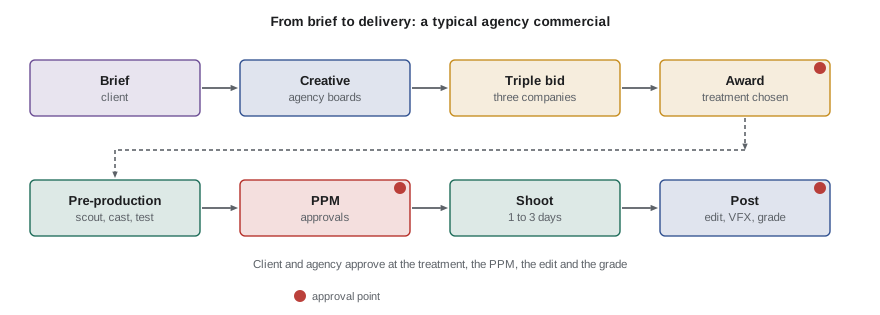
How a commercial job moves from brief to delivery
Most agency commercials follow a recognizable sequence. Knowing it helps the cinematographer understand when their input matters most.
- Brief. The client tells the agency what it wants to achieve: a launch, a seasonal offer or a change in brand image. The agency develops a creative concept and scripts.
- Boards and approval. The agency produces storyboards or animatics and gets client approval for a script and budget range.
- Triple bid. The agency usually sends the boards to several production companies, often three, asking for a bid and a director's treatment. This competitive process sets the budget and selects the director.
- Award. The agency awards the job to one company, often after calls in which the director explains the treatment.
- Pre-production. The production company hires heads of department, scouts locations, casts talent, books equipment, builds sets and tests the look. The director and cinematographer prepare a shot list and lighting plans.
- Pre-production meeting (PPM). The agency, client and production company review every element: casting, wardrobe, props, locations, sets, the shot list, schedule and the look. Approvals at the PPM become the plan for the shoot.
- Shoot. Commercials often shoot in one to three days. The client and agency watch on monitors in a "video village" and approve takes.
- Post-production. The editor cuts versions; visual effects, grading, sound and music are added; the client approves; and the deliverables are made in many lengths and formats.
The director of photography's influence is greatest during the treatment and pre-production, when the look, equipment and methods are decided. On the day, the job is to execute what was promised at the PPM, adjusting to what the client asks for in real time.
The role of the director of photography in commercials
In drama, a cinematographer may spend weeks shaping a visual language with a director. In commercials, the timeline is compressed and the stakeholders are more numerous. The director of photography's tasks include:
- Helping the director develop the look in the treatment with references, frames and lighting ideas.
- Choosing cameras, lenses, filters and specialty tools, and explaining their cost and benefit to the producer.
- Planning lighting and rigging, often with pre-lighting days on a stage.
- Testing products, skin, wardrobe and colour so there are no surprises on the shoot day.
- Running the camera, grip and electric teams efficiently so the schedule holds.
- Protecting the product: making sure the label is sharp, the colour accurate and the shape flattering in every shot.
- Supporting the grade by shooting with appropriate exposure and recording clean, consistent images, as discussed in CINE-310.
Commercial cinematographers also learn diplomacy. A client may ask for the product to be bigger in frame, the colour to be warmer or a shot to be repeated at the last minute. Answering with calm options rather than resistance keeps the day productive.
The music video landscape
Music videos are usually commissioned by a record label or by the artist and their management. A label video commissioner sends a track and a brief to directors, who respond with treatments; the chosen director then works with a producer or production company to make the video. Budgets range from almost nothing for an independent artist to large sums for a global release, but many music videos are made with small crews, short schedules and borrowed favours.
The director of photography's role in a music video is often more creative and more exposed than in commercials. There may be no agency or client in the room, just the artist, the director and a small crew. The look may be bold and stylized, with strong colour, unusual lenses or in-camera effects. Many cinematographers find music videos the place where they develop a personal style that later attracts commercial and narrative work.
| Factor | Commercial | Music video |
|---|---|---|
| Who pays | Brand through an agency | Label or artist |
| Main goal | Sell a product or build a brand | Promote a song and artist |
| Decision makers on set | Client, agency, director | Artist, director, label rep |
| Typical schedule | One to three shoot days, careful prep | One or two days, fast prep |
| Approval of shots | Formal, on monitors | Informal, quick |
| Creative freedom | Constrained by brand rules | Often high |
| Deliverables | Many lengths and formats | Main video plus social cuts |
| Typical risk | Client changes on the day | Budget too small for ambition |
Money: how jobs are bid and paid
The commercial bid is a detailed estimate of every cost, prepared by the production company. In the United States, many production companies use the Association of Independent Commercial Producers (AICP) bid form, a standard set of cost categories that makes competing bids easier to compare. Canadian companies use similar categories, and many Canadian agencies and advertisers accept the AICP form or a local equivalent. Lesson 2 works through a bid in detail.
The production company adds a markup, sometimes called a production fee, to cover overhead and profit, and charges a director's fee. Insurance, payroll taxes and contingency also appear. Cinematographers are usually paid a day rate for prep days, pre-light days, shoot days and sometimes travel days, with overtime after a set number of hours. Camera, grip and lighting equipment is rented from rental houses, often with a package discount negotiated by the production company.
Worked problem
Reading the shape of a commercial budget
A thirty-second spot has a production budget of 300,000 (in local currency). The production company estimates that crew labour is 22 %, equipment 12 %, studio and sets 18 %, talent 8 %, travel and locations 6 %, media and miscellaneous 4 %, the director's fee 10 %, insurance 2 % and the production fee (markup) 18 %. How much is available for camera, grip and electric equipment, and how much is the markup?
Show solution
- Equipment is 12 % of 300,000.
- 0.12 × 300,000 = 36,000.
- The markup is 18 % of 300,000.
- 0.18 × 300,000 = 54,000.
- Check that the percentages sum to 100 %: 22 + 12 + 18 + 8 + 6 + 4 + 10 + 2 + 18 = 100.
Answer: About 36,000 is available for equipment, and the production fee is 54,000. The cinematographer's equipment wish list must fit within the equipment line or be traded against other lines.
Unions, guilds and agreements
Commercials and music videos are made under a mix of union and non-union arrangements, and the rules differ between the two countries. Rates, overtime, meal penalties and hours of rest are set by agreements, so the cinematographer needs to know which agreement applies before quoting a rate.
In Canada, camera crews are represented mainly by IATSE Local 667 (camera, eastern Canada) and IATSE Local 669 (camera, western Canada). Technicians such as grips and electricians belong to locals such as IATSE 873 in Toronto and IATSE 891 in British Columbia, and some productions work with NABET 700-M Unifor. Directors may be members of the Directors Guild of Canada (DGC). Performers in commercials are covered by ACTRA, whose National Commercial Agreement (NCA) with the Association of Canadian Advertisers sets session fees and use fees; recent renewals have been for one year at a time, so check the current term before budgeting. Quebec has its own unions and agreements, including the Union des artistes (UDA) for performers.
Union status affects the cinematographer's rate, the size of the crew and the paperwork. Non-union music videos are common, but crew members should still insist on safe hours, meal breaks and written terms. When a union crew is hired, the production must follow that agreement's rules even on a tiny job.
Rights, buyouts and why they matter on set
Advertising is shaped by rights. Talent, music, locations, artwork and even recognizable buildings may need clearance, and a shot that includes something uncleared may be unusable. Performers in commercials are paid not only for the session but for how and where the commercial is used. A shot showing an extra's face prominently may turn that extra into a principal performer with higher fees, so assistant directors and cinematographers watch framing carefully.
Under the ACTRA NCA, performers receive session fees plus use fees that depend on the medium, the region and the length of use. A background performer who is featured may be upgraded. Music in a Canadian commercial requires a synchronization licence from the publisher and a master use licence from the record company; SOCAN collects performance royalties when the spot airs, and CMRRA represents many publishers for reproduction rights.
For the cinematographer, the practical point is to know what is cleared. Ask the producer about logos, artwork and signs in frame before lighting a set; cover or replace anything that might cause trouble; and follow the assistant director's guidance on featuring extras.
Building a career in commercial and music video camera work
Most commercial cinematographers start by shooting music videos, short films and low-budget branded content, or by working their way up as camera assistants and operators on commercial crews. Agents and representation companies help established directors of photography find work. A strong reel, a reliable reputation and good relationships with directors are the main assets. Many directors bring the same cinematographer to every job they win.
- Build a reel of short, striking clips that show range: product, people, movement and colour.
- Learn the specialty tools that commercials use, such as high-speed cameras, probe lenses and motion control, even if only through workshops and rental house demos.
- Understand budgets so you can propose looks that fit the money.
- Be calm and pleasant under pressure; clients remember how the day felt.
Common mistakes
MistakeTreating the agency and client as obstacles.
InsteadTreat them as collaborators whose goals must be met and explain options clearly.
MistakeChoosing equipment before reading the budget.
InsteadFit the equipment wish list to the equipment line or trade it against other lines with the producer.
MistakeIgnoring the PPM decisions on the shoot day.
InsteadExecute what was approved at the PPM and raise changes through the director and producer.
MistakeFeaturing an extra's face without checking.
InsteadKnow that featuring background performers can upgrade them to principals and frame accordingly.
MistakeQuoting a rate without knowing the agreement.
InsteadCheck whether the job is union and which agreement and rates apply before quoting.
Summary and key terms
- Commercials and music videos are short, intense forms that teach precision, invention and speed.
- The main players in a commercial are the client, agency, production company, director, cinematographer, post houses and talent.
- A typical job moves from brief, boards and triple bid to award, pre-production, the PPM, the shoot and post.
- The cinematographer's influence is greatest during the treatment and pre-production.
- Music videos are commissioned by labels or artists and often give the cinematographer more creative freedom.
- Bids break costs into standard categories, with a production fee, director's fee, insurance and contingency.
- Unions, performer agreements and music rights differ between Canada and the US and shape what can be shot and how.
- Advertising agency
- The firm that creates the concept and manages the client relationship on a commercial.
- Production company
- The firm hired to produce the film, employing or representing the director and crew.
- Triple bid
- The practice of asking several production companies to bid on the same boards.
- Treatment
- A director's written and visual proposal for how a commercial or video will look and feel.
- PPM
- The pre-production meeting where client, agency and production approve every element.
- Video village
- The monitor area where clients, agency and director watch takes.
- Production fee
- The production company's markup for overhead and profit.
- Video commissioner
- The label staff member who commissions music videos from directors.
- Use fee
- A payment to a performer based on how and where a commercial is shown.
- Synchronization licence
- Permission from a music publisher to pair a composition with moving images.
Practice problems
Work each problem on paper first, then reveal the answer to check.
Who usually pays for a commercial?
Show answer
The advertiser, through the agency.
Who hires the director of photography on a commercial?
Show answer
The production company, often at the director's request.
What happens at the PPM?
Show answer
Client, agency and production approve casting, wardrobe, sets, shot list, schedule and look.
Why do agencies triple bid?
Show answer
To compare costs and approaches and choose a director.
When is the cinematographer's influence greatest?
Show answer
During the treatment and pre-production.
If equipment is 12 % of 250,000, what is the equipment line?
Show answer
30,000.
Who commissions most music videos?
Show answer
A record label's video commissioner or the artist and management.
What is a master use licence?
Show answer
Permission from the record company to use a specific recording.
Why watch how extras are framed?
Show answer
Featuring them can upgrade them to principal performers with higher fees.
Name one skill commercials teach.
Show answer
Precision, such as exact product placement and repeatable moves.
Lesson quiz · 5 questions
Score 60% or more to complete this lesson.
Create a free account to save your progress, take quizzes and earn a certificate.