
CINE-330 · Lesson 9 of 12 · 28 min
Stylized looks, lensing and in-camera effects
Commercials and music videos are where bold visual styles are born. A look that would distract in a feature film, such as heavy anamorphic flares, saturated coloured light, extreme wide lenses, prisms in front of the lens or a strobing shutter, can define a music video or make a spot memorable. This lesson explores how cinematographers create stylized looks deliberately: choosing lenses for character, using filters and optical tricks, shaping colour with light rather than only in the grade, using shutter and frame rate creatively, and building in-camera effects that are faster and more convincing than post-production. It assumes the grading knowledge from CINE-310 and focuses on what happens in front of the lens.
Designing a look with intent
A stylized look should serve the idea. Before choosing tools, the director and cinematographer agree on what the look must express: energy, nostalgia, luxury, unease, dream, rebellion. References from films, photography, painting and earlier videos help, but the best looks adapt references rather than copy them.
- Define two or three visual rules, such as "every scene lit by a single coloured practical" or "camera never moves except on the chorus".
- Decide what is achieved in camera and what in the grade or visual effects.
- Test the look early with the actual camera, lenses and lighting.
- Build a monitoring look so the director and client see the style on set.
- Keep the brand or artist in mind: a cosmetics client may reject harsh skin rendering even if it suits the concept.
Lenses with character
Modern lenses are sharp, clean and consistent. Many commercials and music videos deliberately choose lenses with more character.
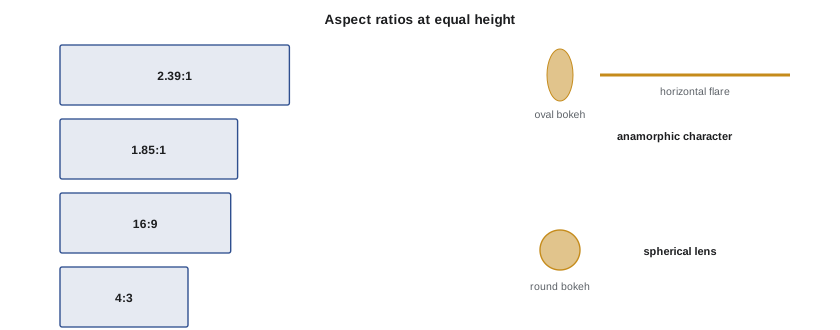
- Anamorphic lenses squeeze a wide field of view onto the sensor, then unsqueeze it in post. They produce oval out-of-focus highlights, horizontal flares and a characteristic falloff. Some productions use them for a cinematic widescreen look even when delivering in narrower aspect ratios.
- Vintage spherical lenses have lower contrast, softer edges, coloured flares and unique bokeh, giving warmth and nostalgia.
- Detuned or rehoused lenses are modified to increase flare or softness in a controlled way.
- Extreme wide angles exaggerate perspective, a staple of energetic music videos and hip-hop videos where the camera sits close to the artist.
- Long telephoto lenses compress space and isolate subjects, useful for heat-haze and fashion looks.
- Specialty lenses, such as tilt-shift, swing lenses and pinhole lenses, create unusual planes of focus or deliberate imperfections.
Worked problem
Anamorphic squeeze and field of view
A 2× anamorphic lens with a 50 mm focal length is used on a sensor area 22 mm wide. What is the horizontal field of view compared with a 25 mm spherical lens on the same width?
Show solution
- An anamorphic lens with a 2× squeeze captures horizontally what a spherical lens of half its focal length would, so the horizontal angle matches a 25 mm spherical lens.
- Horizontal angle = 2 × arctan(22 ÷ (2 × 25)) = 2 × arctan(0.44) ≈ 2 × 23.7° ≈ 47.5°.
- Vertically, the lens behaves like a 50 mm lens, so the frame feels wider and more compressed at once.
Answer: Horizontally about 47.5°, the same as a 25 mm spherical lens; the anamorphic image has the depth of field and compression of a 50 mm lens, which is part of its distinctive feel.
Filters and optical effects
Filters placed in front of the lens shape the image before it reaches the sensor.
- Diffusion filters soften highlights and skin, adding glow or halation.
- Low-contrast and fog filters lift shadows and create atmosphere.
- Streak filters add horizontal flares that mimic anamorphic lenses.
- Star filters create points of light on highlights, a classic for jewellery, cars and night scenes.
- Coloured and graduated filters tint parts of the frame.
- Polarizers control reflections and deepen skies.
Optical effects go further. Prisms, crystals, glass objects and mirrors held in front of the lens create reflections, multiplications and colour fringes. The technique is sometimes called "prism" or "lens whacking" when a lens is detached slightly to leak light. These effects are unpredictable, which is part of their charm, and they need patience and many takes.
Colour in light
The grade can change colour after the shoot, but colour created in light looks different: it falls on surfaces with real shadows, reflections and spill. Many stylized looks are built with coloured light on set.
- RGB LED fixtures can produce saturated colours and change them instantly, even in time with the music.
- Contrasting colours, such as warm key and cool fill, create depth and mood.
- Practical lights in frame, such as neon signs, LED strips and coloured bulbs, motivate the colour and create a believable world.
- Coloured light on skin can be unflattering; test skin tones and keep some light near neutral on faces if the brand or artist requires it.
- Saturated colours can clip on camera sensors and monitors; watch colour channels on scopes and expose to protect them.
Worked problem
Mixing two coloured sources
A face is lit by a magenta key at 400 lux and a cyan fill from the other side at 100 lux. How many stops brighter is the key than the fill, and what is the lighting ratio?
Show solution
- Ratio = 400 ÷ 100 = 4.
- Stops = log₂ 4 = 2.
- The lighting ratio key to fill (key plus fill on the bright side) is (400 + 100) ÷ 100 = 5:1.
Answer: The key is 2 stops brighter than the fill, a ratio of about 5:1 measured key-plus-fill to fill, giving a dramatic but readable face with colour separation.
Shutter, frame rate and motion as style
Changing shutter angle and frame rate alters how motion looks, and these choices can be strong stylistic tools.
- A narrow shutter angle, such as 45 or 90 degrees, produces crisp, staccato motion with little blur, famously used for battle and action scenes and often for energetic music videos.
- A wide shutter angle, such as 270 or 360 degrees, increases motion blur, creating a dreamy, smeared effect.
- Step printing and frame skipping in post create a jerky, rhythmic look, often combined with a slow shutter for smears.
- Strobe lighting synchronized with the camera can freeze motion or create stuttering patterns.
- Variable frame rate ramps, from normal speed to high speed within one shot, emphasize key moments.
Worked problem
Motion blur at different shutter angles
A dancer's hand moves at 3 m/s. At 24 fps, how far does the hand travel during one exposure at 180° and at 45° shutter?
Show solution
- Exposure at 180°: 0.5 × 1/24 = 1/48 s ≈ 0.0208 s. Travel: 3 × 0.0208 ≈ 0.0625 m = 6.3 cm.
- Exposure at 45°: 0.125 × 1/24 = 1/192 s ≈ 0.0052 s. Travel: 3 × 0.0052 ≈ 0.0156 m = 1.6 cm.
- The narrow shutter reduces blur by a factor of 4 but also reduces light by 2 stops.
Answer: About 6.3 cm of blur at 180° and 1.6 cm at 45°. The narrow shutter gives crisper, staccato motion and needs 2 stops more light.
In-camera effects
Many memorable music videos use effects created in camera rather than in post. In-camera effects often look more organic and can be cheaper when planned well.
- Forced perspective places objects at different distances to change apparent scale.
- Rotating sets and camera rigs make people appear to walk on walls or ceilings.
- Mirrors and reflections double performers or create infinite tunnels.
- Projection onto performers or surfaces creates moving textures.
- Practical smoke, haze, rain, fire and particles add atmosphere that light can shape.
- One-take choreographed shots combine camera, performers and lighting changes in real time.
- Reverse action: the artist performs the song backwards to reversed playback, and the footage is reversed in the edit, so everything else moves backward while the lips sync normally.
Each effect requires precise planning and rehearsal. One-take videos, for example, may need days of rehearsal for a single shot, with lighting cues programmed on a console and timed to playback.
| Tool | Visual effect | Watch for |
|---|---|---|
| Anamorphic lenses | Oval bokeh, horizontal flares, widescreen feel | Cost, minimum focus, weight |
| Vintage lenses | Softness, warm flares, character | Inconsistency between lenses |
| Diffusion filters | Glow, softened highlights | Loss of contrast and detail |
| Coloured RGB light | Saturated mood, music-synced changes | Skin tones, sensor clipping |
| Narrow shutter | Crisp, staccato motion | Light loss, flicker |
| Wide shutter | Dreamy motion blur | Highlights smear |
| Prisms and glass | Reflections, fractured images | Unpredictable, slow |
| Rotating set | Gravity-defying movement | Safety, cost, rehearsal |
Balancing in-camera and post
Not every effect belongs in camera. The cinematographer, director and visual effects supervisor decide together, weighing cost, time, control and look. In-camera effects are committed: if the client wants a change later, it may be impossible. Post-production effects offer flexibility but may look artificial or take more time. Many productions do both: capture practical elements in camera and enhance them in post.
Haze, smoke and atmosphere
Atmosphere is one of the oldest stylistic tools. Haze machines fill a space with a fine, even mist that makes light beams visible, softens contrast and adds depth. Smoke and fog are thicker and more uneven, used for drama and texture. In music videos, haze turns coloured beams into architecture: shafts of light from behind the artist, moving spots sweeping the room, sunlight streaming through windows. The cinematographer works with the gaffer and the special effects team to control density, because haze drifts and settles; fans and timed bursts keep it consistent between takes. Performers and crew should be told when haze is in use, and fluid types and exposure times should follow safety guidance, as discussed in Lesson 12.
Practicals as design elements
Practical lights, those visible in frame, can define a look on their own: a row of bare bulbs, neon tubes spelling words, LED strips outlining a set, a television glowing in a dark room. Practicals set the colour and mood, motivate the rest of the lighting and add depth to the background. In stylized work, practicals are often brighter and more saturated than in drama, and many are dimmable or programmable from a lighting console so they can change with the music. When planning practicals, consider their brightness relative to the exposure: a practical that clips to white may lose its colour, so dimming it or using coloured gels inside shades keeps it readable.
Movement as style
Camera movement can be as stylistic as light. A slow, continuous push that never stops creates tension; whip pans between set-ups create energy and transitions; a static locked-off frame with performers moving through it feels formal and graphic. Snorricam rigs, which mount the camera on the performer's body facing them, make the background swing while the face stays still. Many music videos assign a movement rule to each section of the song, giving the edit a clear visual rhythm.
Testing and documenting a look
Once a look is agreed, document it so it survives the pressure of the shoot day: lens set and filters, shutter angle, colour temperatures and gel numbers, haze density, monitoring look file and reference frames. Share the document with the gaffer, the first assistant and the digital imaging technician, and bring it to the grade.
Common mistakes
MistakeCopying a reference look without adapting it.
InsteadAdapt references to the idea, artist and brand.
MistakeRelying only on the grade for colour.
InsteadBuild colour in light where surfaces and reflections matter.
MistakeLighting faces with strong saturated colour without testing.
InsteadTest skin tones and keep faces readable.
MistakeUsing a narrow shutter without checking light and flicker.
InsteadAccount for the light loss and test fixtures.
MistakeChoosing an in-camera effect without rehearsal time.
InsteadSchedule rehearsals and tests for complex practical effects.
Summary and key terms
- Stylized looks should serve the idea with clear visual rules.
- Lenses with character, such as anamorphic and vintage lenses, give distinctive bokeh, flare and feel.
- Filters and optical tricks shape glow, flare, contrast and reflections in camera.
- Coloured light creates mood with real shadows and reflections, but skin tones need care.
- Shutter angle and frame rate change motion character, from staccato to dreamy.
- In-camera effects such as forced perspective, mirrors and reverse action can be organic and memorable.
- The team balances in-camera commitment against post-production flexibility.
- Anamorphic lens
- A lens that squeezes a wide view horizontally onto the sensor.
- Bokeh
- The appearance of out-of-focus areas.
- Flare
- Light scattering in the lens, producing streaks or veils.
- Diffusion filter
- A filter that softens highlights and adds glow.
- Lens whacking
- Detaching a lens slightly to leak light and shift focus for effect.
- Forced perspective
- Arranging objects at different distances to change apparent size.
- Shutter angle
- The fraction of the frame interval during which the sensor is exposed.
- Step printing
- Repeating or skipping frames to create jerky motion.
- Reverse action
- Performing to reversed playback and reversing the footage.
- Lighting ratio
- The ratio of key-plus-fill to fill on a subject.
Practice problems
Work each problem on paper first, then reveal the answer to check.
Horizontal view of a 40 mm 2× anamorphic matches which spherical focal length?
Show answer
20 mm.
Stops between 800 lux and 200 lux?
Show answer
2 stops.
Motion blur of a 2 m/s hand at 180° shutter, 24 fps?
Show answer
About 4.2 cm.
Light lost going from 180° to 90° shutter?
Show answer
One stop.
Name one effect of a diffusion filter.
Show answer
Glow or softened highlights.
Why build colour in light rather than the grade?
Show answer
Real shadows, spill and reflections look different.
What is reverse action?
Show answer
Performing to reversed playback, then reversing the footage.
Why test vintage lenses before a shoot?
Show answer
They vary in character and quality.
Name one in-camera effect.
Show answer
Forced perspective, mirrors or a rotating set.
Why might a client reject a strong look?
Show answer
It may conflict with brand rules or flatter skin poorly.
Lesson quiz · 5 questions
Score 60% or more to complete this lesson.
Create a free account to save your progress, take quizzes and earn a certificate.