
CISSP-113 · Lesson 12 of 12 · 31 min
Capstone: designing and defending a segmented network
This capstone brings the course together. You will work through the network security design for an invented organization, from understanding its business and assets, through architecture, components and secure channels, to monitoring, governance and a risk-based investment case. Along the way, the lesson shows how the Domain 4 topics connect, and it closes with strategies for answering Domain 4 questions on the exam. The organization, its people and its numbers are invented for teaching; any resemblance to a real company is coincidental.
The organization
Tamarack Freight is a mid-sized logistics company headquartered in Winnipeg, with two automated warehouses in Mississauga and Calgary, about 900 employees, a fleet of trucks with telematics units, and a customer portal where shippers book loads and track freight. It processes card payments for small customers, holds personal information about drivers and customers, and runs warehouse automation, conveyors, sorters and robotic pickers, controlled by PLCs. Its applications are split between a small headquarters data centre and a public cloud provider. Since 2020, about 40 % of office staff work from home part of the week. Its largest customers include federally regulated retailers and a bank, which send security questionnaires every year.
A recent assessment found the following. The headquarters and warehouse networks are flat, with office PCs, servers, cameras, door controllers and warehouse PLCs on the same subnets. A remote access VPN gives every user full network access, protected by passwords only. The warehouse automation vendor connects through an always-on remote desktop tool. Corporate Wi-Fi uses WPA2-Personal with a passphrase unchanged for four years. The customer portal runs in the cloud, but its database has a public IP address. Firewall rules number about 1,400, many without owners. Logs are kept on each device for a few days, and no one reviews them. There is no DMARC record, and the company has been impersonated in invoice fraud twice this year.
Step 1: understand the business and its protect surface
The first step is not technical. Before redesigning anything, the security manager meets business owners to understand what matters. For Tamarack, the critical services are the customer portal and booking system, the warehouse management system and automation that move freight, the payment flow, driver dispatch and telematics, and email and collaboration. The critical data are customer and driver personal information, payment card data, contracts and pricing. Downtime of warehouse automation costs about $45,000 an hour in missed shipments and penalties; a week-long outage could lose major customers. These facts set priorities: availability of warehouse operations and the portal, confidentiality of personal and payment data, and integrity of bookings and dispatch.
| Protect surface | Main threat | Business impact | Priority |
|---|---|---|---|
| Warehouse automation (PLCs, sorters) | Ransomware spreading from office network; vendor access abuse | About $45,000 per hour of stoppage; safety risk | Critical |
| Customer portal and database | Internet exposure, web attacks, DDoS | Lost bookings, customer data breach | Critical |
| Payment flow | Card data theft | Card brand penalties, loss of ability to accept cards | High |
| Email and identity | Phishing, invoice fraud, credential theft | Fraud losses, entry point for all attacks | High |
| Telematics and dispatch | Exposed devices, interception | Delays, safety, location privacy | Medium |
Step 2: design the zones
With priorities clear, the architect designs zones and the flows between them. At headquarters: a user zone for office devices, divided by department where useful; a server zone for internal applications; a restricted payment zone kept as small as possible to reduce the scope of payment card compliance; a management zone for network and system administration, reached only through privileged access workstations and a jump host; a building systems zone for cameras, door controllers and heating; a guest zone with internet access only; and a backup zone with immutable storage. At each warehouse: an office zone, and an OT zone structured along Purdue lines, with an industrial DMZ holding a historian replica, patch server and remote access broker, and the PLCs and HMIs below it. In the cloud: a virtual network with public subnets only for the load balancer, private subnets for the application and database tiers, and security groups allowing each tier to reach only the next.
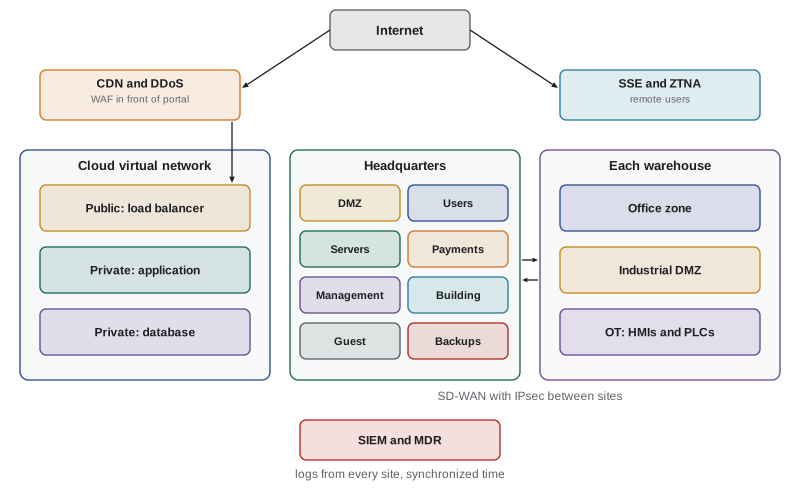
| From | To | Permitted flow | Control point |
|---|---|---|---|
| Internet | Cloud load balancer | HTTPS 443 via CDN and WAF | CDN, WAF, security group |
| Cloud application tier | Cloud database tier | Database port only | Security groups |
| Users (via ZTNA) | Internal applications | Per-application HTTPS after identity and device checks | ZTNA broker, internal firewall |
| Warehouse management servers | Historian in industrial DMZ | Specific read-only replication | OT firewalls |
| Vendor | Warehouse PLCs | Brokered, MFA, time-limited sessions via DMZ jump host, recorded | Remote access broker |
| Management zone | Network and server interfaces | SSH, HTTPS, SNMPv3 from jump host only | Internal firewall, device ACLs |
| All zones | Backup zone | Backup agent ports to backup servers only | Internal firewall |
| Guest zone | Internet | Web only, client isolation | Guest firewall |
| Any | Any | Everything else denied and logged | All firewalls |
Worked problem
Sizing the address plan
Headquarters has 600 user devices, 120 servers, 40 payment systems, 60 management interfaces, 250 building system devices and up to 300 guests. Allocate IPv4 subnets from 10.10.0.0/16 with room to grow, and state each subnet's usable hosts.
Show solution
- Users: 600 devices with growth fit a /22 (1,022 usable): 10.10.0.0/22.
- Guests: 300 fit a /23 (510 usable): 10.10.4.0/23.
- Building systems: 250 with growth fit a /23 (510 usable): 10.10.6.0/23.
- Servers: 120 fit a /24 (254 usable): 10.10.8.0/24.
- Management: 60 fit a /25 (126 usable): 10.10.9.0/25. Payments: 40 fit a /26 (62 usable): 10.10.9.128/26.
- Matching IPv6 /64s are allocated from the site /48 for each zone, with the same policy applied.
Answer: Contiguous, right-sized blocks per zone make firewall rules short and readable, and leave most of the /16 free for future zones and sites.
Step 3: secure the components
Next, the design specifies how each component is secured. Access switches enforce 802.1X with EAP-TLS for managed laptops, placing devices into their zone by policy; printers, cameras and door controllers are profiled by NAC and placed in restricted segments; port security, DHCP snooping, dynamic ARP inspection, RA Guard and BPDU guard are enabled on access ports; unused ports are disabled. Corporate Wi-Fi moves to WPA3-Enterprise with EAP-TLS and protected management frames; guest Wi-Fi uses a separate SSID with client isolation and a captive portal. Internal firewalls between zones are next-generation firewalls with application identification and intrusion prevention, deployed first in detection mode. The 1,400-rule legacy rule base is replaced by a new rule base built from the documented flows, with every rule assigned an owner and review date. Network devices are managed through TACACS+ with individual accounts and MFA, configurations are backed up and checked for drift, and firmware is tracked against vendor support dates.
Step 4: secure the channels
Remote access moves from the full-network VPN to zero trust network access delivered by a security service edge provider, with phishing-resistant MFA and device posture checks; a small VPN remains for administrators, through the management zone only. Warehouses connect to headquarters and the cloud over SD-WAN with IPsec tunnels, with an MPLS link retained at the busiest site for predictable performance and still encrypted. The cloud is reached over IPsec until a dedicated interconnect is justified, and the database loses its public IP, with access only from the application tier through private subnets. Email gains SPF, DKIM and DMARC, rolled out from monitoring to reject over three months, plus a mandatory call-back procedure for payment changes. The vendor's always-on remote desktop tool is removed on day one and replaced with brokered, recorded, time-limited sessions. Telematics units connect over cellular to a dedicated cloud endpoint using mutual TLS with device certificates.
Step 5: monitor and govern
Logs from firewalls, ZTNA and SSE services, DNS resolvers, DHCP, NAC, wireless controllers, cloud flow logs and endpoint detection are sent to a SIEM, with all devices synchronized to redundant NTP sources. Flow records are kept for a year and full packet capture for seven days at the internet edge and the industrial DMZs. Passive OT monitoring sensors watch the warehouse control networks. A managed detection and response provider gives around-the-clock coverage, with documented escalation to Tamarack's on-call staff. Governance completes the design: a network security standard approved by leadership, owners for every zone and rule, change management with security review, quarterly rule reviews, annual penetration tests and segmentation tests, tested failover, and an incident response plan that maps reporting obligations under privacy law, critical infrastructure rules that may apply to customers' supply chains, and payment card rules.
Step 6: prioritize and justify
No organization can do everything at once. The security manager sequences the work by risk reduction per dollar and per week of effort, putting quick, high-impact fixes first and larger architectural projects after. A simple quantitative model helps leadership see the value. The model below simulates a year of incidents many times, using invented but plausible frequencies and impacts, before and after the program, and compares expected annual losses with the program's cost.
import random
random.seed(113)
# (name, annual rate before, annual rate after, typical loss, loss spread factor) - invented figures
risks = [
    ('Ransomware reaching warehouse OT', 0.30, 0.06, 2_500_000, 0.6),
    ('Customer database breach', 0.15, 0.04, 1_800_000, 0.5),
    ('Invoice fraud via spoofed email', 1.50, 0.30, 90_000, 0.4),
    ('Portal DDoS outage', 0.60, 0.10, 300_000, 0.5),
]
def simulate(after, years=20_000):
    total = 0.0
    for _ in range(years):
        for name, before_rate, after_rate, loss, spread in risks:
            rate = after_rate if after else before_rate
            # number of events this year: approximate Poisson by 12 monthly Bernoulli trials
            events = sum(random.random() < rate / 12 for _ in range(12))
            for _ in range(events):
                total += loss * random.lognormvariate(0, spread)
    return total / years
before = simulate(False)
after = simulate(True)
cost = 650_000
print(f'Expected annual loss before: ${before:,.0f}')
print(f'Expected annual loss after:  ${after:,.0f}')
print(f'Annual program cost:       ${cost:,.0f}')
print(f'Net annual value: ${before - after - cost:,.0f}')Expected annual loss before: $1,554,870 Expected annual loss after: $328,060 Annual program cost: $650,000 Net annual value: $576,810
| Phase | Actions | Why first or later |
|---|---|---|
| Days 1 to 30 | Remove vendor always-on access; MFA on VPN; make cloud database private; DMARC monitoring; centralize logs; new Wi-Fi passphrase as an interim step | Closes the most exploited paths quickly and cheaply |
| Months 2 to 6 | Asset and flow inventory; industrial DMZ and OT segmentation; management zone; 802.1X and NAC pilot; DMARC to reject; CDN and DDoS contract | Builds the architecture on accurate knowledge, protecting the highest-impact assets first |
| Months 6 to 12 | Full zone segmentation at headquarters; new rule base; ZTNA replacing the user VPN; WPA3-Enterprise; immutable backups; managed detection | Completes the design and shifts from location-based trust |
| Year 2 | Micro-segmentation for servers; policy as code in the cloud; OT monitoring maturity; zero trust for privileged access | Refines and automates once foundations are in place |
Worked problem
Explaining the case to the board
Summarize the investment case for the board in four points, without technical jargon.
Show solution
- Today, one infected office computer could stop all three sites, because the network has no internal walls.
- The plan builds those walls first around the warehouses and customer data, and closes the outside doors attackers use most.
- Estimated losses fall by well over half, more than paying for the program each year, and customer security questionnaires become easier to pass.
- Progress will be reported quarterly with measures such as the share of traffic flowing through approved paths, time to detect incidents and results of independent tests.
Answer: Business risk, a plan in priority order, value for money and measurable progress: the language that lets leadership make an informed decision.
Step 7: test the design
A design is a hypothesis until it is tested. Segmentation testing, which is required at least annually for payment card environments under PCI DSS and more often for service providers, confirms that zones really are isolated, by attempting connections across boundaries that should be closed. Penetration tests and red team exercises test whether an attacker who phishes one employee can reach the warehouses or the database. Tabletop exercises test DDoS activation, OT incident response and regulatory reporting. Failover tests confirm that redundant links and firewalls work. Findings feed back into the design and the roadmap, so the network keeps improving.
Strategy for Domain 4 questions
Domain 4 questions reward a few consistent habits. First, read for the layer: decide whether the scenario is about the physical medium, local switching, routing, transport or the application, and favour controls that work at that layer. Second, read for the real requirement: confidentiality, integrity, availability, authentication or nonrepudiation, and choose the mechanism that provides it; IPsec ESP for confidentiality of network traffic, DNSSEC for integrity of DNS, SRTP for voice, DMARC for email domain authenticity. Third, prefer root causes over symptoms: segmentation over another perimeter device, replacing clear-text protocols over monitoring them, mutual authentication over hiding the SSID. Fourth, think like a manager: when asked what to do first, understanding the environment, assessing risk, involving the business and legal counsel, and following policy usually come before buying or configuring. Fifth, eliminate distractors that are true statements but do not answer the question asked.
| Question pattern | Best answer usually | Common distractor |
|---|---|---|
| Lateral movement in a flat network | Segmentation based on assets and flows | A bigger edge firewall |
| Credentials stolen by fake Wi-Fi | EAP-TLS or enforced server certificate validation | Hiding the SSID |
| Clear-text management protocol found | Replace with secure version (SSH, SNMPv3) | Add monitoring of the clear-text protocol |
| Volumetric DDoS | Upstream scrubbing or CDN with a plan | Faster on-premises firewall |
| Spoofed email from the company domain | SPF, DKIM and staged DMARC | Changing the domain name |
| Exposed cloud resource | Fix exposure, investigate, add policy as code | Ask the provider to fix it |
| What to do first | Understand assets, flows and risk | Buy and deploy a product |
Finally, manage your preparation. Domain 4 is about 13 % of the exam, similar to Domains 3, 5 and 7, so it deserves proportionate time; if you come from a networking background, spend more time on the domains you know least. Practise explaining each concept in plain language, because the exam's scenarios are written in business terms. And remember that the CISSP is a professional's credential: the best answer is the one a responsible security leader would choose, balancing risk, cost, law and the needs of the business.
Thinking like a manager
The capstone shows the manager's path through any network security problem: understand the business and its protect surface; design zones and flows from that understanding; secure components and channels at every layer; monitor, govern and test; prioritize by risk and explain the case in business terms. Each step depends on the one before it, and skipping the first, understanding, is the commonest reason that expensive network security projects disappoint.
Common mistakes
MistakeStarting a redesign by choosing products.
InsteadStart with the business, its protect surface and its flows, then choose controls.
MistakeMigrating the old rule base into new firewalls unchanged.
InsteadBuild a new rule base from documented flows with owners and review dates.
MistakeDoing large architecture projects before closing obvious exposures.
InsteadFix quick, high-impact gaps first, such as exposed vendor access and public databases.
MistakePresenting the program to the board in technical terms.
InsteadExplain risk, priorities, value and measures in business language.
MistakeTreating the design as finished once implemented.
InsteadTest segmentation, failover and response regularly and feed results back.
Summary and key terms
- Begin with the business: critical services, data, impacts and the protect surface.
- Design zones and permitted flows, including an industrial DMZ for OT and private data tiers in the cloud.
- Secure components with NAC, switch protections, WPA3-Enterprise, managed firewalls and protected management.
- Secure channels with ZTNA, IPsec, mutual TLS, DMARC and brokered vendor access.
- Monitor centrally with synchronized time, and govern with owners, change control and reviews.
- Prioritize by risk reduction and explain the investment in business terms with measurable outcomes.
- On the exam, identify the layer and requirement, fix root causes and think like a manager.
- Protect surface
- The critical data, applications, assets and services an organization must protect.
- Permitted flow
- A documented, approved communication path between zones.
- Industrial DMZ
- A buffer zone brokering data between enterprise and control networks.
- Privileged access workstation
- A hardened device used only for administrative tasks.
- Managed detection and response
- An outsourced service providing continuous monitoring and response.
- Segmentation testing
- Testing that verifies zones are isolated as designed.
- Monte Carlo simulation
- Estimating outcomes by simulating many random trials.
- Roadmap
- A phased plan sequencing security work by priority and dependency.
- Root cause
- The underlying condition that allowed a problem, as opposed to its symptoms.
- Distractor
- An exam option that is true or plausible but does not answer the question.
Practice problems
Work each problem on paper first, then reveal the answer to check.
What is the first step in redesigning Tamarack's network?
Show answer
Understanding the business, its critical services and data, the protect surface.
Why does the payment zone have its own segment?
Show answer
To protect card data and reduce the scope of payment card compliance.
What replaces the vendor's always-on remote desktop?
Show answer
Brokered, MFA-protected, time-limited and recorded sessions through the industrial DMZ.
What replaces the full-network user VPN?
Show answer
Zero trust network access with phishing-resistant MFA and device posture checks.
How many usable hosts are in the /22 allocated to users?
Show answer
1,022.
Why build a new rule base rather than migrate the old one?
Show answer
The old rules lack owners and justification; a new base from documented flows applies least privilege.
Which three fixes belong in the first 30 days?
Show answer
Examples: remove vendor always-on access, add MFA to the VPN, make the cloud database private.
How often must segmentation be tested for a merchant's payment card environment under PCI DSS?
Show answer
At least annually, and after significant changes.
What is the best answer pattern for a volumetric DDoS question?
Show answer
Upstream scrubbing or a CDN with an activation plan.
What share of the CISSP exam does Domain 4 carry?
Show answer
About 13 %.
Lesson quiz · 5 questions
Score 60% or more to complete this lesson.
Create a free account to save your progress, take quizzes and earn a certificate.