
CISSP-116 · Lesson 4 of 12 · 28 min
Configuration, change and patch management for security
Many serious breaches begin not with a clever new technique but with something ordinary: a server deployed with a default password, a storage bucket left open after a test, a firewall rule added for a weekend and never removed, or a patch for a known vulnerability that sat unapplied for months. These are failures of configuration, change and patch management. They are unglamorous disciplines, but they decide whether an organization's systems stay in the secure state its architects designed.
The CISSP outline covers these topics in several sub-domains of Domain 7: perform configuration management (7.3), implement and support patch and vulnerability management (7.8) and understand and participate in change management processes (7.9). CISSP-115 covered vulnerability scanning and scoring as assessment activities, and ITIL-140 covered change enablement as an IT service management practice. This lesson connects them from the security operations point of view: how to define and hold a secure baseline, how to make sure changes do not weaken it, and how to run patching as a reliable process with measurable service levels.
Configuration management and secure baselines
Configuration management is the discipline of establishing, documenting and maintaining the configuration of systems throughout their life. For security, the central idea is the baseline: an approved, documented configuration that a class of systems must meet, covering things such as which services run, which accounts exist, password and lock-out settings, logging, encryption and remote access. New systems are built from hardened images or templates that already meet the baseline, and existing systems are checked regularly for drift.
Organizations rarely write baselines from scratch. Widely used sources include the Center for Internet Security (CIS) Benchmarks, consensus-developed configuration guides for operating systems, cloud platforms and applications, and US government Security Technical Implementation Guides (STIGs). These are starting points; each organization tailors them to its risk and documents justified deviations. Baselines must be versioned and reviewed when platforms change, and when a setting must differ for business reasons, the exception should be approved, time-limited and recorded.
| Configuration management activity | What it involves | Security outcome |
|---|---|---|
| Identification | Define configuration items and record them in an inventory or CMDB | You know what you have to protect |
| Baselining | Approve a secure configuration for each class of system | A known good state to build and measure against |
| Provisioning | Build from hardened images, templates or infrastructure as code | New systems start secure |
| Change control | Approve and record changes to configuration items | Changes do not silently weaken security |
| Status accounting and auditing | Compare actual configurations to baselines | Drift is found and corrected |
| Exception management | Approve, time-limit and track justified deviations | Known risks are owned and revisited |
Automation has changed configuration management. Infrastructure as code describes servers, networks and cloud resources in version-controlled templates, so that the same reviewed template produces the same result every time. Policy-as-code tools check templates for insecure settings before deployment, and cloud security posture management tools continuously compare live cloud configurations against policy. These approaches make the baseline enforceable rather than aspirational, but they also move risk into the pipeline: whoever can change the templates or the pipeline can change production, so the pipeline itself needs strong access control, review and logging.
# Compare actual server settings with the approved baseline and report drift
baseline = {
    'ssh_root_login': 'no', 'password_min_length': 14, 'audit_logging': 'on',
    'tls_min_version': '1.2', 'smb_v1': 'off', 'auto_updates': 'on',
}
servers = {
    'web01': {'ssh_root_login': 'no', 'password_min_length': 14, 'audit_logging': 'on', 'tls_min_version': '1.2', 'smb_v1': 'off', 'auto_updates': 'on'},
    'web02': {'ssh_root_login': 'yes', 'password_min_length': 14, 'audit_logging': 'on', 'tls_min_version': '1.0', 'smb_v1': 'off', 'auto_updates': 'on'},
    'file01': {'ssh_root_login': 'no', 'password_min_length': 8, 'audit_logging': 'off', 'tls_min_version': '1.2', 'smb_v1': 'on', 'auto_updates': 'off'},
}
exceptions = {('file01', 'smb_v1'): 'EXC-114 legacy scanner, expires 2026-12-31'}
for host, cfg in servers.items():
    drift = [k for k, v in baseline.items() if cfg.get(k) != v]
    approved = [k for k in drift if (host, k) in exceptions]
    open_items = [k for k in drift if k not in approved]
    score = 1 - len(open_items) / len(baseline)
    print(f'{host:7s} compliance {score:5.0%}  drift: {open_items or "none"}')
    for k in approved:
print(f' approved exception for {k}: {exceptions[(host, k)]}')web01 compliance 100% drift: none
web02 compliance 67% drift: ['ssh_root_login', 'tls_min_version']
file01 compliance 50% drift: ['password_min_length', 'audit_logging', 'auto_updates']
approved exception for smb_v1: EXC-114 legacy scanner, expires 2026-12-31The report is the kind of output a configuration compliance tool produces. The important management behaviours are what happens next: unapproved drift is assigned to an owner and fixed within a defined time, approved exceptions carry an expiry date and a compensating control, and repeated drift on the same setting prompts a look at the underlying cause, such as a build process that does not apply the baseline.
Change management from a security perspective
Change management makes sure that changes to systems are requested, assessed, approved, tested, implemented and reviewed in a controlled way. ITIL-140 described the practice in detail: change types (standard, normal and emergency), change authorities and change schedules. The security function's role is to make sure that every change is assessed for security impact, that changes that alter the attack surface receive appropriate review, and that unauthorized changes are detected.
Security impact assessment does not need to be heavy for every change. A risk-based approach classifies changes so that low-risk, pre-approved standard changes, such as adding a user to a predefined group, flow quickly, while changes to internet-facing systems, authentication, encryption, logging, firewall rules or privileged access get explicit security review. Emergency changes, made to restore service or respond to an incident, are allowed to bypass normal approval but must be documented and reviewed afterwards; an organization where most changes are emergencies has a process problem, not a run of bad luck.
# Risk scoring for proposed changes to decide the level of security review
factors = {'internet_facing': 3, 'touches_auth_or_crypto': 3, 'changes_firewall': 2,
           'privileged_access': 2, 'no_rollback_plan': 2, 'untested': 2, 'out_of_hours_only': 1}
changes = {
    'CHG-2201 add user to finance-readers group': [],
    'CHG-2202 open port 8443 on edge firewall to new vendor': ['internet_facing', 'changes_firewall'],
    'CHG-2203 replace SSO certificate on identity provider': ['internet_facing', 'touches_auth_or_crypto', 'out_of_hours_only'],
    'CHG-2204 emergency patch of VPN appliance, not yet tested': ['internet_facing', 'privileged_access', 'untested', 'no_rollback_plan'],
}
def route(score):
    if score == 0: return 'standard change, pre-approved'
    if score <= 4: return 'normal change, security peer review'
    return 'normal or emergency change, security sign-off and post-implementation review'
for chg, f in changes.items():
    score = sum(factors[x] for x in f)
print(f'{chg}\n score {score:2d} -> {route(score)}')CHG-2201 add user to finance-readers group
score 0 -> standard change, pre-approved
CHG-2202 open port 8443 on edge firewall to new vendor
score 5 -> normal or emergency change, security sign-off and post-implementation review
CHG-2203 replace SSO certificate on identity provider
score 7 -> normal or emergency change, security sign-off and post-implementation review
CHG-2204 emergency patch of VPN appliance, not yet tested
score 9 -> normal or emergency change, security sign-off and post-implementation reviewDetecting unauthorized change is the complement to controlling authorized change. File integrity monitoring watches critical files and configuration settings and alerts when they change; configuration drift tools compare systems to the baseline; and change records are reconciled against what monitoring actually observed. A change that appears in monitoring but has no matching approved ticket is either a process failure or a possible intrusion, and should be investigated as such.
Patch and vulnerability management as an operational process
Patch management keeps software up to date with fixes released by vendors; vulnerability management is the broader process of identifying, prioritizing and remediating weaknesses, of which patching is the most common remedy. CISSP-115 covered scanning and prioritization using CVSS, EPSS and known exploited vulnerability catalogues. In operations, the challenge is execution: getting fixes deployed across thousands of systems, quickly enough to matter, without breaking the business.
A mature patch process has these stages: maintain an accurate inventory of assets and software (you cannot patch what you do not know about); monitor vendor and government advisories; assess and prioritize each fix by severity, exploitation status and asset criticality; test on representative systems; deploy in waves, starting with a pilot group; verify through scanning that the fix is in place; and report compliance against service levels. When a patch cannot be applied, for example because a vendor no longer supports a product or a medical device cannot be changed, the risk is mitigated by compensating controls such as network isolation and monitoring, and accepted formally by the system owner.
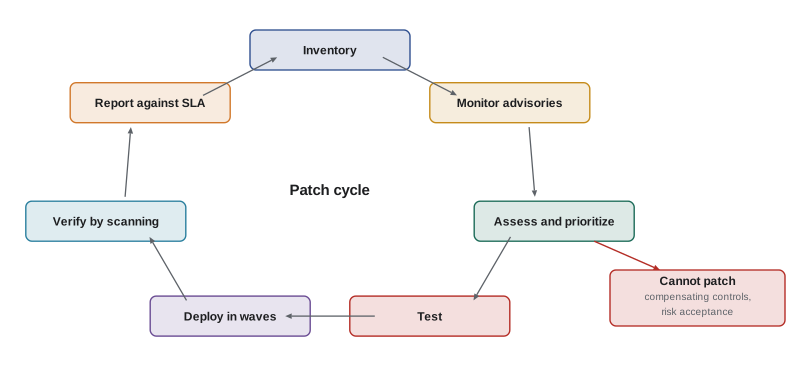
Service levels turn the process into something measurable. A typical policy sets remediation targets by severity, with shorter targets for vulnerabilities that are known to be exploited in the wild and for internet-facing systems. US federal agencies, for example, must remediate entries in CISA's Known Exploited Vulnerabilities catalogue within deadlines set by Binding Operational Directive 22-01; many private organizations borrow the same idea. In Canada, CCCS's baseline cyber security controls for small and medium organizations likewise stress prompt patching of internet-facing and actively exploited flaws.
from datetime import date
# Patch SLA compliance from a sample of closed findings (synthetic)
sla_days = {'critical-kev': 14, 'critical': 30, 'high': 60, 'medium': 90}
findings = [
    ('critical-kev', date(2026, 8, 1), date(2026, 8, 9)),
    ('critical-kev', date(2026, 8, 3), date(2026, 8, 25)),
    ('critical', date(2026, 7, 10), date(2026, 8, 2)),
    ('critical', date(2026, 7, 12), date(2026, 8, 30)),
    ('high', date(2026, 6, 1), date(2026, 7, 20)),
    ('high', date(2026, 6, 5), date(2026, 8, 15)),
    ('medium', date(2026, 5, 1), date(2026, 7, 2)),
    ('medium', date(2026, 5, 2), date(2026, 9, 1)),
]
from collections import defaultdict
stats = defaultdict(lambda: [0, 0])
for sev, found, fixed in findings:
    days = (fixed - found).days
    stats[sev][0] += 1
    stats[sev][1] += days <= sla_days[sev]
    print(f'{sev:13s} {days:3d} days  target {sla_days[sev]:2d}  {"met" if days <= sla_days[sev] else "MISSED"}')
for sev, (n, ok) in stats.items():
print(f'{sev:13s} on time {ok}/{n}')critical-kev 8 days target 14 met critical-kev 22 days target 14 MISSED critical 23 days target 30 met critical 49 days target 30 MISSED high 49 days target 60 met high 71 days target 60 MISSED medium 62 days target 90 met medium 122 days target 90 MISSED critical-kev on time 1/2 critical on time 1/2 high on time 1/2 medium on time 1/2
Reporting should show not just the percentage met but the age of what remains open, broken down by owner and asset criticality. A single critical, actively exploited flaw on an internet-facing system that is three weeks overdue matters more than dozens of low-severity items, and management reports should make that visible.
Worked problem
A patch that breaks a business system
A critical patch for a widely exploited flaw in a web server is released. Testing shows it breaks an older order-entry application that the business says cannot be changed for three months.
Show solution
- Confirm the exposure: is the web server internet-facing, and is the flaw being exploited in the wild?
- Look for a vendor workaround or configuration change that removes the vulnerable feature without the full patch.
- Apply compensating controls: restrict access to known partner addresses, place a web application firewall rule in front, and increase monitoring.
- Record a formal risk acceptance signed by the application owner, with the compensating controls and a firm date to patch or replace.
- Track the exception in the vulnerability system so it appears in reports until closed.
Answer: Do not simply wait three months: mitigate with workarounds and compensating controls, record a time-limited risk acceptance, and track it to closure.
Worked problem
Unauthorized change discovered
File integrity monitoring alerts that the configuration of the payroll database server changed at 23:40 on a Saturday. There is no change ticket.
Show solution
- Treat it as a potential security event until proven otherwise; open an investigation.
- Identify who made the change from system and privileged access logs.
- If it was an administrator fixing an outage, record a retrospective emergency change and address the process failure.
- If no legitimate explanation is found, escalate to incident response and preserve evidence.
Answer: Investigate every unticketed change; it is either a process failure to correct or a possible intrusion.
Common mistakes
MistakeWriting a baseline once and never revisiting it.
InsteadVersion baselines and review them when platforms, threats or business needs change.
MistakeGranting configuration exceptions with no end date.
InsteadApprove exceptions with an owner, compensating controls and an expiry date.
MistakeReviewing every change with the same heavy process.
InsteadUse risk-based routing so high-impact changes get security review and routine changes flow quickly.
MistakeIgnoring changes that appear in monitoring without tickets.
InsteadReconcile observed changes to approved records and investigate gaps.
MistakePatching only what the scanner happens to see.
InsteadStart from an accurate asset and software inventory so nothing is missed.
MistakeLeaving unpatchable systems exposed because the patch breaks something.
InsteadMitigate with compensating controls and a formal, time-limited risk acceptance.
Summary and key terms
- Configuration management establishes and maintains secure baselines throughout a system's life.
- Baselines are often tailored from CIS Benchmarks or STIGs, versioned, and enforced through hardened images and infrastructure as code.
- Drift is detected by comparing actual configurations to baselines; exceptions are approved, time-limited and tracked.
- Security's role in change management is impact assessment, risk-based review and detecting unauthorized change.
- Patch management runs as a cycle from inventory and advisories through testing, staged deployment, verification and reporting.
- Severity-based service levels, with shorter targets for exploited and internet-facing flaws, make patching measurable.
- Systems that cannot be patched need compensating controls and formal risk acceptance.
- Baseline
- An approved, documented secure configuration for a class of systems.
- Configuration drift
- Divergence of a system's actual configuration from its baseline.
- CIS Benchmarks
- Consensus-developed secure configuration guides for many platforms.
- Infrastructure as code
- Defining infrastructure in version-controlled templates that are deployed automatically.
- Standard change
- A pre-approved, low-risk change performed by a defined procedure.
- Emergency change
- A change made urgently to restore service or address an incident, reviewed afterwards.
- File integrity monitoring
- Detection of changes to critical files and settings.
- Compensating control
- An alternative control that reduces risk when the primary control cannot be applied.
- Patch service level
- A time target for remediating vulnerabilities of a given severity.
- Risk acceptance
- A formal decision by an accountable owner to tolerate a known risk for a period.
Practice problems
Work each problem on paper first, then reveal the answer to check.
What is a security baseline?
Show answer
An approved, documented secure configuration that a class of systems must meet.
Name two common external sources for baselines.
Show answer
CIS Benchmarks and US government STIGs.
What should every configuration exception include?
Show answer
An owner, a justification, compensating controls and an expiry date.
Why does infrastructure as code move risk into the pipeline?
Show answer
Whoever can change the templates or pipeline can change production, so the pipeline needs strong controls.
What is the security function's role in change management?
Show answer
Assess security impact, review high-risk changes and detect unauthorized changes.
What should happen after an emergency change?
Show answer
It should be documented and reviewed after implementation.
What does file integrity monitoring detect?
Show answer
Changes to critical files and configuration settings.
Why does patch management start with inventory?
Show answer
You cannot patch systems or software you do not know about.
Which US directive sets deadlines for remediating known exploited vulnerabilities in federal agencies?
Show answer
CISA Binding Operational Directive 22-01.
What should be done when a critical system cannot be patched?
Show answer
Apply compensating controls and record a formal, time-limited risk acceptance by the owner.
Lesson quiz · 5 questions
Score 60% or more to complete this lesson.
Create a free account to save your progress, take quizzes and earn a certificate.