
CMPUT-229 · Lesson 8 of 12 · 33 min
From C to machine code
Lessons 5 to 7 treated assembly language as the programmer's starting point. In practice almost all machine code is produced by tools: a compiler translates a high-level language, an assembler turns assembly into binary object files, a linker combines object files and libraries into an executable, and a loader puts the executable into memory and starts it. Each step changes the program's form while keeping its meaning, and each leaves fingerprints that you can see if you know where to look. This lesson follows a small C program through the whole toolchain, using clang and the LLVM tools targeting RV32IM, and shows the real intermediate files at each stage: the compiler's intermediate representation, assembly, object files with their symbols and relocations, the linked executable and its program headers. It then compares the code generated for RISC-V with that for x86-64 and looks briefly at interpreters and just-in-time compilers.
The four stages
Running cc prog.c on a Unix system hides four separate programs. The preprocessor handles directives such as #include and #define, producing pure C text. The compiler translates that text into assembly language for the target processor. The assembler translates assembly into an object file containing machine code and data, plus tables describing what the file defines and what it still needs. The linker combines one or more object files with library code into an executable file. When you run the executable, the operating system's loader reads it, maps its segments into memory, sets up the stack and jumps to the entry point. CMPUT-201 lesson 2 walked through these stages for x86-64 from the C programmer's point of view; this lesson looks inside the files they produce.
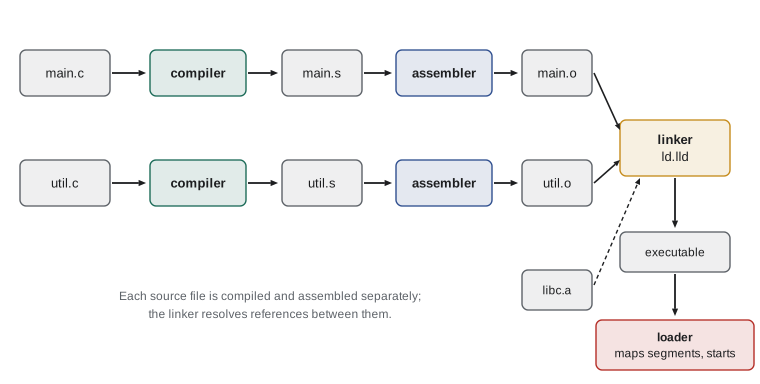
The example has two source files. util.c defines a global variable counter, a file-private variable scale and a function bump. main.c declares counter and bump as external, defines a constant string and an array, and calls bump. Because each file is compiled separately, the compiler working on main.c does not know where counter or bump will end up; resolving those references is the linker's job.
int counter = 5;
static int scale = 3;

int bump(int x) {
    counter += x;
    return counter * scale;
}extern int counter;
int bump(int x);
const char greeting[] = "hi";
int table[100];
int main(void) {
return bump(2) + counter + table[3] + greeting[0];
}Inside the compiler
A modern compiler has three parts. The front end parses the source language, checks types and produces an intermediate representation, or IR, a simple language independent of both the source language and the target machine. The middle end, or optimizer, transforms the IR to make it faster or smaller: removing unused code, propagating constants, keeping values in registers, inlining small functions, simplifying loops. The back end translates the optimized IR into the target's assembly, choosing instructions, assigning the program's many temporary values to the processor's limited registers, and scheduling instructions to suit the pipeline. Because the parts are separate, LLVM can support many languages (C, C++, Rust, Swift) and many processors (x86-64, Arm, RISC-V, WebAssembly) with one optimizer.
LLVM's IR can be printed. Here is the optimized IR for util.c, with metadata lines removed. It looks like assembly for an imaginary machine with an unlimited number of registers, written %2, %3 and so on, each assigned exactly once.
clang --target=riscv32 -march=rv32im -mabi=ilp32 -O1 -S -emit-llvm util.c -o -@counter = dso_local local_unnamed_addr global i32 5, align 4
define dso_local i32 @bump(i32 noundef %0) local_unnamed_addr #0 {
%2 = load i32, ptr @counter, align 4, !tbaa !4
%3 = add nsw i32 %2, %0
store i32 %3, ptr @counter, align 4, !tbaa !4
%4 = mul nsw i32 %3, 3
ret i32 %4
}Two optimizations are already visible. The variable scale has disappeared: it is static, so no other file can change it, and nothing in util.c ever assigns to it, so the optimizer replaced every use with the constant 3. And the IR flags the addition and multiplication with nsw, meaning no signed wrap, recording C's rule that signed overflow is undefined so that later passes may assume it does not happen.
The back end then turns the IR into RISC-V assembly. The multiplication by 3 has become a shift and an add, the strength reduction from lesson 2, because a shift and an add are cheaper than mul on most implementations.
int counter = 5;
static int scale = 3;

int bump(int x) {
    counter += x;
    return counter * scale;
}$ clang --target=riscv32 -march=rv32im -O1 -S util.c -o -
bump:
lui a1, %hi(counter)
lw a2, %lo(counter)(a1)
add a2, a2, a0
slli a0, a2, 1
add a0, a0, a2
sw a2, %lo(counter)(a1)
ret
counter:
.word 5Object files, symbols and relocations
The assembler produces an object file in ELF, the Executable and Linkable Format used by Linux and most Unix-like systems. An object file is divided into sections: .text holds machine code, .data holds initialized variables, .rodata holds read-only constants such as string literals, and .bss records the size of zero-initialized variables without storing their bytes, since zeros need not be kept in the file. Other sections hold the symbol table, which lists the names the file defines and uses, and relocation records, which mark places in the code where an address must be filled in later.
clang --target=riscv32 -march=rv32im -mabi=ilp32 -O1 -c main.c util.c
llvm-nm main.o util.o
llvm-readelf -S main.o # section list, filteredmain.o:
U bump
U counter
00000000 R greeting
00000000 T main
00000000 B table
util.o:
00000000 T bump
00000000 D counter
[ 2] .text PROGBITS 00000000 000034 00003c 00 AX 0 0 4
[ 3] .rela.text RELA 00000000 000180 000078 0c I 10 2 4
[ 4] .rodata PROGBITS 00000000 000070 000003 00 A 0 0 1
[ 5] .bss NOBITS 00000000 000074 000190 00 WA 0 0 4
[10] .symtab SYMTAB 00000000 0000c0 0000c0 10 1 7 4In the nm listing, T marks a symbol defined in a text section, D in a data section, R in read-only data, B in bss, and U a symbol that is used but undefined in this file. main.o defines main, greeting and table, but uses counter and bump without defining them. The section list confirms the sizes: table's 400 bytes appear as 0x190 in .bss without taking space in the file, greeting's three bytes (h, i and the terminator) are in .rodata, and .rela.text holds the relocation records.
clang --target=riscv32 -march=rv32im -mabi=ilp32 -O1 -c main.c
llvm-objdump -dr --no-show-raw-insn main.o00000000 <main>:
0: addi sp, sp, -0x10
4: sw ra, 0xc(sp)
8: li a0, 0x2
c: auipc ra, 0x0
0000000c: R_RISCV_CALL_PLT bump
0000000c: R_RISCV_RELAX *ABS*
10: jalr ra <main+0xc>
14: lui a1, 0x0
00000014: R_RISCV_HI20 counter
00000014: R_RISCV_RELAX *ABS*
18: lw a1, 0x0(a1)
00000018: R_RISCV_LO12_I counter
00000018: R_RISCV_RELAX *ABS*
1c: lui a2, 0x0
0000001c: R_RISCV_HI20 table+0xc
0000001c: R_RISCV_RELAX *ABS*
20: lw a2, 0x0(a2)
00000020: R_RISCV_LO12_I table+0xc
00000020: R_RISCV_RELAX *ABS*
24: add a0, a0, a1
28: add a0, a0, a2
2c: addi a0, a0, 0x68
30: lw ra, 0xc(sp)
34: addi sp, sp, 0x10
38: retEach indented line after an instruction is a relocation record. The call to bump has been assembled as auipc ra, 0 followed by jalr, with a zero offset because the target is unknown, and an R_RISCV_CALL_PLT record asks the linker to patch in the real distance. The load of counter uses a lui and lw pair, with R_RISCV_HI20 and R_RISCV_LO12_I records asking for the high 20 and low 12 bits of counter's eventual address, the same split you computed by hand in lesson 5. The access to table[3] asks for the address of table + 12. The R_RISCV_RELAX records give the linker permission to shorten these sequences if the final addresses allow it. One more optimization is visible: greeting[0] has become the constant 0x68, the ASCII code of h, because greeting is a constant array whose contents the compiler knows.
Linking
The linker reads all the object files, decides where each section will go in memory, builds a combined symbol table, and then applies every relocation using the final addresses. If a symbol is undefined everywhere, or defined twice, linking fails with an error such as undefined reference to bump. Here the link uses LLVM's linker, ld.lld, with the text segment placed at 0x00400000 as in the course's simulator.
clang --target=riscv32 -march=rv32im -mabi=ilp32 -O1 -c main.c util.c
ld.lld -m elf32lriscv -Ttext=0x00400000 -e main main.o util.o -o prog
llvm-objdump -d --no-show-raw-insn prog
llvm-nm prog00400000 <main>: 400000: addi sp, sp, -0x10 400004: sw ra, 0xc(sp) 400008: li a0, 0x2 40000c: jal 0x400038 <bump> 400010: lui a1, 0x402 400014: lw a1, 0x58(a1) 400018: lui a2, 0x402 40001c: lw a2, 0x68(a2) 400020: add a0, a0, a1 400024: add a0, a0, a2 400028: addi a0, a0, 0x68 40002c: lw ra, 0xc(sp) 400030: addi sp, sp, 0x10 400034: ret 00400038 <bump>: 400038: lui a1, 0x402 40003c: lw a2, 0x58(a1) 400040: add a2, a2, a0 400044: slli a0, a2, 0x1 400048: add a0, a0, a2 40004c: sw a2, 0x58(a1) 400050: ret 00400038 T bump 00402058 D counter 00401054 R greeting 00400000 T main 0040205c B table
Compare this with the object file. The two-instruction auipc and jalr call has been relaxed to a single jal, because bump ended up only a few dozen bytes away, well within jal's ±1 MiB reach; the program is one instruction shorter than the compiler's output. The lui instructions now contain real upper address bits, and the loads have real offsets: counter lives at 0x00402058 and table at 0x0040205C. bump follows main directly in the text segment.
Libraries complicate the picture slightly. A static library is an archive of object files, and the linker copies in just the ones the program needs. A shared library, a .so file on Linux or a .dll on Windows, is linked at load time or run time instead, so many programs can share one copy in memory and a library can be updated without relinking its users. Calls into shared libraries go through small stubs in a procedure linkage table (PLT), and addresses of shared data go through a global offset table (GOT), both filled in by the dynamic linker, which is why the relocation above mentions PLT even though this program is linked statically.
| Section or tool | What it holds or does |
|---|---|
| .text | Machine instructions |
| .data | Initialized global and static variables |
| .rodata | Read-only data such as string literals and const arrays |
| .bss | Size of zero-initialized variables; no bytes stored in the file |
| .symtab | Symbols defined and referenced by the file |
| .rela.text | Relocation records: places in .text to patch with final addresses |
| nm | Lists symbols and their types (T, D, R, B, U) |
| objdump -d / -r | Disassembles code and shows relocations |
| readelf -S / -l | Shows section headers and program headers |
Loading and starting a program
An executable also contains program headers, which tell the loader which parts of the file to map into memory, at which addresses and with which permissions. The section headers are for linkers and debuggers; the program headers are for the loader. The readelf listing below shows that the text is loaded read-and-execute, the read-only data read-only, and the data and bss read-write, with a memory size larger than the file size: the difference is the bss, which the loader fills with zeros.
llvm-readelf -l prog # program headersElf file type is EXEC (Executable file) Entry point 0x400000 There are 7 program headers, starting at offset 52 Program Headers: Type Offset VirtAddr PhysAddr FileSiz MemSiz Flg Align PHDR 0x000034 0x00010034 0x00010034 0x000e0 0x000e0 R 0x4 LOAD 0x000000 0x00010000 0x00010000 0x00114 0x00114 R 0x1000 LOAD 0x001000 0x00400000 0x00400000 0x00054 0x00054 R E 0x1000 LOAD 0x001054 0x00401054 0x00401054 0x00003 0x00003 R 0x1000 LOAD 0x001058 0x00402058 0x00402058 0x00004 0x00194 RW 0x1000 GNU_STACK 0x000000 0x00000000 0x00000000 0x00000 0x00000 RW 0x0
On Linux, the execve system call does the loading. The kernel checks the file's header, maps each LOAD segment at its address with the requested permissions, allocates a stack, copies the program's arguments and environment strings onto it, and starts executing at the entry point. For dynamically linked programs, the entry point first belongs to the dynamic linker, which maps the shared libraries and fills in the GOT. The entry point of a normal C program is not main but a small piece of startup code, often called crt0 or _start, which sets up the global pointer and stack, initializes the C library and calls main with argc and argv; when main returns, it calls exit with main's return value. The course's simulator uses an even smaller startup sequence that calls main and then requests the exit service.
Mapping segments with separate permissions is an important security property. Because the text segment is not writable, a bug cannot modify the program's code, and because the data and stack are not executable, injected data cannot be run as code. Address space layout randomization, mentioned in lesson 7, places these segments at different addresses each time, which is why real systems compile code as position-independent, using auipc-relative addresses instead of the absolute lui addresses in this example.
The same C code on two ISAs
Comparing the output for two ISAs shows how much of a program's machine code reflects the source and how much reflects the processor. Here is a short function that counts how many elements of an array exceed a threshold, compiled by clang for RV32IM and by gcc for x86-64 at the same optimization level.
int count_above(const int *a, int n, int t) {
    int c = 0;
    for (int i = 0; i < n; i++)
        if (a[i] > t)
            c++;
    return c;
}$ clang --target=riscv32 -march=rv32im -O1 -S count.c -o -
count_above:
li a3, 0
blez a1, .LBB0_3
slli a1, a1, 2
add a1, a0, a1
.LBB0_2:
lw a4, 0(a0)
slt a4, a2, a4
addi a0, a0, 4
add a3, a3, a4
bne a0, a1, .LBB0_2
.LBB0_3:
mv a0, a3
ret
$ gcc -O1 -masm=intel -S count.c -o - (x86-64)
count_above:
test esi, esi
jle .L5
mov rax, rdi
movsx rsi, esi
lea rdi, [rdi+rsi*4]
mov ecx, 0
.L4:
cmp DWORD PTR [rax], edx
setg sil
movzx esi, sil
add ecx, esi
add rax, 4
cmp rax, rdi
jne .L4
.L1:
mov eax, ecx
ret
.L5:
mov ecx, 0
jmp .L1Both compilers turned the loop into a pointer walk and avoided a branch for the if. clang used slt, which directly produces the 0 or 1 to add, in the style of lesson 2; gcc used x86-64's setg instruction, which reads the condition flags written by cmp. The x86-64 code can add a memory operand directly in instructions such as cmp DWORD PTR [rax], edx, which RISC-V cannot; RISC-V needs a separate lw. On the other hand every RISC-V instruction is 4 bytes, while the x86-64 instructions here range from 1 byte (ret) to 5 bytes (mov ecx, 0), so the two functions end up almost the same size: 52 bytes for RISC-V and 50 for x86-64. The x86-64 loop body has seven instructions to RISC-V's five, partly because turning a flag into a number takes two instructions, setg and movzx. Differences like these are real but modest; for performance, the microarchitecture that runs the code usually matters more than the ISA it is written in.
Worked problem
Reading compiler output
In the RISC-V code for count_above, which register holds the counter c, and which instruction implements the comparison a[i] > t?
Show solution
- The function returns c, and the return value goes in a0, so look for what is moved into a0 before ret: the counter register is copied to a0 at the end.
- Inside the loop, lw loads a[i], slt compares the threshold with the loaded value and writes 1 if t < a[i], which is a[i] > t with the operands swapped.
- add then adds that 0 or 1 to the counter, so c increases exactly when the condition holds, without a branch.
Answer: The counter is kept in a register that is moved to a0 at the end, and slt with the operands swapped implements a[i] > t; the if statement has become arithmetic.
Optimizing compilers apply many more transformations than these examples show. Inlining replaces a call with a copy of the callee's body, removing the call overhead and exposing more optimization. Loop unrolling repeats the loop body several times per iteration to reduce branch overhead. Vectorization uses SIMD instructions, which lesson 12 introduces, to process several array elements at once. Each makes the generated code harder to match with the source, which is why debuggers struggle with optimized programs and why compilers offer -Og, an optimization level that keeps code debuggable.
Interpreters, bytecode and just-in-time compilation
Not every language is compiled ahead of time to machine code. Python compiles source to bytecode, instructions for a virtual stack machine, and an interpreter written in C executes the bytecode one instruction at a time. Each bytecode instruction costs many machine instructions, which is a large part of why pure Python loops run tens of times more slowly than C loops. The dis module shows the bytecode.
import dis

def count_above(a, t):
    c = 0
    for x in a:
        if x > t:
            c += 1
    return c

print(count_above([5, 12, 7, 20, 3], 6))
ops = [ins.opname for ins in dis.get_instructions(count_above)]
print(len(ops), 'bytecode instructions; loop uses', ', '.join(dict.fromkeys(ops[4:14])))3 20 bytecode instructions; loop uses GET_ITER, FOR_ITER, STORE_FAST, LOAD_FAST_LOAD_FAST, COMPARE_OP, POP_JUMP_IF_TRUE, JUMP_BACKWARD, LOAD_FAST, LOAD_CONST, BINARY_OP
Java and C# compile to bytecode too, but their virtual machines include just-in-time (JIT) compilers that translate frequently executed bytecode into native machine code while the program runs, using information about how the program actually behaves to optimize it. JavaScript engines in web browsers do the same, and recent CPython versions include an experimental JIT compiler. The trade-offs are those of this whole lesson in miniature: interpreting is simple and portable, compiling ahead of time gives fast start-up and predictable speed, and JIT compilation can approach or occasionally beat ahead-of-time code at the cost of warm-up time and memory.
Common mistakes
MistakeAssuming the compiler emits one machine instruction per source line in order.
InsteadOptimizers remove, merge, reorder and replace code; read optimized output with that in mind, or compile with -Og to debug.
MistakeThinking an undefined reference error comes from the compiler.
InsteadEach file compiles separately; undefined references are reported by the linker when no object file or library defines the symbol.
MistakeExpecting .bss variables to take space in the executable file.
Instead.bss records only a size; the loader allocates and zeros the memory.
MistakeConfusing section headers with program headers.
InsteadSections organize the file for linkers and debuggers; program headers tell the loader what to map, where and with which permissions.
MistakeBelieving main is the first code that runs.
InsteadStartup code such as crt0 or the dynamic linker runs first, then calls main and passes its return value to exit.
Summary and key terms
- The toolchain is preprocessor, compiler, assembler, linker and loader; each changes the program's form but not its meaning.
- Compilers have a front end producing IR, an optimizer transforming it, and a back end selecting instructions and allocating registers.
- Object files in ELF hold sections (.text, .data, .rodata, .bss), a symbol table and relocation records for addresses not yet known.
- The linker places sections, resolves symbols across files and applies relocations, and may relax auipc and jalr pairs into a single jal.
- Program headers tell the loader which segments to map with which permissions; startup code runs before main.
- Shared libraries are linked at load time through the PLT and GOT; static libraries are copied into the executable.
- The same C code becomes similar-length but differently shaped code on RISC-V and x86-64; interpreters execute bytecode, and JIT compilers translate hot code at run time.
- Intermediate representation (IR)
- A machine-independent language a compiler uses between parsing and code generation.
- Object file
- The assembler's output: machine code and data with symbol and relocation tables, not yet runnable.
- ELF
- Executable and Linkable Format, the object and executable file format of Linux and most Unix systems.
- Symbol table
- A list of names a file defines or references, with their sections and addresses.
- Relocation
- A record telling the linker to patch an instruction or data word with a final address.
- Linker relaxation
- Replacing a long instruction sequence with a shorter one once final addresses show it is in range.
- .bss
- The section for zero-initialized data, which occupies memory but not file space.
- Program header
- An ELF entry telling the loader to map part of the file into memory with given permissions.
- Shared library
- A library loaded at run time and shared by many programs, reached through the PLT and GOT.
- Just-in-time compiler
- A compiler that translates bytecode to machine code while the program runs.
Practice problems
Work each problem on paper first, then reveal the answer to check.
Which stage reports undefined reference to bump?
Show answer
The linker, when no object file or library defines bump.
What do the nm codes T, U and B mean?
Show answer
T: defined in text; U: used but undefined here; B: defined in bss.
Why did scale disappear from the optimized IR?
Show answer
It is static and never assigned in util.c, so the optimizer replaced it with its constant value 3.
What do R_RISCV_HI20 and R_RISCV_LO12_I ask the linker to do?
Show answer
Fill in the upper 20 bits of a symbol's address in a lui and the lower 12 bits in a following I-type instruction.
Why could the linker replace auipc + jalr with jal?
Show answer
The final distance to bump was within jal's ±1 MiB range, so one instruction sufficed.
An array int big[1000000]; is declared globally without an initializer. How much does it add to the executable file?
Show answer
Essentially nothing; it goes in .bss, which records only its 4 MB size.
Why is MemSiz larger than FileSiz for the read-write segment?
Show answer
It includes the .bss, which the loader zero-fills without reading it from the file.
What runs before main in a C program?
Show answer
Startup code such as crt0 or _start, and for dynamic programs the dynamic linker.
Name one difference between the RISC-V and x86-64 code for count_above.
Show answer
x86-64 compares with a memory operand and uses flags with setg; RISC-V loads separately and uses slt; instruction lengths also differ.
Why is a Python loop much slower than the equivalent C loop?
Show answer
Each bytecode instruction is interpreted by many machine instructions, and Python values are general objects needing type checks.
Lesson quiz · 5 questions
Score 60% or more to complete this lesson.
Create a free account to save your progress, take quizzes and earn a certificate.